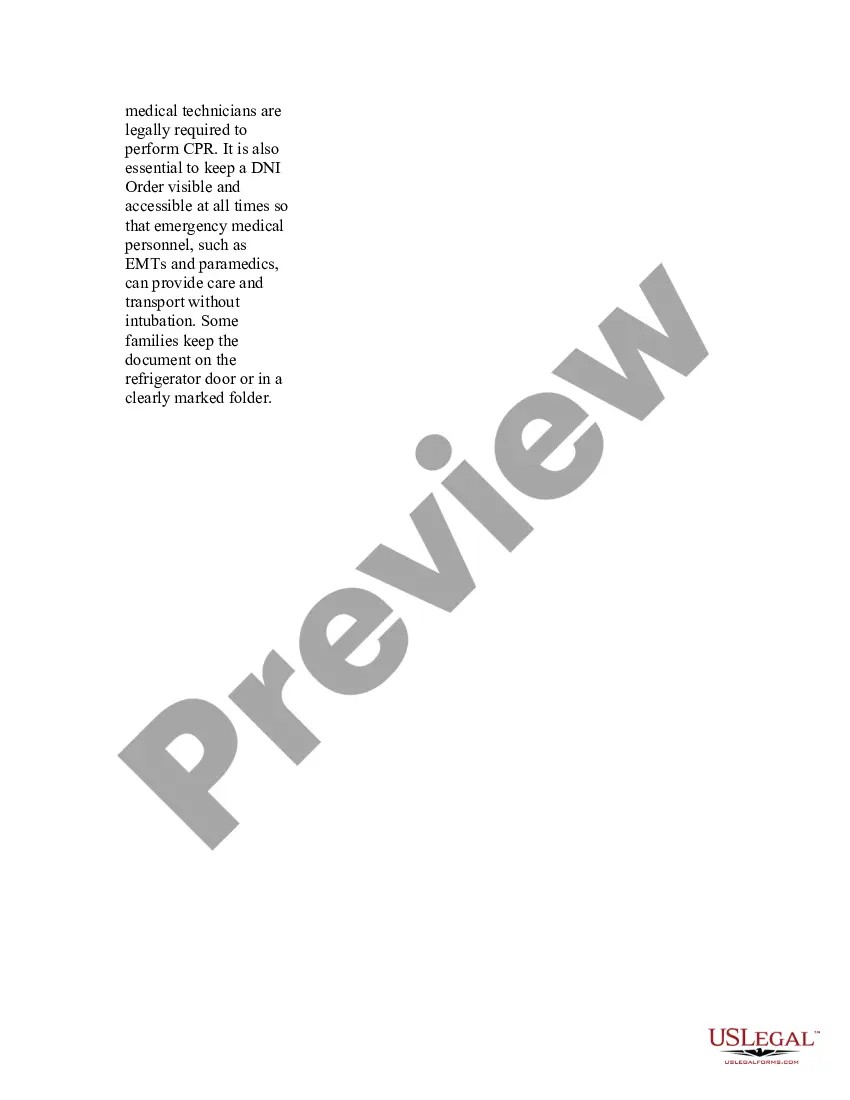
This pamphlet provides an overview on Do Not Resuscitate (DNI) orders. A comparison of DNI and DNR orders is included.
Kentucky USLegal Pamphlet on Do Not Intubate - DNI
Category:
State:
Multi-State
Control #:
US-PMPH-05
Format:
Word;
Rich Text
Instant download
Description
Free preview

How to fill out USLegal Pamphlet On Do Not Intubate - DNI?
If you require to complete, acquire, or print valid document templates, utilize US Legal Forms, the largest selection of legal forms available online.
Employ the site's simple and user-friendly search to locate the documents you need. Numerous templates for commercial and personal purposes are organized by categories and titles, or keywords.
Use US Legal Forms to access the Kentucky USLegal Pamphlet on Do Not Intubate - DNI in just a few clicks.
Every legal document template you obtain is yours permanently. You have access to every form you saved in your account. Click the My documents section and select a form to print or download again.
Stay competitive and acquire, and print the Kentucky USLegal Pamphlet on Do Not Intubate - DNI with US Legal Forms. There are thousands of professional and state-specific forms you can use for your business or personal needs.
- When you are already a US Legal Forms user, Log In to your account and click the Download button to retrieve the Kentucky USLegal Pamphlet on Do Not Intubate - DNI.
- You can also access forms you previously saved from the My documents tab of your account.
- If you are using US Legal Forms for the first time, follow the steps below.
- Step 1. Ensure you have selected the form for the correct city/state.
- Step 2. Use the Preview option to review the form's details. Remember to read the description.
- Step 3. If you are dissatisfied with the form, utilize the Search field at the top of the screen to find alternative forms in the legal form template.
- Step 4. Once you have located the form you need, click on the Purchase now button. Choose the pricing plan you prefer and enter your information to register for an account.
- Step 5. Process the transaction. You can use your Visa or MasterCard or PayPal account to complete the transaction.
- Step 6. Select the format of the legal form and download it to your device.
- Step 7. Complete, modify, and print or sign the Kentucky USLegal Pamphlet on Do Not Intubate - DNI.
Form popularity
FAQ
A Do Not Intubate (DNI) form is a legal document that outlines a patient's wishes regarding intubation in case of a medical emergency. Specifically, it instructs healthcare providers not to insert a breathing tube if the patient cannot breathe on their own. The Kentucky USLegal Pamphlet on Do Not Intubate - DNI provides clear guidelines and a template to help individuals create this important document. By using this pamphlet, you can ensure that your healthcare preferences are respected and understood.
If you do not have a DNR in place, medical personnel are required to attempt resuscitation in the event of a cardiac arrest. This can lead to unwanted medical interventions that may not align with your wishes. The Kentucky USLegal Pamphlet on Do Not Intubate - DNI emphasizes the importance of having a DNR to communicate your preferences clearly. By having a DNR, you can ensure that your healthcare aligns with your values.
To obtain a DNR in Kentucky, you must have a discussion with your healthcare provider. They will help you understand your options and complete the necessary paperwork. The Kentucky USLegal Pamphlet on Do Not Intubate - DNI serves as a valuable resource during this process, guiding you through the steps required to establish your DNR. Taking these steps ensures your healthcare wishes are honored.
In Kentucky, a DNR does not need to be notarized to be considered valid. While a signature from a physician and the patient or their representative is essential, notarization is not a requirement. The Kentucky USLegal Pamphlet on Do Not Intubate - DNI clarifies this aspect, ensuring you have accurate information about the process. This knowledge can simplify your experience when preparing a DNR.
For a DNR to be valid in Kentucky, it must meet certain criteria set by state law. Generally, it should be signed by the patient or their legal representative and a physician. The Kentucky USLegal Pamphlet on Do Not Intubate - DNI outlines these requirements in detail, helping you ensure that your DNR is legally binding. Understanding these requirements is crucial for making your healthcare preferences clear.
Kentucky has specific laws regarding Do Not Resuscitate (DNR) orders that you should understand. These laws ensure that a person's wishes regarding resuscitation are respected in medical situations. The Kentucky USLegal Pamphlet on Do Not Intubate - DNI provides essential information about these laws and how they protect patients. Familiarizing yourself with these regulations can help you make informed decisions about your healthcare.
A natural reaction to medicine's use of CPR and MV was the advent of advance directives and more specific Do-Not-Resuscitate (DNR) and Do-Not-Intubate (DNI) orders meant to protect a patient's ability to remain autonomous with their end of life decisions. 1.
A DNI or Do Not Intubate order means that chest compressions and cardiac drugs may be used, but no breathing tube will be placed. An AND or Allow Natural Death order is a term used at some hospitals as an alternative to the more traditional DNR order.
In medical terms, a DNI means that patients do not want a breathing tube inserted into their trachea, via the nose or mouth, to restore normal breathing. If the patient's breathing remains impaired, the tube remains in place and is eventually connected to a ventilator to maintain breathing.
Strictly defined, a do not resuscitate/do not intubate (DNR/DNI) status indicates a patient does not want to receive CPR or intubation in the event of cardiopulmonary arrest.