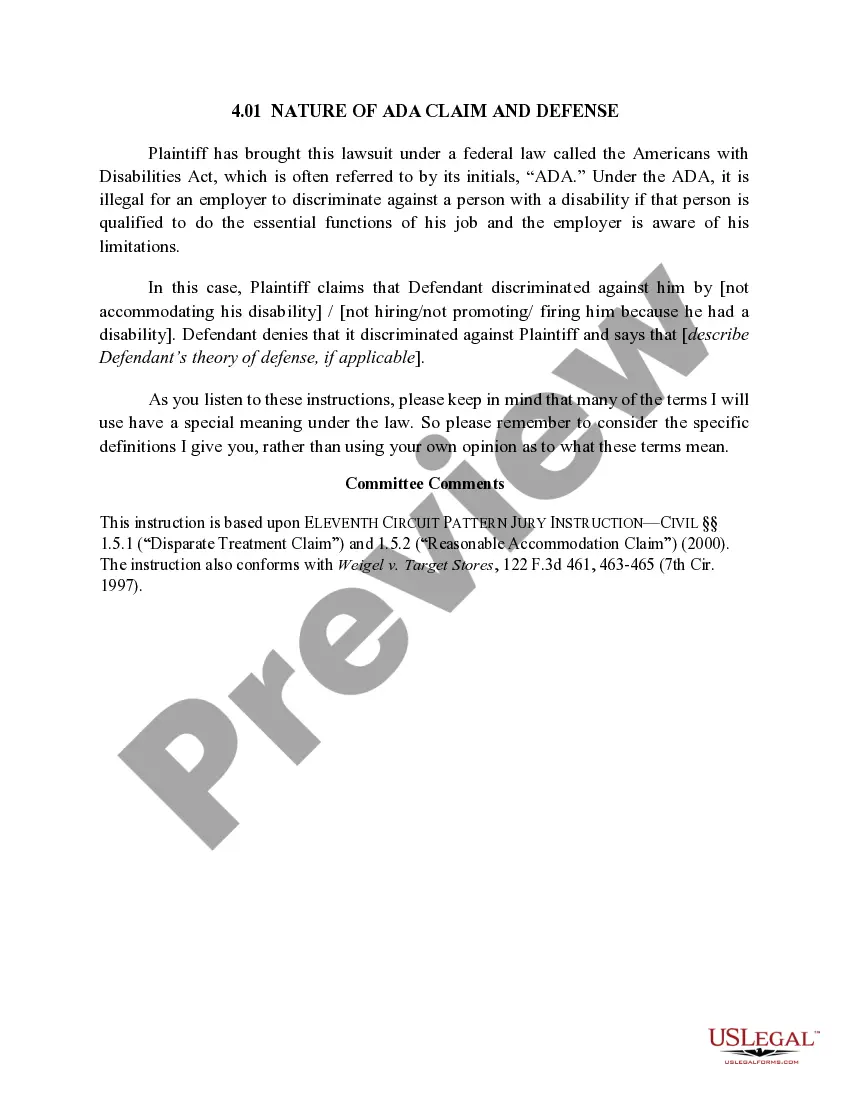
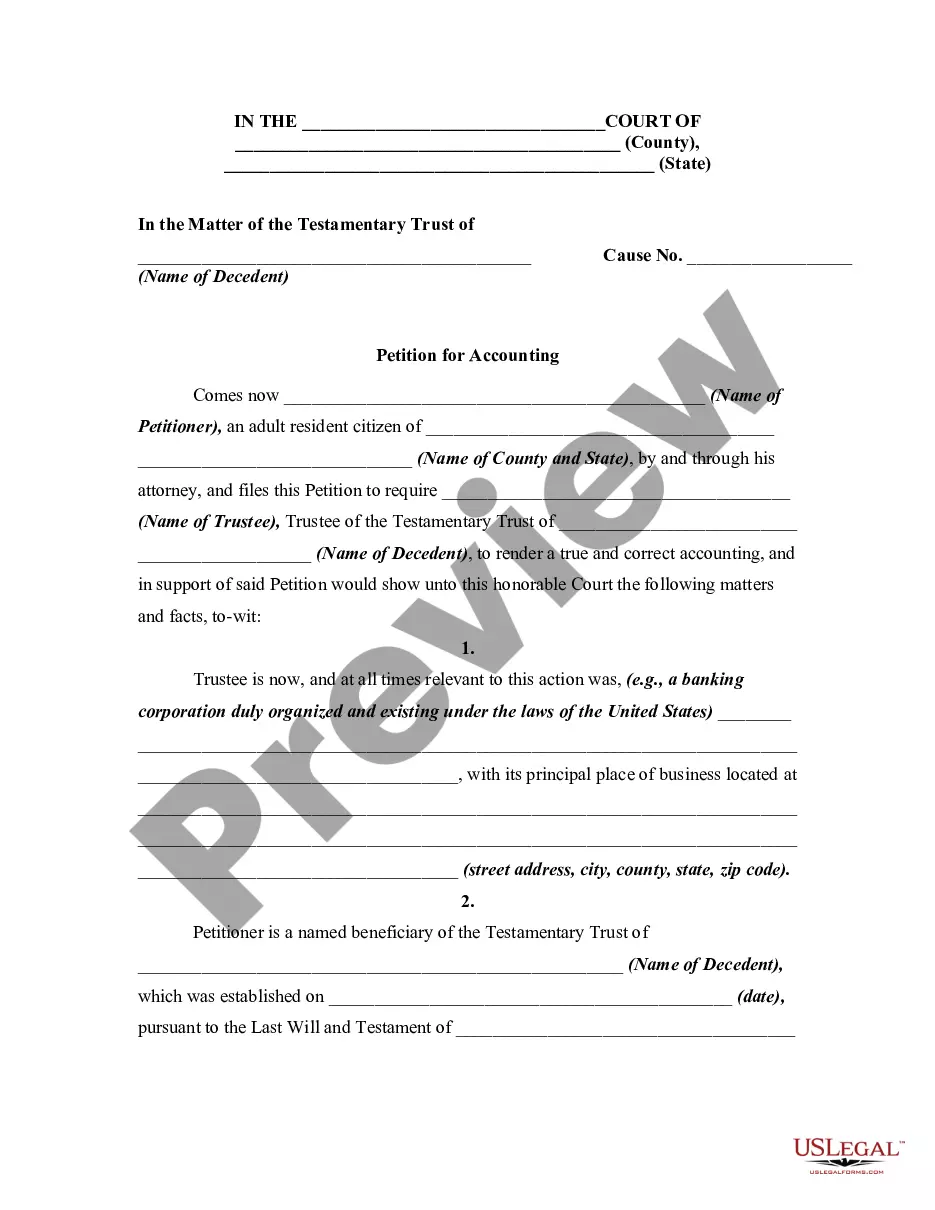
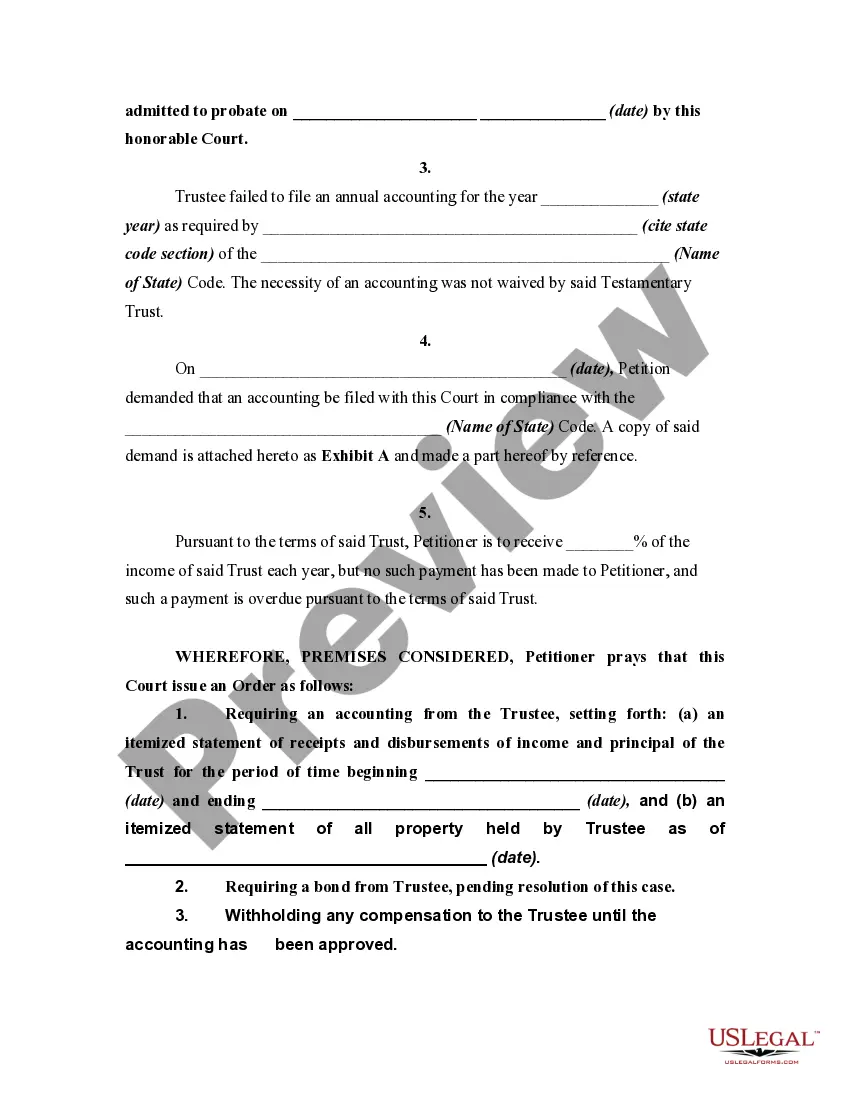
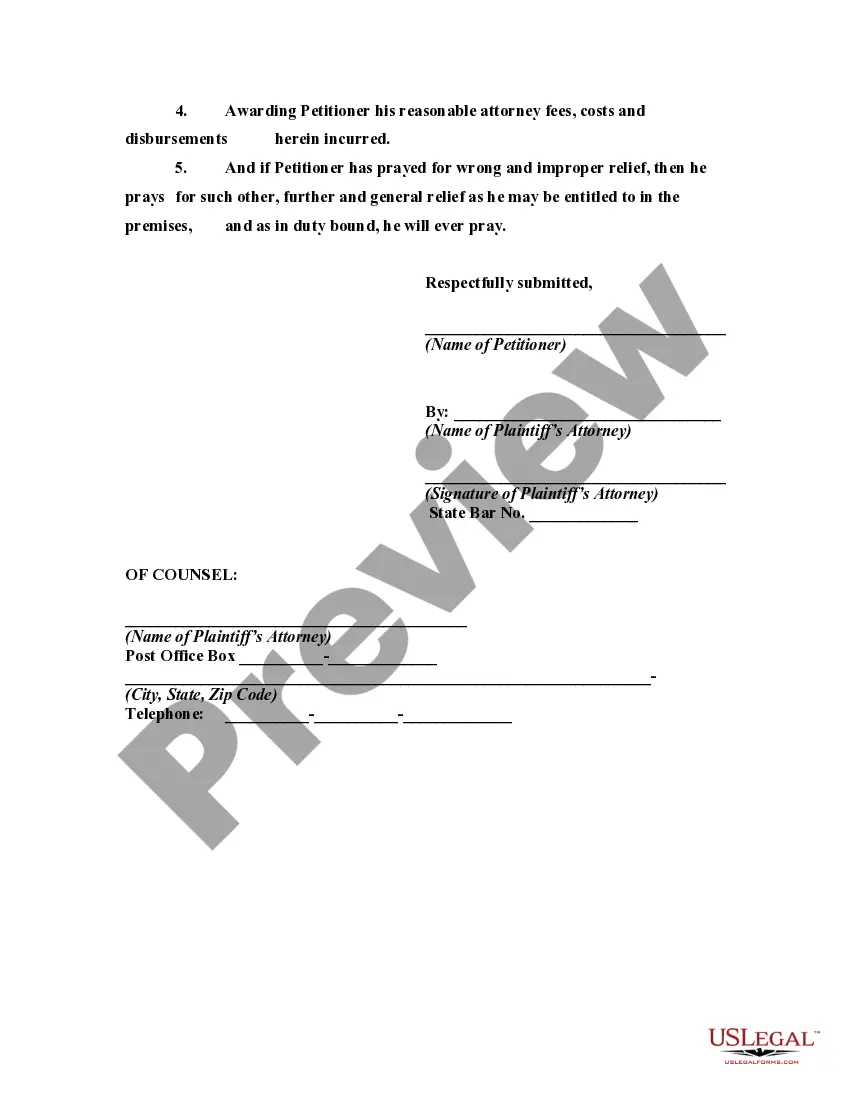
An accounting by a fiduciary usually involves an inventory of assets, debts, income, expenditures, and other items, which is submitted to a court. Such an accounting is used in various contexts, such as administration of a trust, estate, guardianship or conservatorship. Generally, a prior demand by an appropriate party for an accounting, and a refusal by the fiduciary to account, are conditions precedent to the bringing of an action for an accounting.
Kentucky Petition to Require Accounting from Testamentary Trustee
Instant download
Description
Free preview

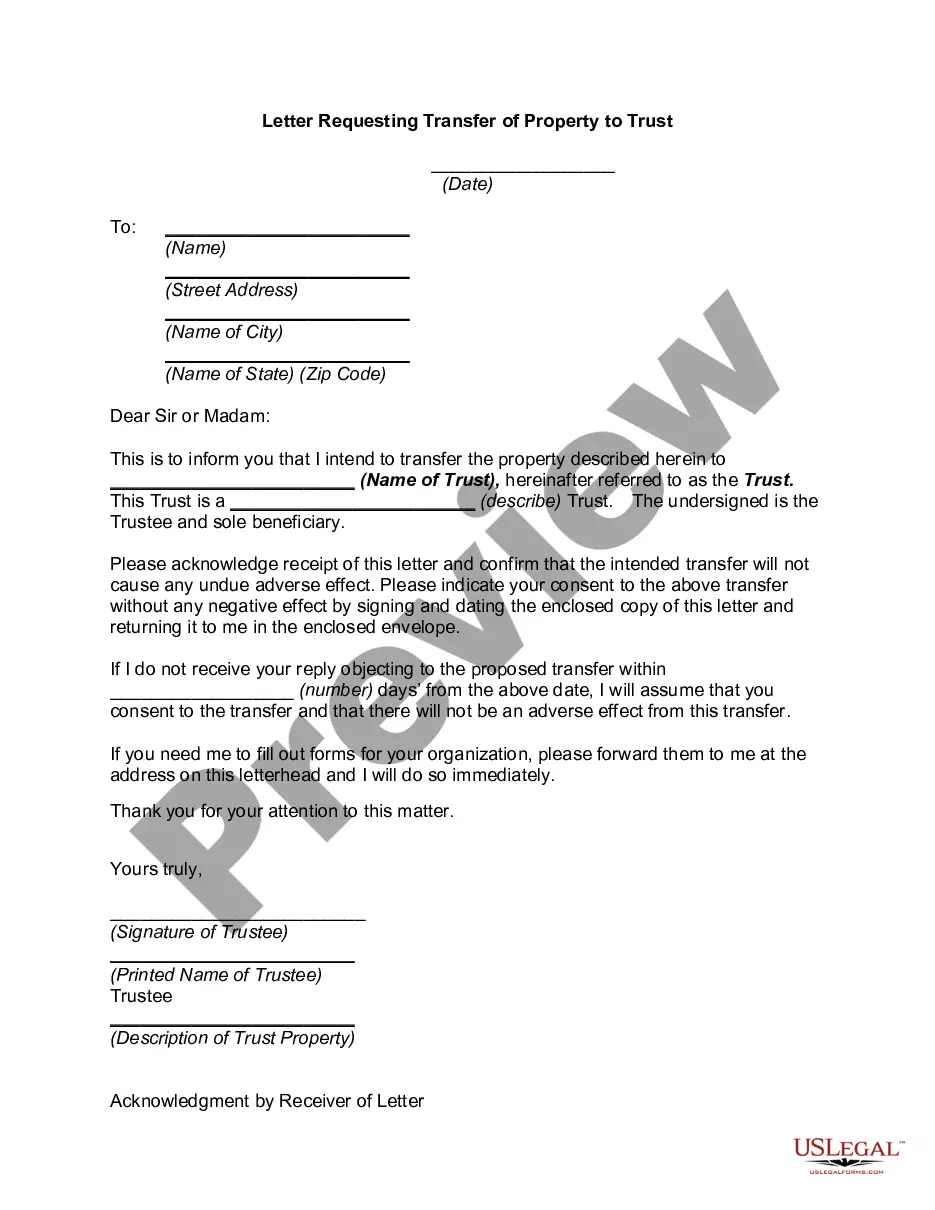

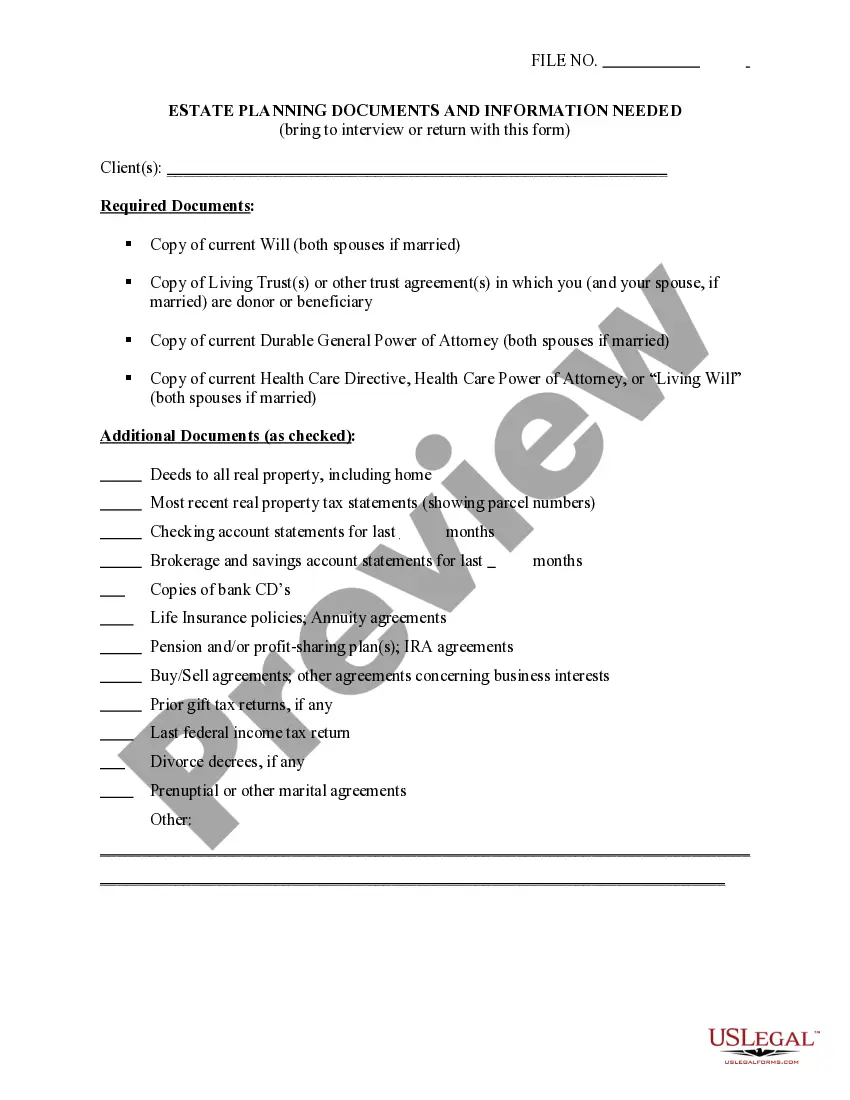




How to fill out Petition To Require Accounting From Testamentary Trustee?
You might spend hours online looking for the legal document template that meets the state and federal requirements you desire. US Legal Forms offers a vast array of legal forms that have been reviewed by experts.
It is easy to access or print the Kentucky Petition to Require Accounting from Testamentary Trustee through the service.
If you already possess a US Legal Forms account, you can sign in and click on the Download button. After that, you can complete, modify, print, or sign the Kentucky Petition to Require Accounting from Testamentary Trustee. Every legal document template you acquire is yours permanently. To obtain another copy of any purchased form, visit the My documents tab and click on the corresponding option.
Select the format of the document and download it to your device. Make modifications to your document if needed. You can complete, modify, sign, and print the Kentucky Petition to Require Accounting from Testamentary Trustee. Download and print a vast number of document templates using the US Legal Forms website, which provides the largest collection of legal forms. Utilize professional and state-specific templates to address your business or personal needs.
- If you are using the US Legal Forms website for the first time, follow the simple instructions below.
- First, ensure you have selected the correct document template for the state/city of your choice. Review the form description to confirm you have chosen the appropriate form.
- If available, use the Review option to look over the document template as well.
- To find another version of the form, use the Lookup field to discover the template that fits your needs and requirements.
- Once you have found the template you want, click Buy now to proceed.
- Choose the payment plan you prefer, enter your credentials, and register for an account on US Legal Forms.
- Complete the transaction. You can use your credit card or PayPal account to pay for the legal document.
Form popularity
FAQ
All creditors that wish to be paid from the estate are required to file a claims against the estate within 180 days (6 months) from the date the personal representative is appointed. Valid debts can be paid after the six months are up.
Kentucky has a lenient time requirement for probate. ing to the Kentucky Revised Statutes 395.010, it must be completed within 10 years after the person's death. However, it is better to file soon after the person's death and to complete the probate process as quickly as possible.
There are situations when a beneficiary will request that the executor or trustee provide an accounting. This may be a formal or informal accounting, depending on the request. Regardless, the fiduciary has a responsibility to provide an accounting when requested. It's preferable to provide an informal accounting.
You are responsible for maintaining and protecting any and all of the deceased's business interests, personal property, legal affairs, his or her personal residence, vacation home(s), timeshare(s) and other interest(s). Along with taking inventory, you may very well need to obtain appraisals for certain items.
In general, beneficiaries do have the proper to request data about the estate, inclusive of financial institution statements. However, the unique regulations and limitations on gaining access to bank statements may also range relying on the jurisdiction and the particular circumstances of the estate.
If the executor can sell the property for more than 90 percent of its appraised value then they do not need to get the permission of the beneficiaries or of the court.
As a beneficiary, you are entitled to review the trust's records including bank statements, the checking account ledger, receipts, invoices, etc. Before the trust administration is complete, it is recommended you request and review the trust's records which support the accounting.