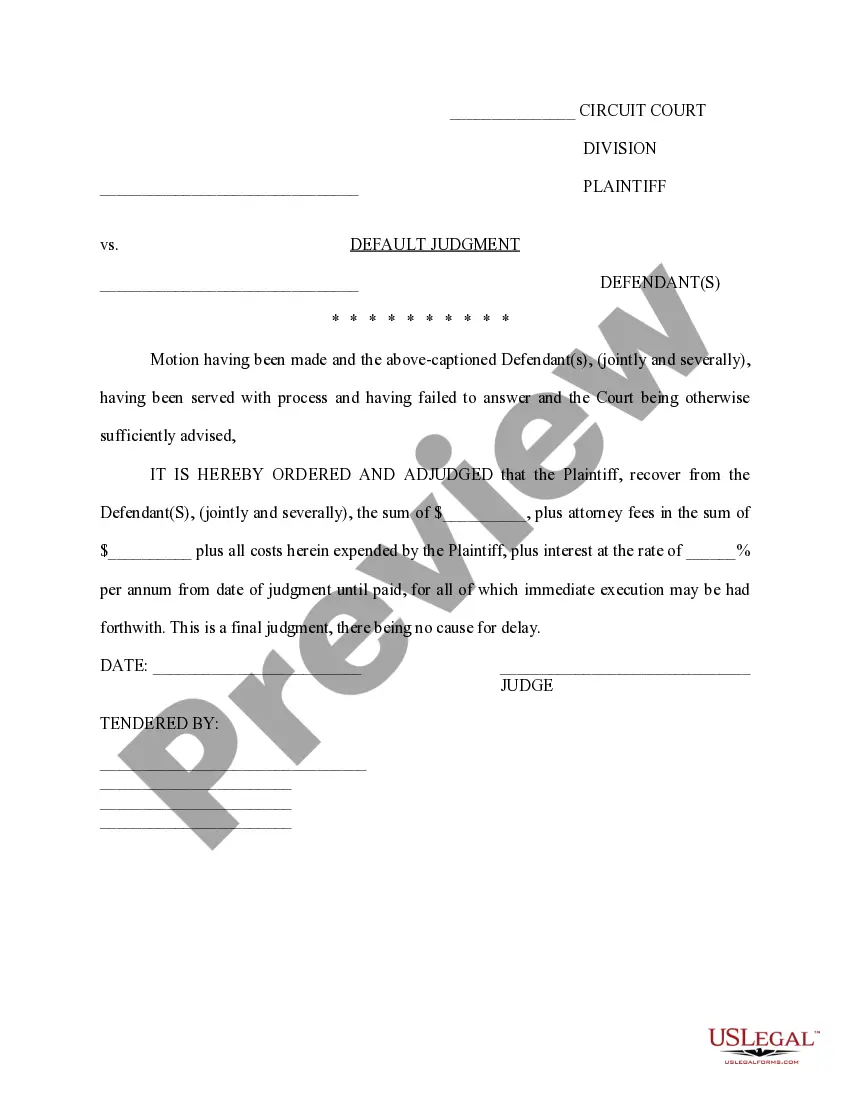
Kentucky Default Judgment
About this form
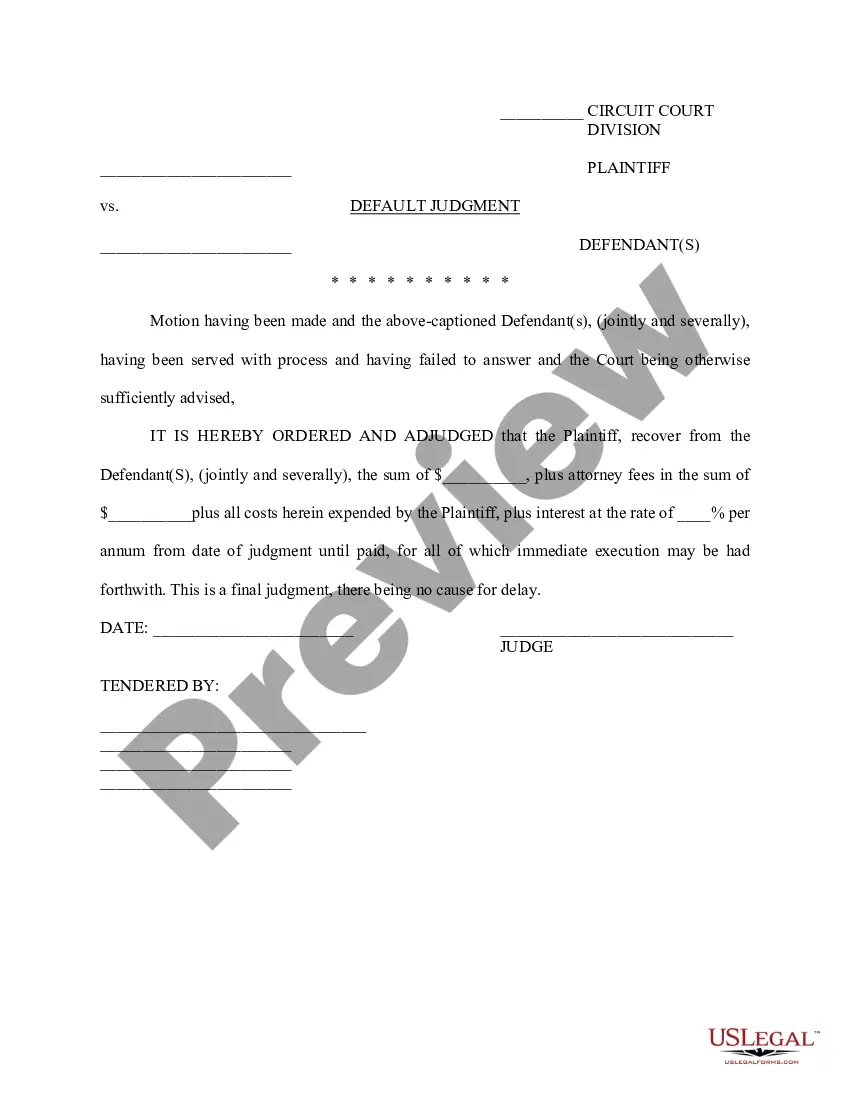
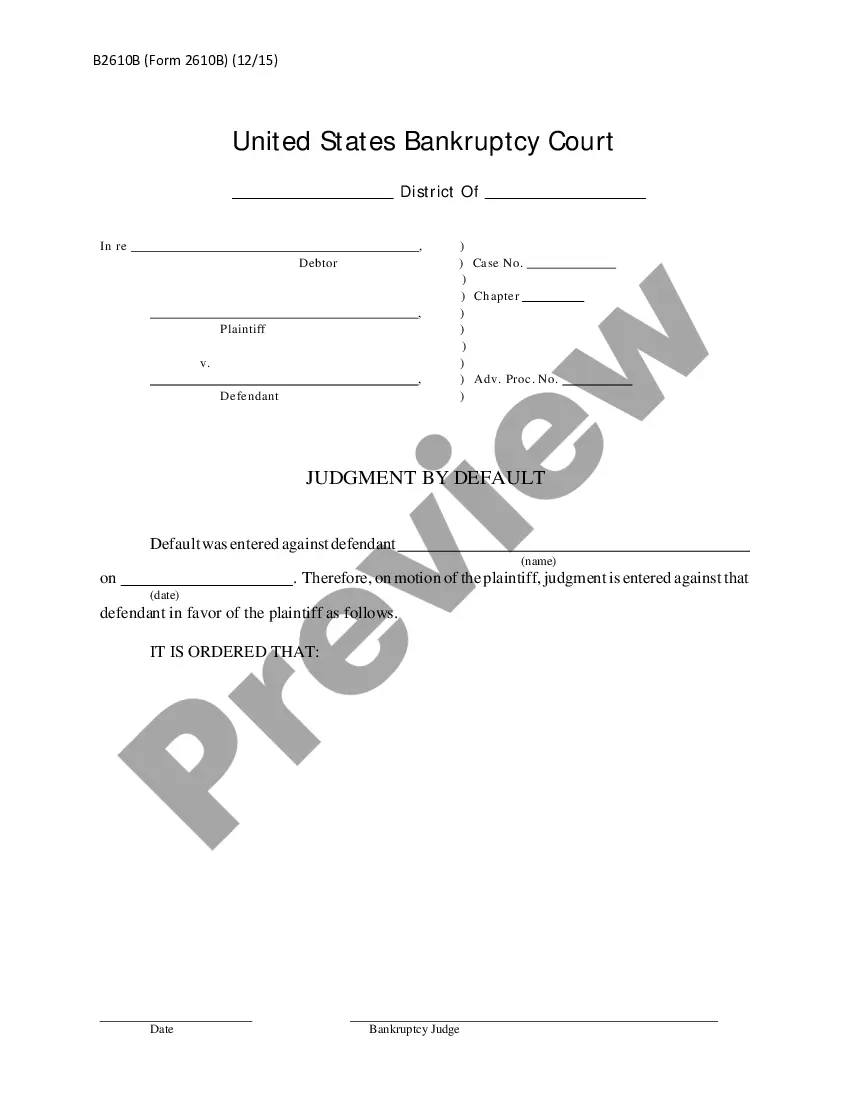
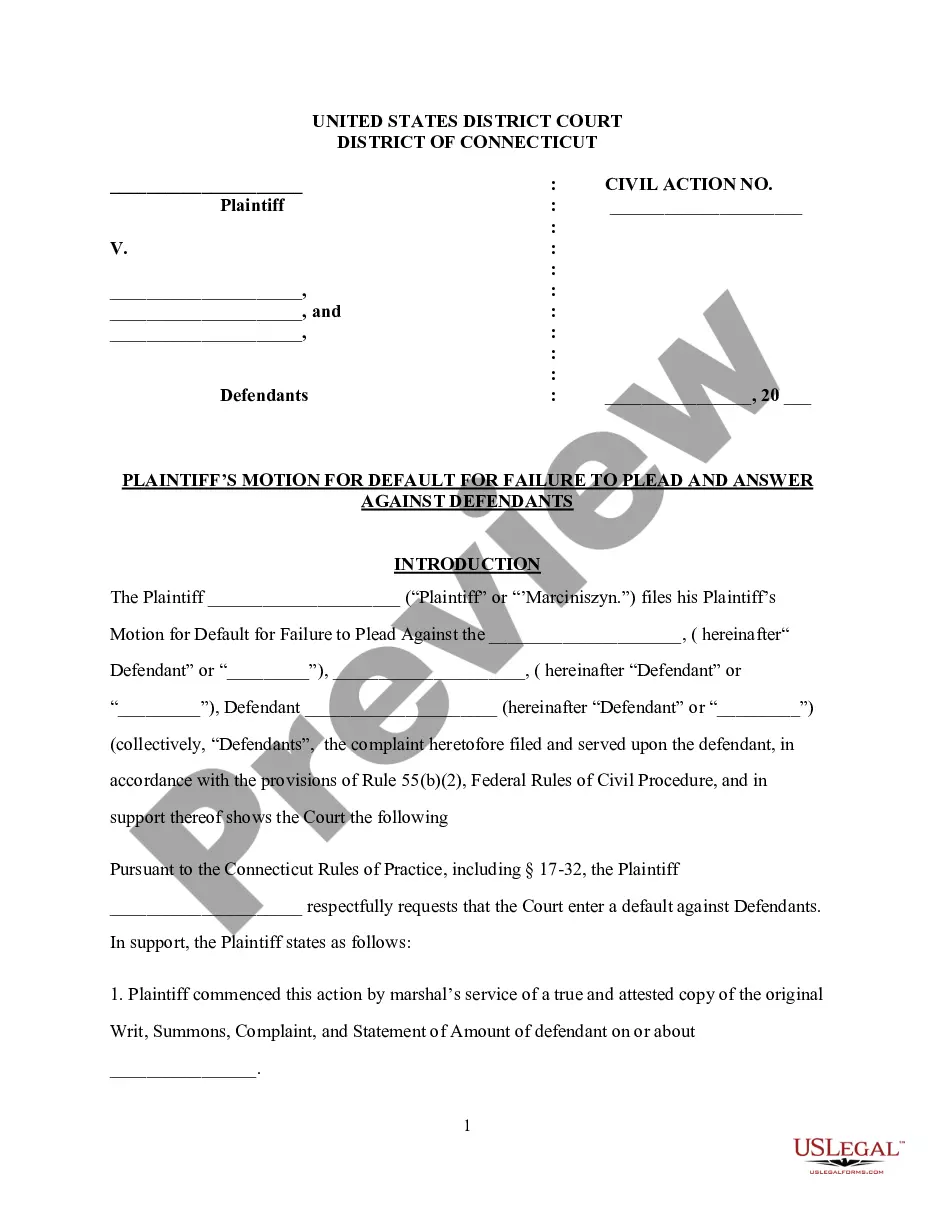
The Default Judgment form is a legal document used to request a judgment against a defendant when they fail to respond to a complaint within the specified time frame. This form allows the plaintiff to seek a decision from the court without the defendant's input, establishing liability and allowing for the recovery of financial damages and attorney fees. Unlike other legal forms, the Default Judgment specifically addresses situations where a defendant does not appear, rather than contests the claims made against them.
Main sections of this form
- Title indicating it is a Default Judgment conducted in a specific Circuit Court.
- Names of the parties involved, including the plaintiff and defendant.
- Statement acknowledging that the defendant has been served and failed to respond.
- Details on the amount to be recovered, including damages, attorney fees, and costs.
- Interest rate specified for the judgment amount until it is paid.
- Signature line for the judge and other relevant parties.
When to use this form
This form should be used when a plaintiff has filed a complaint against a defendant, served them with the complaint, and the defendant has failed to file an answer within the required timeframe. Common scenarios include debt collection cases, evictions, and breach of contract disputes where the defendant does not contest the claims made against them.
Who needs this form
- Individuals or businesses seeking a default judgment due to a defendant's lack of response.
- Plaintiffs who have properly served the defendant with legal documents.
- Attorneys representing clients in civil litigation who need to obtain a judgment without opposition.
Instructions for completing this form
- Identify the caption, including the Circuit Courtâs name and the partiesâ names.
- Specify the date and details of service to the defendant.
- Enter the amount sought in damages, including any attorney fees and costs.
- Include the interest rate applicable to the judgment amount.
- Sign and date the form at the appropriate places designated for the judge and attorney.
Notarization guidance
This form does not typically require notarization unless specified by local law. However, it is always wise to check with local court requirements for any additional stipulations regarding notarization before submission.
Get your form ready online
Our built-in tools help you complete, sign, share, and store your documents in one place.
Make edits, fill in missing information, and update formatting in US Legal Forms—just like you would in MS Word.
Download a copy, print it, send it by email, or mail it via USPS—whatever works best for your next step.
Sign and collect signatures with our SignNow integration. Send to multiple recipients, set reminders, and more. Go Premium to unlock E-Sign.
If this form requires notarization, complete it online through a secure video call—no need to meet a notary in person or wait for an appointment.
We protect your documents and personal data by following strict security and privacy standards.

Make edits, fill in missing information, and update formatting in US Legal Forms—just like you would in MS Word.

Download a copy, print it, send it by email, or mail it via USPS—whatever works best for your next step.

Sign and collect signatures with our SignNow integration. Send to multiple recipients, set reminders, and more. Go Premium to unlock E-Sign.

If this form requires notarization, complete it online through a secure video call—no need to meet a notary in person or wait for an appointment.

We protect your documents and personal data by following strict security and privacy standards.
Avoid these common issues
- Failing to properly serve the defendant before filing for default judgment.
- Not including the correct amount of damages or attorney fees.
- Omitting the interest rate or miscalculating accrued interest on the judgment.
- Neglecting to sign and date the judgment form appropriately.
Why use this form online
- Convenience of completing the form from any location at any time.
- Editable digital format allows for easy updates or corrections.
- Access to attorney-drafted templates ensures legal compliance.
- Time-saving, as forms can be downloaded immediately after purchase.
Looking for another form?

Form popularity
FAQ
To remove an expired judgment lien in Kentucky, you need to file a motion with the court to have it vacated. Provide evidence that the lien has indeed expired, following the proper legal procedures. If you're facing challenges, consider utilizing platforms like US Legal Forms to find the necessary forms and guidance for this process. Securing your property rights can often depend on effective management of your Kentucky Default Judgment.
A judgment is a formal decision by a court resolving a dispute, while a default refers to the failure of a party to respond to a lawsuit. In Kentucky, a default judgment can be entered if you do not appear in court or respond to claims. Understanding these terms can clarify your legal standing regarding the Kentucky Default Judgment. Seeking legal assistance may help navigate these distinctions more effectively.
After 5 years of a judgment in Kentucky, the judgment remains enforceable, but be mindful of the full 15-year duration. Securing a renewal of your Kentucky Default Judgment can be beneficial if you haven't collected the debt. Generally, creditors can continue to pursue payment during this time. If you have concerns, consider reaching out to professionals for guidance.