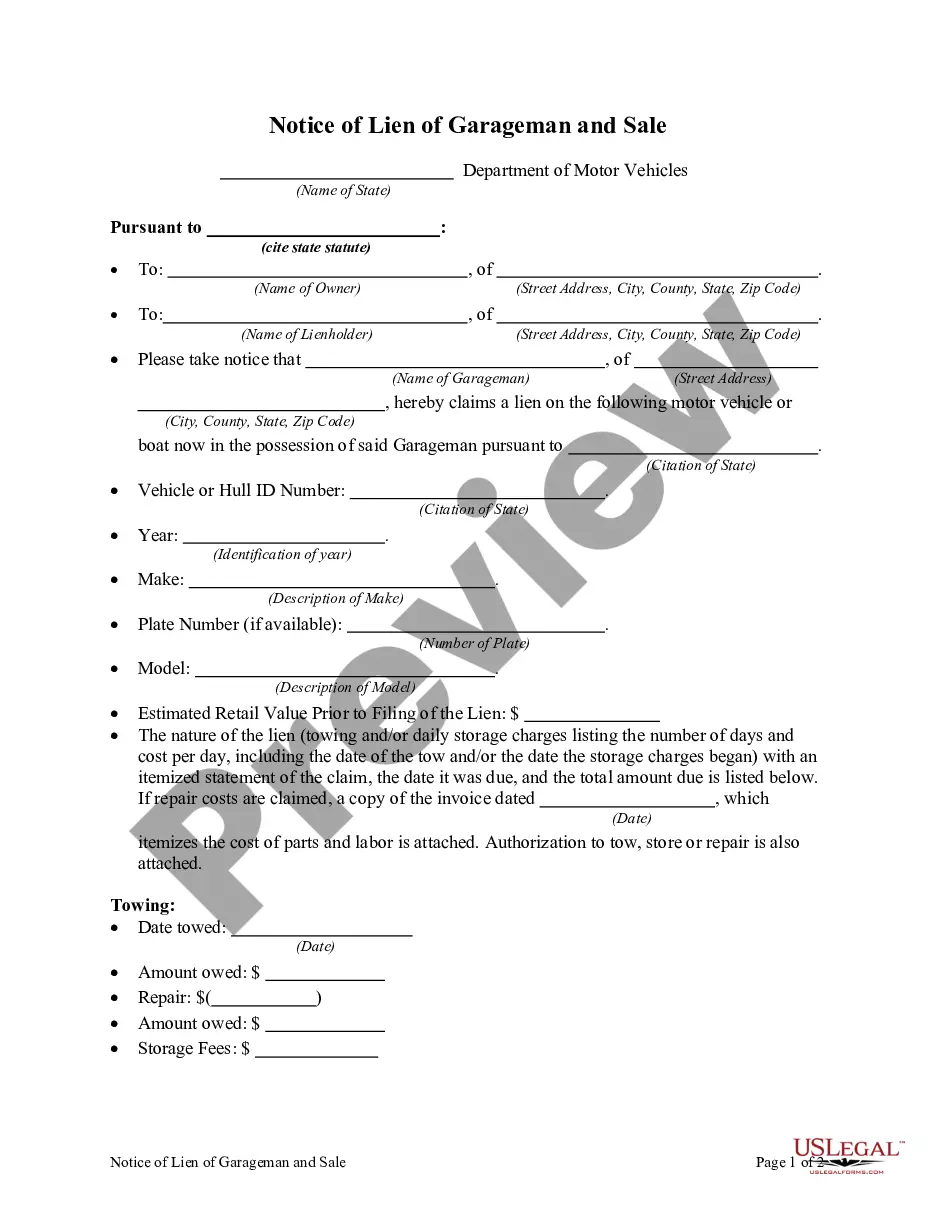
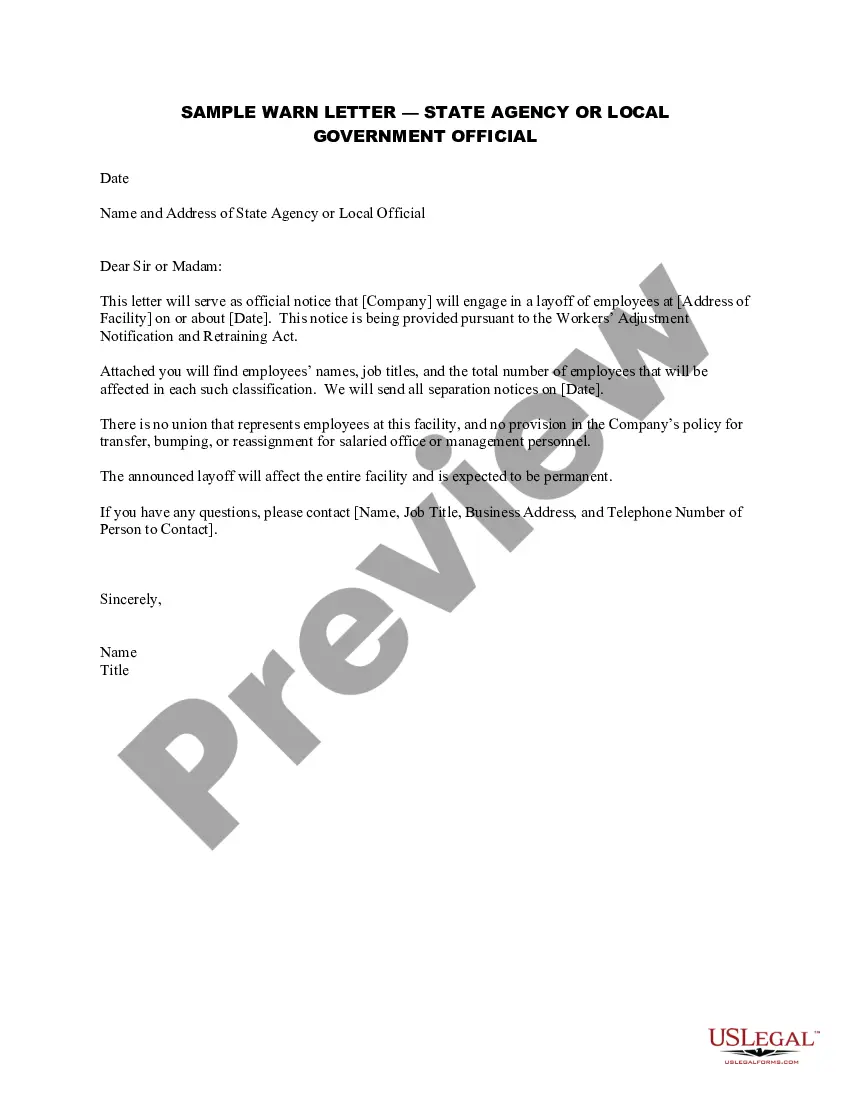
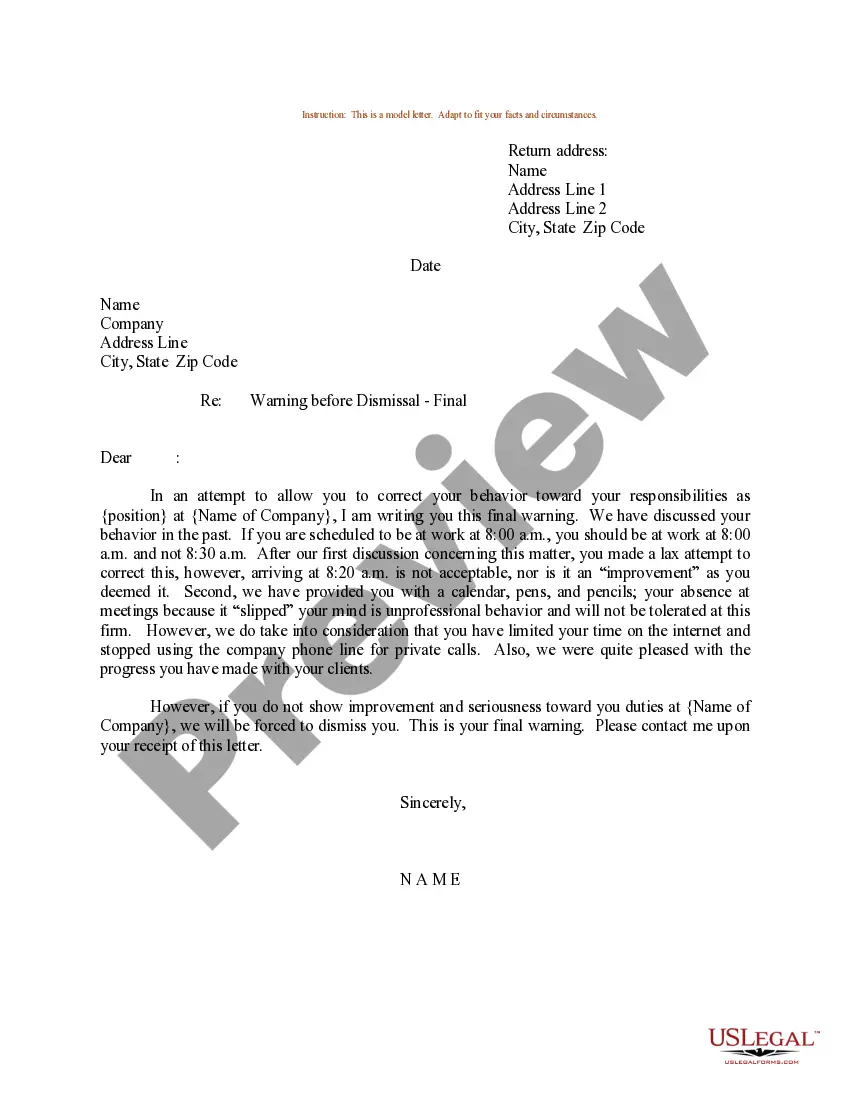
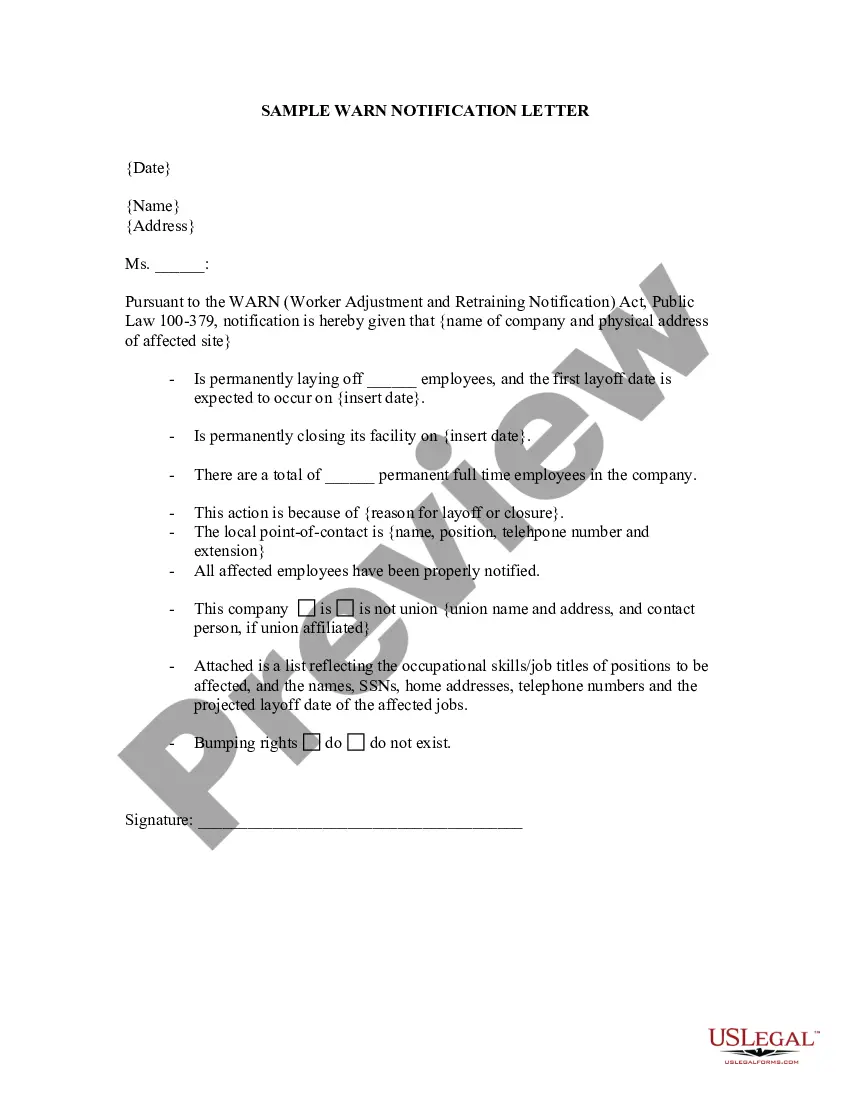
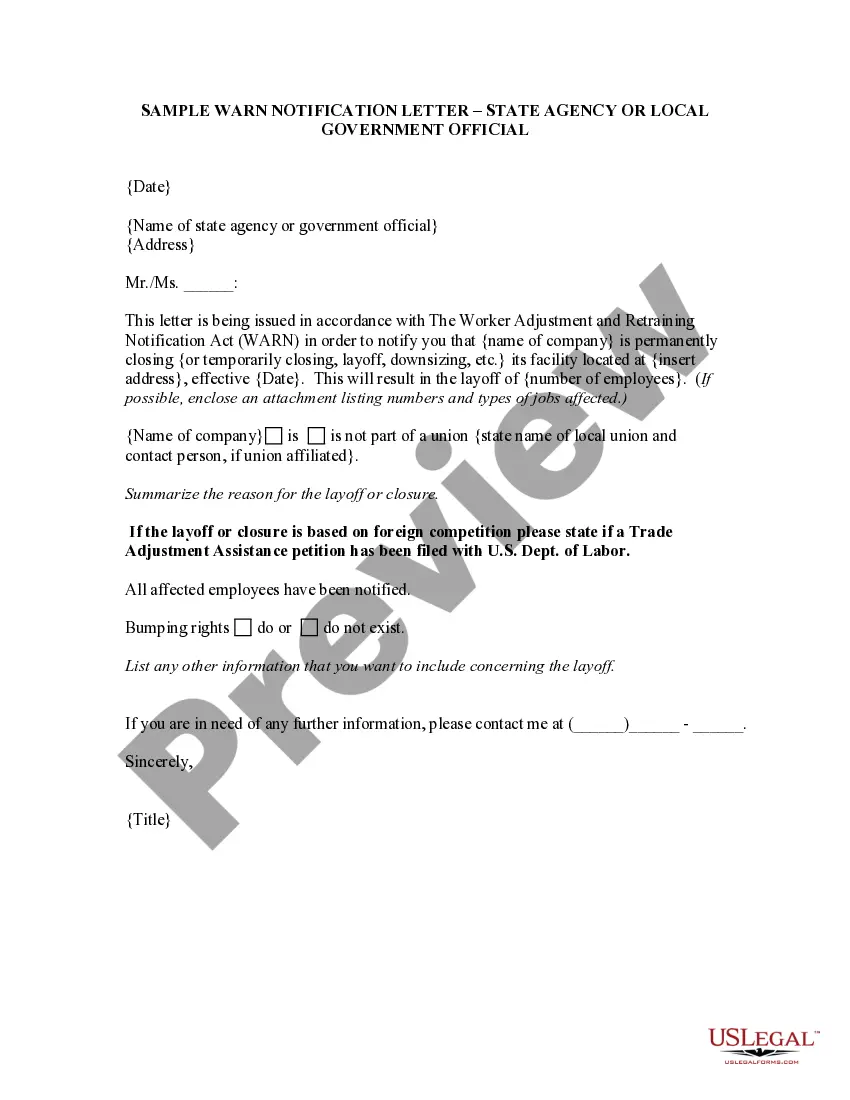
Kansas Sample WARN Letter - State Agency of Local Government Official
Description
Get your form ready online
Our built-in tools help you complete, sign, share, and store your documents in one place.
Make edits, fill in missing information, and update formatting in US Legal Forms—just like you would in MS Word.
Download a copy, print it, send it by email, or mail it via USPS—whatever works best for your next step.
Sign and collect signatures with our SignNow integration. Send to multiple recipients, set reminders, and more. Go Premium to unlock E-Sign.
If this form requires notarization, complete it online through a secure video call—no need to meet a notary in person or wait for an appointment.
We protect your documents and personal data by following strict security and privacy standards.

Make edits, fill in missing information, and update formatting in US Legal Forms—just like you would in MS Word.

Download a copy, print it, send it by email, or mail it via USPS—whatever works best for your next step.

Sign and collect signatures with our SignNow integration. Send to multiple recipients, set reminders, and more. Go Premium to unlock E-Sign.

If this form requires notarization, complete it online through a secure video call—no need to meet a notary in person or wait for an appointment.

We protect your documents and personal data by following strict security and privacy standards.
Looking for another form?
How to fill out Sample WARN Letter - State Agency Of Local Government Official?
Are you presently in a position where you frequently require documentation for both business or personal purposes each day.
There are numerous legal document templates accessible online, but finding ones you can trust is challenging.
US Legal Forms offers thousands of forms, such as the Kansas Sample WARN Letter - State Agency of Local Government Official, which are designed to meet state and federal requirements.
Select a convenient file format and download your copy.
Access all the document templates you have purchased in the My documents section. You can obtain an additional copy of the Kansas Sample WARN Letter - State Agency of Local Government Official at any time, if needed. Just select the desired document to download or print the template. Utilize US Legal Forms, one of the most extensive collections of legal forms, to save time and avoid errors. The service provides properly crafted legal document templates that can be used for various purposes. Create an account on US Legal Forms and start making your life a bit easier.
- If you are already familiar with the US Legal Forms website and have an account, simply sign in.
- After that, you can download the Kansas Sample WARN Letter - State Agency of Local Government Official template.
- If you do not possess an account and wish to start using US Legal Forms, follow these steps.
- Find the form you require and ensure it is for the correct city/region.
- Use the Preview option to review the template.
- Read the description to confirm you have selected the correct document.
- If the form is not what you're looking for, utilize the Search box to find a form that fits your needs and requirements.
- Once you locate the right document, click Purchase now.
- Choose the pricing plan you want, complete the necessary information to create your account, and make a payment using your PayPal or Visa or Mastercard.
Form popularity
FAQ
The act applies to companies with over 100 active full-time employees, private and public companies and all non-profit and for-profit organizations. Employees covered under the act include both salaried and hourly employees. Employees must be employed for at least six months during the last 12 months.
3) When is an employer required to provide 60-day advance written notice under the WARN Act? Under the federal WARN Act, employers are required to provide written advance notice in the event of either a plant closing or a mass layoff. Both of these events are specifically defined under the Act.
Mandatory subjects are those topics required by law and the National Labor Relations Board (NLRB). Those subjects include items like wages, overtime, bonuses, grievance procedures, safety and work practices, and seniority, as well as procedures for discharge, layoff, recall, or discipline.
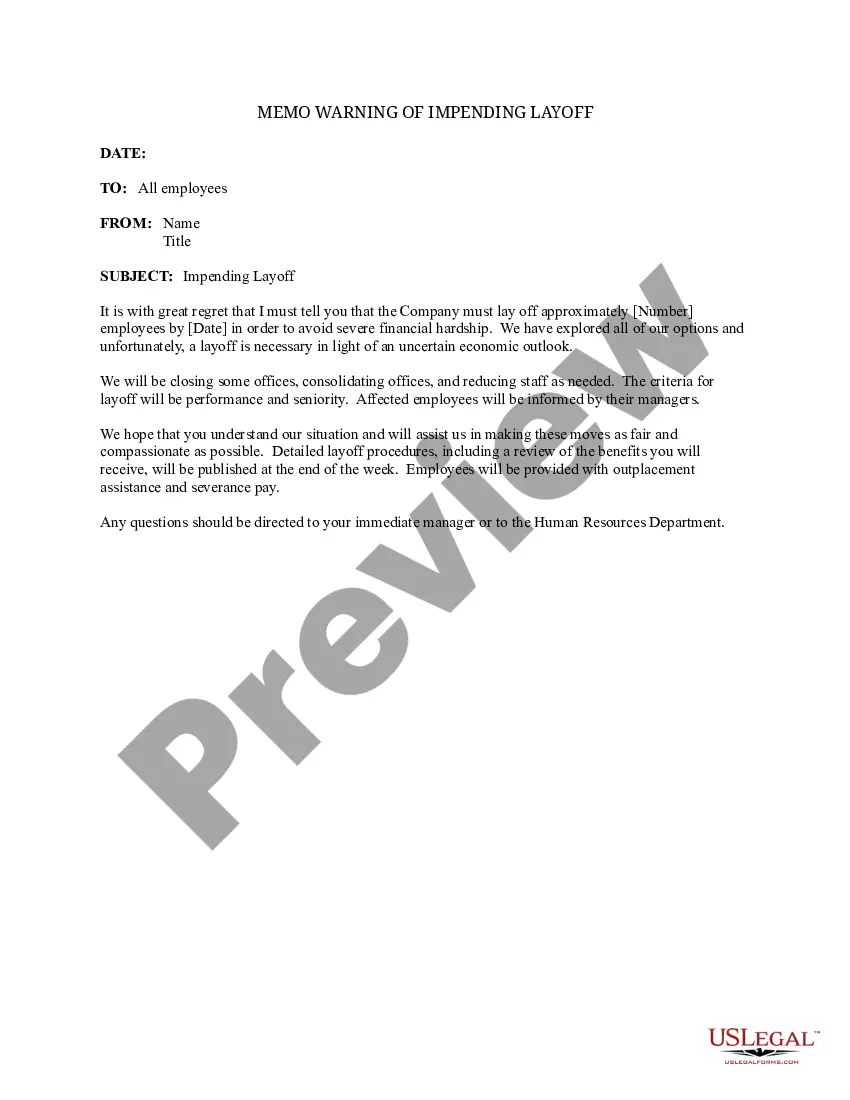
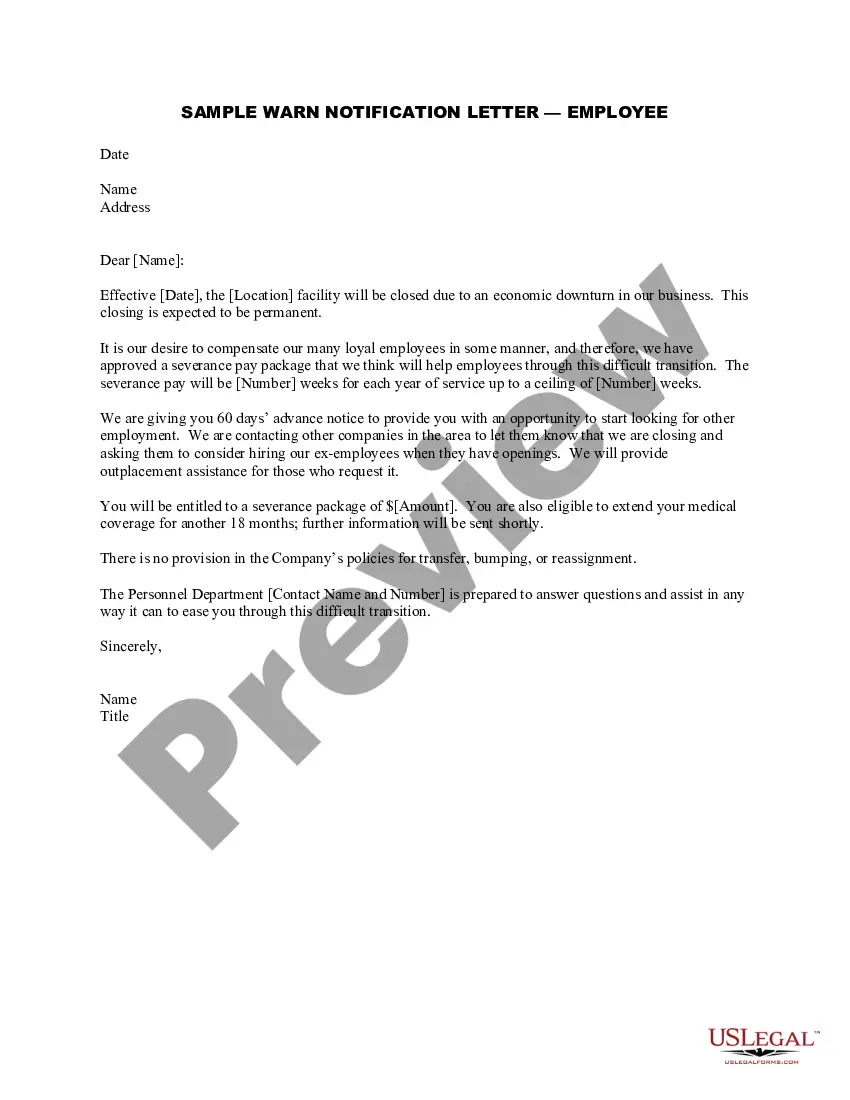
The Warn Act: Warning of Layoffs to Employees - The Federal and California Law. The Worker Adjustment and Retraining Notification Act (WARN Act) is a federal act that requires certain employers to give advance notice of significant layoffs to their employees.
When an arbitrator is evaluating an employee misconduct case, the relative value of the damage is the primary factor in considering the appropriate discipline; the person's deliberate and malicious intent has relatively little significance.
Discrimination by race, creed, color, religion, or national origin is a mandatory subject for collective bargaining.
The Worker Adjustment and Retraining Notification (WARN) Act is a federal law that requires employers to provide advanced notification to workers when faced with a plant closing or mass layoff.
Under which of the following circumstances is a successor employer considered to be guilty of an unfair labor practice? The successor employer refuses to hire existing employees due to their union status.
The Worker Adjustment and Retraining Notification Act (WARN Act) is a federal act that requires certain employers to give advance notice of significant layoffs to their employees.
Which of the following factors must be present for the successorship doctrine to apply to the purchaser of a business employing union members? The successor should substantially continue the business operations of the predecessor.