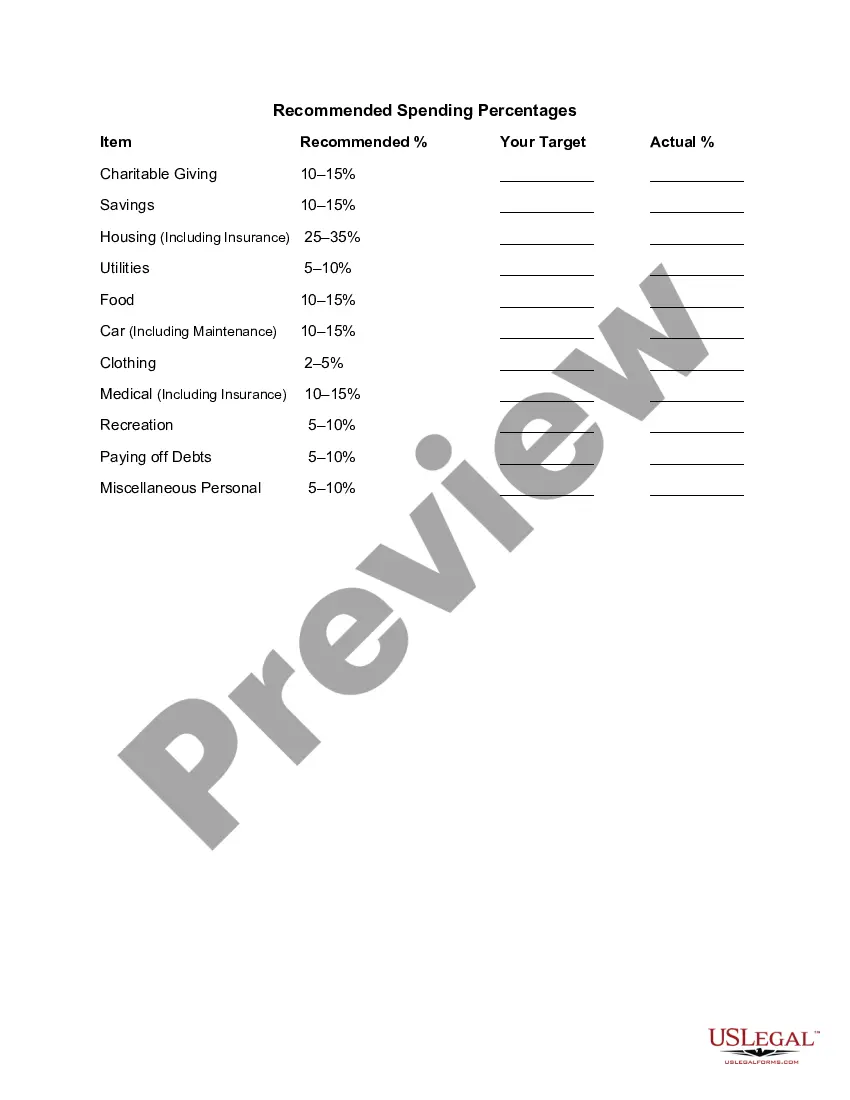
Kansas Recommended Spending Percentages
Description
Get your form ready online
Our built-in tools help you complete, sign, share, and store your documents in one place.
Make edits, fill in missing information, and update formatting in US Legal Forms—just like you would in MS Word.
Download a copy, print it, send it by email, or mail it via USPS—whatever works best for your next step.
Sign and collect signatures with our SignNow integration. Send to multiple recipients, set reminders, and more. Go Premium to unlock E-Sign.
If this form requires notarization, complete it online through a secure video call—no need to meet a notary in person or wait for an appointment.
We protect your documents and personal data by following strict security and privacy standards.

Make edits, fill in missing information, and update formatting in US Legal Forms—just like you would in MS Word.

Download a copy, print it, send it by email, or mail it via USPS—whatever works best for your next step.

Sign and collect signatures with our SignNow integration. Send to multiple recipients, set reminders, and more. Go Premium to unlock E-Sign.

If this form requires notarization, complete it online through a secure video call—no need to meet a notary in person or wait for an appointment.

We protect your documents and personal data by following strict security and privacy standards.
Looking for another form?

How to fill out Recommended Spending Percentages?
Have you found yourself in a circumstance where you require documentation for various organizational or specific purposes nearly every day.
There are countless legal document templates accessible online, but locating reliable ones is challenging.
US Legal Forms offers thousands of form templates, including the Kansas Recommended Spending Percentages, designed to comply with federal and state regulations.
If you identify the correct form, click Get now.
Choose the payment plan you prefer, fill in the required information to create your account, and finalize the transaction using your PayPal or credit card.
- If you are already familiar with the US Legal Forms site and possess an account, simply Log In.
- Then, you can download the Kansas Recommended Spending Percentages template.
- If you do not have an account and wish to start using US Legal Forms, follow these instructions.
- Find the form you need and confirm that it is for the appropriate city/county.
- Utilize the Review option to inspect the form.
- Check the description to ensure that you have selected the correct form.
- If the form does not match what you are looking for, use the Lookup field to search for a form that satisfies your needs.
Form popularity
FAQ
Meatpacking and dairy industries are major economic activities, and the Kansas City stockyards are among the nation's largest. Food processing ranked as the state's third largest industry in the 1990s. The two leading industries are the manufacture of transportation equipment and industrial and computer machinery.
Family-owned farms and ranches account for most of the state's approximately $20 billion agriculture industry. Kansas is a major producer of wheat, beef and grain sorghum, traditionally used for livestock feed and some ethanol plants.
Into the following fiscal year. The divergence in revenues and spending left Kansas with an ending balance of just $89.1 million. With updated tax revenue projections, the Kansas state budget will not balance unless the state finds an additional $121 million.
The federal taxes you pay are used by the government to invest in technology and education, and to provide goods and services for the benefit of the American people. The three biggest categories of expenditures are: Major health programs, such as Medicare and Medicaid. Social security.
Every U.S. state other than Vermont has some form of balanced budget provision that applies to its operating budget. The precise form of this provision varies from state to state. Indiana has a state debt prohibition with an exception for "temporary and casual deficits," but no balanced budget requirement.
Kansas is a major producer of wheat, beef and grain sorghum, traditionally used for livestock feed and some ethanol plants.
Agriculture remains the largest economic and industrial driver in Kansas, generating more than $70 billion into the state's economy. The state remains in the top 10 for beef cattle, corn, hay, hogs, soybean, sunflower, sorghum and wheat.
Agriculture is the largest economic driver in Kansas, with a total contribution of $67 billion to the Kansas economy. The agriculture sector in Kansas supports more than 238,000 jobs through direct, indirect and induced effect careers, or about 12% percent of the entire workforce in the state.
The appropriations process budgets money from state funds so they may be spent by government agencies. Spending typically falls within one of six buckets called state functions: General Government, Human Services, Education, Public Safety, Agriculture and Natural Resources and Transportation.