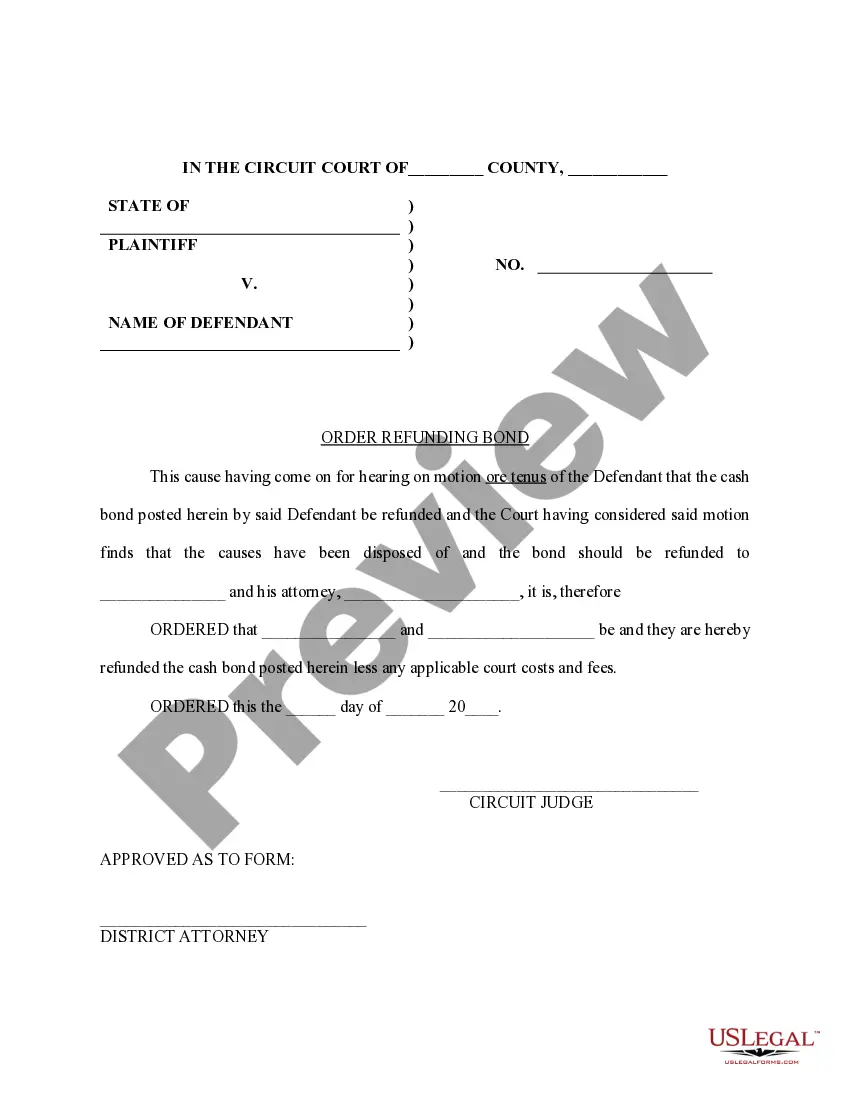
Kansas Order Refunding Bond
Description

Get your form ready online
Our built-in tools help you complete, sign, share, and store your documents in one place.
Make edits, fill in missing information, and update formatting in US Legal Forms—just like you would in MS Word.
Download a copy, print it, send it by email, or mail it via USPS—whatever works best for your next step.
Sign and collect signatures with our SignNow integration. Send to multiple recipients, set reminders, and more. Go Premium to unlock E-Sign.
If this form requires notarization, complete it online through a secure video call—no need to meet a notary in person or wait for an appointment.
We protect your documents and personal data by following strict security and privacy standards.

Make edits, fill in missing information, and update formatting in US Legal Forms—just like you would in MS Word.

Download a copy, print it, send it by email, or mail it via USPS—whatever works best for your next step.

Sign and collect signatures with our SignNow integration. Send to multiple recipients, set reminders, and more. Go Premium to unlock E-Sign.

If this form requires notarization, complete it online through a secure video call—no need to meet a notary in person or wait for an appointment.

We protect your documents and personal data by following strict security and privacy standards.
Looking for another form?
How to fill out Order Refunding Bond?
It is feasible to dedicate numerous hours online trying to discover the valid document template that aligns with the state and federal standards you desire. US Legal Forms offers thousands of valid forms that are evaluated by professionals.
You can download or print the Kansas Order Refunding Bond from my services. If you already possess a US Legal Forms account, you may Log In and then click the Obtain button. Afterward, you can complete, modify, print, or sign the Kansas Order Refunding Bond. Every valid document template you purchase is yours permanently.
To obtain another copy of the purchased form, go to the My documents tab and click the corresponding button. If you are using the US Legal Forms website for the first time, follow the simple instructions below: Firstly, ensure that you have selected the correct document template for the region/city of your choice. Review the form description to confirm that you have chosen the right form. If available, utilize the Preview button to examine the document template as well.
Utilize professional and state-specific templates to address your business or personal requirements.
- To locate another version of the form, use the Search field to find the template that meets your needs and specifications.
- Once you have found the template you require, click on Purchase now to proceed.
- Select the pricing plan you want, enter your details, and register for a free account on US Legal Forms.
- Complete the transaction. You can use your credit card or PayPal account to pay for the valid form.
- Choose the file format of the document and download it to your device.
- Make adjustments to the document if needed. You can complete, modify, sign, and print the Kansas Order Refunding Bond.
- Download and print thousands of document templates using the US Legal Forms site, which offers the largest variety of valid forms.
Form popularity
FAQ
Generally unique to municipal securities, a refunding is the process by which an issuer refinances outstanding bonds by issuing new bonds. This may serve either to reduce the issuer's interest costs or to remove a restrictive covenant imposed by the terms of the bonds being refinanced.
Generally unique to municipal securities, a refunding is the process by which an issuer refinances outstanding bonds by issuing new bonds. This may serve either to reduce the issuer's interest costs or to remove a restrictive covenant imposed by the terms of the bonds being refinanced.
For example, an issuer that refunds a $100 million bond issue with a 10% coupon at maturity and replaces it with a new $100 million issue (refunding bond issue) with a 6% coupon, will have savings of $4 million in interest expense per annum.
Example of Advance Refunding Advance refunding is popular in low-interest-rate environments, when bond issuers may seek to take advantage of lower rates by refinancing outstanding bonds that have not yet matured. For example, suppose a municipality wants to refinance its current unpaid bonds at a new, lesser rate.
Refunding bonds are bonds that are issued to replace and refinance outstanding general obligation or revenue bonds (chapter 39.53 RCW). The use of a refunding mechanism is often driven by the desire to lower interest rates and reduce payment amounts on older, more expensive debt.
Advantages. Some of the major advantages of bond refunding are as follows: First, it helps the bond issuer replace the existing high-interest-rate and new low-cost bonds. It helps the issuers improve their capital structure and maintain a suitable debt-equity ratio.
Calling a bond means the bond can be called in advance than the maturity of the bond and it will be redeemed by the issuer. Bond refunding means retiring the bond at its maturity by using a new debt issue.