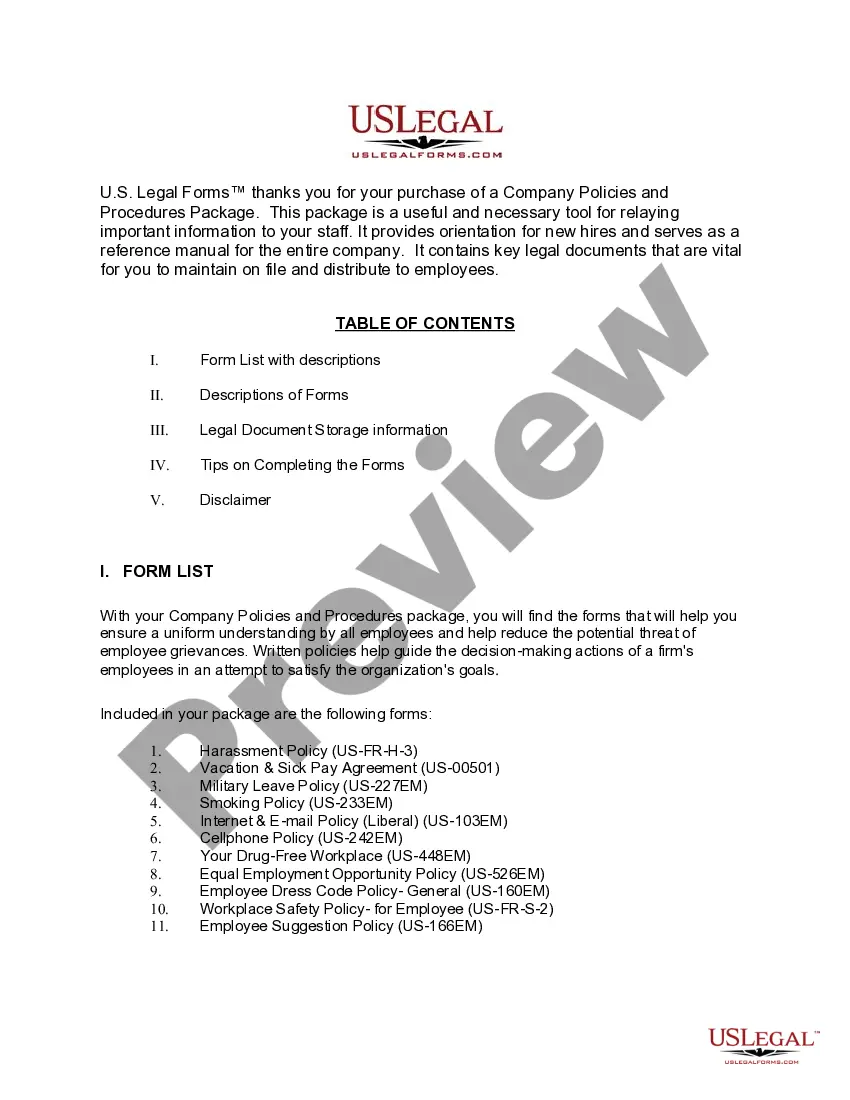
1. Harassment Policy
2. Vacation & Sick Pay Agreement
3. Military Leave Policy
4. Smoking Policy
5. Internet & E-mail Policy (Liberal)
6. Cellphone Policy
7. Your Drug-Free Workplace
8. Equal Employment Opportunity Policy
9. Employee Dress Code Policy- General
10. Workplace Safety Policy- for Employee
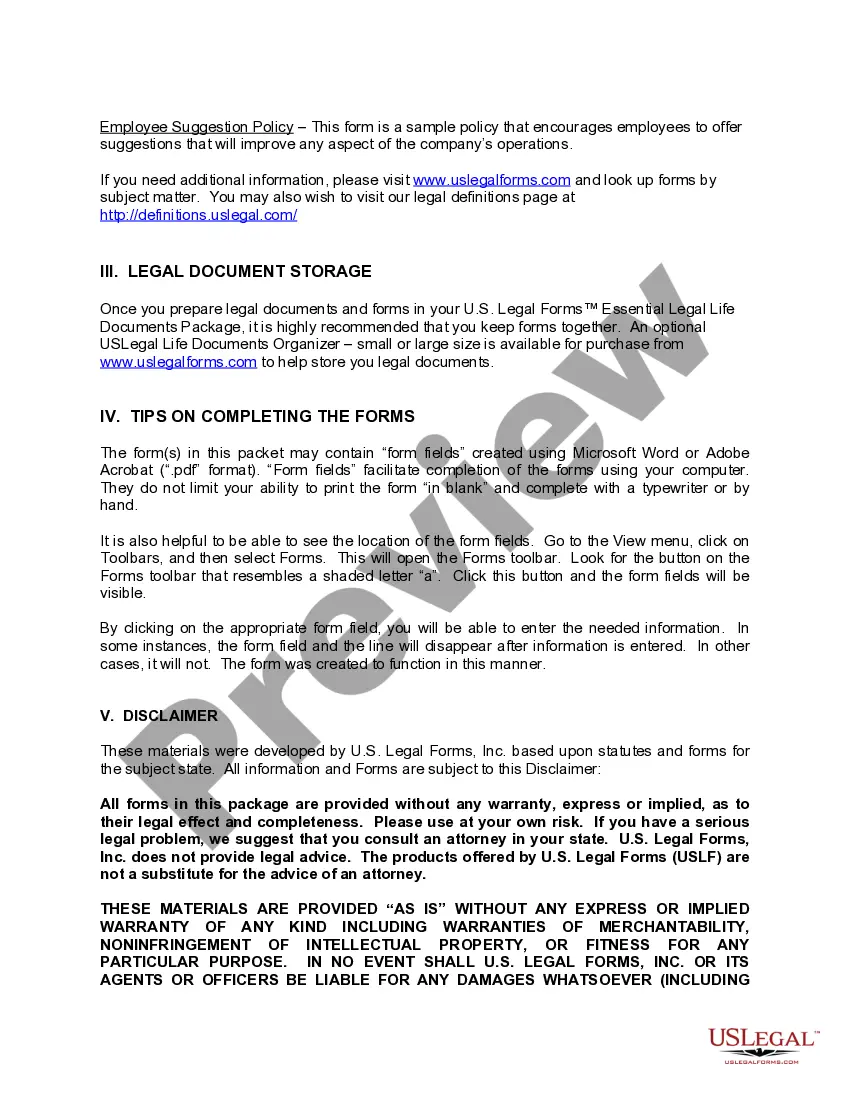
11. Employee Suggestion Policy
Kansas Company Employment Policies and Procedures Package
Category:
State:
Kansas
Control #:
KS-P008-PKG
Format:
Word;
Rich Text;
PDF
Instant download
Description
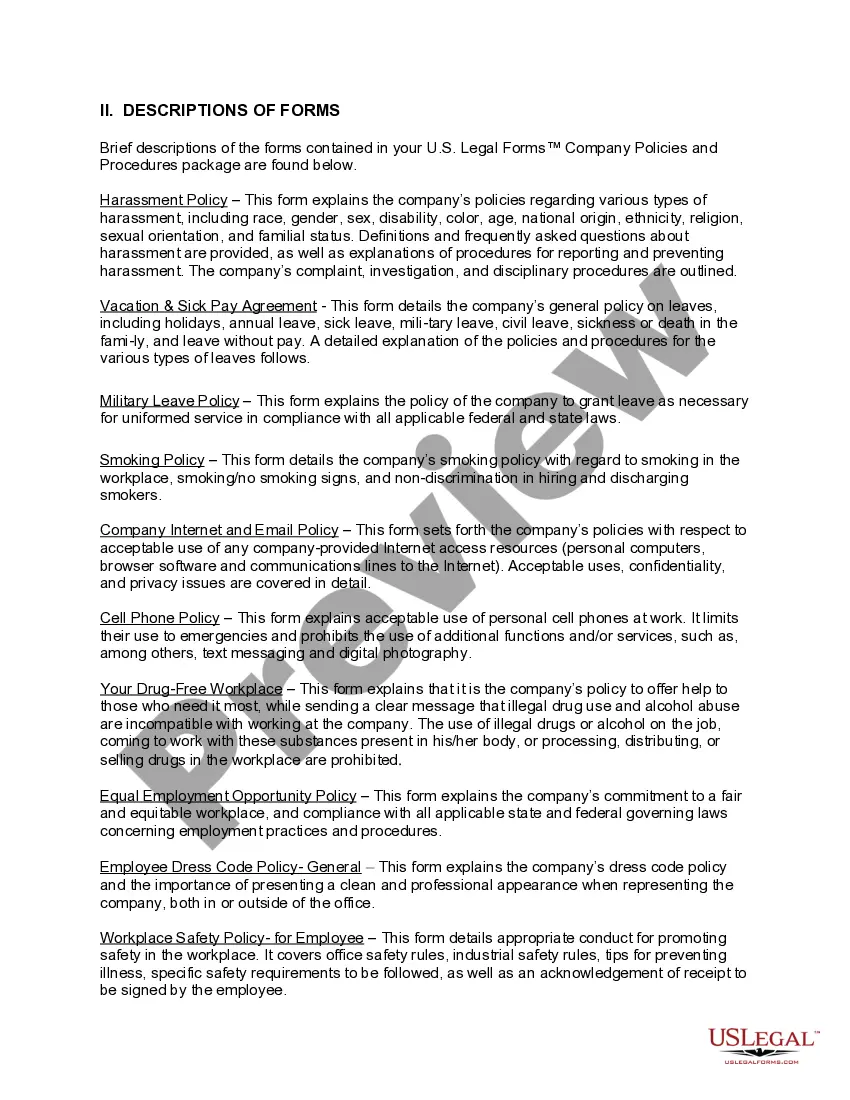
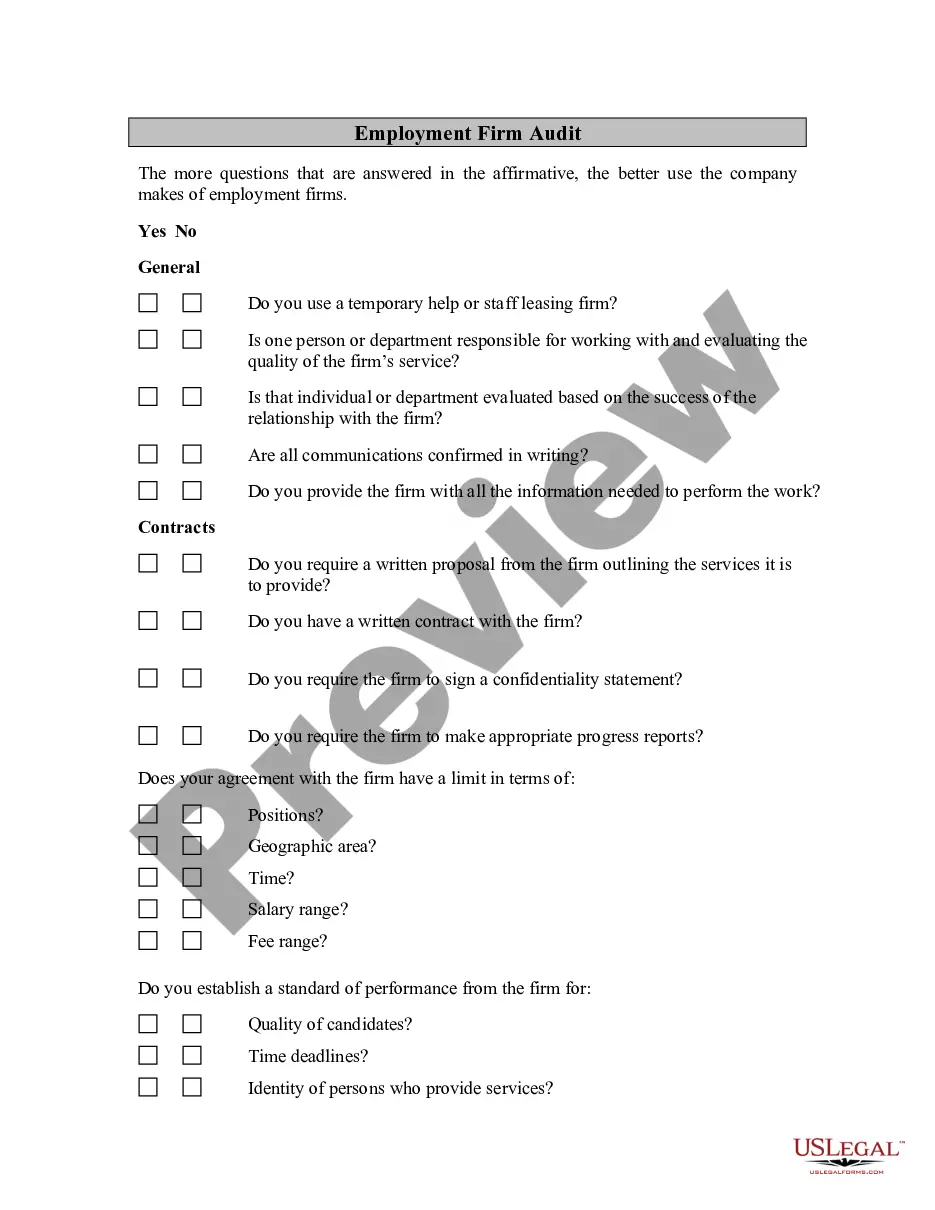
This package contains essential policy and procedures forms to help your company ensure a uniform understanding by all employees and help reduce the potential threat of employee grievances. It provides orientation for new hires and serves as a reference manual for the entire company. The documents in this package include the following:
Free preview


How to fill out Kansas Company Employment Policies And Procedures Package?
Locating Kansas Company Employment Policies and Procedures Package templates and completing them can be difficult.
To conserve time, expenses, and effort, utilize US Legal Forms to find the suitable sample specific to your state within a few clicks.
Our lawyers prepare each document, so you merely need to fill them in. It really is that simple.
If there's a description, read it to understand the details. Click on the Buy Now button if you found what you're looking for. Choose your plan on the pricing page and create your account. Select your payment method by credit card or PayPal. Store the file in your preferred file format. Now you can print the Kansas Company Employment Policies and Procedures Package form or complete it using any online editor. Don’t be concerned about making mistakes because your template can be used and submitted, and printed as many times as you wish. Try US Legal Forms and gain access to over 85,000 state-specific legal and tax documents.
- Log in to your account.
- Return to the form's web page and save the sample.
- All your downloaded samples are kept in My documents and are available at all times for future use.
- If you have not subscribed yet, you must register.
- Review our comprehensive instructions on how to obtain your Kansas Company Employment Policies and Procedures Package sample in just a few minutes.
- To get a valid example, check its relevance for your state.
- Examine the form using the Preview feature (if available).
Form popularity
FAQ
Step 1: Review and Make Required Revisions to the Current Company Policies. Step 2: Create an Outline of What to Include in the Employee Handbook. Step 3: Create Summarized Versions of Each Policy and Procedure. Step 4: Add Each Summary Statement in the Appropriate Sections According to the Outline.
Use the handbook as a communication tool. Employees can be full of legal agreements and notices, which important as they are, can be daunting. Safety and security. Get a legal review. Outline your expectations/Code of conduct. Hours, benefits, and compensation. Don't be redundant. Make it readable. Leave room for change.
Policy includes statements of rules or standards. Policies do not change frequently. Policies may not include procedures or supplemental information.
Prioritize a policy list. Keep in mind that you can't tackle every policy at once. Conduct thorough research. Take a look at your existing procedures to zone in on how things are currently done. Write an initial draft. After defining what you need to cover, you can begin your first draft. Validate the procedures.
Equal opportunity policy. Workplace health and safety. Employee code of conduct policy. Attendance, vacation and time-off policies. Employee disciplinary action policy. Employee complaint policies.
Step 1: Determine the Purpose and Intention of the Policy. Step 2: Assemble All Prior Writings and Practices on the Same or Similar Topics. Step 3: Obtain Information and Input from Relevant Stakeholders. Step 4: Conduct Research to Determine Status of the Law and Identify Trends.
Company policies are rules that govern a company's code of conduct. They apply to both employees and employers, and they may govern conduct both within and outside the workplace. Company policies are usually written policies included in your business's employee handbook.
Company History. While not required, a brief section discussing the company's history and its mission can help set the tone for an employee handbook. Paid Time-Off Policy. Employee Behavior. Pay and Promotions. Benefits.
Code of conduct. Attendance/vacation/time off policy. Equal opportunity and non-discrimination policies. Workplace safety. Alcohol, drug-free workplace, smoking, cannabis policies. Whistleblower policy. Anti-harassment policy. Privacy policy.