Kansas Survivorship Deed with General Warranty Covenants
What is this form?
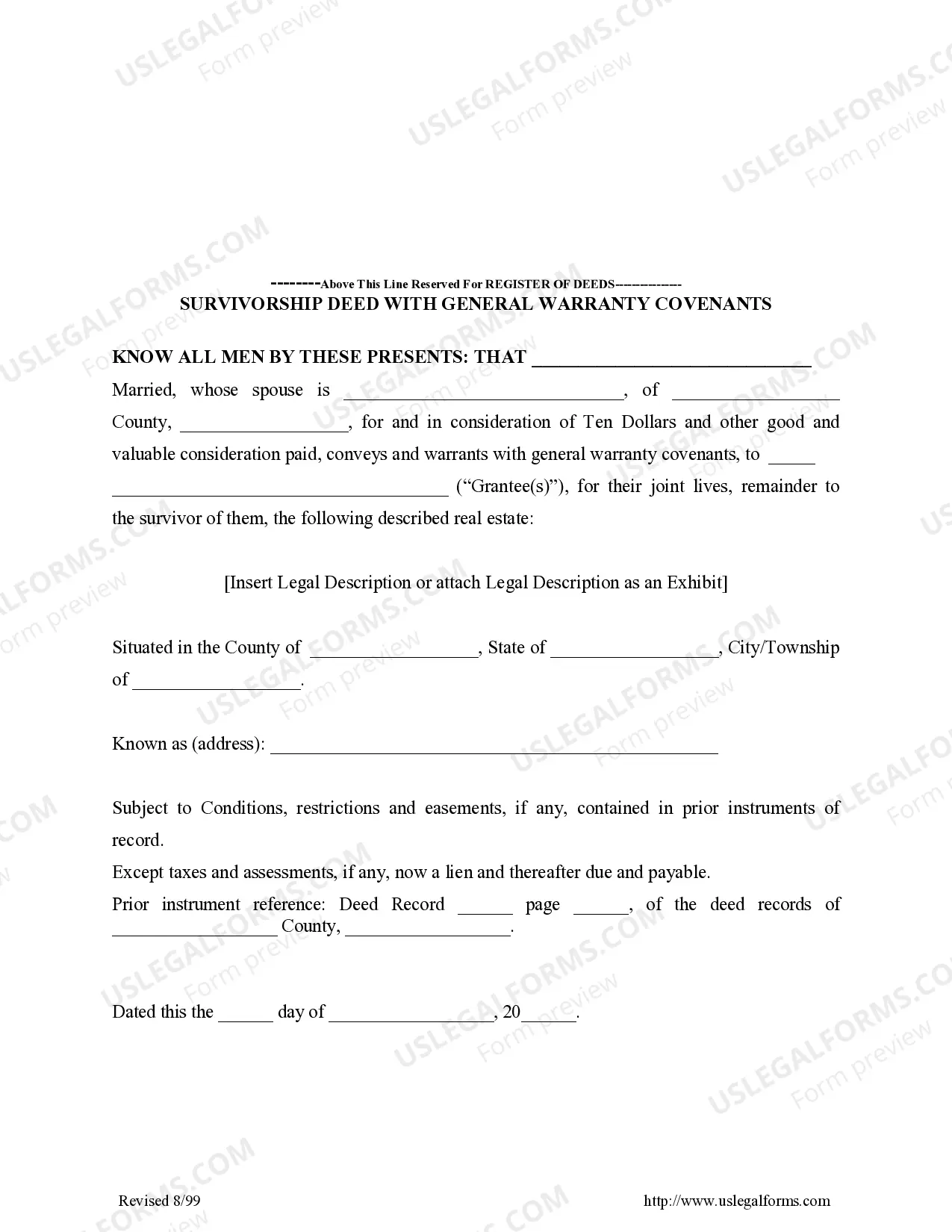
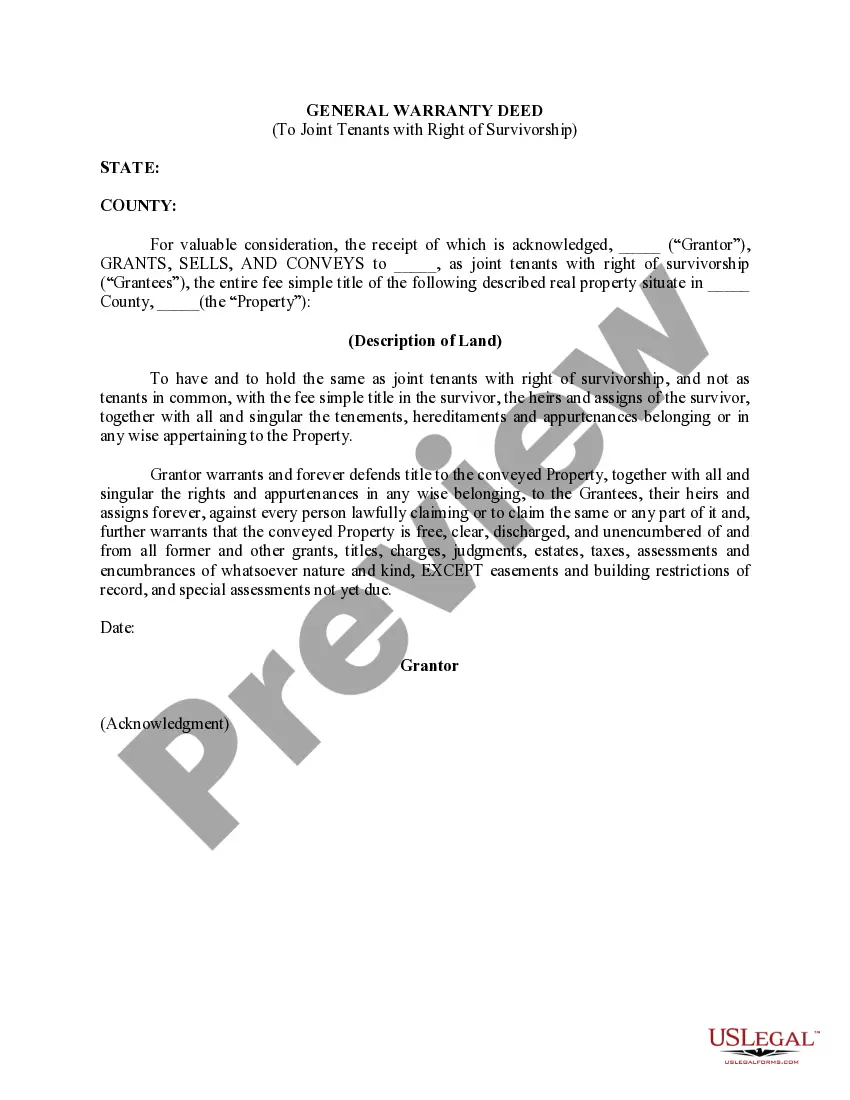
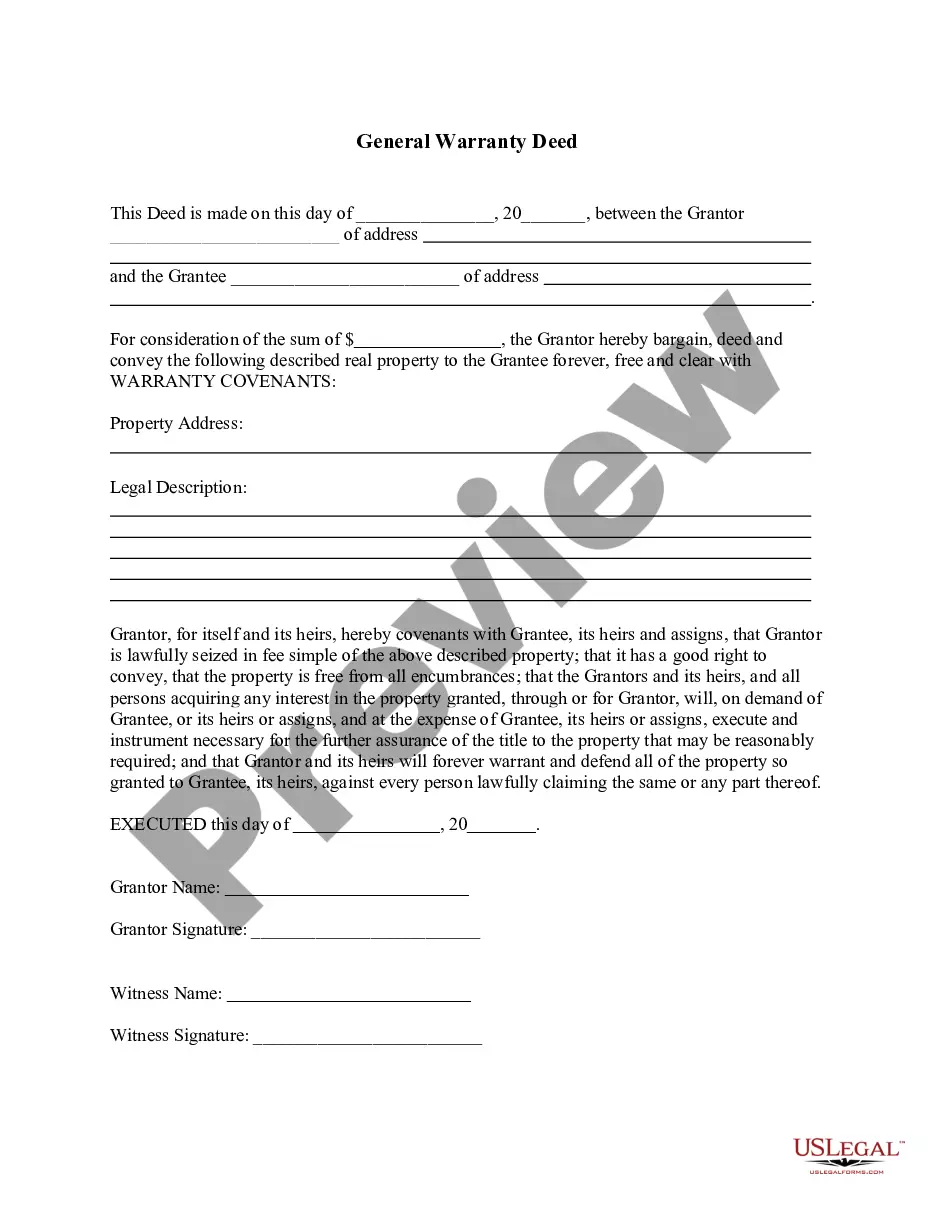
The Survivorship Deed with General Warranty Covenants is a legal document used in property transactions. This deed ensures that when one of the joint owners passes away, the surviving owner automatically receives full ownership of the property. The document also includes general warranty covenants, providing a level of protection against potential claims on the property. This form is essential in estate planning and property transfer scenarios, differing from other deeds that may not provide the same level of assurance and survivorship rights.
Main sections of this form
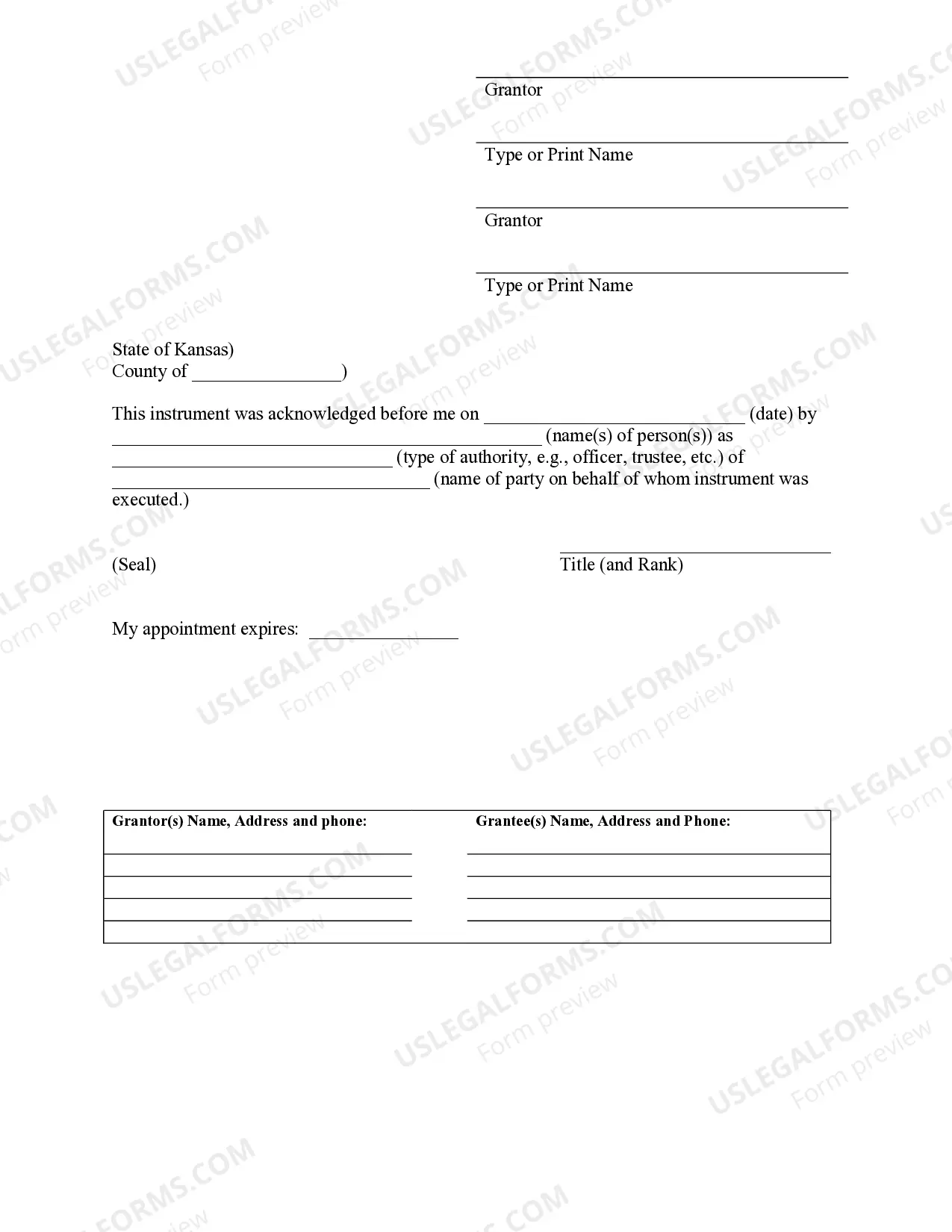
- Identification of the granter(s) and grantee(s).
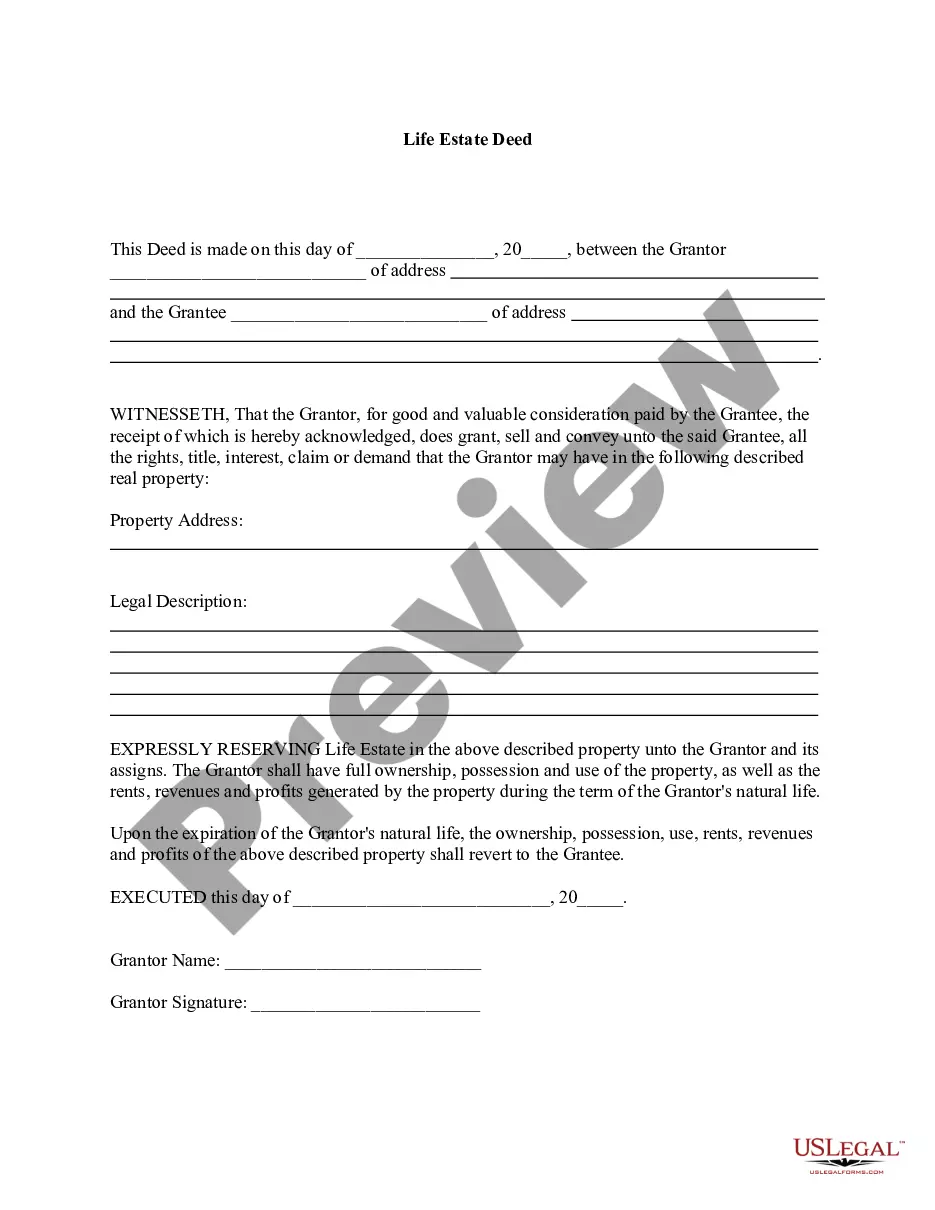
- Legal description of the property being transferred.
- Statement of consideration, indicating the payment or value exchanged.
- Survivorship clause stating that property ownership transfers to the surviving owner.
- Notary acknowledgment section for legal validation.


Common use cases
This form should be used when co-owners of a property want to ensure that ownership passes directly to the surviving co-owner upon death. It is commonly utilized in scenarios involving married couples or business partners who wish to maintain property continuity and prevent estate complications.
Who this form is for
- Married couples holding joint property.
- Domestic partners or cohabitating individuals wishing to establish survivorship rights.
- Business partners who co-own real estate.
- Individuals involved in estate planning to secure property transfer upon death.
Steps to complete this form
- Identify the granter(s) by entering their full names and marital status.
- Provide the legal description of the property being conveyed.
- Specify the grantee(s) who will receive the title upon the death of the granter.
- Enter the date of the transaction and the consideration amount.
- Obtain notarization from a qualified official to validate the deed.
Does this form need to be notarized?
To make this form legally binding, it must be notarized. Our online notarization service, powered by Notarize, lets you verify and sign documents remotely through an encrypted video session.
Get your form ready online
Our built-in tools help you complete, sign, share, and store your documents in one place.
Make edits, fill in missing information, and update formatting in US Legal Forms—just like you would in MS Word.
Download a copy, print it, send it by email, or mail it via USPS—whatever works best for your next step.
Sign and collect signatures with our SignNow integration. Send to multiple recipients, set reminders, and more. Go Premium to unlock E-Sign.
If this form requires notarization, complete it online through a secure video call—no need to meet a notary in person or wait for an appointment.
We protect your documents and personal data by following strict security and privacy standards.

Make edits, fill in missing information, and update formatting in US Legal Forms—just like you would in MS Word.

Download a copy, print it, send it by email, or mail it via USPS—whatever works best for your next step.

Sign and collect signatures with our SignNow integration. Send to multiple recipients, set reminders, and more. Go Premium to unlock E-Sign.

If this form requires notarization, complete it online through a secure video call—no need to meet a notary in person or wait for an appointment.

We protect your documents and personal data by following strict security and privacy standards.
Avoid these common issues
- Not accurately describing the property, which may lead to validity issues.
- Failing to include all required signatures, particularly that of the granter.
- Leaving the date section incomplete, which is essential for record-keeping.
- Failing to notarize the deed, which can result in the deed being challenged.
Benefits of completing this form online
- Convenience of downloading the form at any time without the need for in-person appointments.
- Editability allows users to input their specific information directly into the document.
- Access to professionally drafted templates ensures legal accuracy and compliance.
- Easy record-keeping; forms can be stored digitally for future reference.
Looking for another form?
Form popularity
FAQ
A restrictive covenant creates a deed restricted community. It is an agreement that states what a homeowner can or cannot do with their house or land. They are binding legal obligations which sellers write into the deed or contract of the property, and they can have penalties against buyers who fail to follow them.
Legally, a properly recorded covenant (technically, a "restrictive deed covenant") is binding and enforceable. Even when covenants are not part of the contract and are instead signed among neighbors (such as a mutual compact), they are binding and may be litigated if breached.
A covenant, in its most general sense and historical sense, is a solemn promise to engage in or refrain from a specified action.In real property law, the juristic term real covenants means conditions tied to the ownership or use of land.
In real property law, the juristic term real covenants means conditions tied to the ownership or use of land.Covenants for title are covenants which come with a deed or title to the property, in which the grantor of the title makes certain guarantees to the grantee.
Is this why a fresh deed of covenant is required from the buyer of a flat every time a flat changes?So covenants by and in favour of management companies in leases are enforceable in exactly the same circumstances as if they had been between landlord and tenant. So they are NOT legally necessary.
A covenant deed is a less comprehensive warranty deed. It still conveys title but may contain any number or types of covenants. A covenant deed may contain restrictive covenants that prohibit the grantee from using the property in a certain way, or it may be tailored for a certain transaction.
A covenant deed is a less comprehensive warranty deed. It still conveys title but may contain any number or types of covenants. A covenant deed may contain restrictive covenants that prohibit the grantee from using the property in a certain way, or it may be tailored for a certain transaction.
A covenant is a provision, or promise, contained in a deed to land. Land may be subject to a covenant which affects or limits its use.A covenant may give a landowner some say over what is permissible on neighbouring property. This is called the benefit of a covenant.
A covenant is a provision, or promise, contained in a deed to land. Land may be subject to a covenant which affects or limits its use.A covenant may give a landowner some say over what is permissible on neighbouring property. This is called the benefit of a covenant.