Kansas Quitclaim Deed - Individual to Trust
Understanding this form
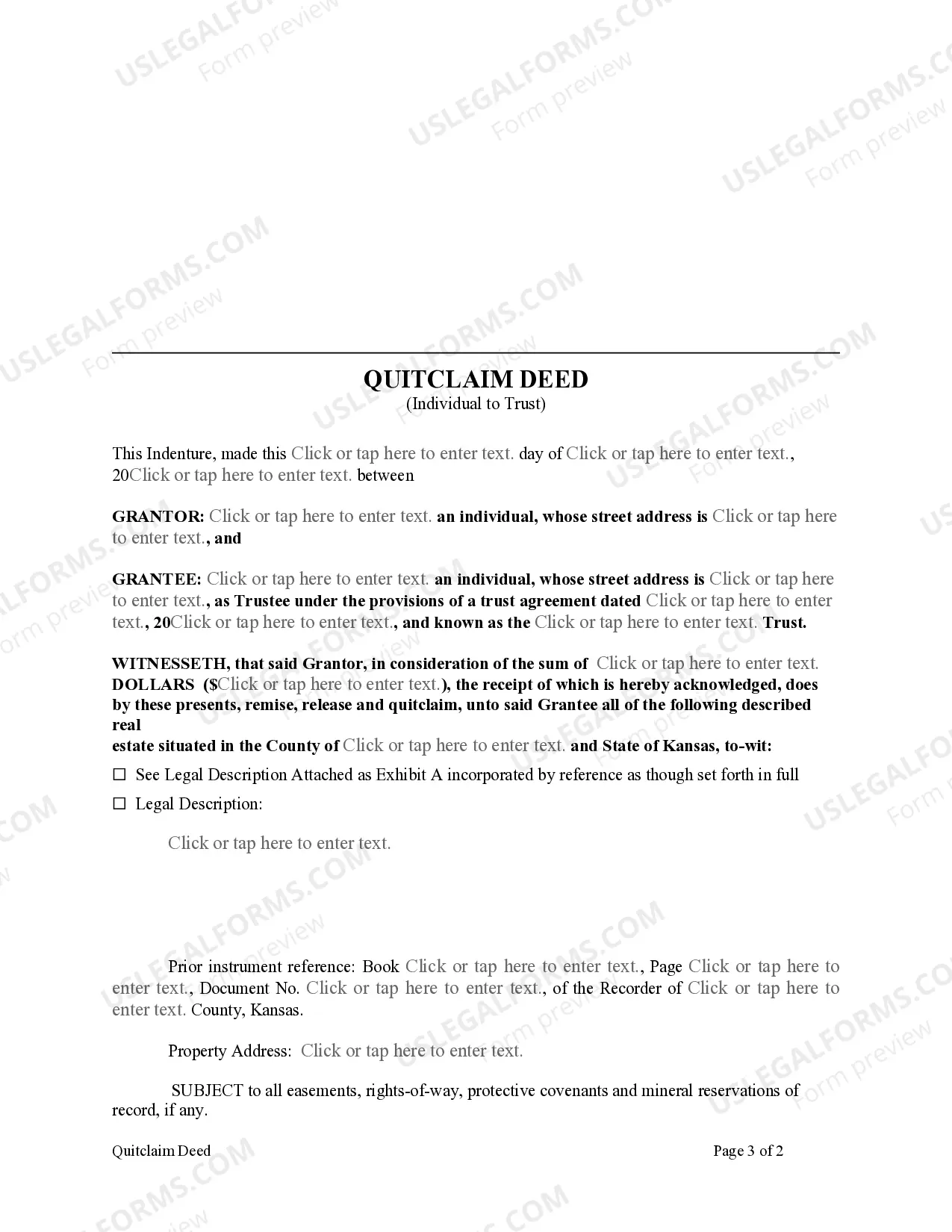
A Quitclaim Deed - Individual to Trust is a legal document where an individual (the Grantor) conveys property rights to a trust (the Grantee). This type of deed is unique because it transfers the property without guaranteeing that the Grantor holds any clear title. Unlike warranty deeds, quitclaim deeds provide no warranties or guarantees regarding the property title, making this form useful for situations where the Grantor wants to transfer property rights simply and without complex procedures.
Key components of this form
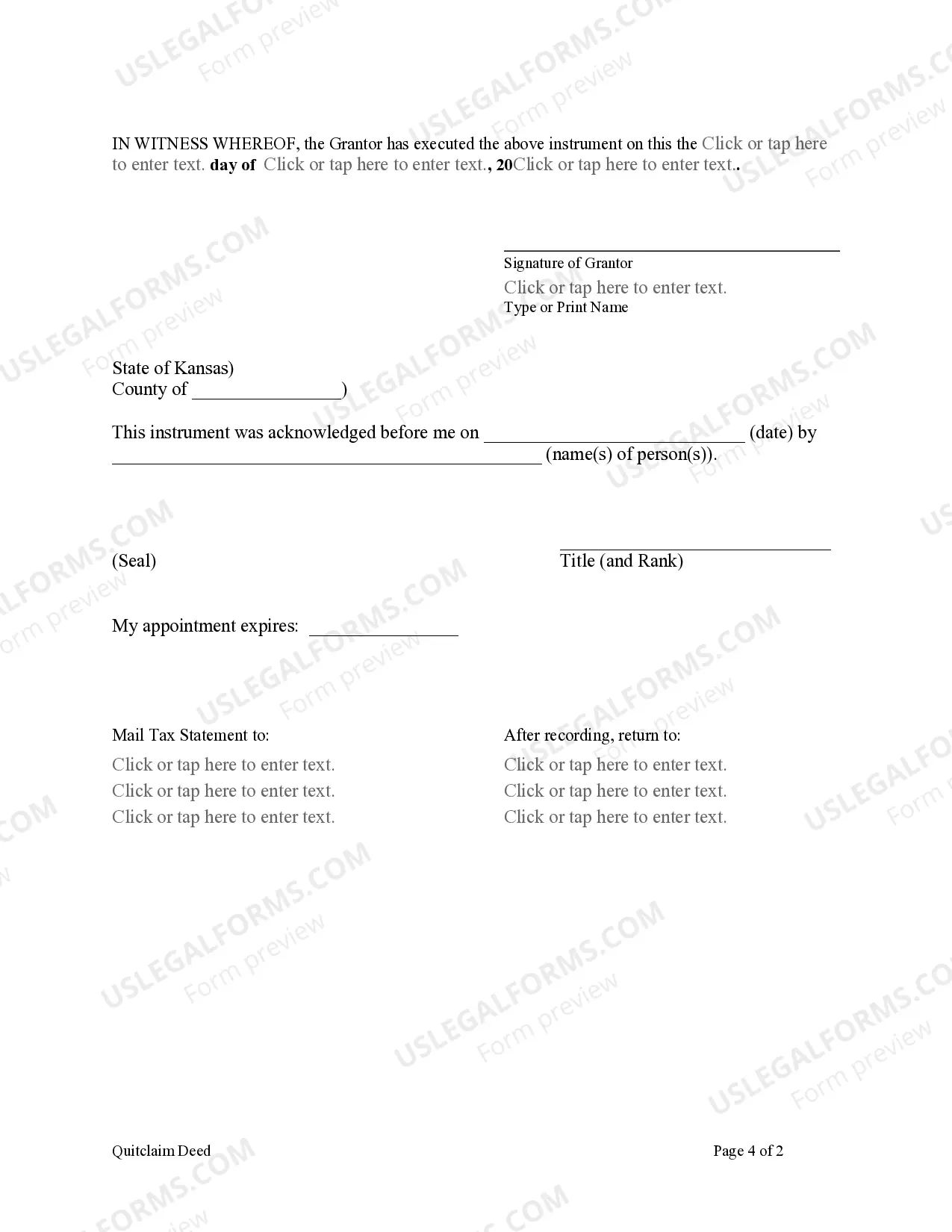
- Identification of the Grantor and Grantee
- Description of the property being conveyed
- Statement of consideration (the value exchanged for the property)
- Signature lines for the Grantor
- Notary acknowledgment section, if required




Common use cases
This form is ideal when an individual wishes to transfer property ownership to a trust. It might be used in estate planning, where property is moved into a trust to manage its distribution after death. Additionally, it is suitable for transferring real estate between family members or other parties without the need for a warranty on the title.
Who this form is for
This form can be used by:
- Individuals transferring property to an already established trust
- Trustees managing property on behalf of the beneficiaries
- Individuals engaging in simple property transfers without title guarantees
Instructions for completing this form
- Identify the Grantor by entering their full legal name.
- Enter the trust name as the Grantee, along with its established date.
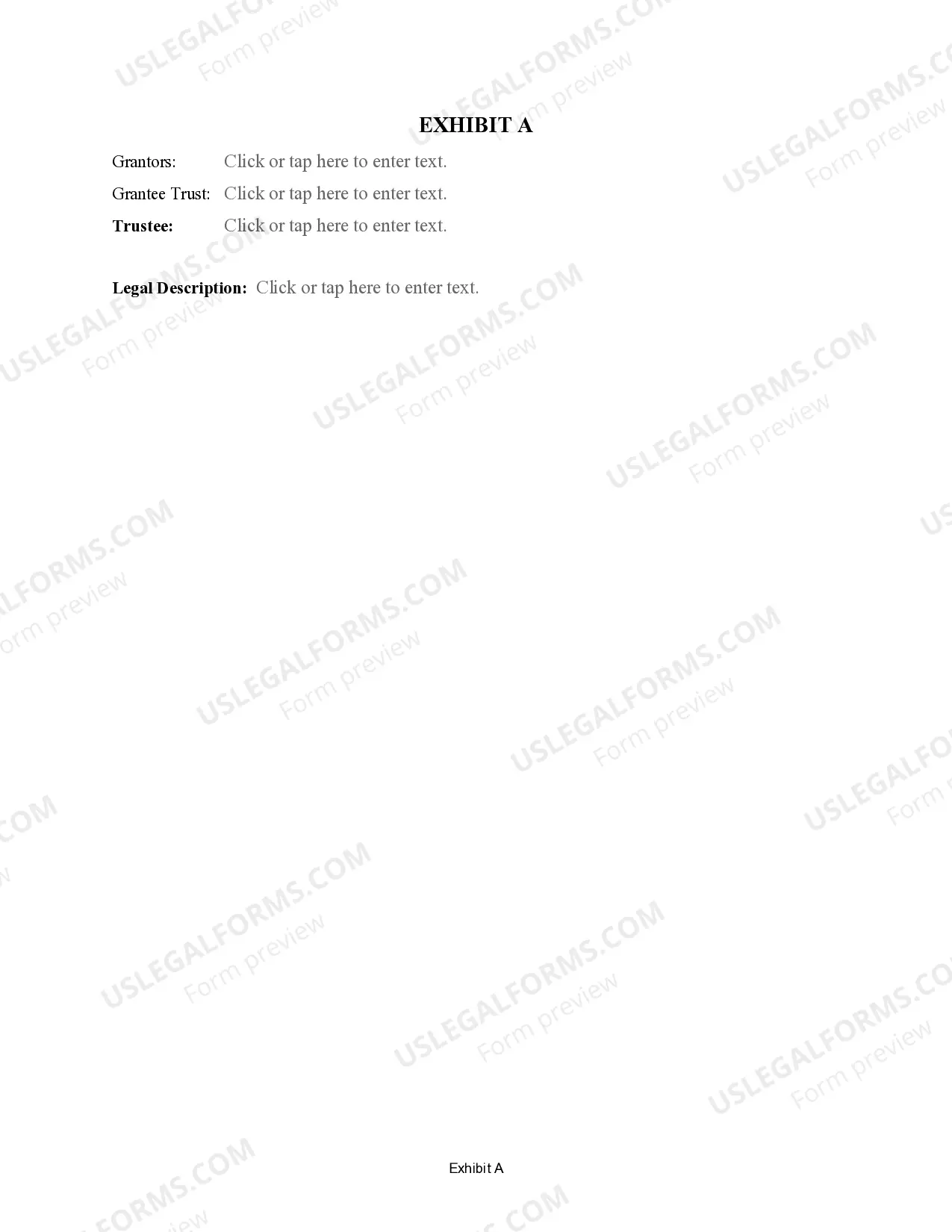
- Provide a complete legal description of the property being transferred.
- Specify the consideration amount (often a nominal fee).
- Sign the document in the presence of a notary, if required.
Does this document require notarization?
This document requires notarization to meet legal standards. US Legal Forms provides secure online notarization powered by Notarize, allowing you to complete the process through a verified video call, available 24/7.
Get your form ready online
Our built-in tools help you complete, sign, share, and store your documents in one place.
Make edits, fill in missing information, and update formatting in US Legal Forms—just like you would in MS Word.
Download a copy, print it, send it by email, or mail it via USPS—whatever works best for your next step.
Sign and collect signatures with our SignNow integration. Send to multiple recipients, set reminders, and more. Go Premium to unlock E-Sign.
If this form requires notarization, complete it online through a secure video call—no need to meet a notary in person or wait for an appointment.
We protect your documents and personal data by following strict security and privacy standards.

Make edits, fill in missing information, and update formatting in US Legal Forms—just like you would in MS Word.

Download a copy, print it, send it by email, or mail it via USPS—whatever works best for your next step.

Sign and collect signatures with our SignNow integration. Send to multiple recipients, set reminders, and more. Go Premium to unlock E-Sign.

If this form requires notarization, complete it online through a secure video call—no need to meet a notary in person or wait for an appointment.

We protect your documents and personal data by following strict security and privacy standards.
Avoid these common issues
- Failing to include a clear property description.
- Not signing the deed in front of a notary, if necessary.
- Leaving out the consideration amount, which is essential for the transfer.
Why use this form online
- Convenient access and ability to fill out forms electronically.
- Editability allows users to customize the deed as needed.
- Reliable templates drafted by licensed attorneys ensure compliance with legal standards.
Legal use & context
- Quitclaim deeds serve as a method for transferring property without a warranty.
- They are often used among family members and in trust arrangements.
- While they are simpler, quitclaim deeds may not protect the Grantee against title defects.
Summary of main points
- A Quitclaim Deed - Individual to Trust is a straightforward property transfer tool.
- This form provides no guarantees about the title, making it essential for users to understand their rights.
- Completing the form correctly is crucial to ensure a valid transfer.
Looking for another form?


Form popularity
FAQ
To file a quitclaim deed in Kansas, start by completing the Kansas Quitclaim Deed - Individual to Trust form. After ensuring all information is correct, have it notarized to affirm its authenticity. The final step is to file the notarized deed with the county recorder’s office, thus officially documenting the transfer.
The most efficient way to obtain a Kansas Quitclaim Deed - Individual to Trust is to use an online legal service like US Legal Forms. By accessing customizable templates, you can create a deed that fits your needs without the uncertainty of drafting your own. This approach saves time and provides peace of mind as you ensure compliance with Kansas laws.
Locate your current deed. Use the proper deed. Check with your title insurance company and lender. Prepare a new deed. Sign in the presence of a notary. Record the deed in the county clerk's office. Locate the deed that's in trust. Use the proper deed.
How To Establish A Trust. You will need to retain an estate attorney to draft and execute your trust document. For a simple revocable or irrevocable trust, it may cost anywhere from $2,000 $5,000.
No. And unless the deed identifies the trust as an owner, then father is the owner of an interest. It is a common mistake to set up a trust and then fail to deed property into the trust. However, you cannot force him to make the changes you are...
Recording A quitclaim deed must be filed with the County Recorder's Office where the real estate is located. Go to your County Website to locate the office nearest you. Signing (§ 58-2205) A quitclaim deed is required to be authorized with a notary public present.
Retrieve your original deed. Get the appropriate deed form. Draft the deed. Sign the deed before a notary. Record the deed with the county recorder. Obtain the new original deed.
The act of transferring a property that is owned by an individual into a trust, will see the trust liable to pay stamp duty on acquisition of the asset. Additionally, the individual who is transferring ownership to the trust, will be liable to pay capital gains tax on the disposal of the asset.
Determine the Current Title and Vesting to Your Property. Prepare a Deed. Be Aware of Your Lender and Title Insurance. Prepare a Preliminary Change of Ownership Report. Execute Your Deed. Record Your Deed. Wait for the Deed to be Returned. Keep the Property in the Trust.
Yes, a quit claim deed supercedes the trust. The only thing that can be done is to file a suit in court challenging the deed as the product of fraud and undue influence. A court action like that will cost thousands of dollars, but might be worth it if the house was owned free and clear.