Kansas Quitclaim Deed - Trust (2 Co--Trustees) to LLC
Understanding this form
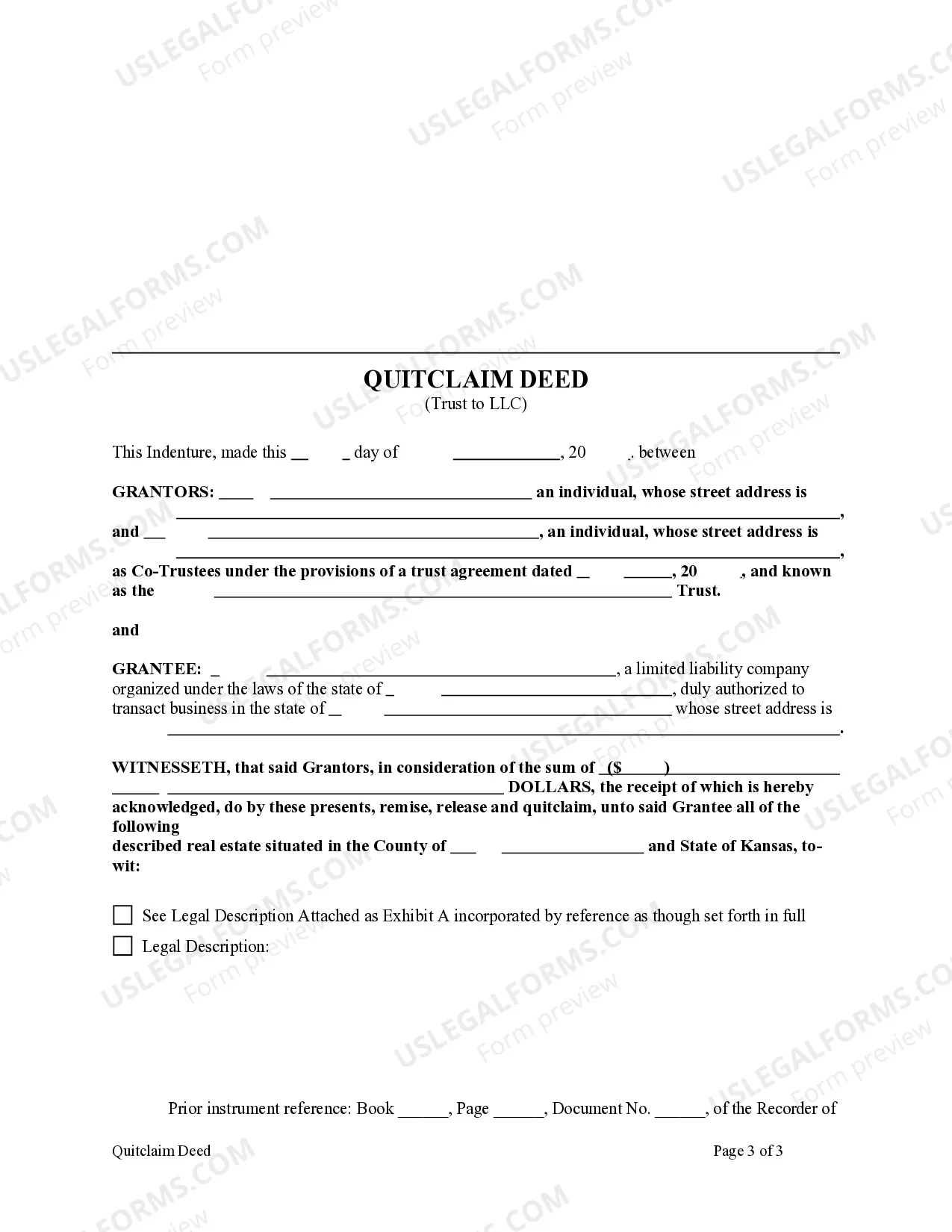
The Quitclaim Deed - Trust (2 Co-Trustees) to LLC is a legal document used when two co-trustees wish to transfer property ownership to a limited liability company (LLC). Unlike other types of deeds, a quitclaim deed conveys whatever interest the grantors have in the property without guaranteeing its status, making it a simple and quick way to transfer property rights. This form is particularly useful for trust administrators managing real estate assets on behalf of a trust.
Form components explained
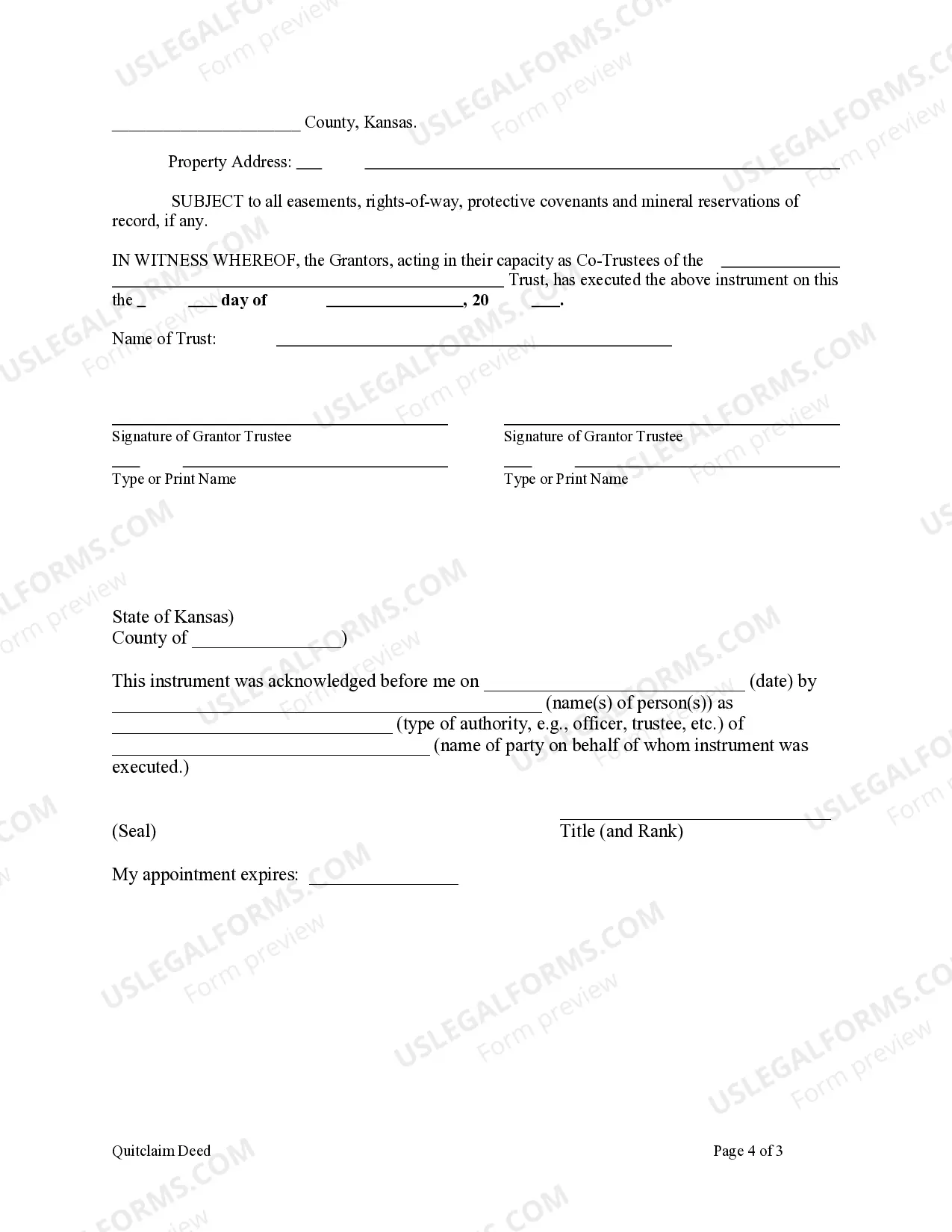
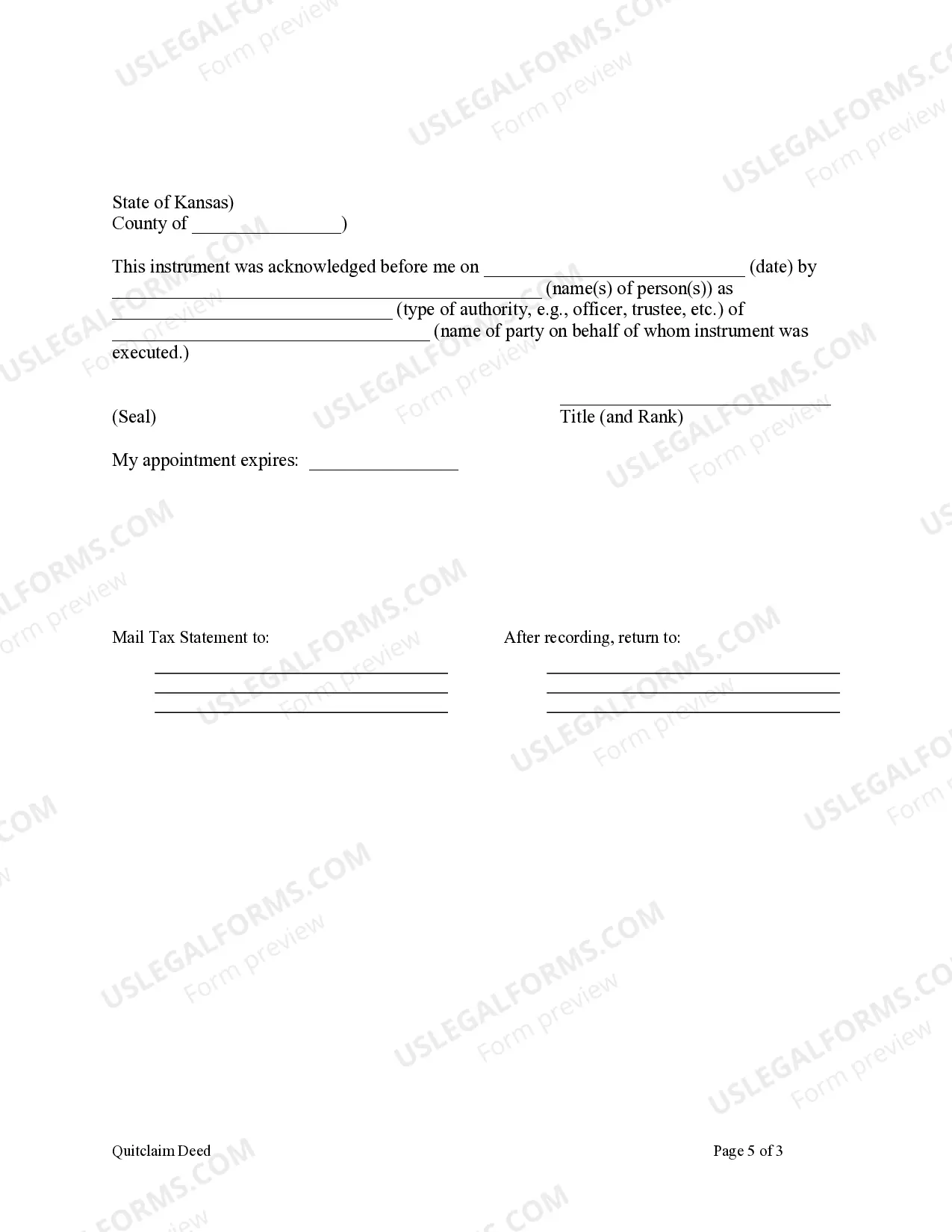
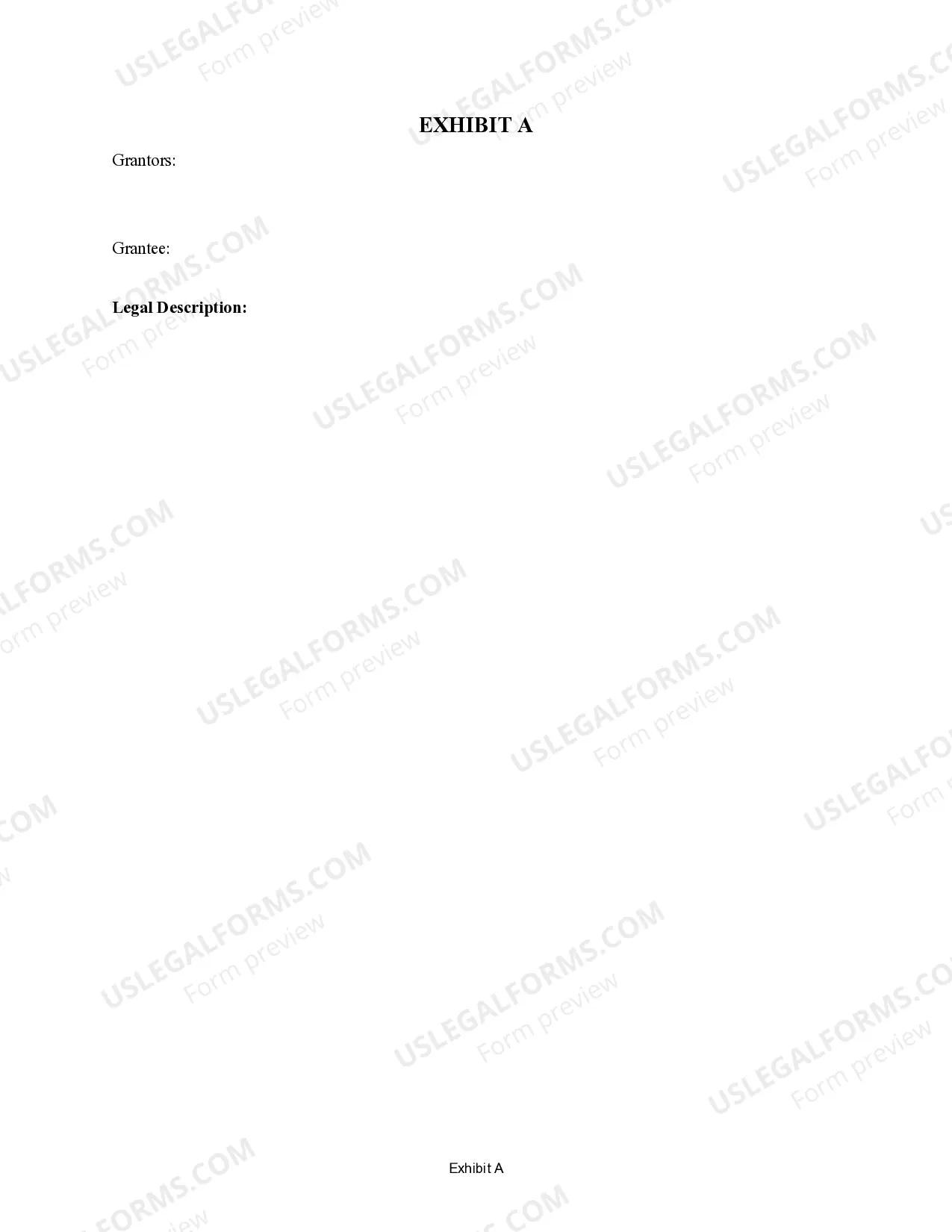
- Names of the grantors (the co-trustees) and the grantee (the LLC).
- Description of the property being transferred.
- Statement of the intent to convey property through a quitclaim deed.
- Dates of execution by the grantors.
- Signatures of the grantors to validate the deed.




Situations where this form applies
This quitclaim deed is commonly used when two co-trustees decide to transfer property held in trust to an LLC. It may be necessary during the reallocation of assets, for estate planning purposes, or when simplifying the management of a property by placing it in an LLC for liability protection and tax benefits.
Who needs this form
The following individuals or entities may benefit from using this form:
- Co-trustees managing a trust that holds real estate.
- Members of an LLC that require property ownership transferred from a trust.
- Individuals seeking to simplify property management under an LLC structure.
Steps to complete this form
- Identify the grantors by entering the names of the two co-trustees.
- Specify the name of the grantee, which in this case is the LLC.
- Provide a detailed description of the property being transferred.
- Enter the date on which the deed is being executed.
- Have both co-trustees sign the document in the designated areas.
Is notarization required?
This form does not typically require notarization unless specified by local law. However, it is advisable to check the specific requirements in your state for added legal assurance.
Get your form ready online
Our built-in tools help you complete, sign, share, and store your documents in one place.
Make edits, fill in missing information, and update formatting in US Legal Forms—just like you would in MS Word.
Download a copy, print it, send it by email, or mail it via USPS—whatever works best for your next step.
Sign and collect signatures with our SignNow integration. Send to multiple recipients, set reminders, and more. Go Premium to unlock E-Sign.
If this form requires notarization, complete it online through a secure video call—no need to meet a notary in person or wait for an appointment.
We protect your documents and personal data by following strict security and privacy standards.

Make edits, fill in missing information, and update formatting in US Legal Forms—just like you would in MS Word.

Download a copy, print it, send it by email, or mail it via USPS—whatever works best for your next step.

Sign and collect signatures with our SignNow integration. Send to multiple recipients, set reminders, and more. Go Premium to unlock E-Sign.

If this form requires notarization, complete it online through a secure video call—no need to meet a notary in person or wait for an appointment.

We protect your documents and personal data by following strict security and privacy standards.
Avoid these common issues
- Failing to include a complete and accurate property description.
- Not having both co-trustees sign the deed.
- Using an incorrect name for the LLC or failing to verify its formation.
Benefits of using this form online
- Convenient access to the form at any time, allowing you to complete it at your own pace.
- Editability ensures that all necessary details can be accurately filled in before printing.
- Reliable format that meets legal standards, minimizing the risk of errors.
Looking for another form?
Form popularity
FAQ
Yes, a quit claim deed supercedes the trust. The only thing that can be done is to file a suit in court challenging the deed as the product of fraud and undue influence. A court action like that will cost thousands of dollars, but might be worth it if the house was owned free and clear.
Recording A quitclaim deed must be filed with the County Recorder's Office where the real estate is located. Go to your County Website to locate the office nearest you. Signing (§ 58-2205) A quitclaim deed is required to be authorized with a notary public present.
A quitclaim deed can be used to transfer property from a trust, but a Special Warranty Deed seems to be a more common way to do this.
In the context of a California mortgage transaction, a trust deed also transfer ownership. Only this time, the title is being placed in the hands of a third-party trustee, who holds the property on behalf of the lender and the homeowner-borrower until the mortgage is paid.
When you're ready to transfer trust real estate to the beneficiary who is named in the trust document to receive it, you'll need to prepare, sign, and record a deed. That's the document that transfers title to the property from you, the trustee, to the new owner.
California Property TaxesTransferring real property to yourself as trustee of your own revocable living trust -- or back to yourself -- does not trigger a reassessment for property tax purposes. (Cal. Rev. & Tax Code § 62(d).)
In order to transfer ownership of the marital home pursuant to a divorce, one spouse is going to need to sign a quitclaim deed, interspousal transfer deed, or a grant deed, in order to convey the title to the property.
It is also crucial that a spouse know about the loan, even if he or she is not on the mortgage. In general, the spouse must sign a deed of trust, the Truth in Lending and Right to Cancel documents. By signing these documents, they are simply acknowledging the existence of the mortgage.
A person who signs a quitclaim deed to transfer property they do not own results in no title at all being transferred since there is no actual ownership interest. The quitclaim deed only transfers the type of title you own.