Kansas Lien Statement by Contractor as Individual
What is this form?
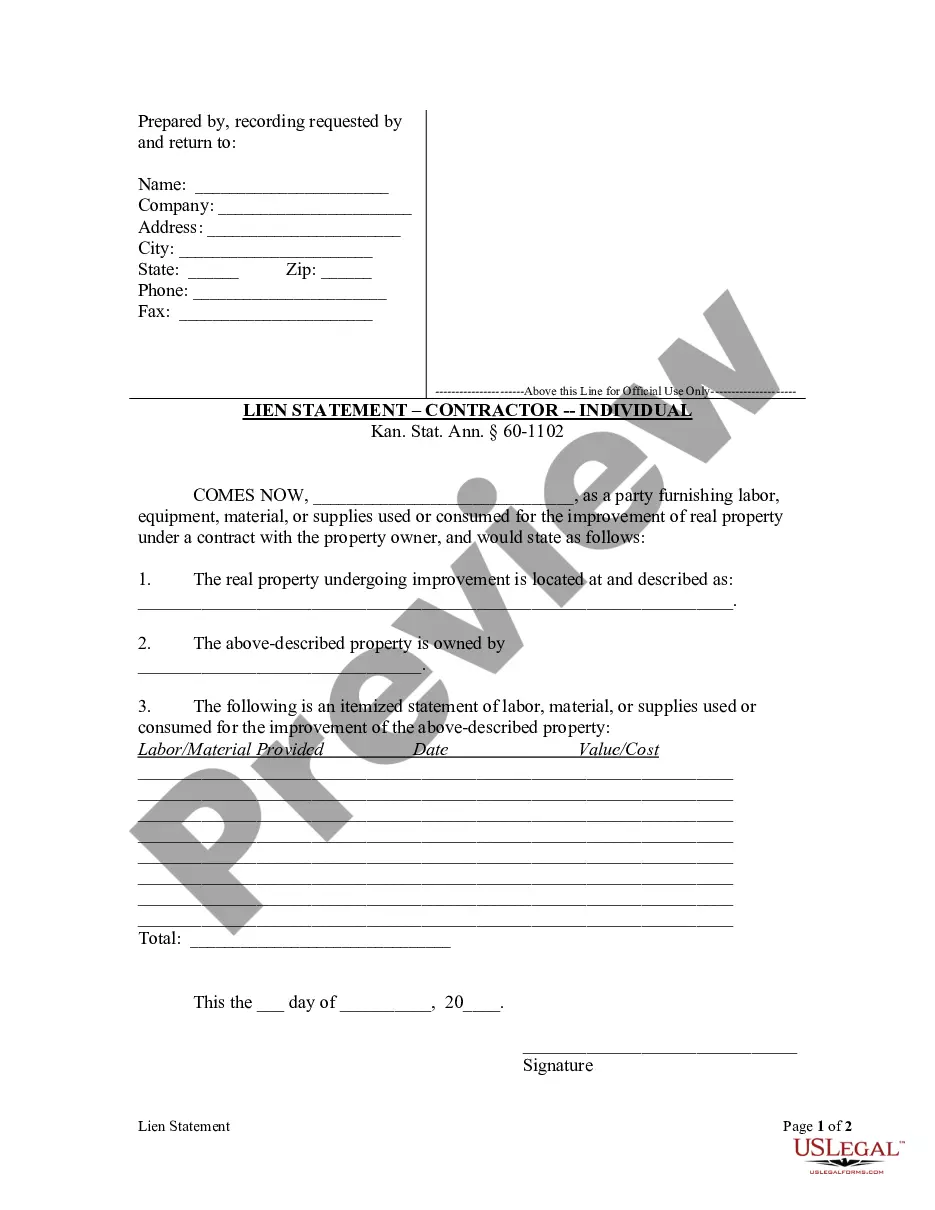
The Lien Statement by Contractor as Individual is a legal document used in Kansas that allows contractors to file a lien against a property for unpaid labor or materials provided. This form specifically distinguishes the filing process for contractors, which differs from that of subcontractors. By submitting this lien statement, contractors inform property owners of their claim, which can be crucial in ensuring payment for work completed.
What’s included in this form
- Name and contact information of the contractor
- Description of the property undergoing improvement
- Name of the property owner
- Itemized statement of labor, materials, or supplies provided
- Total value of the services or materials supplied
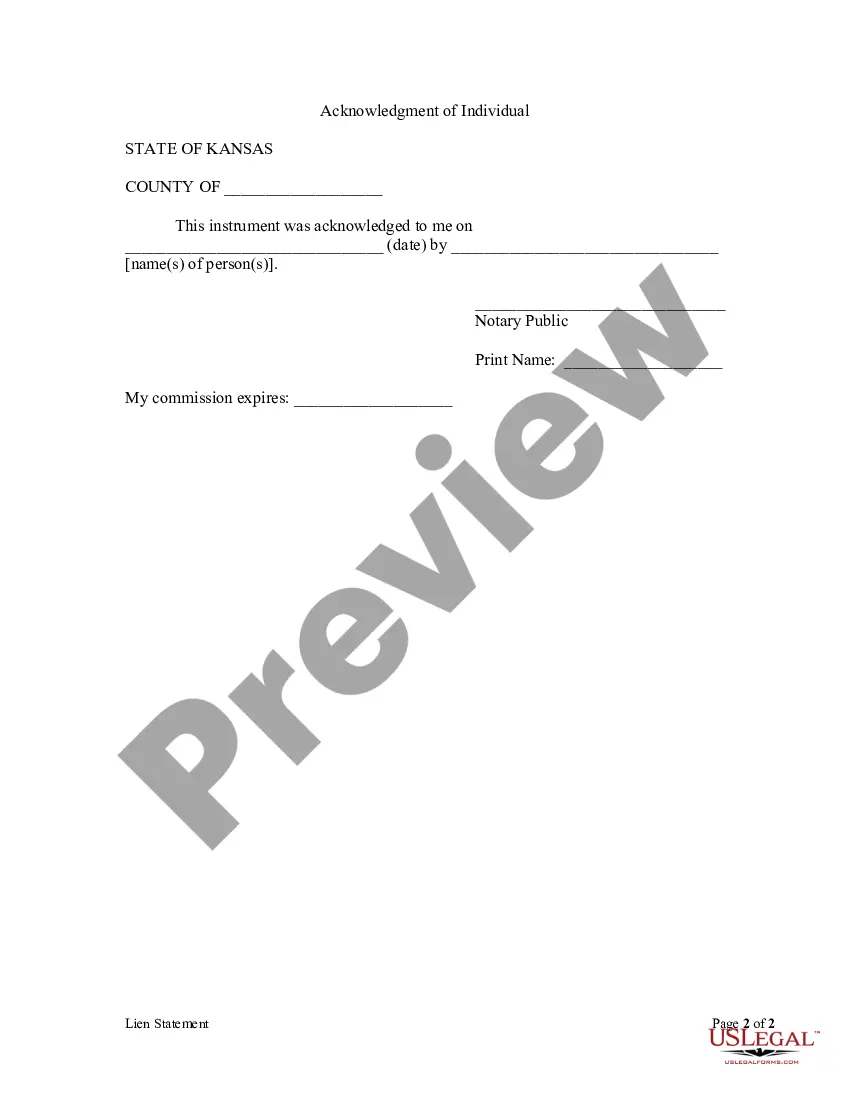
- Signature and notarization section
When to use this document
This form should be used when a contractor needs to assert a lien against a property for work completed or materials supplied that remain unpaid. It must be filed within four months of the last date labor was performed or materials were provided to ensure the contractor's claim is legally enforceable.
Who this form is for
- Individual contractors working directly for property owners
- Contractors who have provided labor or materials for property improvements
- Any contractor wishing to secure payment through a legal lien
Steps to complete this form
- Enter your name, company details, and contact information at the top of the form.
- Provide the legal description and address of the property being improved.
- List the property owner's name accurately.
- Itemize the labor, materials, or supplies provided along with the corresponding dates and costs.
- Sign the form and ensure it is notarized to confirm its authenticity.
Is notarization required?
Yes, this form must be notarized to be legally valid. Notarization helps ensure the authenticity of the signature, which is vital in legal procedures. US Legal Forms provides integrated online notarization services, allowing you to complete the process securely via video call, 24/7.
Get your form ready online
Our built-in tools help you complete, sign, share, and store your documents in one place.
Make edits, fill in missing information, and update formatting in US Legal Forms—just like you would in MS Word.
Download a copy, print it, send it by email, or mail it via USPS—whatever works best for your next step.
Sign and collect signatures with our SignNow integration. Send to multiple recipients, set reminders, and more. Go Premium to unlock E-Sign.
If this form requires notarization, complete it online through a secure video call—no need to meet a notary in person or wait for an appointment.
We protect your documents and personal data by following strict security and privacy standards.

Make edits, fill in missing information, and update formatting in US Legal Forms—just like you would in MS Word.

Download a copy, print it, send it by email, or mail it via USPS—whatever works best for your next step.

Sign and collect signatures with our SignNow integration. Send to multiple recipients, set reminders, and more. Go Premium to unlock E-Sign.

If this form requires notarization, complete it online through a secure video call—no need to meet a notary in person or wait for an appointment.

We protect your documents and personal data by following strict security and privacy standards.
Common mistakes
- Failing to file the lien statement within the four-month timeframe.
- Providing incorrect or incomplete property descriptions.
- Not properly itemizing the services or materials provided.
- Forgetting to sign the document or have it notarized.
Why use this form online
- Convenient access to downloadable templates that can be filled out at your own pace.
- Easy customization to fit your specific project and payment details.
- Reliable resources drafted by licensed attorneys to ensure legal compliance.
Main things to remember
- The form is essential for contractors seeking payment for unpaid work.
- It must be filed within four months of the last labor or materials supplied.
- Accurate completion and notarization of the form are crucial for legal enforceability.
Looking for another form?
Form popularity
FAQ
A contractual lien is essentially a contract that gives a security interest in property to one of the parties involved. One example would be a mortgage. Some commentators insist that a "contractual lien" should not be called a lien at all, because a "true" lien should arise without the consent of the property owner.
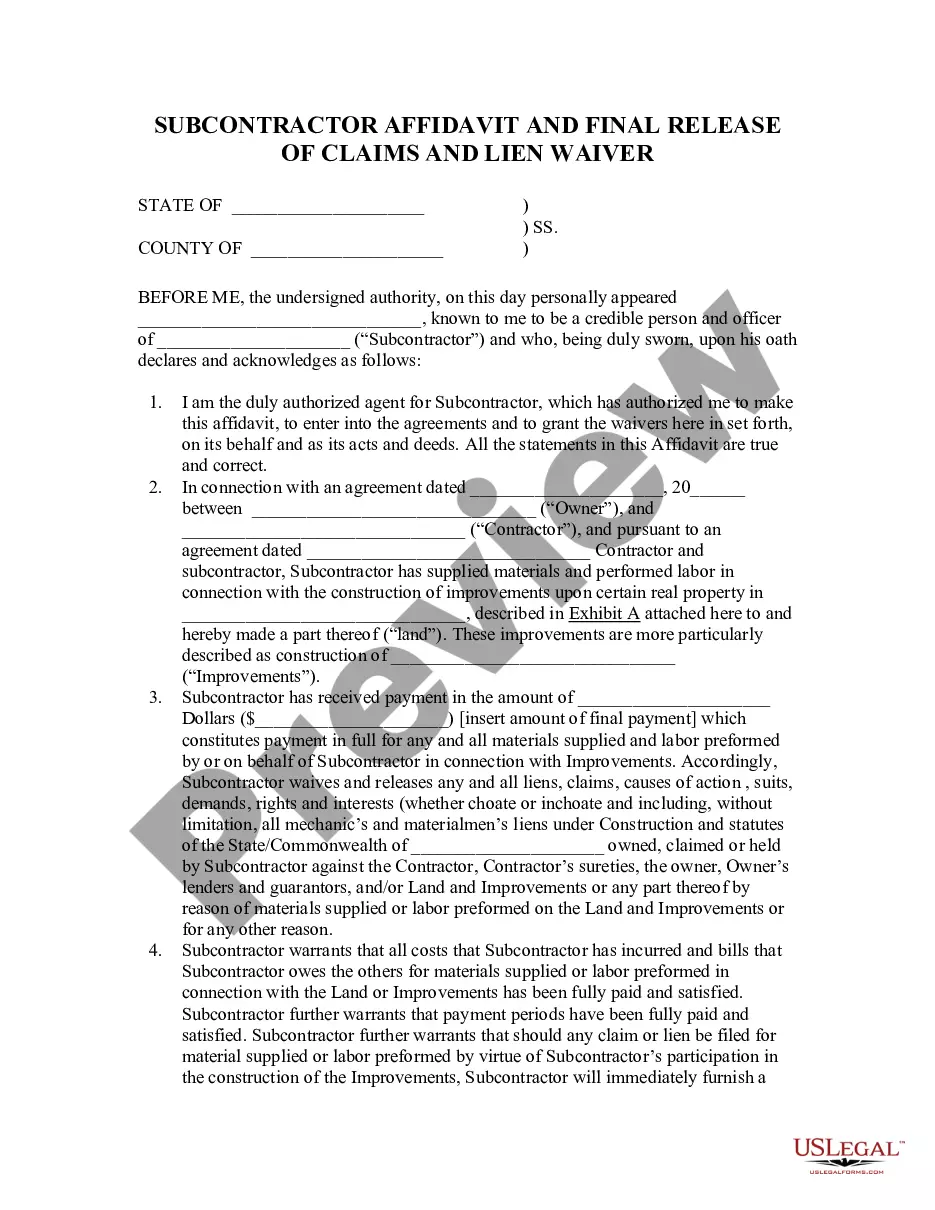
Steps to avoid a lien Before making any partial or final payment to your contractor, ask for a Release of Lien and Affidavit (or Partial Release of Lien and Affidavit). These will either indicate that the contractor has paid all laborers or list out who is still owed money and how much.
A contractor's lien (often known as a mechanic's lien, or a construction lien) is a claim made by contractors or subcontractors who have performed work on a property, and have not yet been paid.After all, contractors would rather work out a deal than go through the hassle of filing a lien against your property.
Arranging Progress Payments Is Wise. Most contractors ask, in negotiating the contract for work, for some amount of money up front. Talk to the Homeowners About the Balance Due. File a Lien. Sue for Breach of Contract.
A contractor's lien (often known as a mechanic's lien, or a construction lien) is a claim made by contractors or subcontractors who have performed work on a property, and have not yet been paid.After all, contractors would rather work out a deal than go through the hassle of filing a lien against your property.
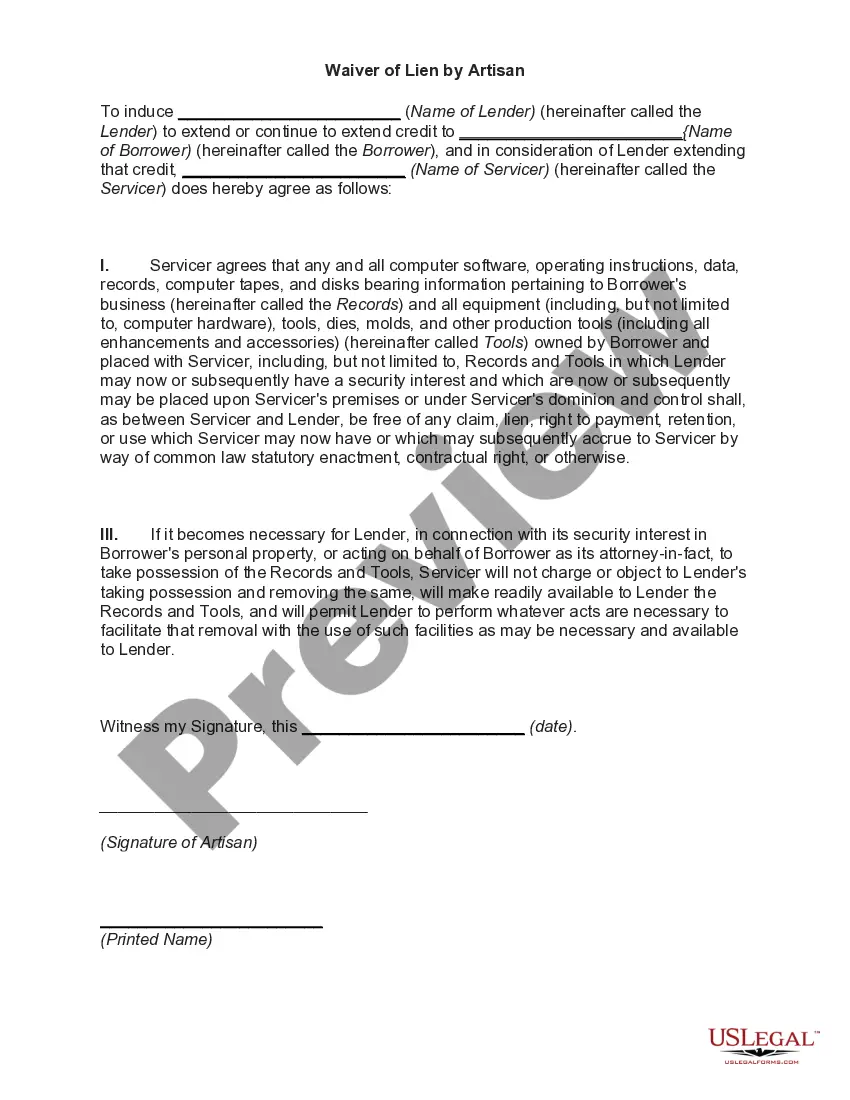
The most common way to reduce or even eliminate mechanic's lien risk is through the use of lien waivers. A lien waiver is a private agreement in which a party surrenders the right to file a lien in exchange for payment.
Negotiate with the contractor who placed the lien (the "lienor" to remove it. Obtain a lien bond to discharge the lien, or. File a lawsuit to vacate the lien.
Anyone who makes or causes to make improvements by providing work or materials in Alberta for an owner, contractor or subcontractor may file an Alberta Builders Lien.