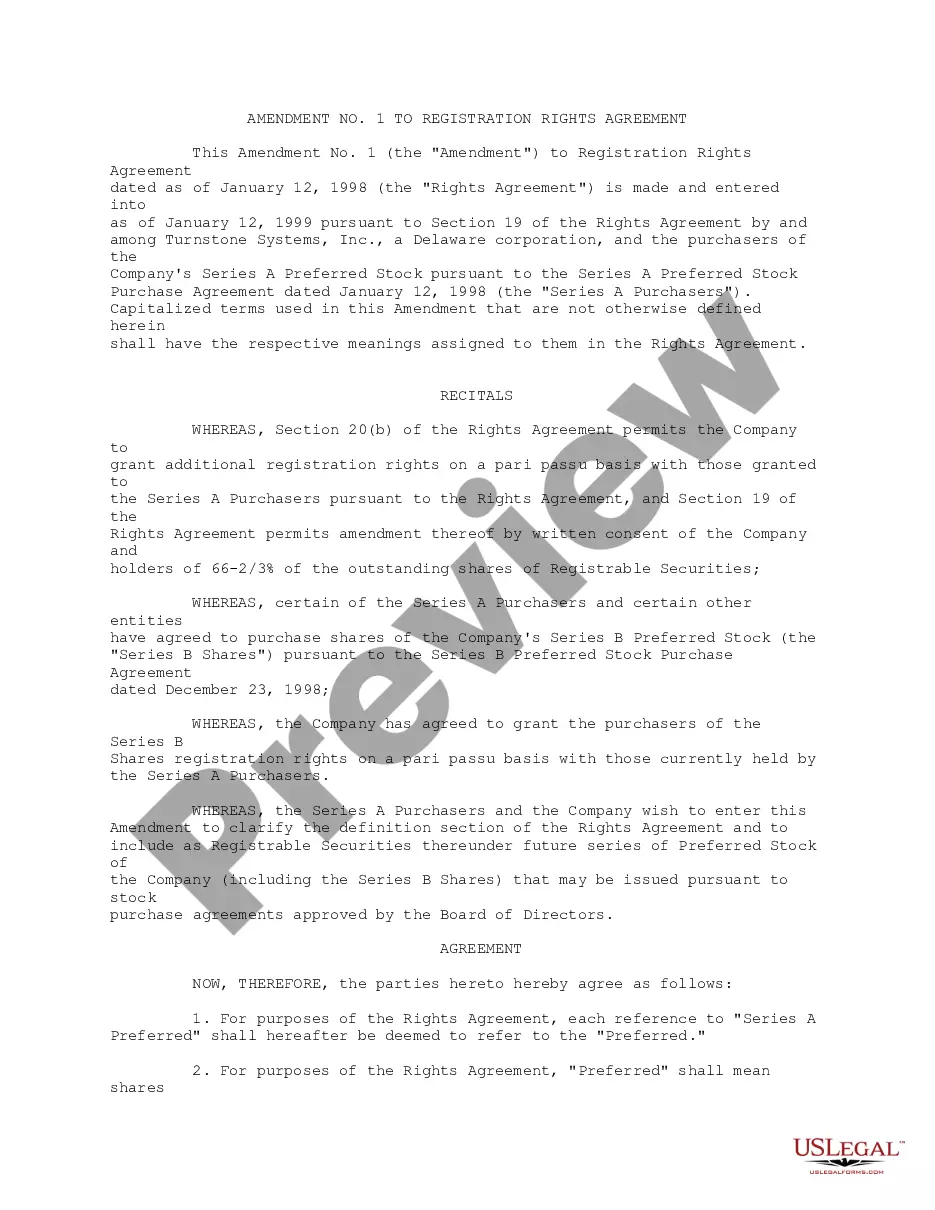
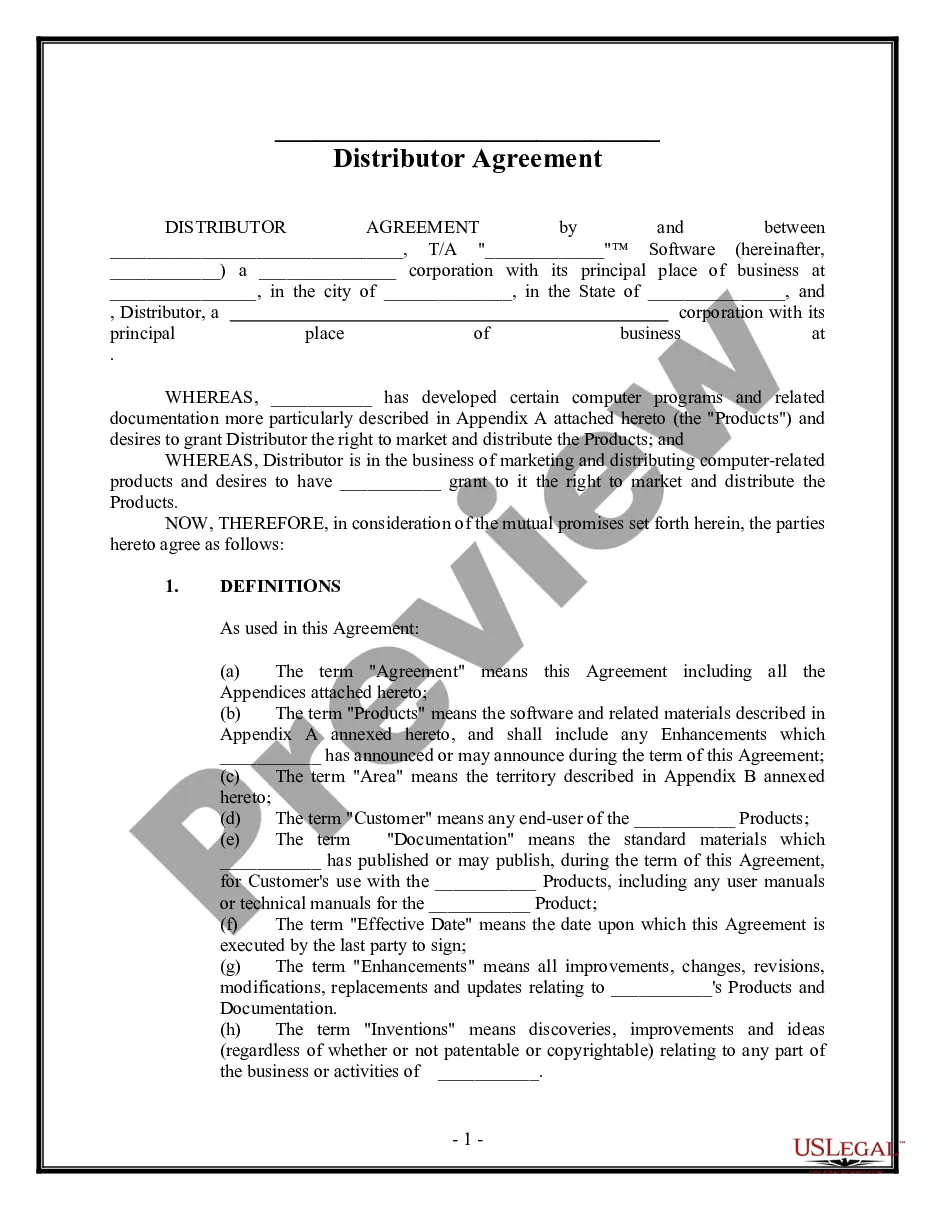
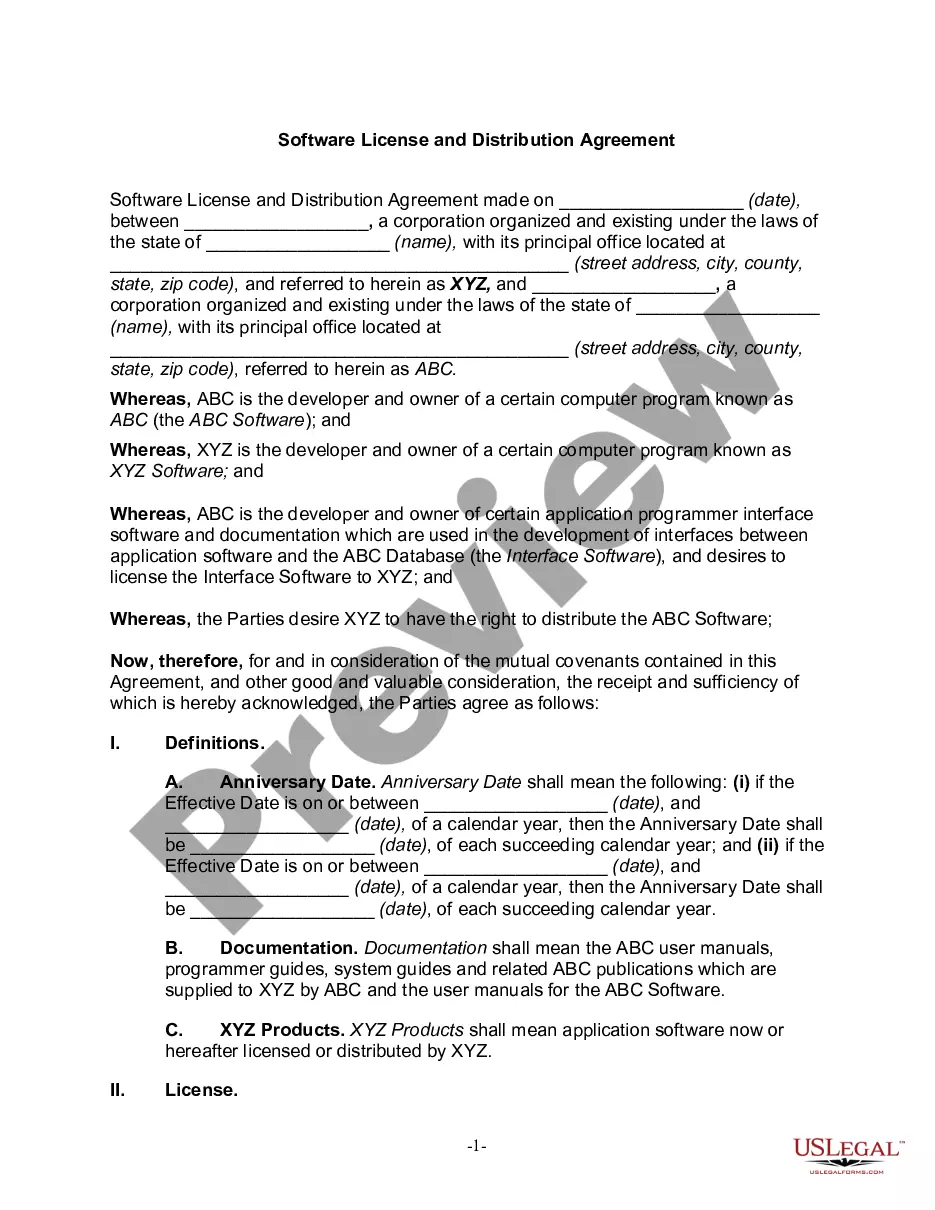
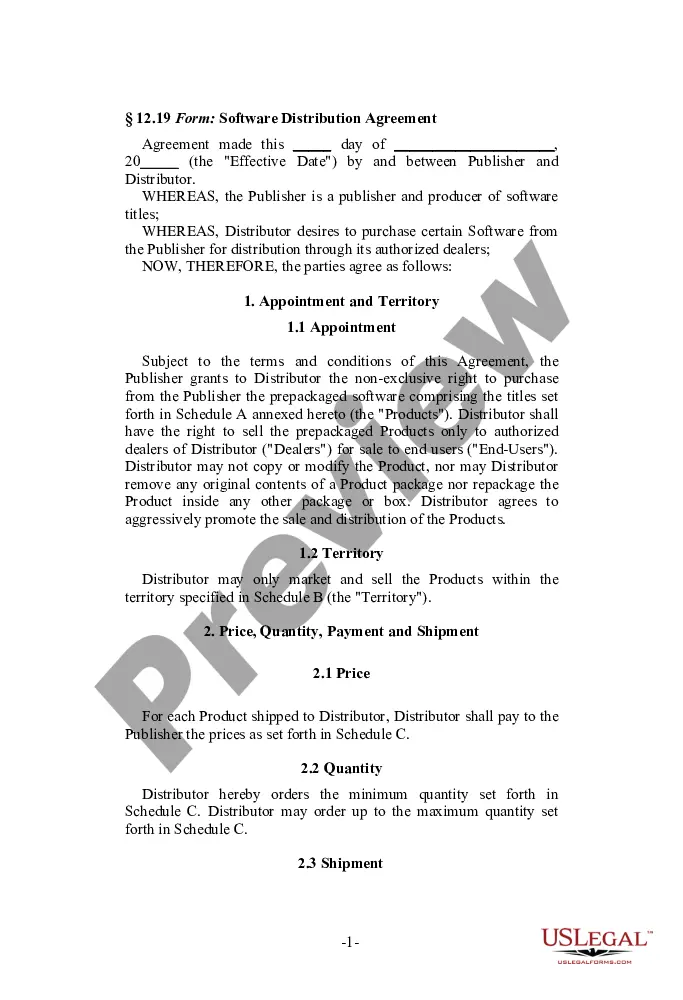
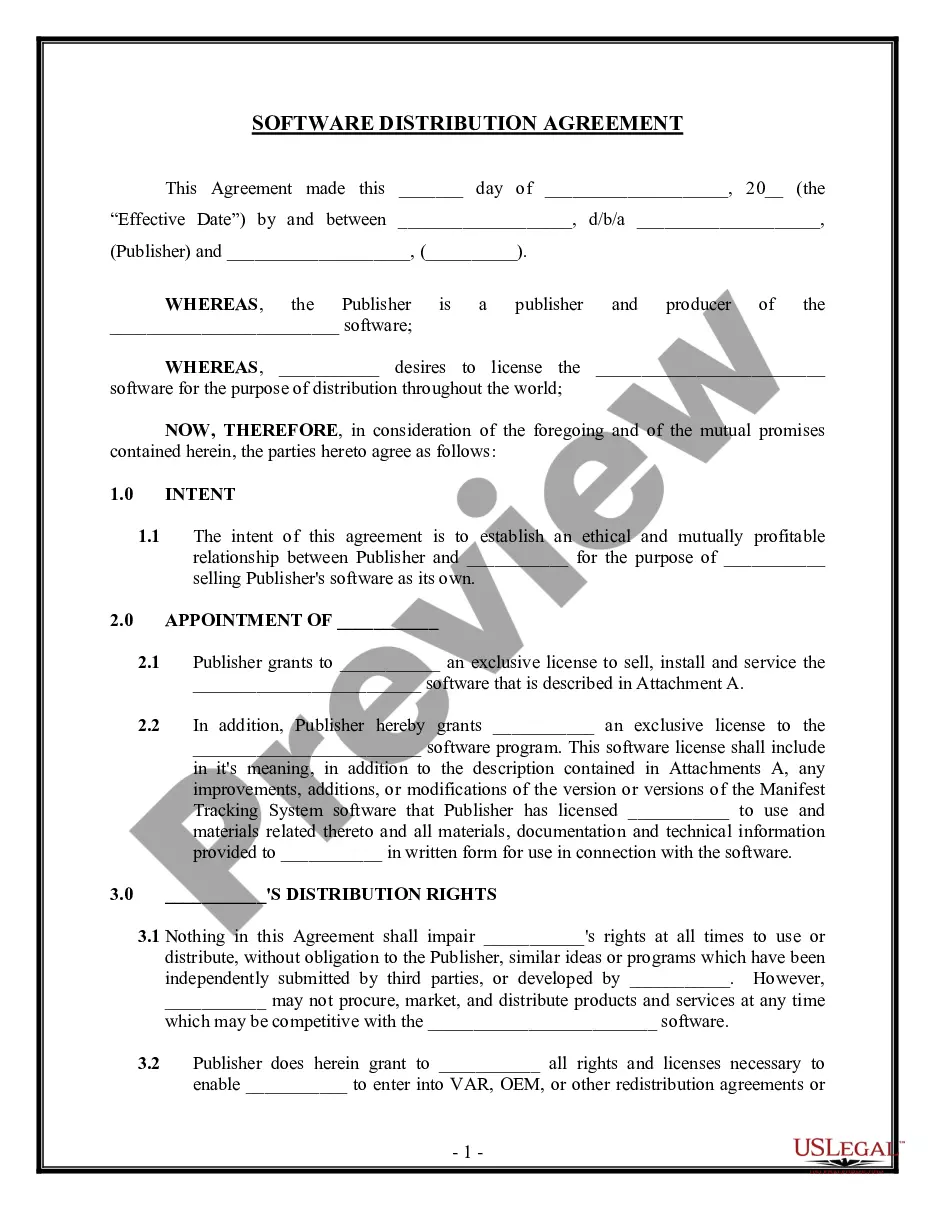
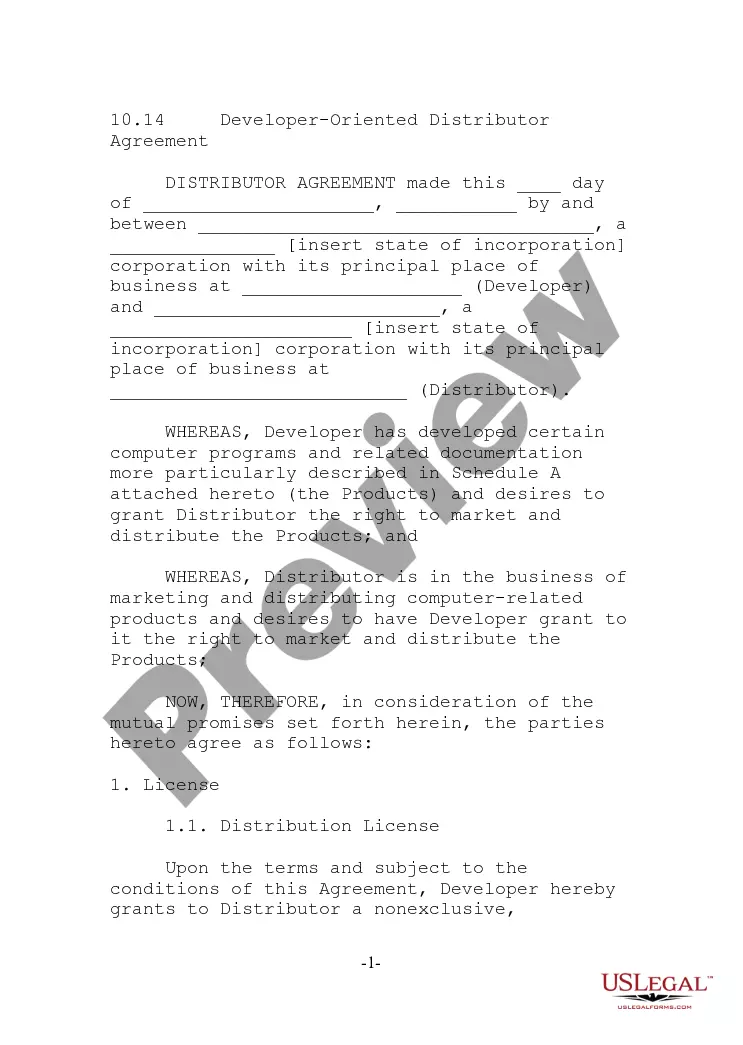
This form is a Distributor Agreement. This is an agreement between a developer of a computer program and a distribution company to market and distribute the computer program. The distributor acknowledges that the territory is the area of its principal responsibility and agrees to use its best efforts to promote the sale of the developer's product.
Indiana Distributor Agreement for Software
Category:
State:
Multi-State
Control #:
US-KWP-0042
Format:
Word;
Rich Text
Instant download
Description
Free preview


Get your form ready online
Our built-in tools help you complete, sign, share, and store your documents in one place.
Built-in online Word editor
Make edits, fill in missing information, and update formatting in US Legal Forms—just like you would in MS Word.
Export easily
Download a copy, print it, send it by email, or mail it via USPS—whatever works best for your next step.
E-sign your document
Sign and collect signatures with our SignNow integration. Send to multiple recipients, set reminders, and more. Go Premium to unlock E-Sign.
Notarize online 24/7
If this form requires notarization, complete it online through a secure video call—no need to meet a notary in person or wait for an appointment.
Store your document securely
We protect your documents and personal data by following strict security and privacy standards.

Make edits, fill in missing information, and update formatting in US Legal Forms—just like you would in MS Word.

Download a copy, print it, send it by email, or mail it via USPS—whatever works best for your next step.

Sign and collect signatures with our SignNow integration. Send to multiple recipients, set reminders, and more. Go Premium to unlock E-Sign.

If this form requires notarization, complete it online through a secure video call—no need to meet a notary in person or wait for an appointment.

We protect your documents and personal data by following strict security and privacy standards.
Looking for another form?




How to fill out Distributor Agreement For Software?
If you need to total, download, or print out authorized document templates, utilize US Legal Forms, the largest collection of legal forms available online.
Take advantage of the site’s straightforward and convenient search function to locate the documents you require.
Various templates for business and personal purposes are categorized by type and state, or by keywords.
Step 4. Once the desired form is located, click the Get now button. Choose your preferred pricing plan and enter your credentials to register for an account.
Step 5. Complete the purchase process. You can use your Visa, Mastercard, or PayPal account to finalize the transaction.
- Use US Legal Forms to find the Indiana Distributor Agreement for Software with just a few clicks.
- If you are an existing US Legal Forms customer, Log In to your account and click the Obtain button to retrieve the Indiana Distributor Agreement for Software.
- You can also access forms you have previously acquired in the My documents tab of your account.
- If this is your first time using US Legal Forms, follow the steps outlined below.
- Step 1. Ensure you have selected the form for the correct city/state.
- Step 2. Use the Review option to examine the form’s details. Remember to read the description.
- Step 3. If you are not satisfied with the form, utilize the Lookup field at the top of the screen to find alternative versions of the legal form template.
Form popularity
FAQ
While Indiana does not legally require an operating agreement for LLCs, having one is highly recommended for clarity and structure. An operating agreement sets forth the management and operational guidelines for your LLC, providing both members and potential investors with a clear understanding of roles and responsibilities. Using US Legal Forms, you can easily create an appropriate operating agreement to complement your Indiana Distributor Agreement for Software.
Software distribution refers to the process of delivering software products to customers through various channels. An Indiana Distributor Agreement for Software enables distributors to access valuable resources and marketing tools which facilitate this process. This agreement also establishes the legal framework necessary for distributing the software effectively, ensuring both compliance and efficient reach to the market.
The purpose of an Indiana Distributor Agreement for Software is to outline the terms and conditions under which a distributor can sell and promote software products. This agreement helps protect both the manufacturer and the distributor by clearly defining rights, responsibilities, and compensation arrangements. By having this agreement in place, parties can reduce misunderstandings, thus fostering a smooth business relationship.
A distributorship is a business arrangement where a distributor sells products manufactured by another company. For example, a company distributing software to various retailers is a distributorship. Having an Indiana Distributor Agreement for Software in place simplifies the relationship, clearly establishing terms and expectations for both parties.
A license agreement for software installation is a legal contract that grants users the right to use the software under specified conditions. This agreement often includes limitations on usage, redistribution rights, and the duration of the license. Understanding the terms of an Indiana Distributor Agreement for Software can help ensure compliance with these legal requirements.
To write a simple agreement, start by clearly defining the parties involved and the purpose of the agreement. Include key terms such as payment details, delivery timelines, and dispute resolution methods. Using an Indiana Distributor Agreement for Software template can provide a solid foundation, ensuring you cover all necessary aspects without missing critical details.
Exclusive dealing or requirements contracts between manufacturers and retailers are common and are generally lawful.
Six Rules for Negotiating a Better Distribution AgreementBalance. Balance in a distribution agreement ensures that neither party holds unfair power over the other.Due Diligence.Annual Termination and Semiautomatic Renewal.Comparison with Proven Industry Agreements.Four Eyes versus Two Eyes.Cause and Convenience.
A distribution agreement, also known as a distributor agreement, is a contract between a supplying company with products to sell and another company that markets and sells the products. The distributor agrees to buy products from the supplier company and sell them to clients within certain geographical areas.
Below is a basic distribution agreement checklist to help you get started:Names and addresses of both parties.Sale terms and conditions.Contract effective dates.Marketing and intellectual property rights.Defects and returns provisions.Severance terms.Returned goods credits and costs.Exclusivity from competing products.More items...