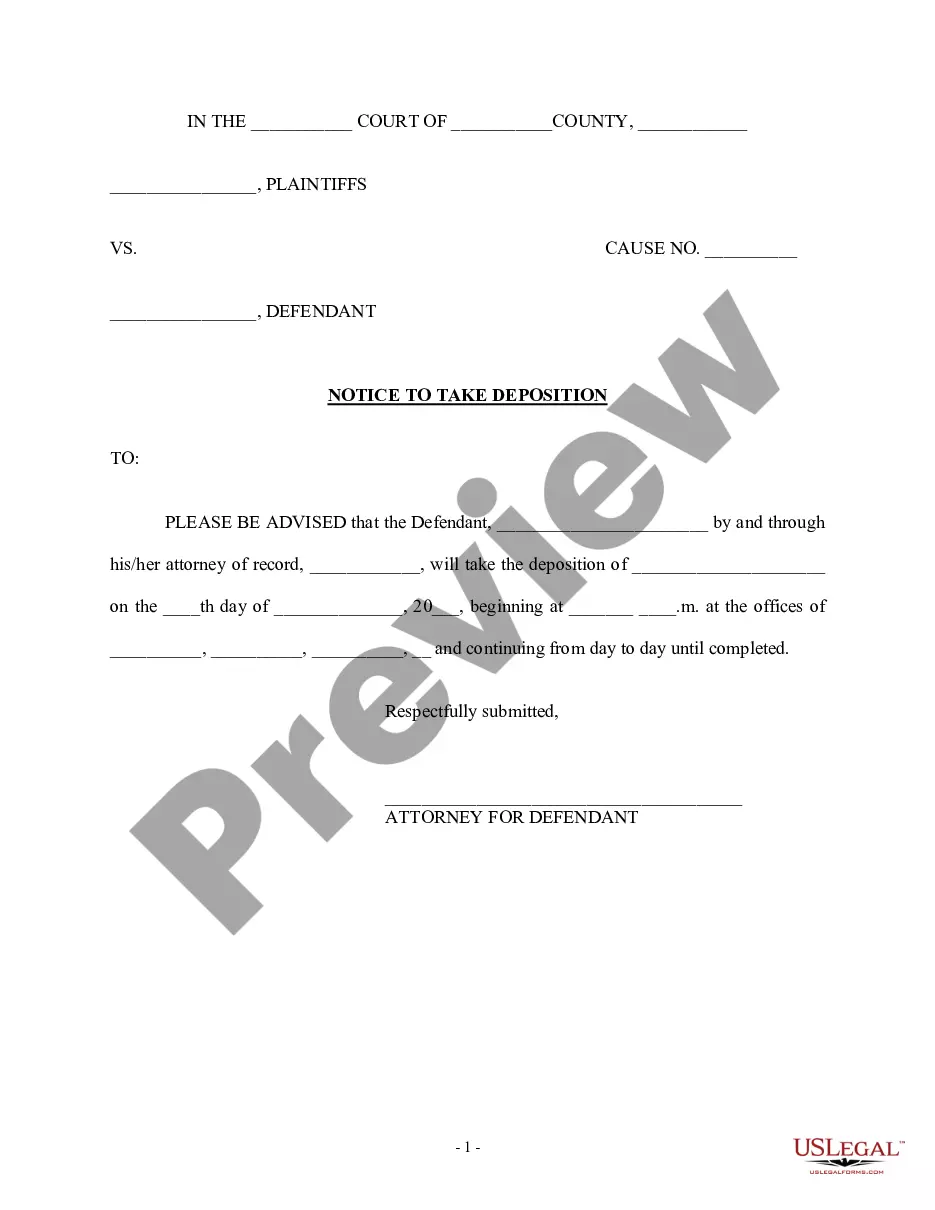
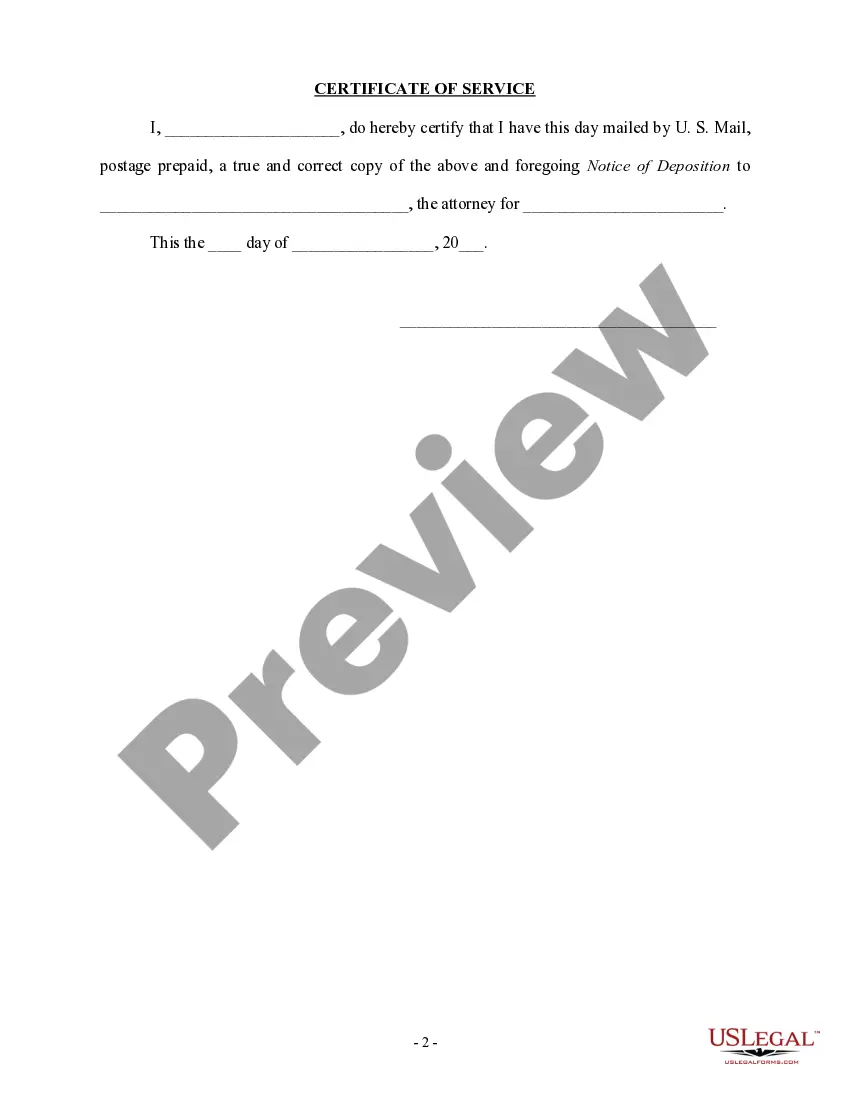
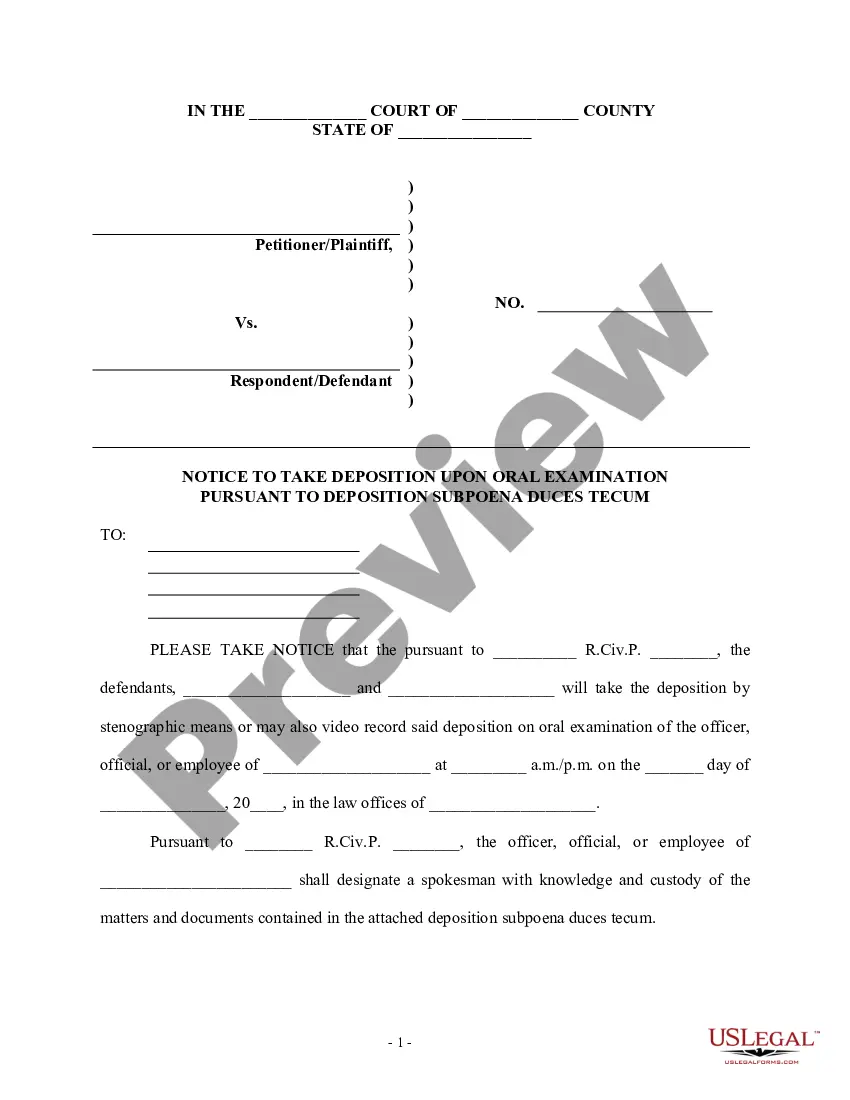
Defendant submits his/her notice to take depositions from day to day until completed. The form also contains a Certificate of Service which states that a true and correct copy of the Notice to Take Deposition was mailed via U.S. Mail and
Indiana Notice to Take Deposition - Discovery
State:
Multi-State
Control #:
US-00904
Format:
Word;
Rich Text
191 downloads
Description
Free preview
Get your form ready online
Our built-in tools help you complete, sign, share, and store your documents in one place.
Built-in online Word editor
Make edits, fill in missing information, and update formatting in US Legal Forms—just like you would in MS Word.
Export easily
Download a copy, print it, send it by email, or mail it via USPS—whatever works best for your next step.
E-sign your document
Sign and collect signatures with our SignNow integration. Send to multiple recipients, set reminders, and more. Go Premium to unlock E-Sign.
Notarize online 24/7
If this form requires notarization, complete it online through a secure video call—no need to meet a notary in person or wait for an appointment.
Store your document securely
We protect your documents and personal data by following strict security and privacy standards.

Make edits, fill in missing information, and update formatting in US Legal Forms—just like you would in MS Word.

Download a copy, print it, send it by email, or mail it via USPS—whatever works best for your next step.

Sign and collect signatures with our SignNow integration. Send to multiple recipients, set reminders, and more. Go Premium to unlock E-Sign.

If this form requires notarization, complete it online through a secure video call—no need to meet a notary in person or wait for an appointment.

We protect your documents and personal data by following strict security and privacy standards.
Looking for another form?
How to fill out Notice To Take Deposition - Discovery?
Are you presently in a situation where you require documents for potential business or personal purposes almost every working day.
There are numerous legal document templates available online, but finding ones you can trust isn't simple.
US Legal Forms offers thousands of form templates, such as the Indiana Notice to Take Deposition - Discovery, which are created to comply with state and federal regulations.
If you locate the correct form, click Purchase now.
Select the pricing plan you prefer, complete the required information to create your account, and complete the transaction using your PayPal or credit card.
- If you are already acquainted with the US Legal Forms website and possess an account, simply Log In.
- Then, you can download the Indiana Notice to Take Deposition - Discovery template.
- If you do not have an account and wish to start using US Legal Forms, follow these steps.
- Obtain the form you need and ensure it is for the correct city/state.
- Utilize the Preview option to review the form.
- Check the description to confirm you have chosen the correct form.
- If the form isn’t what you’re seeking, use the Search box to find the form that fits your needs.
Form popularity
FAQ
Rule 37-Failure to Make or Cooperate in Discovery: Sanctions. (a) Motion for Order Compelling Disclosure or Discovery. A party, upon reasonable notice to other parties and all persons affected thereby, may apply for an order compelling disclosure or discovery as follows: (1) Appropriate Court.
One of the most common methods of discovery is to take depositions. A deposition is an out-of-court statement given under oath by any person involved in the case. It is to be used at trial or in preparation for trial.
We don't like Motions to Compel. Judges don't like them, and neither do the opposing parties we bring them against. But they are, sometimes, required to be brought in cases where you need information to make sure you know what facts, witnesses and documents are in a case prior to going to going to trial.
Rule 37 authorizes the court to direct that parties or attorneys who fail to participate in good faith in the discovery process pay the expenses, including attorney's fees, incurred by other parties as a result of that failure. Since attorneys' fees cannot ordinarily be awarded against the United States (28 U.S.C.
(A) If an arrestee does not present a substantial risk of flight or danger to themselves or others, the court should release the arrestee without money bail or surety subject to such restrictions and conditions as determined by the court except when: (1) The arrestee is charged with murder or treason.
Parties may obtain discovery regarding any matter, not privileged, which is relevant to the subject-matter involved in the pending action, whether it relates to the claim or defense of the party seeking discovery or the claim or defense of any other party, including the existence, description, nature, custody, ...
Rule 36 - Motion to Dismiss (A) Voluntary Dismissal. An appeal may be dismissed on motion of the appellant upon the terms agreed upon by all the parties on appeal or fixed by the Court. (B) Involuntary Dismissal.
When the mental or physical condition (including the blood group) of a party, or of a person in the custody or under the legal control of a party, is in controversy, the court in which the action is pending may order the party to submit to a physical or mental examination by a suitably licensed or certified examiner or ...