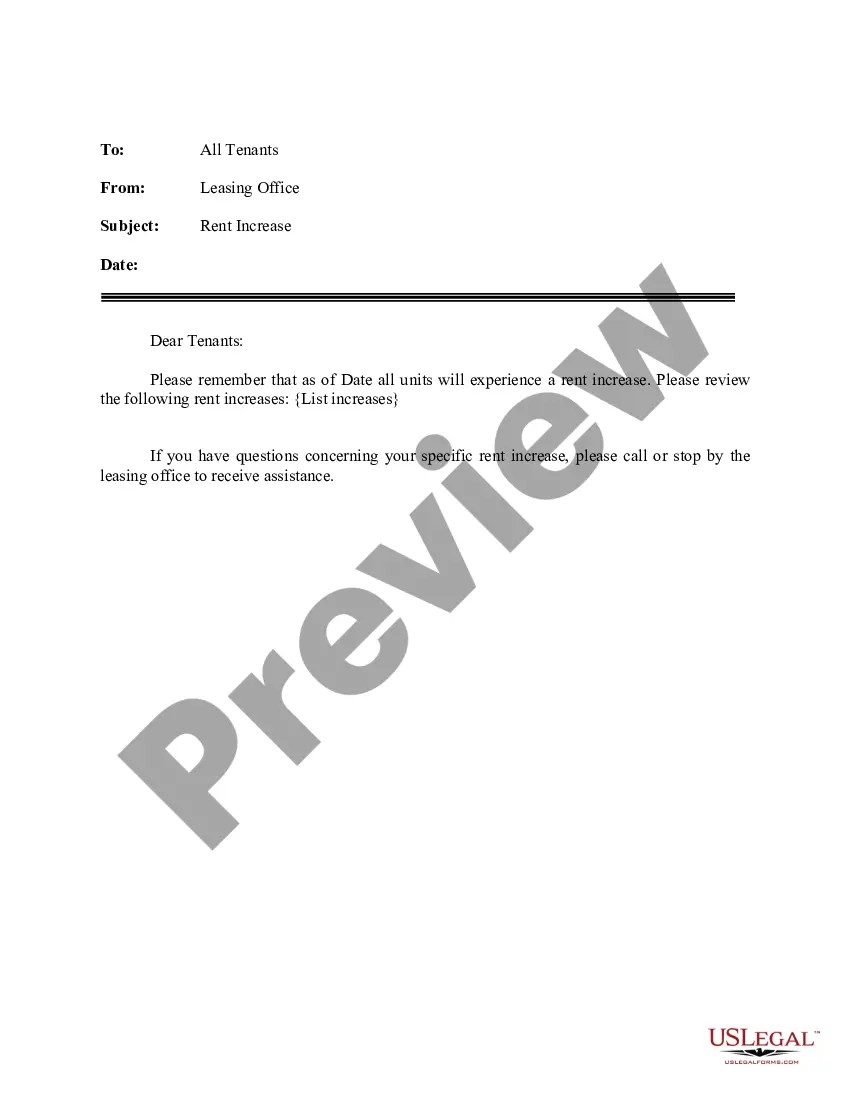
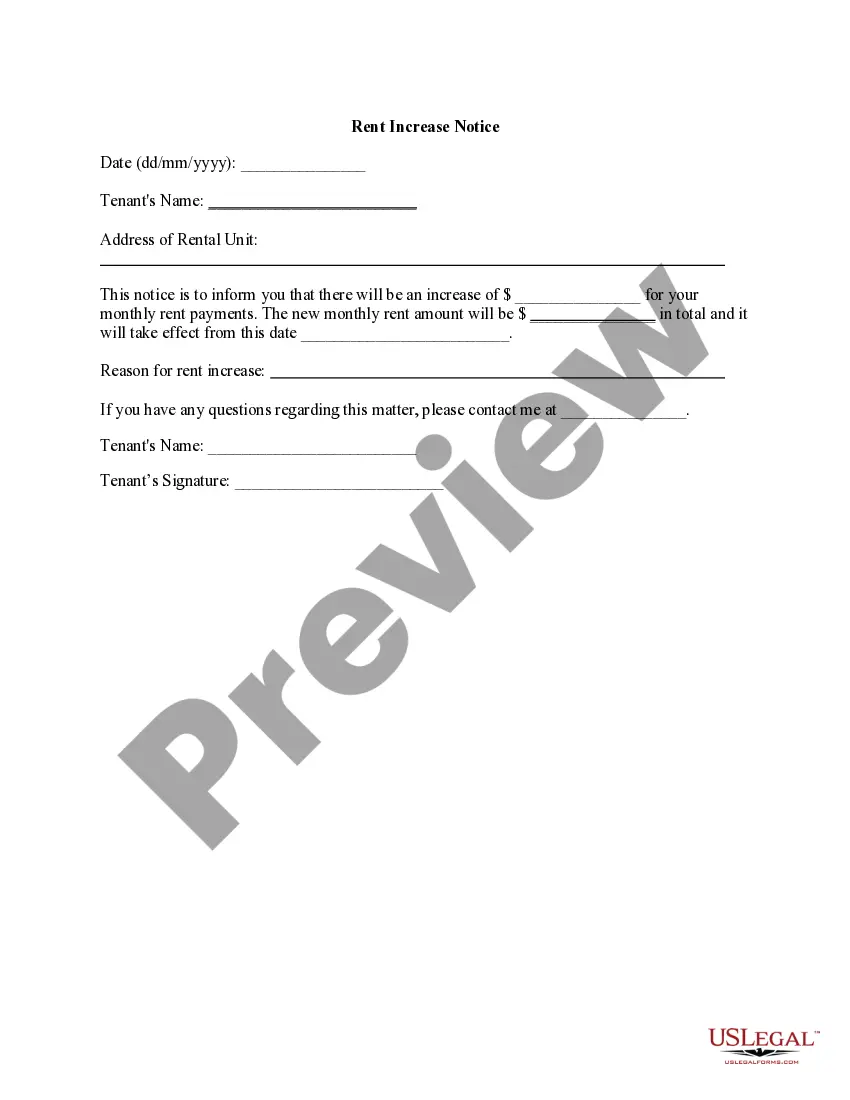
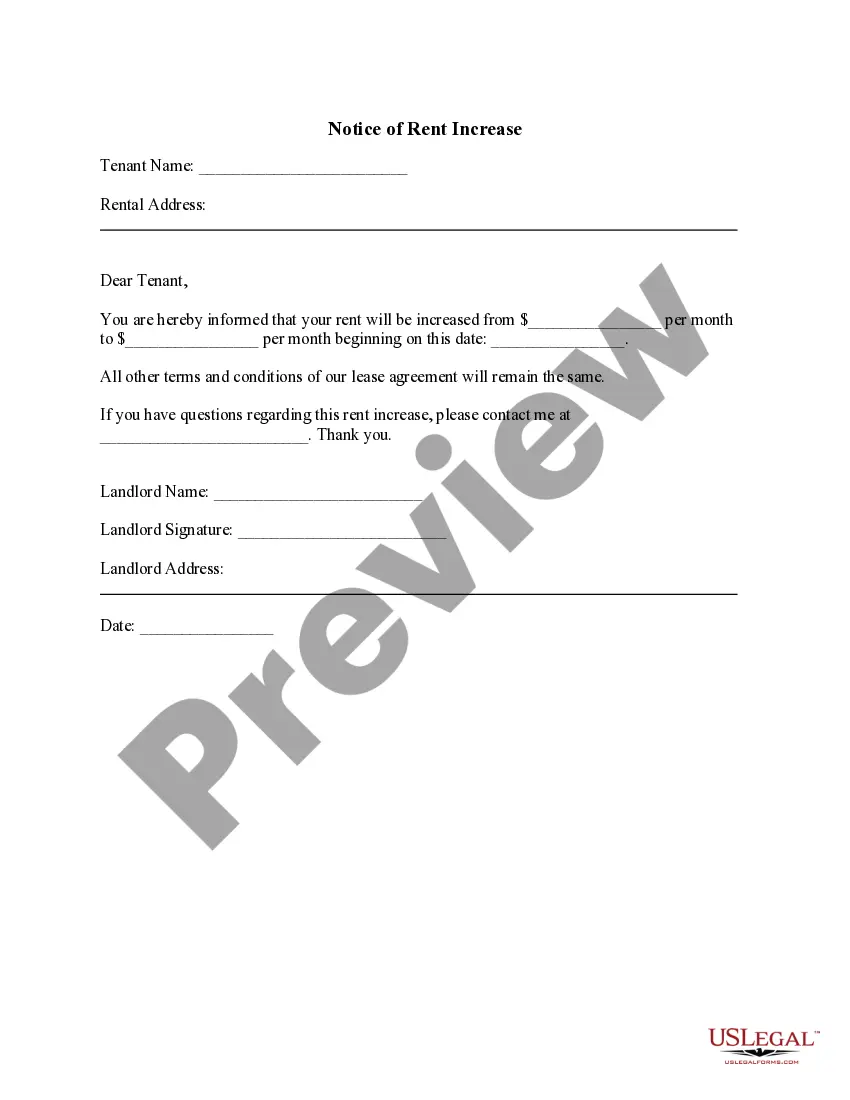
This is a letter to tenants regarding rent increase.
Illinois Letter - Notice To Tenants Announcing Rent Increase
State:
Multi-State
Control #:
US-1110LT
Format:
Word;
Rich Text
210 downloads
Description
Get your form ready online
Our built-in tools help you complete, sign, share, and store your documents in one place.
Built-in online Word editor
Make edits, fill in missing information, and update formatting in US Legal Forms—just like you would in MS Word.
Export easily
Download a copy, print it, send it by email, or mail it via USPS—whatever works best for your next step.
E-sign your document
Sign and collect signatures with our SignNow integration. Send to multiple recipients, set reminders, and more. Go Premium to unlock E-Sign.
Notarize online 24/7
If this form requires notarization, complete it online through a secure video call—no need to meet a notary in person or wait for an appointment.
Store your document securely
We protect your documents and personal data by following strict security and privacy standards.

Make edits, fill in missing information, and update formatting in US Legal Forms—just like you would in MS Word.

Download a copy, print it, send it by email, or mail it via USPS—whatever works best for your next step.

Sign and collect signatures with our SignNow integration. Send to multiple recipients, set reminders, and more. Go Premium to unlock E-Sign.

If this form requires notarization, complete it online through a secure video call—no need to meet a notary in person or wait for an appointment.

We protect your documents and personal data by following strict security and privacy standards.
Looking for another form?

How to fill out Letter - Notice To Tenants Announcing Rent Increase?
US Legal Forms - one of the largest collections of legal documents in the United States - provides a variety of legal document templates that you can download or print.
By using the website, you can find numerous forms for business and personal purposes, organized by categories, claims, or keywords.
You can access the latest versions of forms like the Illinois Letter - Notice To Tenants Announcing Rent Increase in just seconds.
Read the form's description to ensure you have selected the right one.
If the form does not suit your requirements, use the Search field at the top of the screen to find a suitable one.
- If you already have an account, Log In and download the Illinois Letter - Notice To Tenants Announcing Rent Increase from the US Legal Forms library.
- The Download button will appear on every form you view.
- You can find all previously downloaded forms in the My documents section of your account.
- If you are new to US Legal Forms, here are some simple steps to get started.
- Make sure you have selected the correct form for your city/state.
- Click the Review button to check the content of the form.
Form popularity
FAQ
If your tenant pays their rent monthly or weekly you must give at least one month's notice of a proposed rent increase. However, it is good practice to give them two months so they have more time to find another home if they feel the increase is too high.
With regards to notifying my tenants of the rent increase, I send them an email or letter two months before their contract ends, asking if they wish to stay for another year, whilst letting them know what the new rent will be. I also send out their new contract with the increased rent added.
If your tenant pays their rent monthly or weekly you must give at least one month's notice of a proposed rent increase. However, it is good practice to give them two months so they have more time to find another home if they feel the increase is too high.
Your landlord normally has to give you at least 4 weeks' notice in writing before a rent increase. But they do not have to consult you about proposed increases. 'Consult' means finding out what you think first.
Rent Increases In a week-to-week or month-to-month tenancy, the landlord can raise your rent by any amount if he/she gives you seven days' notice for a week-to-week lease or 30 days' notice for a month-to-month lease. Your landlord cannot raise your rent if you have a fixed-term lease.
What to include in a rent increase letterDate of the rent increase letter.Name and information of the tenant and landlord.Property address and unit number (if applicable).Reference the expiration date of the existing lease.Current rent amount.Amount of rent increase.Date the rent increase will go into effect.More items...
A landlord must always provide a tenant with enough notice before any increase in rent. A minimum of one month's notice must be given if you pay rent weekly or monthly. For a yearly tenancy, 6 months' notice must be provided.
This inflation rate varies every year between 1% to 4%. The Tenant Protection Act of 2019, also known as AB 1482, permits annual rent increases of 5% plus the CPI per year, up to 10%. This means that the minimum a landlord can increase rent is 5% per year.
For tenancies 6 months-3 years, must give 60 days notice or tenant can stay for 60 days. For tenancies over 3 years, must give 120 days notice or tenant can stay for 120 days.)
Can my landlord raise the rent during the coronavirus? It depends. If you and your landlord signed a lease, your landlord cannot raise your rent until the lease ends, unless you agreed otherwise in the lease.