Illinois Acknowledgment In a Representative Capacity
About this form
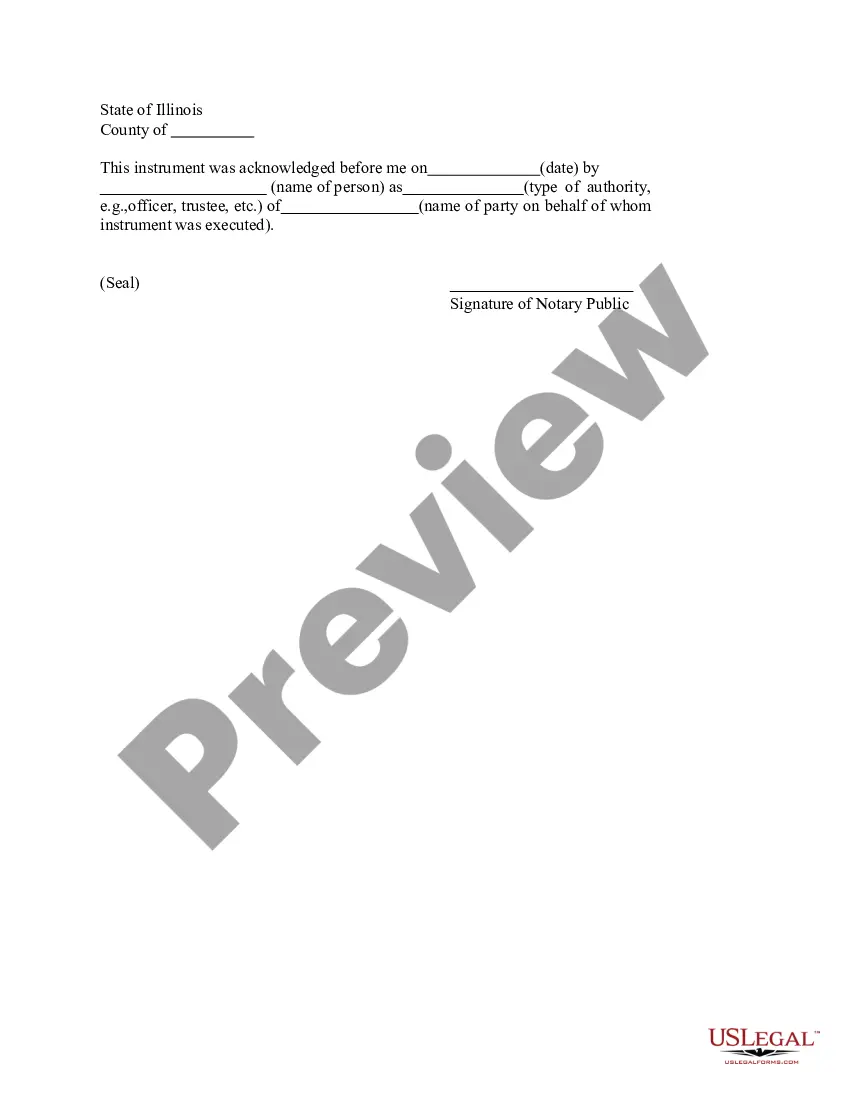
The Acknowledgment In a Representative Capacity is a legal document that certifies a person's authority to act on behalf of another individual or entity. This form serves as a vital record in situations where decisions or agreements must be acknowledged by a representative, thereby ensuring that the authority of the representative is officially recognized. Unlike other acknowledgment forms, this one specifically focuses on representation, making it essential for various legal and business transactions.
Key parts of this document
- Date of acknowledgment
- Name of the person acting as a representative
- Type of authority (e.g., officer, trustee)
- Name of the party for whom the instrument is executed
- Signature of the notary public
When to use this document
This form is typically used in scenarios where an individual is required to acknowledge decisions or documents on behalf of another person or organization. Common situations include real estate transactions, estate planning, and corporate governance, where a representative must verify their role and authority in executing or endorsing legal documents.
Who needs this form
- Individuals acting in a legal capacity for another party (e.g., power of attorney)
- Corporate officers or trustees managing legal affairs on behalf of their organization
- Legal representatives in property transactions
Steps to complete this form
- Identify the date of acknowledgment.
- Enter the name of the person acting as a representative.
- Specify the type of authority (e.g., officer, trustee).
- Provide the name of the party on behalf of whom the document is executed.
- Have the form signed in the presence of a notary public.
Is notarization required?
This form must be notarized to be legally valid. US Legal Forms provides secure online notarization powered by Notarize, allowing you to complete the process through a verified video call.
Get your form ready online
Our built-in tools help you complete, sign, share, and store your documents in one place.
Make edits, fill in missing information, and update formatting in US Legal Forms—just like you would in MS Word.
Download a copy, print it, send it by email, or mail it via USPS—whatever works best for your next step.
Sign and collect signatures with our SignNow integration. Send to multiple recipients, set reminders, and more. Go Premium to unlock E-Sign.
If this form requires notarization, complete it online through a secure video call—no need to meet a notary in person or wait for an appointment.
We protect your documents and personal data by following strict security and privacy standards.

Make edits, fill in missing information, and update formatting in US Legal Forms—just like you would in MS Word.

Download a copy, print it, send it by email, or mail it via USPS—whatever works best for your next step.

Sign and collect signatures with our SignNow integration. Send to multiple recipients, set reminders, and more. Go Premium to unlock E-Sign.

If this form requires notarization, complete it online through a secure video call—no need to meet a notary in person or wait for an appointment.

We protect your documents and personal data by following strict security and privacy standards.
Common mistakes to avoid
- Failing to include the correct date of acknowledgment.
- Not specifying the type of authority clearly.
- Omitting the notary public's signature, which is crucial for validation.
Benefits of completing this form online
- Convenient access to legal forms from anywhere.
- Editability allows for customization to meet specific needs.
- Reliable templates drafted by licensed attorneys ensure legal compliance.
Looking for another form?
Form popularity
FAQ
To write an acknowledgment for an individual assignment, start by clearly stating the purpose of your acknowledgment. Be sure to outline your acceptance of the terms and confirm your role in the assignment. In Illinois acknowledgment in a representative capacity, it's important to include relevant details such as the date and the context of the assignment. For further guidance, consider resources available on platforms like US Legal Forms.
Proper acknowledgment involves following specific guidelines to ensure that a document is legally valid. In the context of Illinois acknowledgment in a representative capacity, this typically includes presenting identification and signing in the presence of a notary public. This protocol not only adds a layer of security but also clarifies the responsibilities of the parties involved. Utilizing services like US Legal Forms can help streamline this process.
Acknowledgment generally means recognizing and accepting the terms laid out in a document. In Illinois, acknowledgment in a representative capacity often involves signing documents in front of a notary, ensuring that the signer's identity is verified. This formal process helps to strengthen the legal authority of the document. By understanding this, you can better navigate legal requirements.
Performing an acknowledgment properly is essential for the integrity of the document. Start by asking the signer to appear before you, then confirm their identity and willingness to sign. Finally, complete the appropriate section of the document to reflect the Illinois Acknowledgment In a Representative Capacity. Always follow state guidelines and best practices to ensure the acknowledgment is valid.
Bring the unsigned document and your photo identification to the notary. Sign the document in the notary's presence. Show the notary your photo identification. Pay the notary fee (usually $1) The notary signs and stamps your document.
In such cases, you should refuse to notarize, citing the blank space as a reason. Remember that you may only complete information in the notarial certificate wording. Any blanks in the main text must be completed by the signer or another individual authorized to do so before the notarization may proceed.
For an acknowledgment, the signer must always: Be positively identified by the Notary. The Notary must always identify the signer for an acknowledgement; whether the signer personally knows the Notary, presents an ID document, or is identified by a credible witness depends on the circumstances.
The certificate of a notary public, justice of the peace, or other authorized officer, attached to a deed, mortgage, or other instrument, setting forth that the parties thereto personally appeared before him on such a date and acknowledged the instrument to be their free and voluntary act and deed. Read v.
When you see (here insert the name and character of the officer) next to a blank as shown below, it means you should insert Your name, Notary Public in the blank.
Yes. The State of Illinois has enacted the Uniform Real Property Electronic Recording Act (765 ILCS 33/1 through 33/7), which authorizes a notary public to obtain an electronic signature and electronic seal to notarize electronic documents in the physical presence of the individual seeking the notarization.