Illinois Statutory Equivalent of Living Will or Declaration
About this form
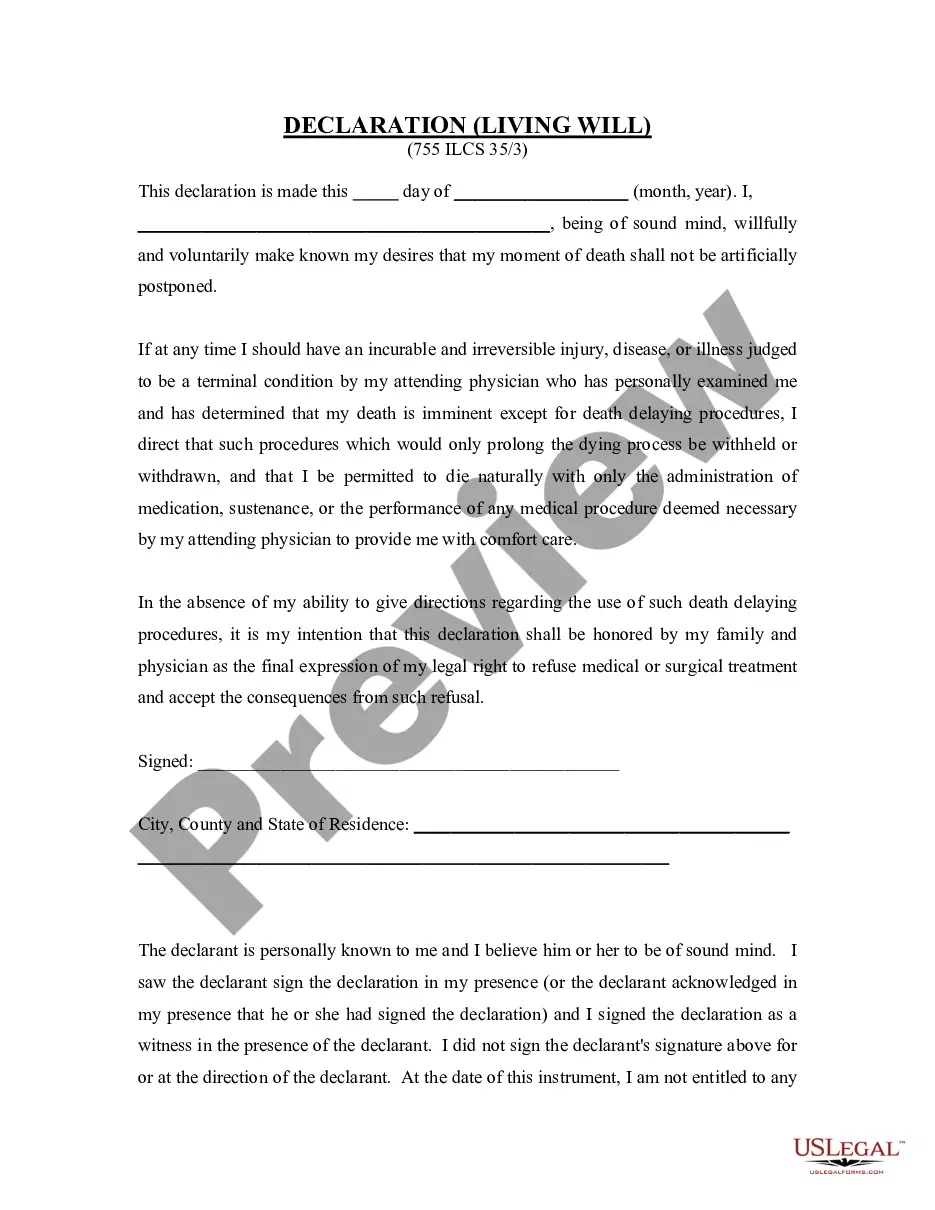
The Statutory Equivalent of Living Will or Declaration, often simply called a Declaration, serves as an important legal document that outlines your healthcare preferences in the event you become unable to communicate your wishes due to an incurable or terminal condition. This form differs from a standard Living Will primarily in its statutory recognition, which may vary by jurisdiction. It allows you to express your desire to refuse life-prolonging medical treatments, ensuring that your wishes are respected by family members and healthcare providers during a critical time.
Main sections of this form
- Identification of the declarant's name and residence.
- Clear directives regarding treatment preferences in the case of a terminal illness.
- Provisions for withholding or withdrawing life-prolonging procedures.
- Confirmation of the declarant's mental soundness and the presence of witnesses during the signing.
- Space for signatures of both the declarant and witnesses to validate the document.

When this form is needed
This form is essential to use in situations where you wish to communicate your healthcare preferences clearly, especially if you are diagnosed with a terminal illness or have an irreversible medical condition. It is particularly useful for individuals who want to ensure their wishes regarding end-of-life care are known and respected. Using this form can alleviate the emotional burden on family members during critical medical situations and avoid potential conflicts about treatment options.
Who this form is for
This form is suitable for:
- Individuals wishing to outline their medical care preferences in advance.
- Those who may be facing serious health issues that could impair their ability to communicate.
- Family members or caretakers looking for guidance on a loved one's medical treatment wishes.
Steps to complete this form
- Identify yourself as the declarant by entering your full name and current address.
- Specify your wishes regarding treatment in the event of a terminal illness.
- Sign the Declaration in the presence of at least one witness.
- Have the witness sign the document, confirming they are not entitled to inherit from you and are of sound mind.
- Retain copies for your records and share your wishes with family members and healthcare providers.
Does this document require notarization?
This form does not typically require notarization unless specified by local law. It is essential to check your state's regulations regarding the notarization of living wills or declarations to ensure the form's effectiveness.
Get your form ready online
Our built-in tools help you complete, sign, share, and store your documents in one place.
Make edits, fill in missing information, and update formatting in US Legal Forms—just like you would in MS Word.
Download a copy, print it, send it by email, or mail it via USPS—whatever works best for your next step.
Sign and collect signatures with our SignNow integration. Send to multiple recipients, set reminders, and more. Go Premium to unlock E-Sign.
If this form requires notarization, complete it online through a secure video call—no need to meet a notary in person or wait for an appointment.
We protect your documents and personal data by following strict security and privacy standards.

Make edits, fill in missing information, and update formatting in US Legal Forms—just like you would in MS Word.

Download a copy, print it, send it by email, or mail it via USPS—whatever works best for your next step.

Sign and collect signatures with our SignNow integration. Send to multiple recipients, set reminders, and more. Go Premium to unlock E-Sign.

If this form requires notarization, complete it online through a secure video call—no need to meet a notary in person or wait for an appointment.

We protect your documents and personal data by following strict security and privacy standards.
Typical mistakes to avoid
- Failing to sign the document properly in the presence of a witness.
- Not specifying clear treatment preferences or directives.
- Forgetting to provide copies to family members or healthcare providers.
Why complete this form online
- Convenience of downloading the form instantly from anywhere.
- Editability allows for personal customization to fit specific needs.
- Reliable templates designed by licensed legal professionals, ensuring compliance with legal standards.
Legal use & context
- Confirms your right to refuse medical treatment in specific situations.
- It may be required by hospitals and healthcare providers to access your treatment preferences.
- Helps prevent family conflicts regarding medical decisions during critical times.
What to keep in mind
- The Declaration is a legally recognized document that outlines your healthcare wishes.
- Complete the form correctly to ensure your preferences are honored.
- Consult with a healthcare provider or legal professional if you have questions about your wishes and rights.
Looking for another form?
Form popularity
FAQ
If you do not have a power of attorney in Illinois, medical decisions may be made by family members as per the state's hierarchy of decision-makers. Without this crucial document, your wishes may not be explicitly honored, leading to potential conflicts during difficult times. It is wise to consider a power of attorney as the Illinois statutory equivalent of a living will or declaration, safeguarding your desires regarding health care.
A living will becomes effective when your primary physician decides that you can no longer make your own healthcare decisions. If you are ill or injured and cannot express your healthcare wishes, and your doctor certifies this fact in writing, your living will takes effect.
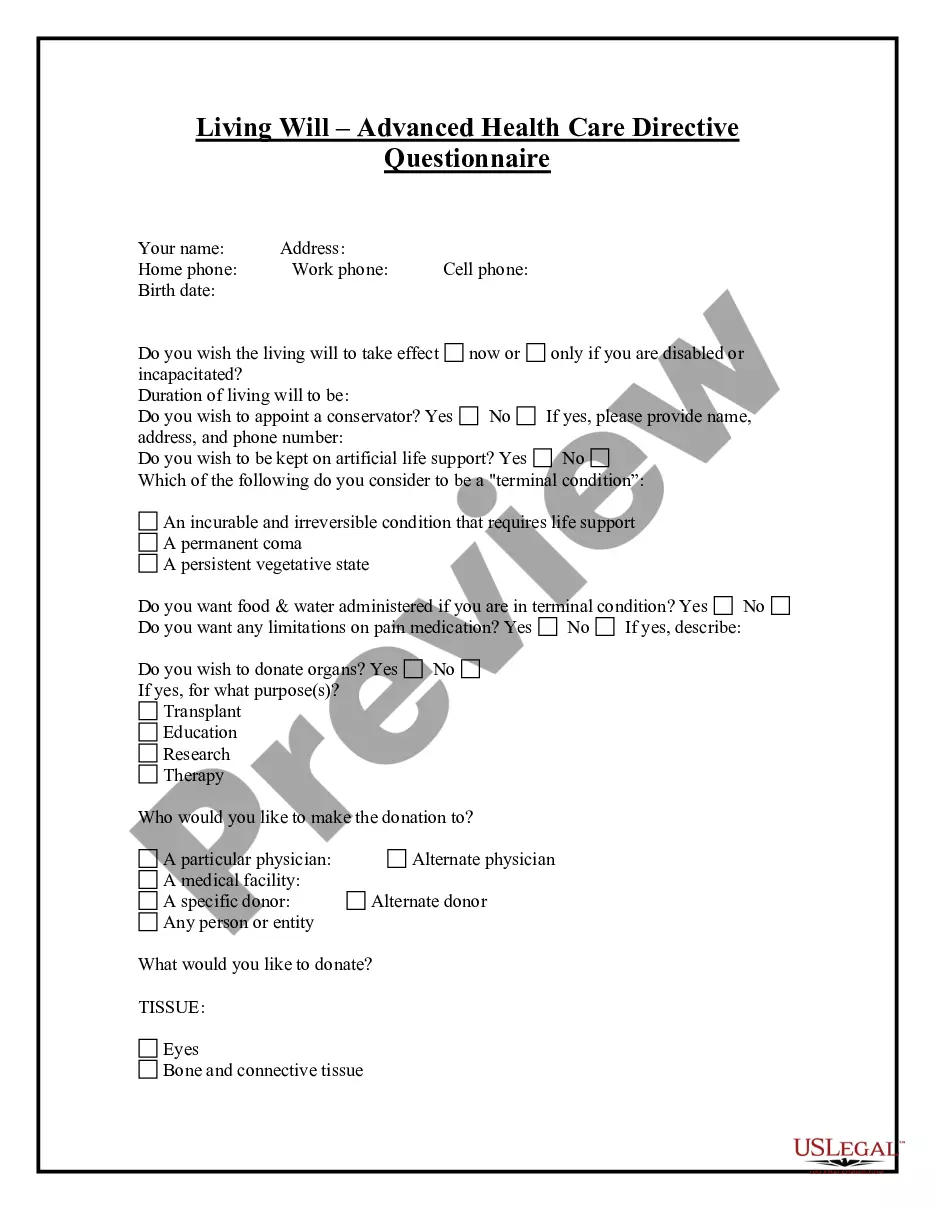
A living will is a written, legal document that spells out medical treatments you would and would not want to be used to keep you alive, as well as your preferences for other medical decisions, such as pain management or organ donation. In determining your wishes, think about your values.
Do I Need to Have My Will Notarized? No, in Illinois, you do not need to notarize your will to make it legal.However, Illinois allows your will to be self-proved without a self-proving affidavit, as long as you sign and witness it correctly.
In most cases, your health care documents will be honored in other states.Most states accept health care directives from other states as long as the documents are legally valid in the state where they were made -- but this is not always the case.
A living will is a document that explains whether or not you want to be kept on life support if you become terminally ill and will die shortly without life support, or fall into a persistent vegetative state.A living will becomes effective only when you cannot communicate your desires on your own.
The basic difference between a will and a living will is the time when it is executed. A will takes legal effect upon death. A living will, on the other hand, gives instructions to your family and doctors about what medical treatment you do and don't wish to have, should you become incapacitated.
1. Living Will Rules Vary by State.Most states do accept living wills from other states as long as the document is valid in the state in which it was created, but not all do, so it is important to check when your living will is created.
You do not need a lawyer to make a living will, although you can get one from a lawyer if you prefer to. Every state has its own requirements for making a living will, so if you make one on your own, make sure you find a form that meets your state's requirements.
An Illinois living will is a legal document used during the estate planning process. The purpose of an Illinois living will is to document your wishes related to medical care in the event that you are unable to make your own medical decisions for any reason.