Illinois Third Party Lender Agreement
Overview of this form
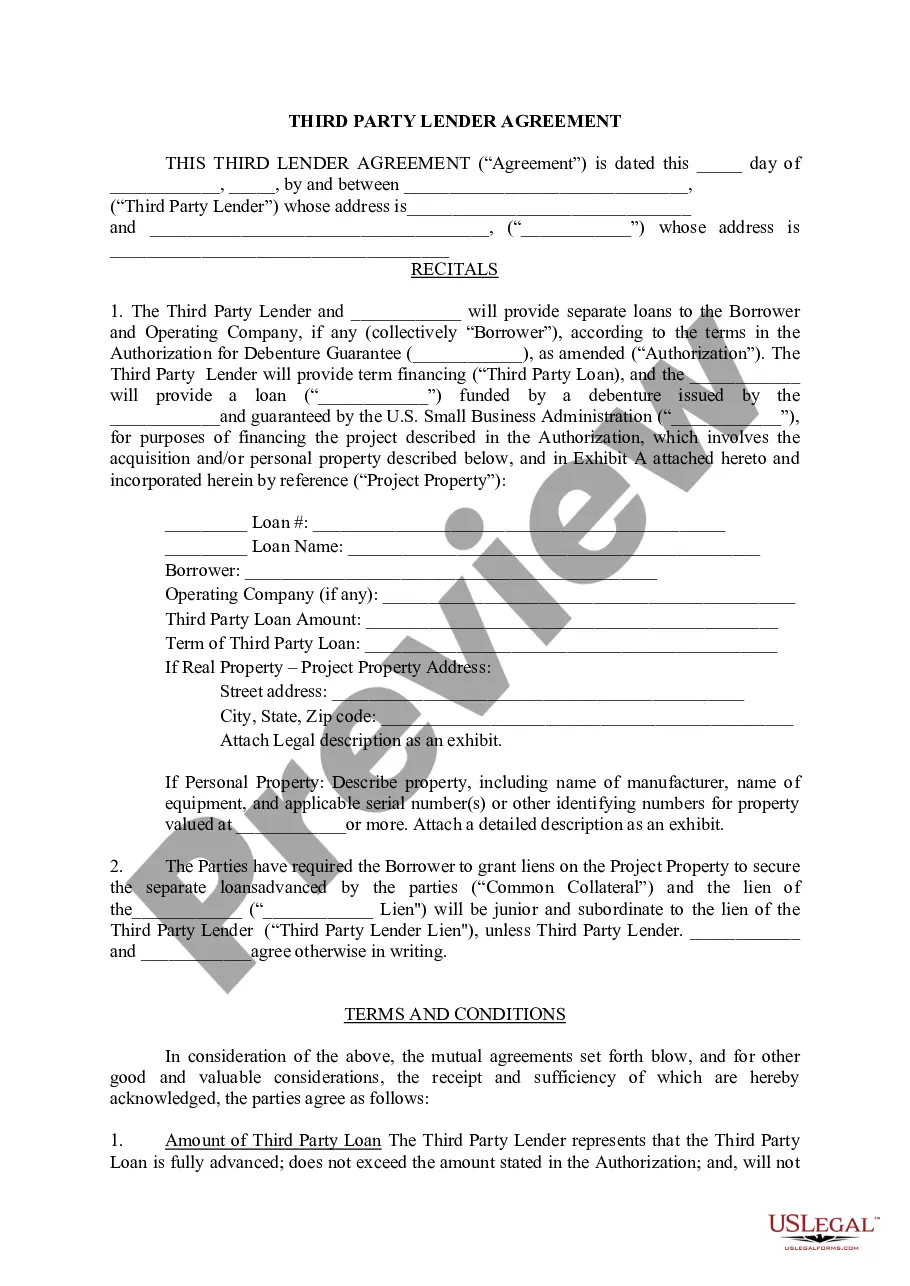
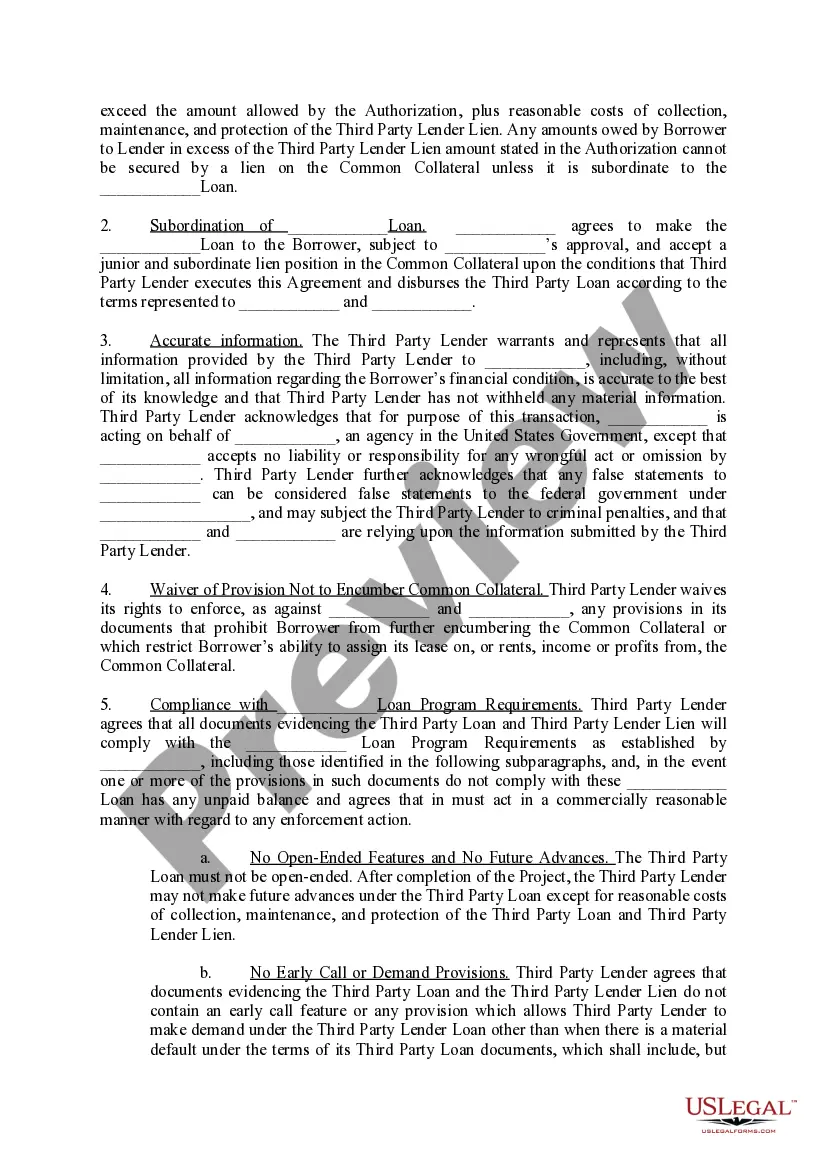
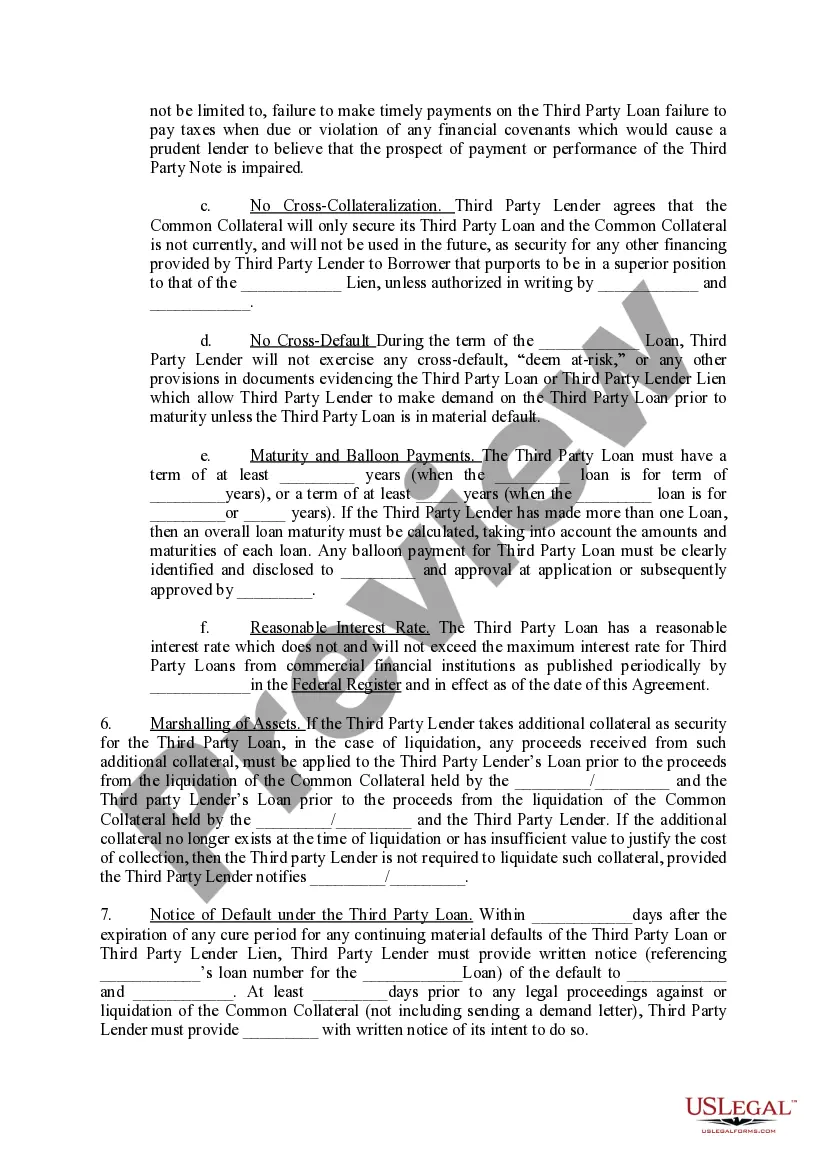
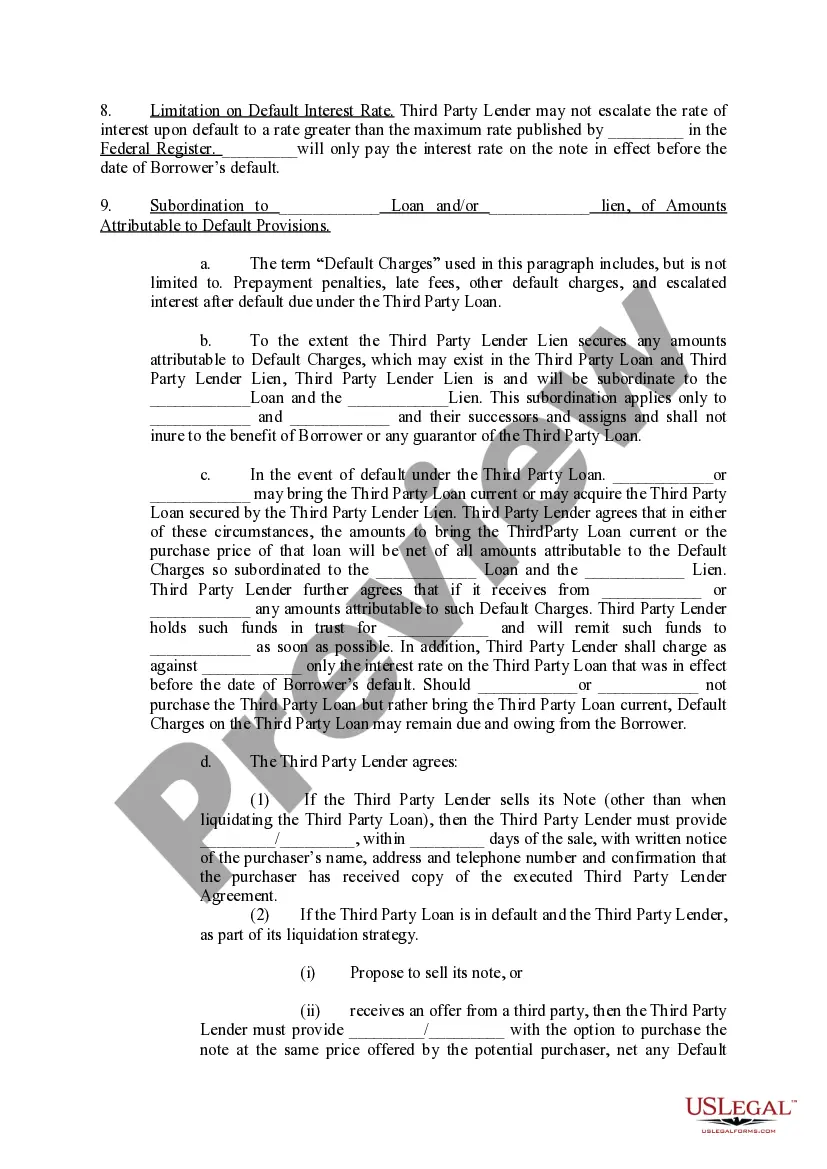
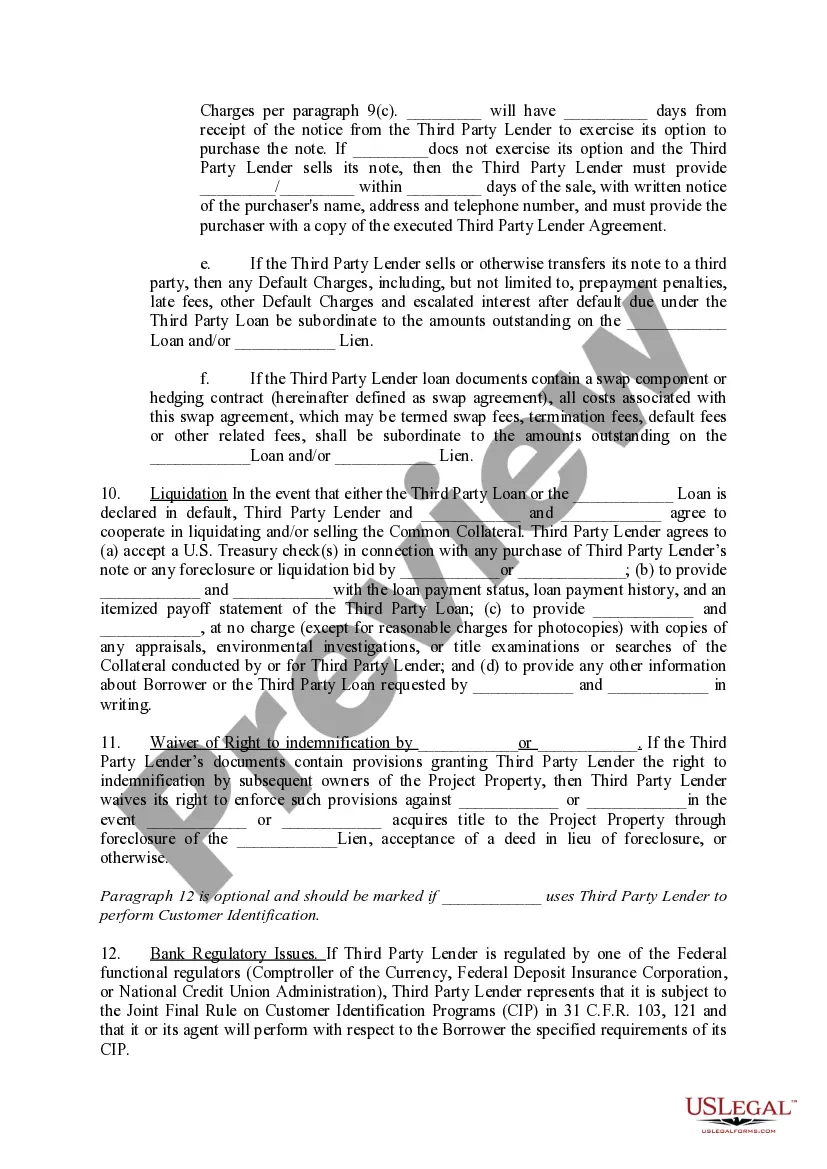
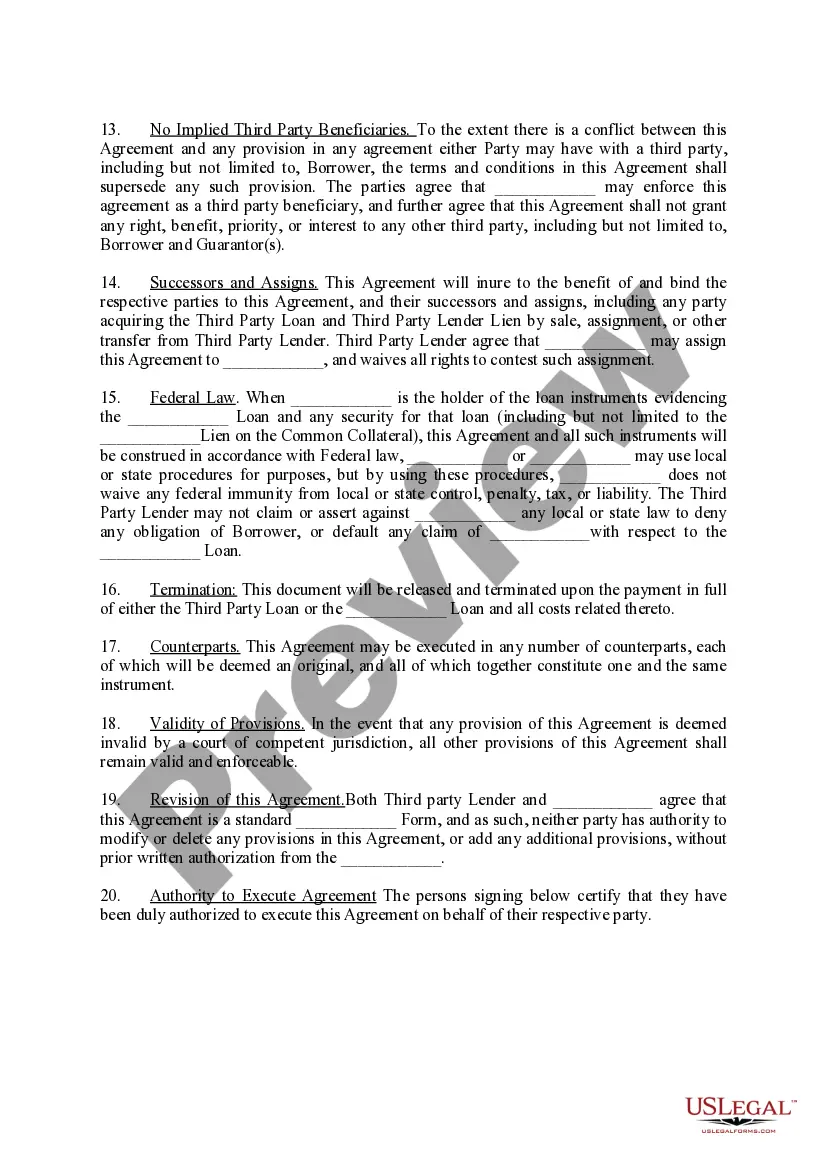
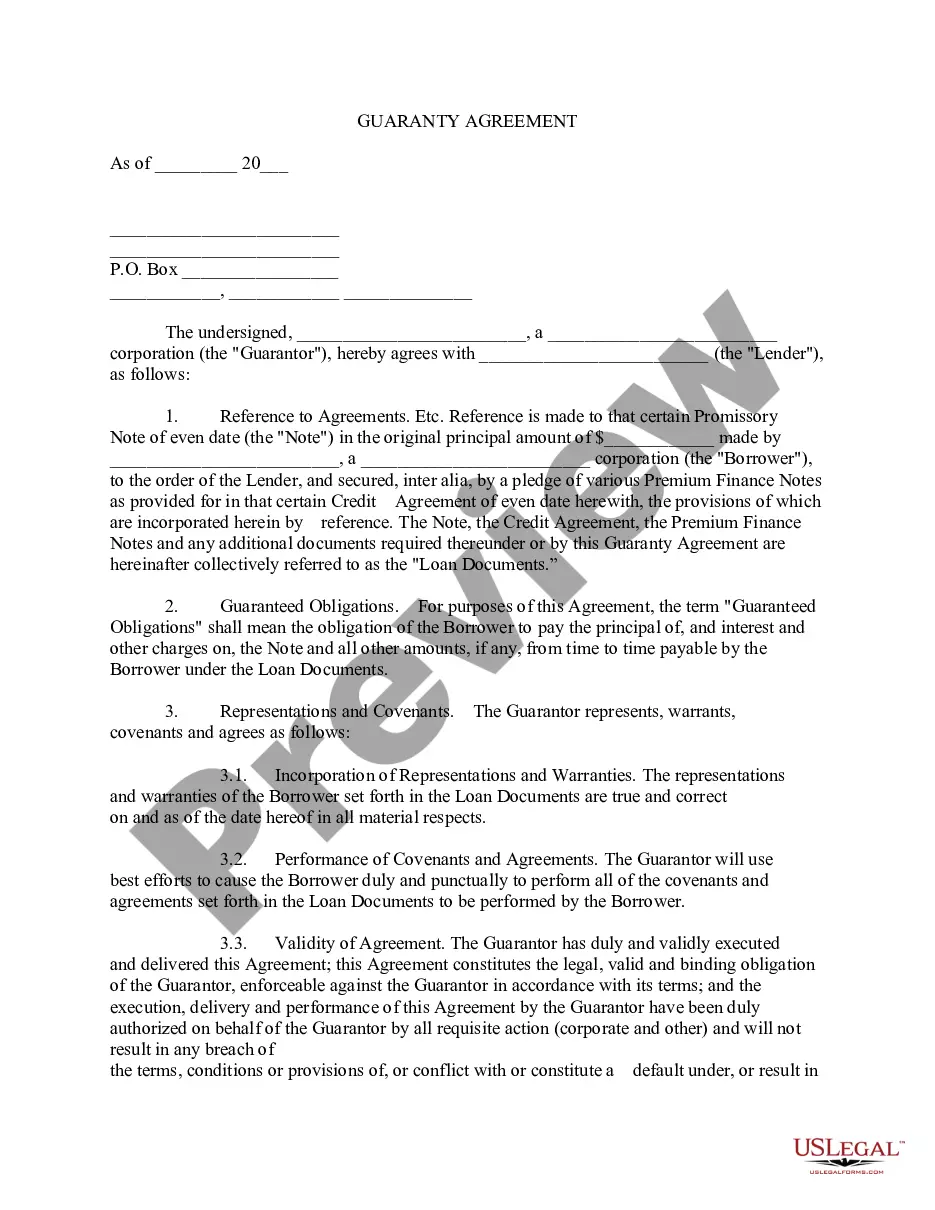
The Third Party Lender Agreement is a legal document used to formalize a loan between a borrower and two lenders, including a commercial or private lender and a government entity. This agreement outlines the terms under which the third-party lender provides financing, detailing information such as loan amounts, collateral, and compliance with relevant statutes. This form is distinct from other loan agreements as it emphasizes multiple lenders collaborating on the same financing project, often in the context of government-backed loans.
Form components explained
- Identification of parties involved in the loan.
- Terms of the loan, including loan amount and purpose.
- Conditions surrounding collateral, including any liens on property.
- Representations and warranties regarding the accuracy of information provided by the Third Party Lender.
- Procedures for default and liquidation of collateral.
- Subordination clauses detailing the relationship between lenders in the event of default.
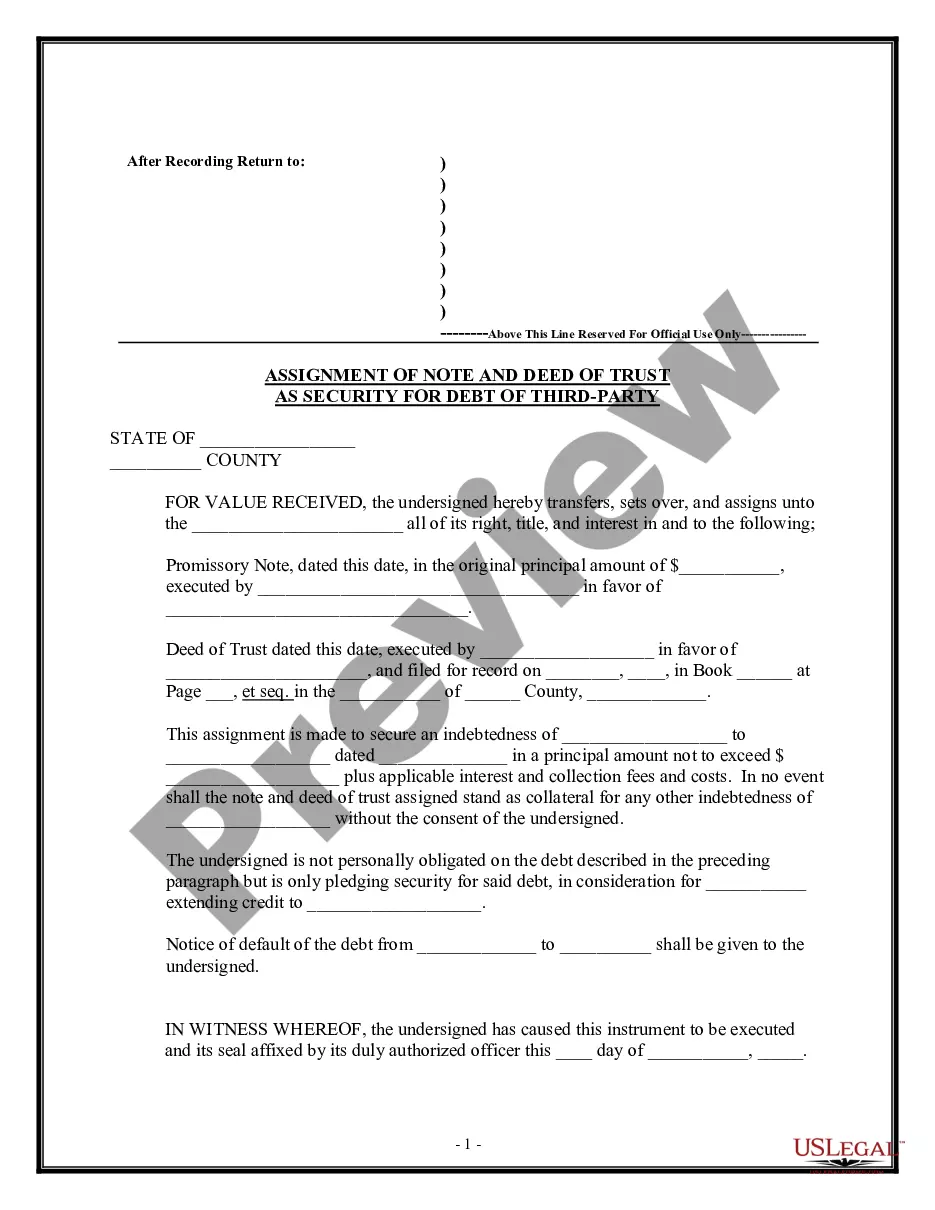
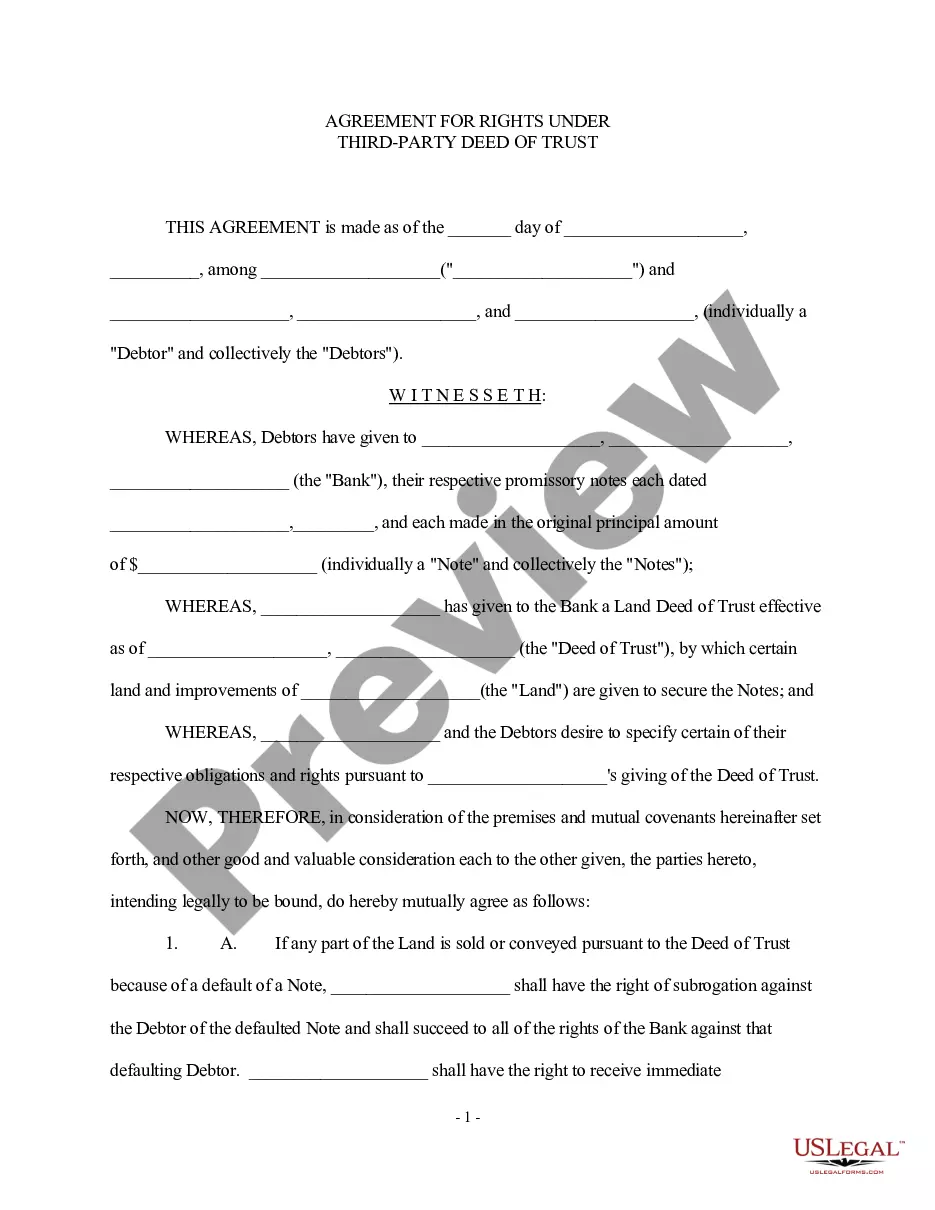
When to use this document
This form is relevant when a borrower seeks financing from multiple sources, particularly when one of the lenders is a government entity or another regulated source. Use this form to ensure all parties clearly understand their rights, obligations, and the structure of the loan arrangement, particularly in projects requiring significant financing or involving multiple collateral interests.
Who can use this document
- Borrowers seeking loans from commercial lenders and government sources.
- Third-party lenders providing financing in a multi-lender arrangement.
- Financial institutions involved in project financing.
- Legal and finance professionals guiding clients through complex loan agreements.
Steps to complete this form
- Identify the parties involved by entering their names and addresses at the beginning of the form.
- Specify the details of the loans, including amounts and purposes of the loans.
- Enter the property descriptions if real or personal property is being financed, including relevant serial numbers or legal addresses.
- Outline the terms of the loans, including any collateral agreements and other necessary conditions.
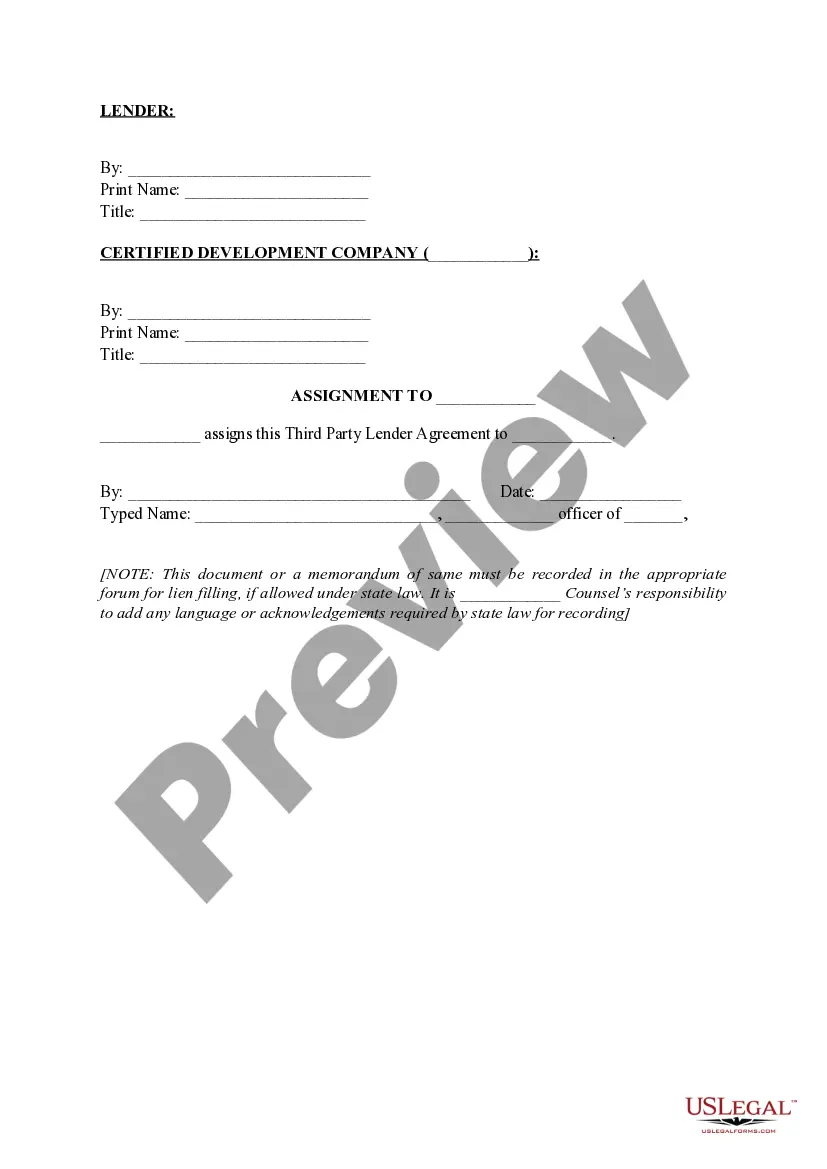
- Ensure signatures are obtained from all parties involved to validate the agreement.
Does this document require notarization?
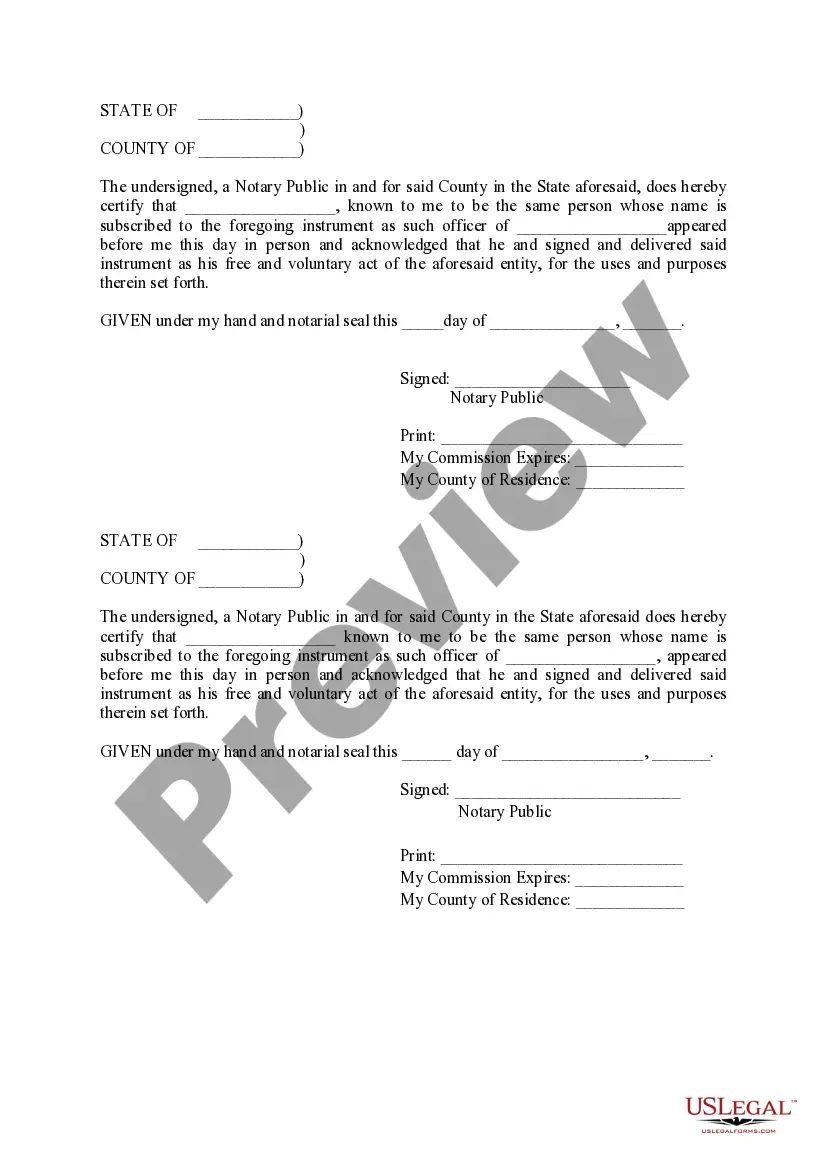
This form does not typically require notarization unless specified by local law. However, it is advisable to check specific jurisdiction requirements to ensure the validity of the agreement.
Get your form ready online
Our built-in tools help you complete, sign, share, and store your documents in one place.
Make edits, fill in missing information, and update formatting in US Legal Forms—just like you would in MS Word.
Download a copy, print it, send it by email, or mail it via USPS—whatever works best for your next step.
Sign and collect signatures with our SignNow integration. Send to multiple recipients, set reminders, and more. Go Premium to unlock E-Sign.
If this form requires notarization, complete it online through a secure video call—no need to meet a notary in person or wait for an appointment.
We protect your documents and personal data by following strict security and privacy standards.

Make edits, fill in missing information, and update formatting in US Legal Forms—just like you would in MS Word.

Download a copy, print it, send it by email, or mail it via USPS—whatever works best for your next step.

Sign and collect signatures with our SignNow integration. Send to multiple recipients, set reminders, and more. Go Premium to unlock E-Sign.

If this form requires notarization, complete it online through a secure video call—no need to meet a notary in person or wait for an appointment.

We protect your documents and personal data by following strict security and privacy standards.
Avoid these common issues
- Failing to accurately identify all parties involved in the agreement.
- Omitting necessary details regarding collateral or loan terms.
- Not reviewing compliance with local or state laws that may impact the loan structure.
- Neglecting to secure proper signatures from authorized representatives.
Benefits of using this form online
- Immediate access to the latest version of the Third Party Lender Agreement, ensuring compliance with current laws.
- Easy customization and completion of the document to meet specific needs.
- Convenient downloading and storing options for your records.
- Assurance of using a form drafted by licensed attorneys, enhancing its legal validity.
Looking for another form?


Form popularity
FAQ
Loan agreements are binding contracts between two or more parties to formalize a loan process.Loan agreements typically include covenants, value of collateral involved, guarantees, interest rate terms and the duration over which it must be repaid.
In the lending industry, third-party mortgage originators can be broad in scope and may be loosely defined as any person or company involved in the process of marketing mortgages, gathering borrower information for a mortgage application, underwriting, closing, or funding a mortgage loan.
Third Party Lender agrees that the Common Collateral will only secure its Third Party Loan and the Common Collateral is not currently, and will not be used in the future, as security for any other financing provided by Third Party Lender to Borrower that purports to be in a superior position to that of the CDC Lien,
When a lender, bank, or mortgage company sells a home loan to another entity, the seller usually takes the following steps. It endorses the promissory note (signs it over) to the new loan owner. The promissory note owner is the only party with the legal right to collect on the debt.
A personal loan agreement is a legally binding document regardless of whether the lender is a financial institution or another person.As a borrower, you could be sued by the lender or lose the asset or assets used to secure the loan.
Identity of the Parties. The names of the lender and borrower need to be stated.Date of the Agreement.Interest Rate.Repayment Terms.Default provisions.Signatures.Choice of Law.Severability.
The purpose of a loan agreement is to detail what is being loaned and when the borrower has to pay it back as well as how. The loan agreement has specific terms that detail exactly what is given and what is expected in return.
Borrower-lender agreement means a credit agreement (i) to finance a transaction between the borrower and a person (the supplier) other than the lender, and. (ii)
The buyer of a bond is a lender. The seller of a bond is a borrower. The bond buyers pay now in exchange for promises of future repaymentthat is, they are lenders. The bond sellers receive money now and in exchange for their promises of future repaymentthat is, they are borrowers.