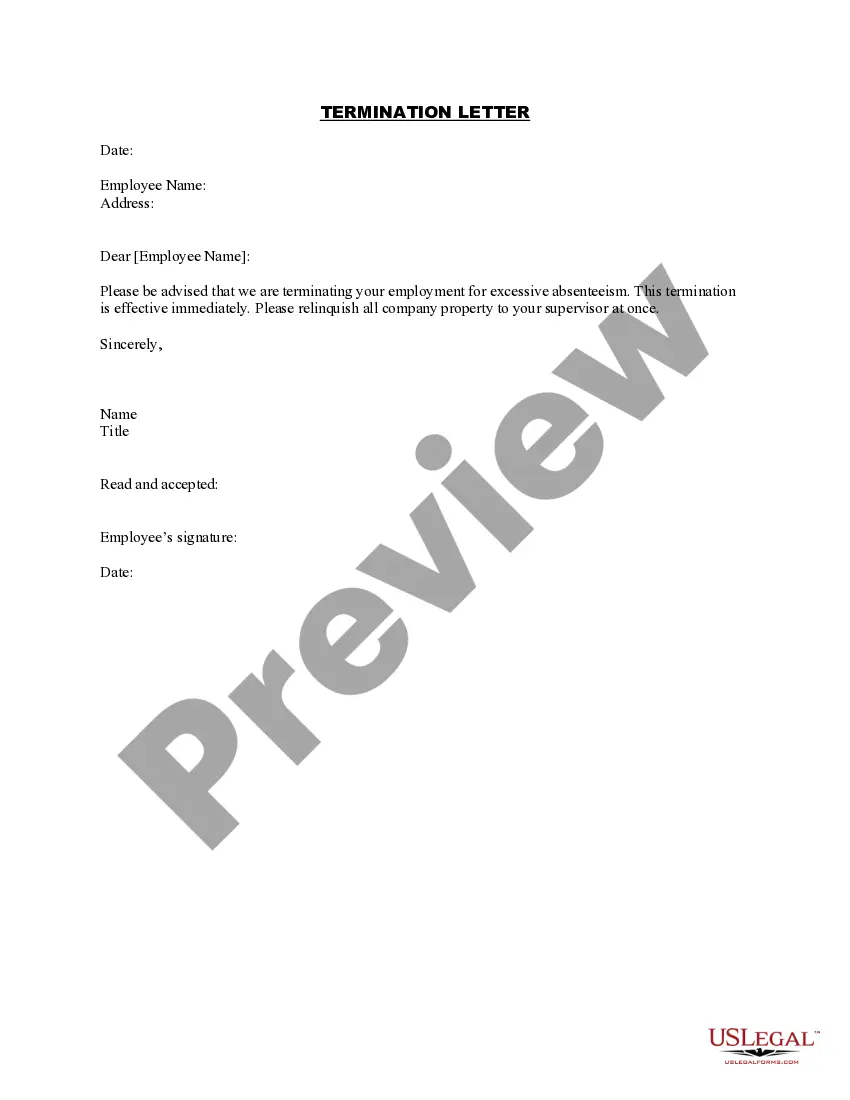
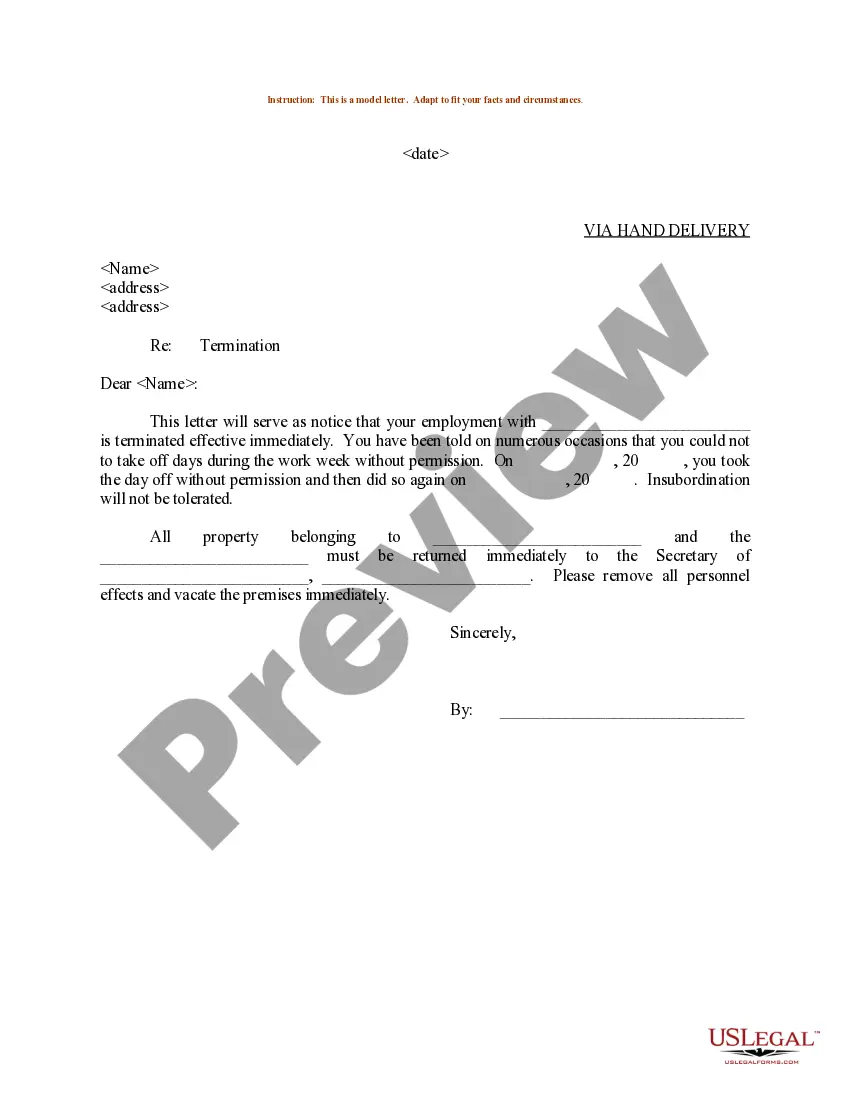
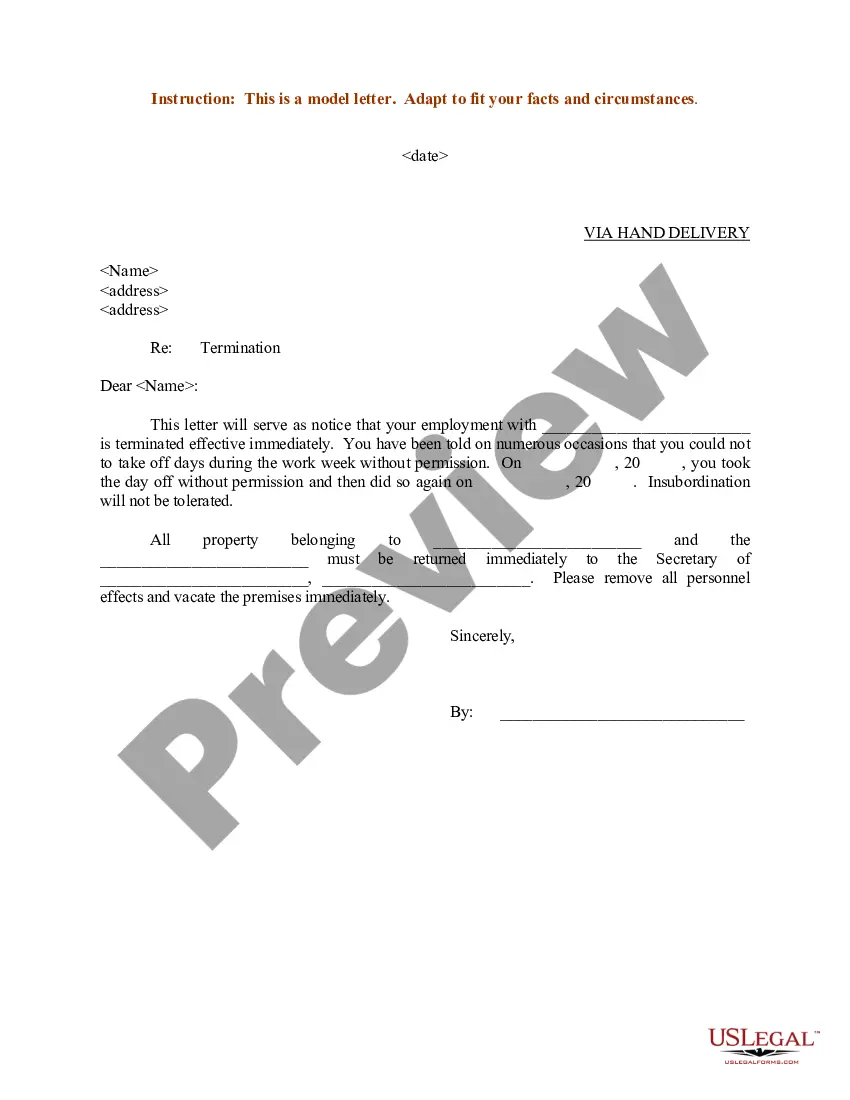
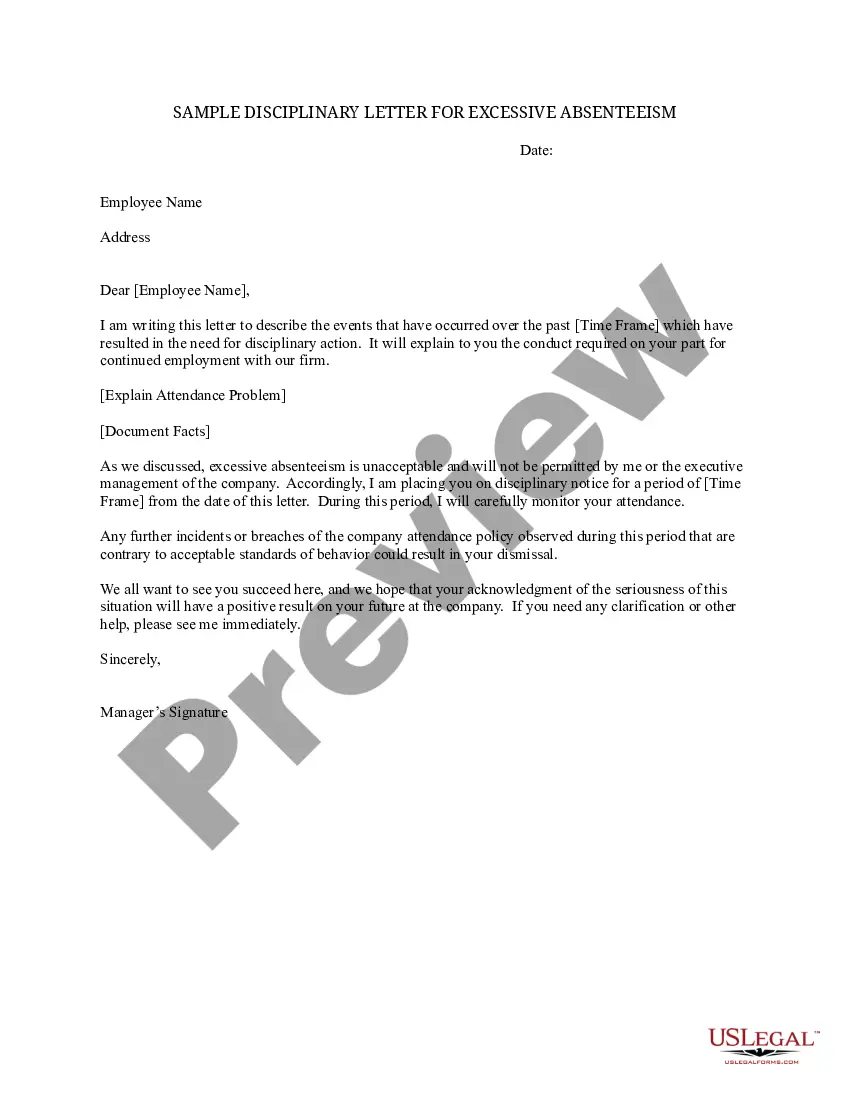
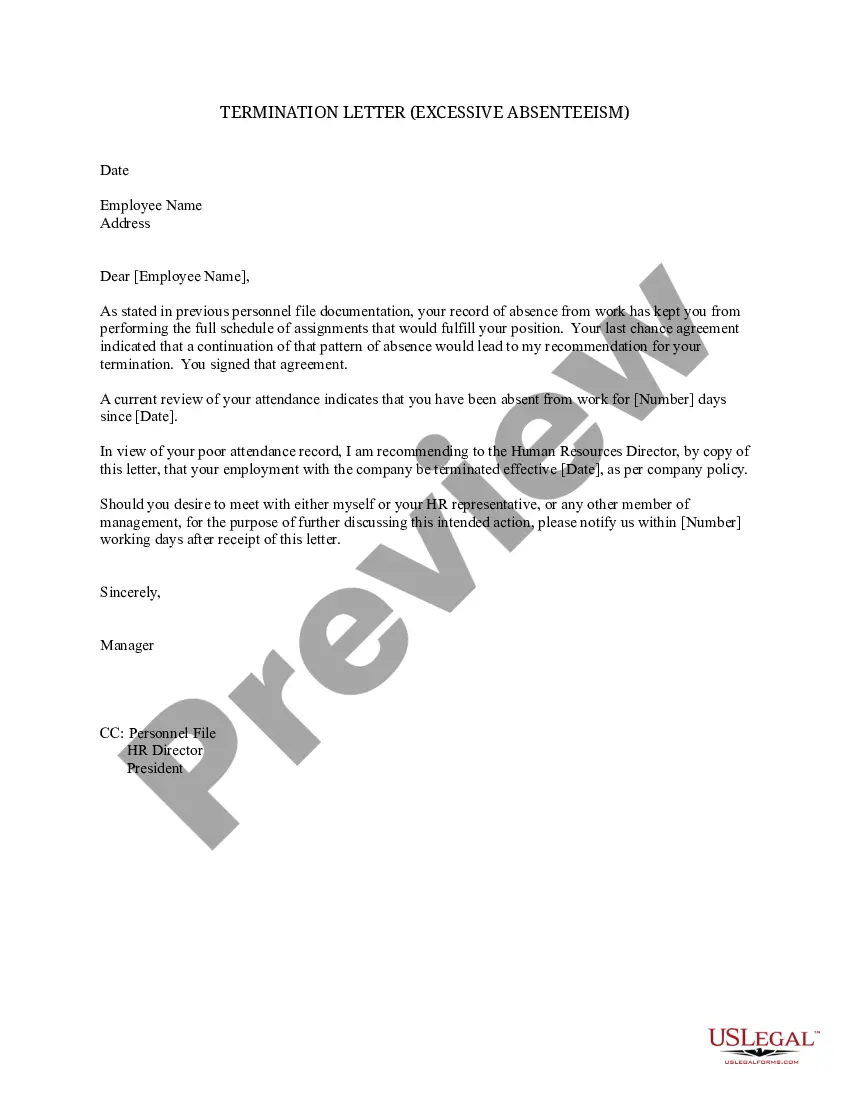
Idaho Termination Letter - Excessive Absenteeism
Description
Get your form ready online
Our built-in tools help you complete, sign, share, and store your documents in one place.
Make edits, fill in missing information, and update formatting in US Legal Forms—just like you would in MS Word.
Download a copy, print it, send it by email, or mail it via USPS—whatever works best for your next step.
Sign and collect signatures with our SignNow integration. Send to multiple recipients, set reminders, and more. Go Premium to unlock E-Sign.
If this form requires notarization, complete it online through a secure video call—no need to meet a notary in person or wait for an appointment.
We protect your documents and personal data by following strict security and privacy standards.

Make edits, fill in missing information, and update formatting in US Legal Forms—just like you would in MS Word.

Download a copy, print it, send it by email, or mail it via USPS—whatever works best for your next step.

Sign and collect signatures with our SignNow integration. Send to multiple recipients, set reminders, and more. Go Premium to unlock E-Sign.

If this form requires notarization, complete it online through a secure video call—no need to meet a notary in person or wait for an appointment.

We protect your documents and personal data by following strict security and privacy standards.
Looking for another form?


How to fill out Termination Letter - Excessive Absenteeism?
US Legal Forms - one of the most important collections of legal templates in the United States - provides a vast selection of legal document layouts that you can download or print.
By utilizing the site, you will receive numerous forms for business and personal purposes, organized by categories, states, or keywords. You can locate the latest versions of forms such as the Idaho Termination Letter - Excessive Absenteeism in moments.
If you have a monthly subscription, Log In and download the Idaho Termination Letter - Excessive Absenteeism from the US Legal Forms library. The Download button will appear on each form you observe. You can access all previously downloaded forms in the My documents tab of your profile.
Process the transaction. Use your credit card or PayPal account to complete the transaction.
Choose the format and download the form to your device. Make modifications. Complete, alter, print, and sign the downloaded Idaho Termination Letter - Excessive Absenteeism. Each template you save in your account has no expiration date and belongs to you indefinitely. Thus, if you wish to download or print another copy, simply navigate to the My documents section and click on the form you need. Access the Idaho Termination Letter - Excessive Absenteeism with US Legal Forms, one of the largest collections of legal document templates. Utilize numerous professional and state-specific templates that meet your business or personal requirements and needs.
- If you wish to utilize US Legal Forms for the first time, here are simple guidelines to help you get started.
- Ensure you have selected the correct form for your city/state.
- Click the Review button to examine the form's details.
- Check the form summary to ensure you have chosen the appropriate form.
- If the form does not meet your needs, take advantage of the Search box at the top of the screen to find one that does.
- If you are satisfied with the form, confirm your choice by clicking the Purchase now button.
- Then, select the pricing plan you prefer and provide your credentials to create an account.
Form popularity
FAQ
Although the general answer is yes, it is accompanied by many what ifs. If the employee's absences are caused by medical reasons, including pregnancy or disability, you mayand more than likely wouldviolate the Family Medical Leave Act, the American Disabilities Act, or any applicable state laws.
While an employer's reason for firing an employee, such as absenteeism, may appear to be a legitimate, nondiscriminatory reason, it may amount to a pretext for discrimination or retaliation if it conflicts with an employer's internal policy, the 1st U.S. Circuit Court of Appeals held.
You can send a termination letter to the employee following the termination meeting with return receipt requested, or you can hand the letter to the employee at the end of the meeting. It should be printed on company stationery with the official signature of the employee's manager.
How to Terminate an Employee for Excessive AbsenteeismLimit Drama. Best practice tips for reducing the drama surrounding an employee termination include firing an employee at a time the office is not busy.Supplemental Documentation.Safety First.Secure Office.Professional Attitude.
You can send a termination letter to the employee following the termination meeting with return receipt requested, or you can hand the letter to the employee at the end of the meeting. It should be printed on company stationery with the official signature of the employee's manager.
Idaho is an employment-at-will state, which means that without a written employee contract, employees can be terminated for any reason at any time, provided that the reason is not discriminatory and that the employer is not retaliating against the employee for a rightful action.
Employers should make sure they have documentation to support any decision to terminate. With that in mind, supervisors should be trained to document issues with employees as they arise. Not all documentation needs to be formal; if it's an isolated minor incident, an email may be enough.
Your employer cannot terminate you because of your medical condition or because you are on medical leave. However, if the employer's reason for terminating your employment has nothing to do with the injury, illness, or medical leave, the firing may be legal.
Federally, and in most states, a termination letter is not legally required. In some states, currently including Arizona, California, Illinois and New Jersey, written termination notices are required by law. Some of these states have specific templates employers must use for the letter.
Dear Employee Name: As of the date of this letter, you have been absent from work since date of last day of work or last day of approved leave. Because your absence has not been approved, and we have not heard from you, we have determined that you have abandoned your position.