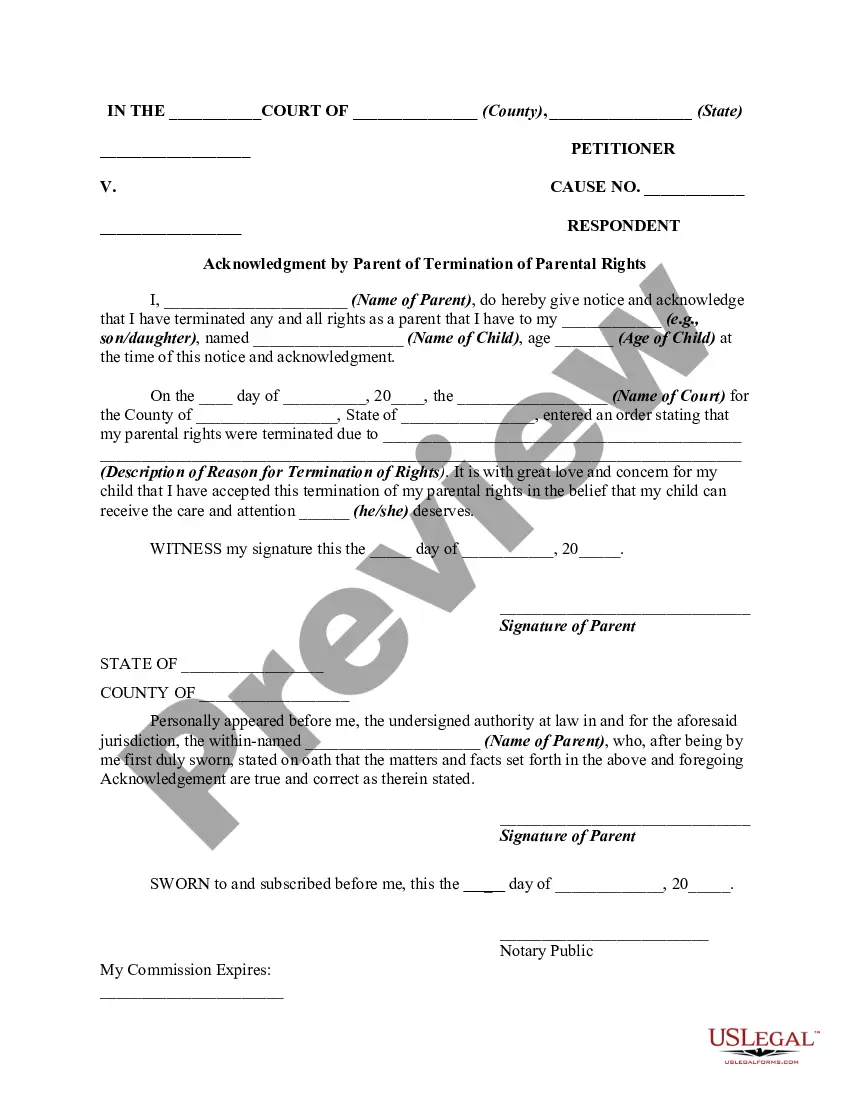
This form is an acknowledgment of a parent of a minor child stating that the parent's parental rights have been duly terminated by a court with proper jurisdiction.
Idaho Acknowledgment and Agreement by Parent of Termination or Relinquish of Parental Rights - Release of Parental Rights
1,884 downloads
Description
Free preview
Get your form ready online
Our built-in tools help you complete, sign, share, and store your documents in one place.
Built-in online Word editor
Make edits, fill in missing information, and update formatting in US Legal Forms—just like you would in MS Word.
Export easily
Download a copy, print it, send it by email, or mail it via USPS—whatever works best for your next step.
E-sign your document
Sign and collect signatures with our SignNow integration. Send to multiple recipients, set reminders, and more. Go Premium to unlock E-Sign.
Notarize online 24/7
If this form requires notarization, complete it online through a secure video call—no need to meet a notary in person or wait for an appointment.
Store your document securely
We protect your documents and personal data by following strict security and privacy standards.

Make edits, fill in missing information, and update formatting in US Legal Forms—just like you would in MS Word.

Download a copy, print it, send it by email, or mail it via USPS—whatever works best for your next step.

Sign and collect signatures with our SignNow integration. Send to multiple recipients, set reminders, and more. Go Premium to unlock E-Sign.

If this form requires notarization, complete it online through a secure video call—no need to meet a notary in person or wait for an appointment.

We protect your documents and personal data by following strict security and privacy standards.
Looking for another form?
How to fill out Acknowledgment And Agreement By Parent Of Termination Or Relinquish Of Parental Rights - Release Of Parental Rights?
Locating the appropriate valid document template can be a challenge. Of course, there are numerous templates accessible online, but how do you find the right form you need? Use the US Legal Forms website. The service offers thousands of templates, including the Idaho Acknowledgment and Agreement by Parent of Termination or Relinquish of Parental Rights - Release of Parental Rights, which can be utilized for business and personal purposes. All of the forms are reviewed by professionals and meet state and federal standards.
If you are already registered, Log In to your account and click on the Download button to obtain the Idaho Acknowledgment and Agreement by Parent of Termination or Relinquish of Parental Rights - Release of Parental Rights. Use your account to browse through the valid forms you have previously obtained. Visit the My documents section of your account and get an additional copy of the document you need.
If you are a new user of US Legal Forms, here are straightforward steps to follow: First, ensure that you have selected the correct form for your city/state. You can review the document using the Preview button and read the form summary to confirm it is suitable for you. If the form does not meet your requirements, use the Search field to find the appropriate document. Once you are certain that the form is suitable, click the Buy now button to obtain the document. Choose the pricing plan you prefer and enter the required information. Create your account and complete the purchase using your PayPal account or credit card. Select the file format and download the valid document template for your device. Complete, modify, print, and sign the acquired Idaho Acknowledgment and Agreement by Parent of Termination or Relinquish of Parental Rights - Release of Parental Rights.
- US Legal Forms is the largest repository of legal documents where you can find various record templates.
- Use the service to obtain professionally crafted documents that comply with state regulations.
- All forms are verified by experts to ensure they meet legal requirements.
- Easily navigate through your account to access previously downloaded forms.
- Follow simple steps to ensure you select the right document for your needs.
- Payment can be completed securely using PayPal or credit card.
Form popularity
FAQ
Physical and Legal Custody in Idaho Parents can share physical and legal custody (called "joint custody") or one parent may be granted sole physical and/or legal custody. Ultimately, the type of custody awarded in your case will depend on your child's best interests. "Physical custody" is where a child lives.
The court's custody decision will be made on what the court determines is in the best interests of the children. If the parties agree to a custody arrangement, the court must still make its own determination whether the arrangement is appropriate and decide whether to approve the agreement of the parties.
If you are considering filing for full custody of your child in Idaho, follow the steps below to give yourself the best chance of success. Understand Your Reasons for Seeking Full Custody. ... Speak to an Attorney. ... File a Motion for Custody. ... Serve the Other Parent. ... Attend the Hearing.
Failure to maintain this relationship without just cause for a period of one (1) year shall constitute prima facie evidence of abandonment.
Under Idaho law, a parent who shares custody of a child is typically not permitted to relocate with them to another state, or even within the state, if the move is more than around 50 miles away.
The father and mother of a legitimate unmarried minor child are equally entitled to its custody, services and earnings. If either the father or mother be dead or be unable or refuse to take the custody or has abandoned his or her family, the other is entitled to the child's custody, services and earnings.
In Idaho, when a child is conceived or born to a married couple, the husband is presumed to be the biological father of all children from the marriage. This presumption can be overcome by an affidavit of nonpaternity or a genetic test.
The process to terminate parental rights begins by filing a petition asking for termination of parental rights with the court. Either parent may file a petition asking to terminate the rights of the other parent, but a parent cannot terminate their own parental rights.