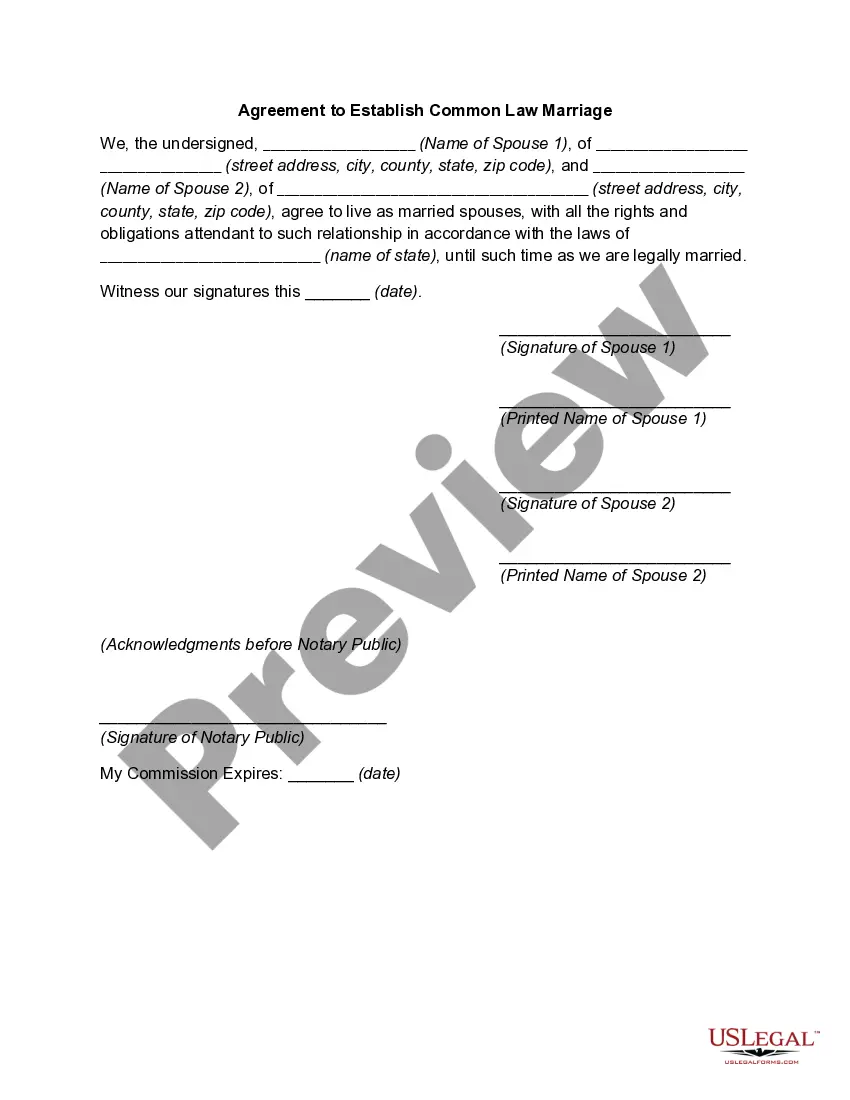
Iowa Agreement to Establish Common Law Marriage
Description
Get your form ready online
Our built-in tools help you complete, sign, share, and store your documents in one place.
Make edits, fill in missing information, and update formatting in US Legal Forms—just like you would in MS Word.
Download a copy, print it, send it by email, or mail it via USPS—whatever works best for your next step.
Sign and collect signatures with our SignNow integration. Send to multiple recipients, set reminders, and more. Go Premium to unlock E-Sign.
If this form requires notarization, complete it online through a secure video call—no need to meet a notary in person or wait for an appointment.
We protect your documents and personal data by following strict security and privacy standards.

Make edits, fill in missing information, and update formatting in US Legal Forms—just like you would in MS Word.

Download a copy, print it, send it by email, or mail it via USPS—whatever works best for your next step.

Sign and collect signatures with our SignNow integration. Send to multiple recipients, set reminders, and more. Go Premium to unlock E-Sign.

If this form requires notarization, complete it online through a secure video call—no need to meet a notary in person or wait for an appointment.

We protect your documents and personal data by following strict security and privacy standards.
Looking for another form?

How to fill out Agreement To Establish Common Law Marriage?
Are you in a situation where you need documents for either business or personal reasons on a daily basis.
There are numerous legal document templates accessible online, but locating reliable ones can be challenging.
US Legal Forms offers a vast array of template forms, such as the Iowa Agreement to Establish Common Law Marriage, designed to comply with federal and state requirements.
Once you find the correct template, click Get now.
Choose the pricing plan you desire, complete the required details to create your account, and pay for the transaction using your PayPal or credit card.
- If you are already acquainted with the US Legal Forms website and possess an account, simply Log In.
- After that, you can download the Iowa Agreement to Establish Common Law Marriage template.
- If you do not have an account and would like to start using US Legal Forms, follow these steps.
- Obtain the template you need and ensure it is for the correct jurisdiction/region.
- Use the Review button to inspect the form.
- Check the description to confirm that you have selected the correct template.
- If the template is not what you are looking for, use the Search field to find the document that fulfills your requirements.
Form popularity
FAQ
Iowa still recognizes common law marriage, unlike most other US states. Despite its legality, however, Iowa courts treat claims of common law marriage with skepticism. If you seek to prove the existence of such an arrangement, you may well face an uphill battle.
As of 2018, eight states acknowledge common law marriages through final legislation. Those states are: Colorado, District of Columbia, Iowa, Kansas, Montana, New Hampshire, Texas, and Utah. The requirements to establish a common law marriage vary by state.
In Iowa, to prove the existence of a lawful common law marriage, there must be substantial evidence of a present intent and agreement to be married, continuous cohabitation, and a public declaration that the parties are husband and wife (or, now, wife and wife, or husband and husband or Party A and Party B).
There are three requirements for a couple to be married by common law in Iowa:There must be an agreement that the people are married.The couple must live together continuously as spouses.The couple needs to present themselves publically as a married couple.
There are three requirements for a couple to be married by common law in Iowa: There must be an agreement that the people are married. The couple must live together continuously as spouses. The couple needs to present themselves publically as a married couple.
Continuous cohabitation However, there is no specific time that a couple must live together to establish a common-law marriage. Obviously, two weeks would not be enough time, and almost as obviously, seven years would be enough time if the other factors necessary to prove a common-law marriage are present.
Very few states recognize Common Law Marriage, Iowa is one of eight states that does recognize this form of marriage. When a couple is married by common law they may enjoy all of the benefits of a marriage including alimony, child support, and property division.
The most common misconceptions about common law marriage in Iowa are (1) living together for a certain period of time (typically seven years) automatically creates a common law marriage and (2) there is such a thing as a common law divorce that is distinct from a legal divorce.