Iowa Joint Motion to Waive Financial Statements and for Court to Enter Decree Without Hearing - Adult Children
What this document covers
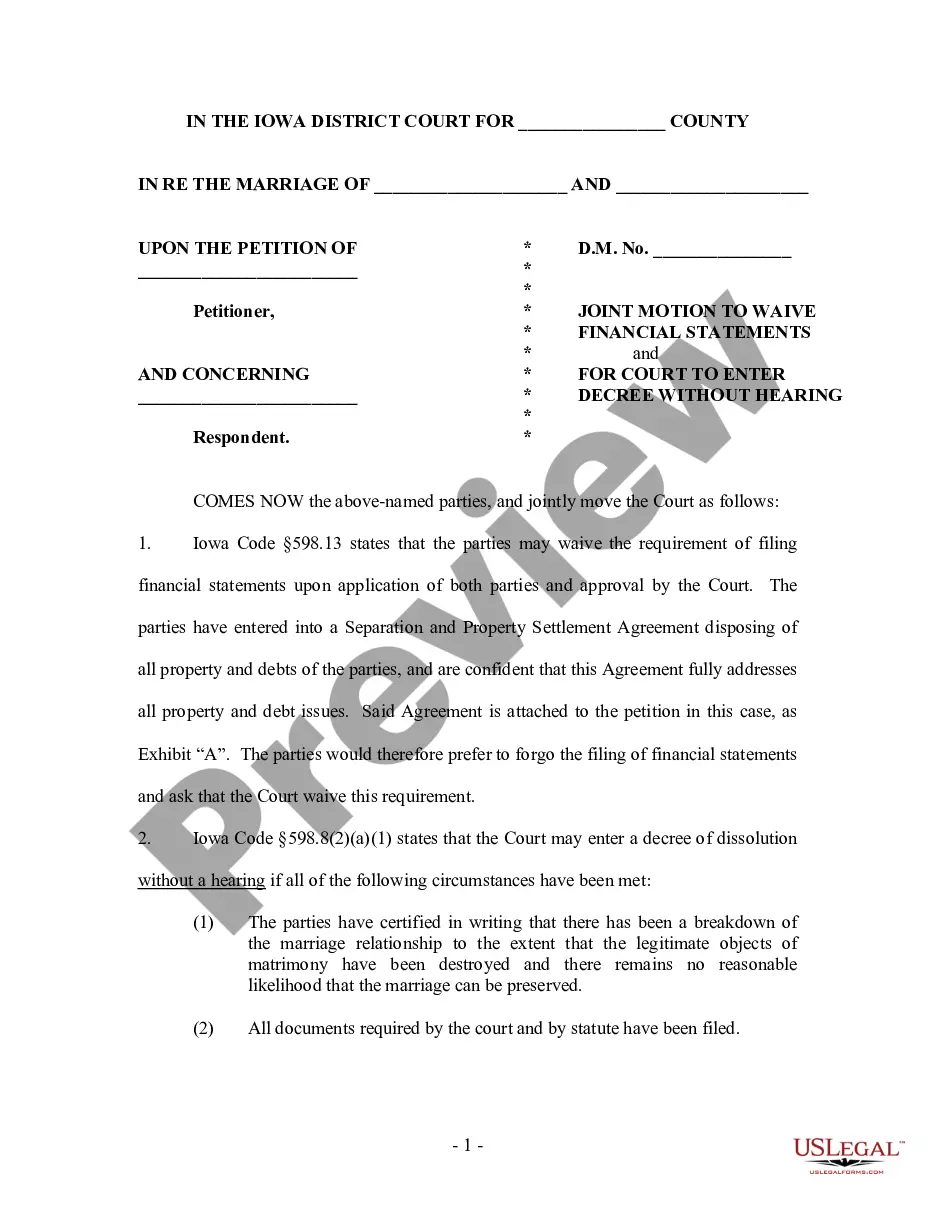
A Joint Motion to Waive Financial Statements and for Court to Enter Decree Without Hearing - Adult Children is a legal document used in divorce proceedings. It allows both parties to request that the court waive the requirement to submit financial statements when dissolving their marriage. This form is particularly useful for couples who have resolved their asset and debt issues and wish to expedite their divorce without a hearing.
Key parts of this document
- Identification of the parties involved in the divorce.
- A statement requesting the waiver of financial statement requirements.
- Reference to the applicable Iowa Code regarding financial statement waivers.
- Details of the Separation and Property Settlement Agreement.
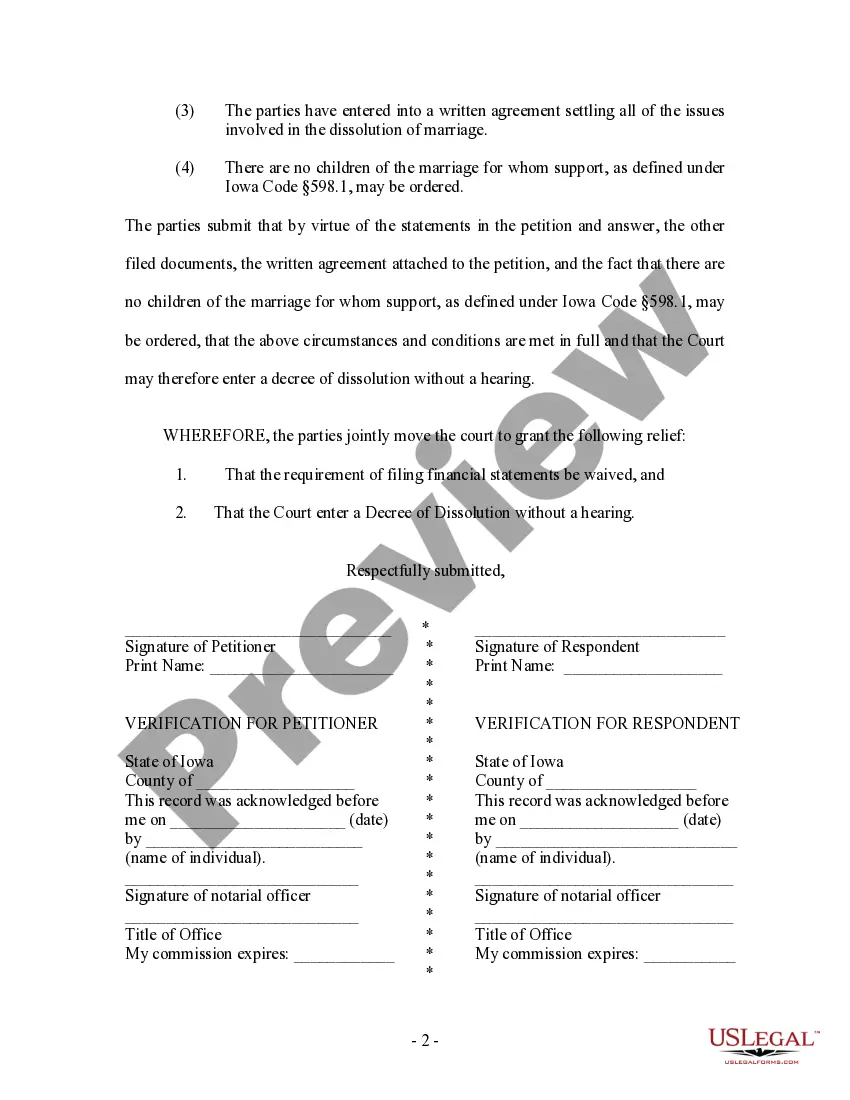
- Assurance that the marriage has irretrievably broken down.
- Certification that all necessary court documents have been submitted.

Situations where this form applies
This form should be used when both parties to a divorce in Iowa agree to waive the requirement of filing financial statements. It is applicable when the couple has no children, has already settled all asset and debt-related issues, and prefers to finalize their divorce without a court hearing.
Who needs this form
- Divorcing couples in Iowa without minor children.
- Parties who have reached a property settlement and wish to expedite their divorce.
- Individuals looking to avoid the complexity of financial disclosures in their divorce proceedings.
How to prepare this document
- Identify the full names of both parties at the top of the form.
- Fill in the case number assigned by the court.
- Attach the Separation and Property Settlement Agreement as Exhibit A.
- Complete the verification sections with signatures and dates.
- Ensure that the motion is signed in front of a notary public.
Notarization requirements for this form
To make this form legally binding, it must be notarized. Our online notarization service, powered by Notarize, lets you verify and sign documents remotely through an encrypted video session.
Get your form ready online
Our built-in tools help you complete, sign, share, and store your documents in one place.
Make edits, fill in missing information, and update formatting in US Legal Forms—just like you would in MS Word.
Download a copy, print it, send it by email, or mail it via USPS—whatever works best for your next step.
Sign and collect signatures with our SignNow integration. Send to multiple recipients, set reminders, and more. Go Premium to unlock E-Sign.
If this form requires notarization, complete it online through a secure video call—no need to meet a notary in person or wait for an appointment.
We protect your documents and personal data by following strict security and privacy standards.

Make edits, fill in missing information, and update formatting in US Legal Forms—just like you would in MS Word.

Download a copy, print it, send it by email, or mail it via USPS—whatever works best for your next step.

Sign and collect signatures with our SignNow integration. Send to multiple recipients, set reminders, and more. Go Premium to unlock E-Sign.

If this form requires notarization, complete it online through a secure video call—no need to meet a notary in person or wait for an appointment.

We protect your documents and personal data by following strict security and privacy standards.
Mistakes to watch out for
- Failing to attach the required Separation and Property Settlement Agreement.
- Not having the form notarized before submission.
- Leaving out important information, such as the case number or parties' names.
Why use this form online
- Easy access to downloadable formats that can be completed at your convenience.
- Editable templates ensure that all necessary information can be provided accurately.
- Reliable legal support from licensed attorneys who draft these forms.
Looking for another form?
Form popularity
FAQ
No, Iowa is not a community property state; it follows the equitable distribution model in divorce cases. This means that assets are divided fairly, though not necessarily equally. Understanding this framework can help you when filing a motion like the Iowa Joint Motion to Waive Financial Statements and for Court to Enter Decree Without Hearing - Adult Children, as it affects how property is divided.
When you file a motion to enforce, the court will review your request to ensure it complies with legal standards. After this, a hearing may be scheduled or the court may issue an order directly, depending on the situation. Utilizing the Iowa Joint Motion to Waive Financial Statements and for Court to Enter Decree Without Hearing - Adult Children can help you achieve prompt resolution and compliance from the other party.
A motion for enforcement of the decree is a request made to the court to compel compliance with a court order. This type of motion is critical after a divorce when one party fails to follow the agreed terms. With the Iowa Joint Motion to Waive Financial Statements and for Court to Enter Decree Without Hearing - Adult Children, you can streamline this process, ensuring compliance as efficiently as possible.
To initiate a divorce settlement, you can file a motion for enforcement in your local court. Utilizing the Iowa Joint Motion to Waive Financial Statements and for Court to Enter Decree Without Hearing - Adult Children can expedite this procedure. Having a clear plan and documented agreements can help you negotiate effectively, ensuring your interests are protected.
You do not strictly need a lawyer to file a motion for contempt, but having legal assistance may streamline the process. The Iowa Joint Motion to Waive Financial Statements and for Court to Enter Decree Without Hearing - Adult Children can be complex; a lawyer can help you understand the implications. Engaging a legal professional ensures that you meet all procedural requirements and effectively present your case.
A divorce decree can be deemed invalid for several reasons, including lack of jurisdiction, failure to follow procedural rules, or if one party was not properly notified. If you find issues with your decree, you may need to take legal action. Utilizing an Iowa Joint Motion to Waive Financial Statements and for Court to Enter Decree Without Hearing - Adult Children could assist in clarifying your position and addressing any discrepancies effectively.
Yes, you can contest a divorce in Iowa by filing a response to the divorce petition and presenting your case effectively. Contesting involves showing valid grounds, which may require legal assistance. In cases where agreements can be reached, consider using the Iowa Joint Motion to Waive Financial Statements and for Court to Enter Decree Without Hearing - Adult Children to facilitate smooth negotiations.
To file a motion to enforce a divorce decree in Iowa, you must prepare and submit a motion to the court detailing your request and the grounds for enforcement. It’s important to include relevant documentation supporting your claim. Using the Iowa Joint Motion to Waive Financial Statements and for Court to Enter Decree Without Hearing - Adult Children can aid in expediting this process, making it more efficient for you.
Yes, appealing a divorce decree in Iowa is possible if you believe there were legal errors affecting the outcome. The appeal process involves filing the correct paperwork and presenting compelling arguments to the court. If applicable, referencing the Iowa Joint Motion to Waive Financial Statements and for Court to Enter Decree Without Hearing - Adult Children can showcase your adherence to procedural requirements.
The odds of winning a divorce appeal in Iowa depend on the specifics of the case and the grounds for the appeal. Generally, appeals focus on legal errors rather than disagreement with the decision. If you've utilized an Iowa Joint Motion to Waive Financial Statements and for Court to Enter Decree Without Hearing - Adult Children, it might simplify your case presentation, improving your chances.