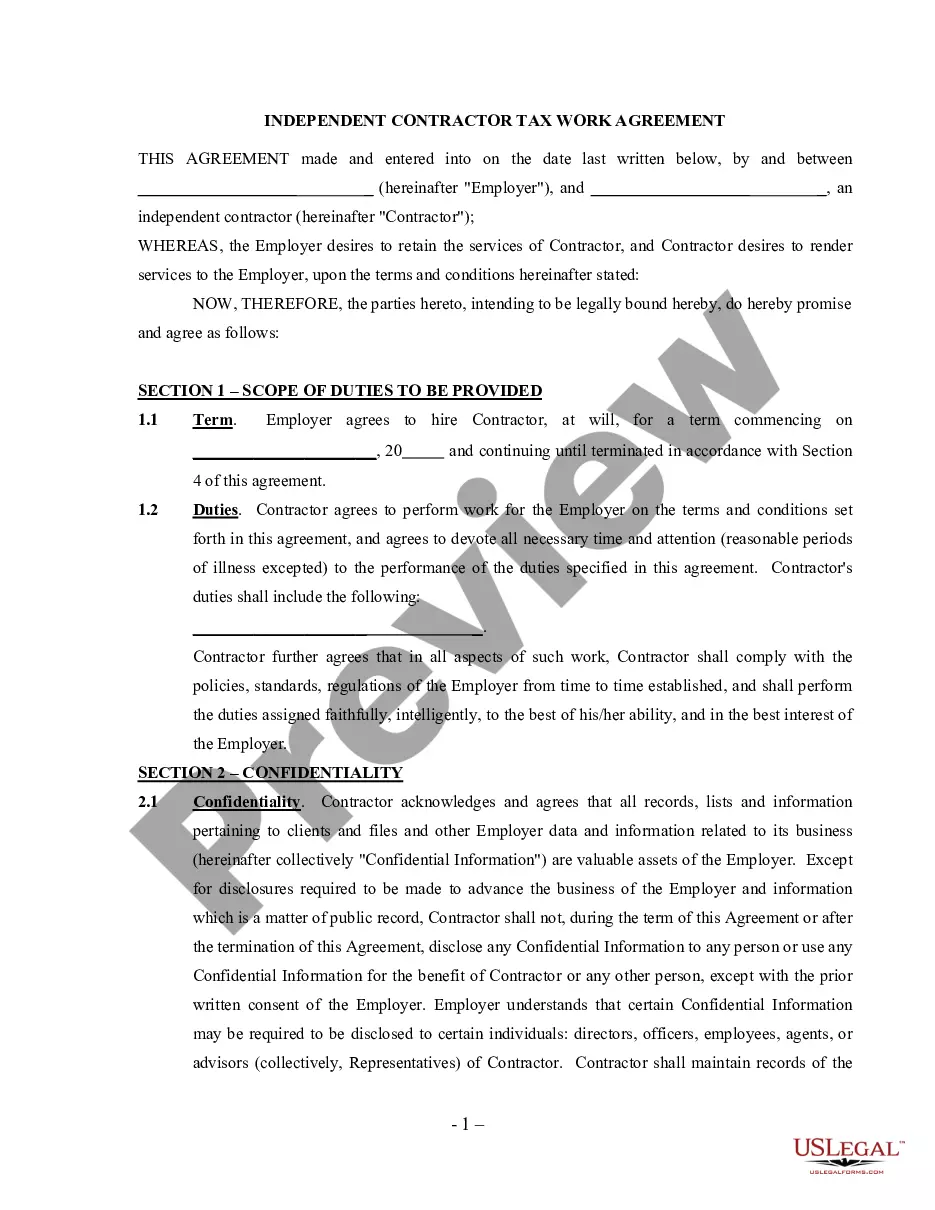
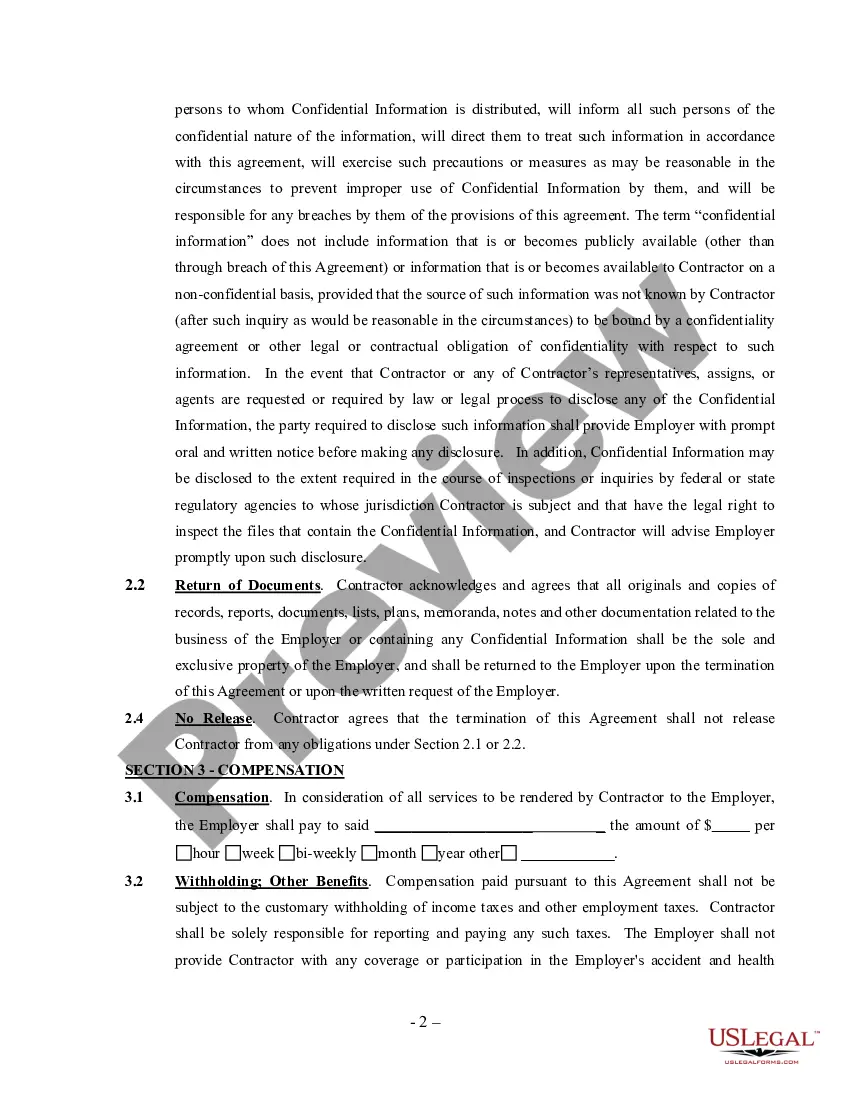
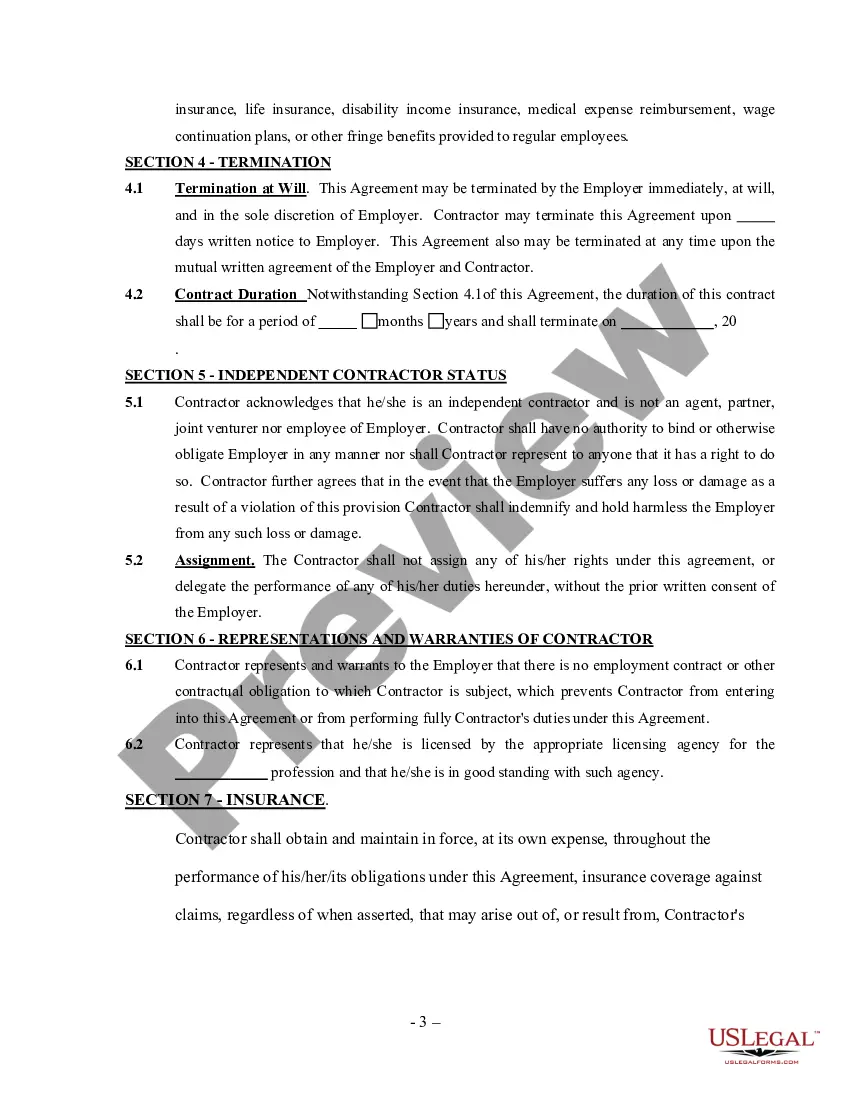
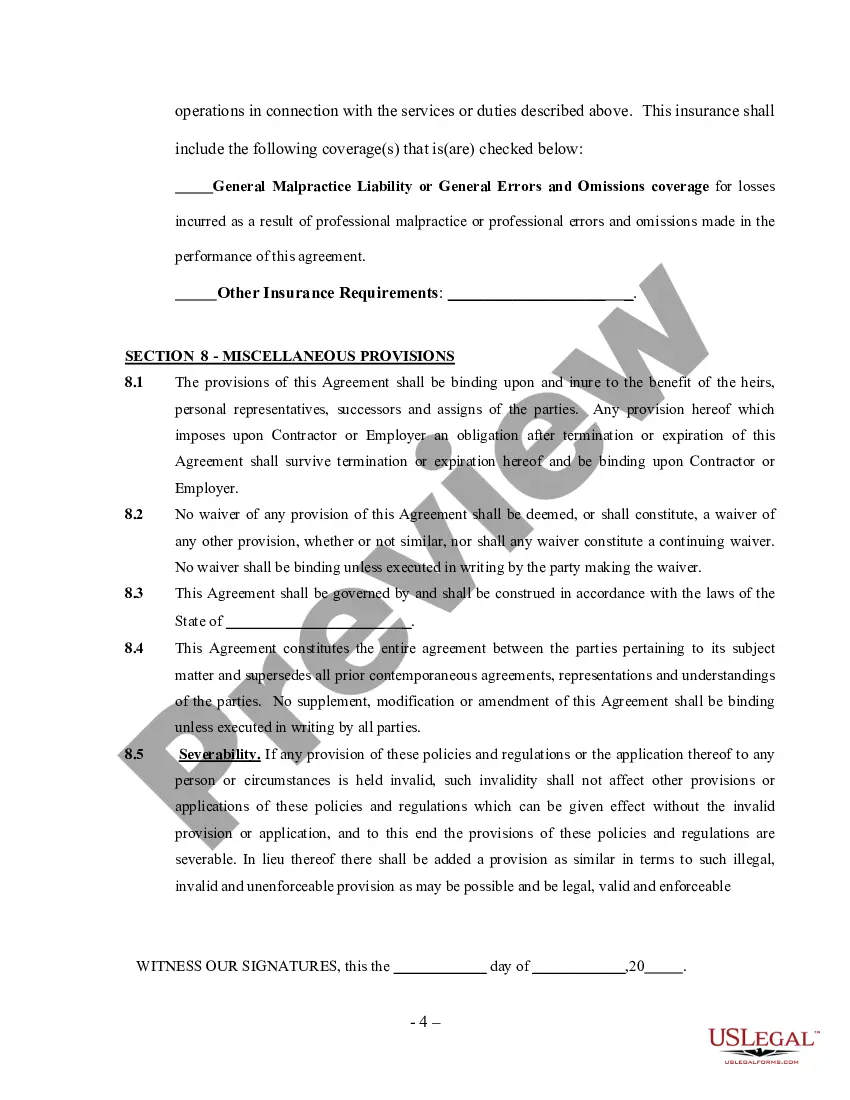
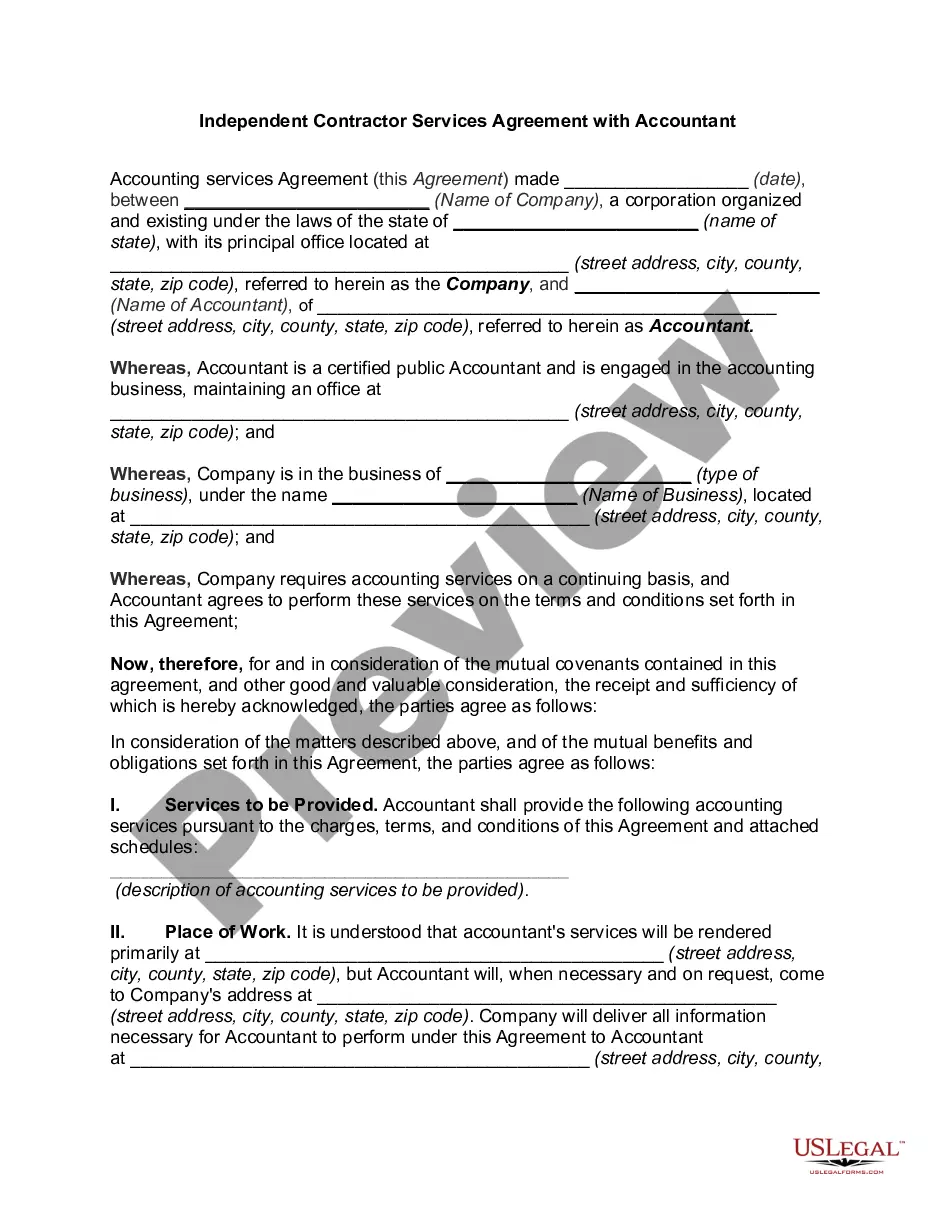
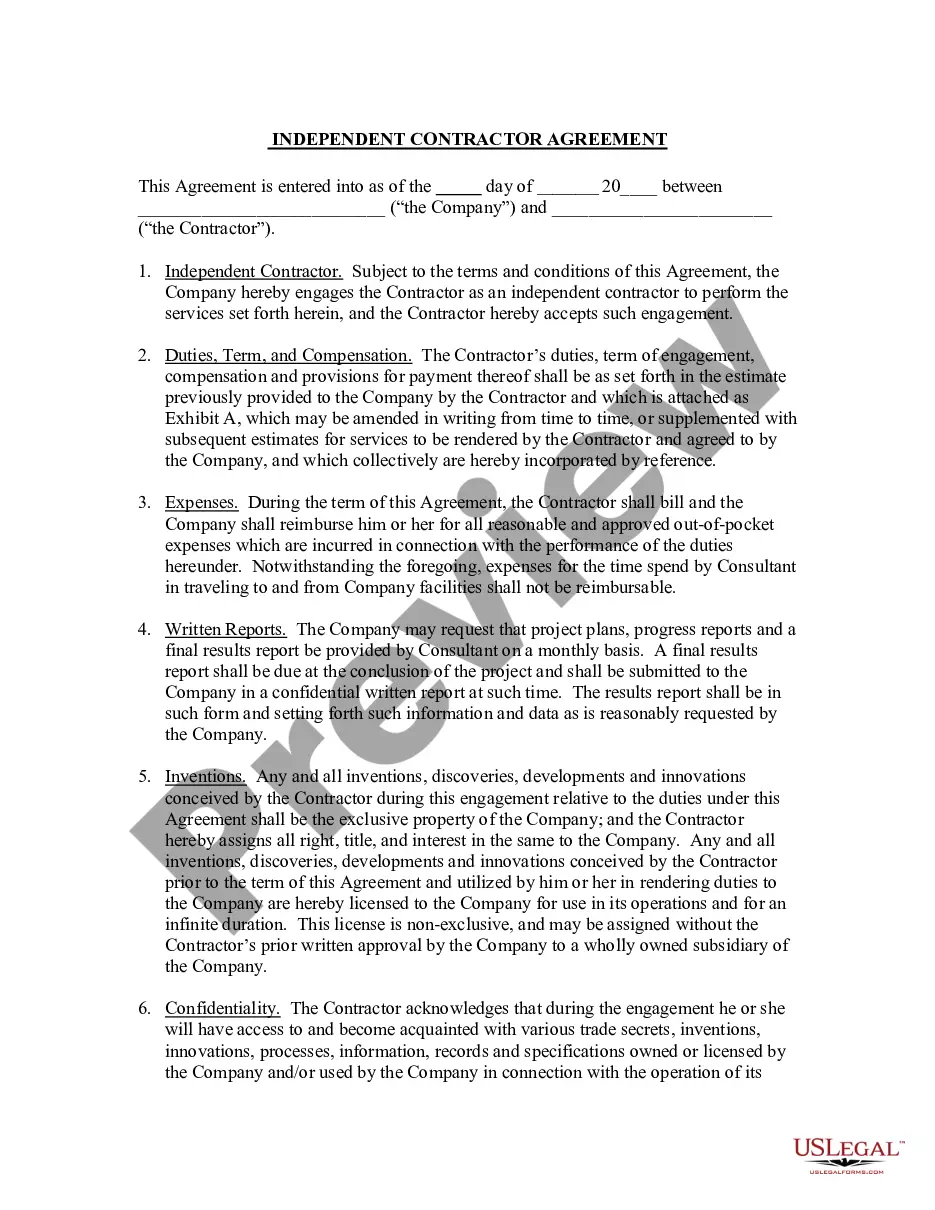
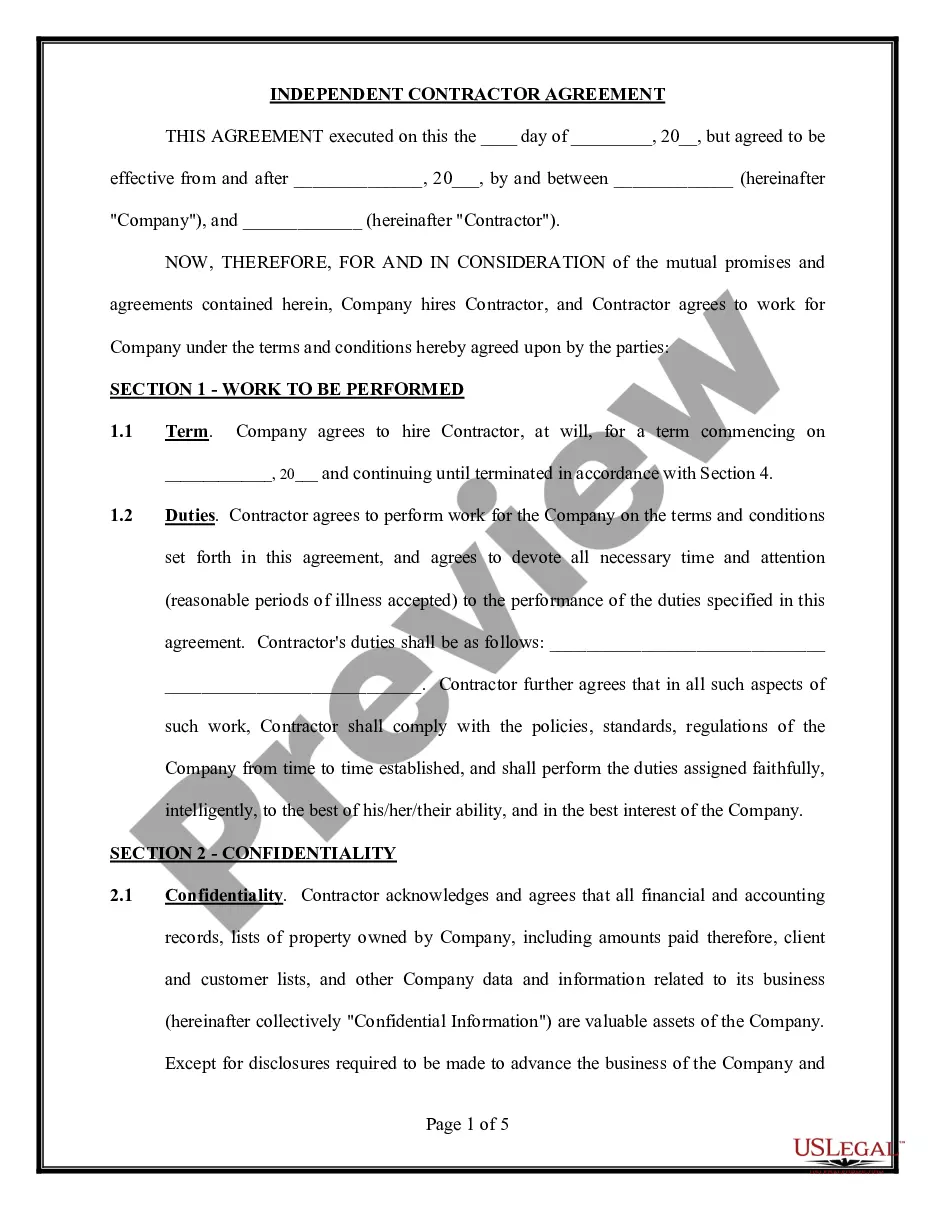
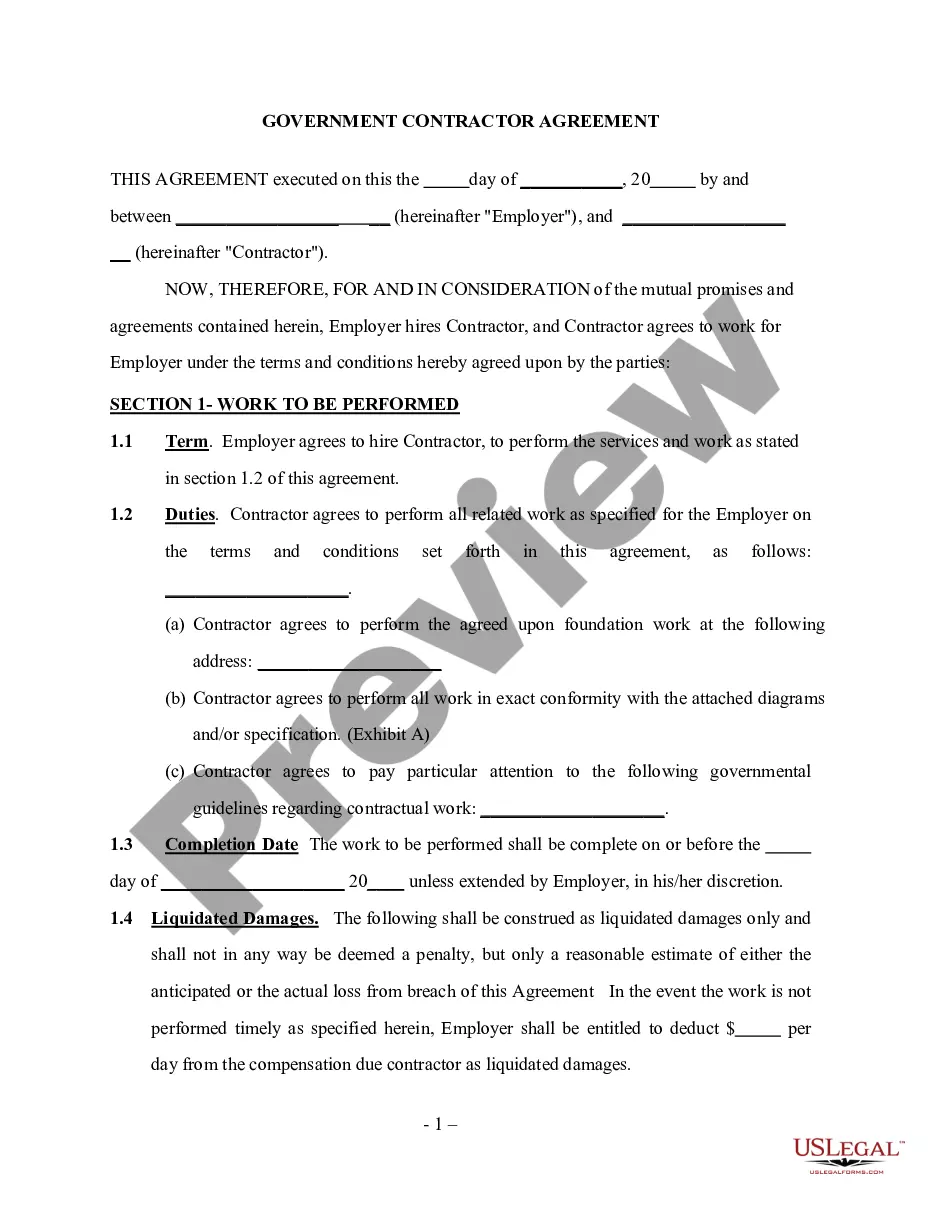
Employer contracts with an independent contractor to provide tax work services as specified and agreed upon in the contract. Contract includes a confidentiality clause.
Hawaii Tax Work Agreement - Self-Employed Independent Contractor
State:
Multi-State
Control #:
US-INDC-128
Format:
Word;
Rich Text
98 downloads
Description
Free preview
Get your form ready online
Our built-in tools help you complete, sign, share, and store your documents in one place.
Built-in online Word editor
Make edits, fill in missing information, and update formatting in US Legal Forms—just like you would in MS Word.
Export easily
Download a copy, print it, send it by email, or mail it via USPS—whatever works best for your next step.
E-sign your document
Sign and collect signatures with our SignNow integration. Send to multiple recipients, set reminders, and more. Go Premium to unlock E-Sign.
Notarize online 24/7
If this form requires notarization, complete it online through a secure video call—no need to meet a notary in person or wait for an appointment.
Store your document securely
We protect your documents and personal data by following strict security and privacy standards.

Make edits, fill in missing information, and update formatting in US Legal Forms—just like you would in MS Word.

Download a copy, print it, send it by email, or mail it via USPS—whatever works best for your next step.

Sign and collect signatures with our SignNow integration. Send to multiple recipients, set reminders, and more. Go Premium to unlock E-Sign.

If this form requires notarization, complete it online through a secure video call—no need to meet a notary in person or wait for an appointment.

We protect your documents and personal data by following strict security and privacy standards.
Looking for another form?
How to fill out Tax Work Agreement - Self-Employed Independent Contractor?
Have you ever found yourself in a situation where you need documents for various business or personal activities on a daily basis? There are numerous legal document templates available online, but finding ones you can rely on isn’t easy.
US Legal Forms offers thousands of form templates, including the Hawaii Tax Work Agreement - Self-Employed Independent Contractor, that are designed to comply with federal and state regulations.
If you are already familiar with the US Legal Forms website and have an account, simply Log In. After that, you can download the Hawaii Tax Work Agreement - Self-Employed Independent Contractor template.
Choose a convenient document format and download your copy.
Access all the document templates you have purchased in the My documents section. You can download an additional copy of the Hawaii Tax Work Agreement - Self-Employed Independent Contractor at any time, if needed. Just select the required form to download or print the document template. Use US Legal Forms, the most extensive collection of legal documents, to save time and avoid mistakes. The service provides professionally crafted legal document templates that you can use for a variety of purposes. Create an account on US Legal Forms and start making your life easier.
- If you do not have an account and wish to start using US Legal Forms, follow these steps.
- Locate the form you need and ensure it is for the correct city/state.
- Utilize the Review option to examine the form.
- Check the summary to confirm that you have chosen the right form.
- If the form isn’t what you’re looking for, use the Lookup section to find the form that suits your requirements.
- Once you find the appropriate form, click on Purchase now.
- Select the pricing plan you want, complete the necessary information to create your account, and make the payment using your PayPal or credit card.
Form popularity
FAQ
The G49 form is used for reporting and paying Hawaii’s general excise tax. If you're an independent contractor operating in Hawaii, understanding this form is crucial for compliance. This requirement may be part of your responsibilities under a Hawaii Tax Work Agreement - Self-Employed Independent Contractor. Familiarizing yourself with the G49 ensures you fulfill your tax obligations effectively.
To prepare taxes as an independent contractor, begin by organizing all income and expense records. Use Schedule C to report net earnings, and don't forget to account for self-employment tax. Familiarize yourself with the requirements outlined in your Hawaii Tax Work Agreement - Self-Employed Independent Contractor to ensure compliance. You may also find tools and resources from uslegalforms useful for filing properly.
Yes, independent contractors are subject to self-employment tax on their net earnings. This tax covers Social Security and Medicare contributions. Understanding this can impact your overall tax liability when working under a Hawaii Tax Work Agreement - Self-Employed Independent Contractor. It is essential to incorporate this when calculating your taxes to avoid surprises at tax time.
Independent contractors typically fill out a W9 form when they start working with a new client. This form provides the necessary tax identification information for the client to issue a 1099 at the end of the year. Understanding when to use each form is crucial for maintaining accurate records within your Hawaii Tax Work Agreement - Self-Employed Independent Contractor. This ensures smooth transactions and compliance.
To file taxes as an independent contractor, gather all relevant documents, including Form 1099 and any expense records. You will report your income on your tax return using Schedule C. Also, ensure you account for self-employment tax in your calculations. Using a service like uslegalforms can simplify this process, providing detailed guidance tailored to your Hawaii Tax Work Agreement - Self-Employed Independent Contractor.
Self-employed independent contractors typically use Schedule C to report income and expenses on their federal tax returns. This form allows you to detail your earnings from business activities. In conjunction with your Hawaii Tax Work Agreement - Self-Employed Independent Contractor, this information helps accurately calculate your net profit. Properly filling out this form streamlines your tax filing process.
The $600 rule states that clients must issue a 1099 form to independent contractors who earn $600 or more in a calendar year. This form reports the payments made to you for tax purposes. Hence, if you're a self-employed independent contractor in Hawaii, it's important to keep track of your earnings. Knowing this rule ensures you receive the appropriate documentation for your tax filings.
An independent contractor must file taxes if they earn $400 or more in a year, according to IRS guidelines. This threshold applies to net earnings, not gross income. Understanding your obligations is essential when working under a Hawaii Tax Work Agreement - Self-Employed Independent Contractor. Staying compliant helps you avoid penalties down the line.
Independent contractors can earn up to $400 in a year without having to file a tax return for self-employment. Beyond this threshold, you must report your earnings and may owe taxes based on the Hawaii Tax Work Agreement - Self-Employed Independent Contractor. It’s best to track your income accurately to meet tax obligations.
The new federal rule clarifies the classification of workers as independent contractors versus employees. It primarily impacts how benefits and protections apply under federal law. Under the Hawaii Tax Work Agreement - Self-Employed Independent Contractor, understanding these changes is vital to ensure compliance and protect your rights.