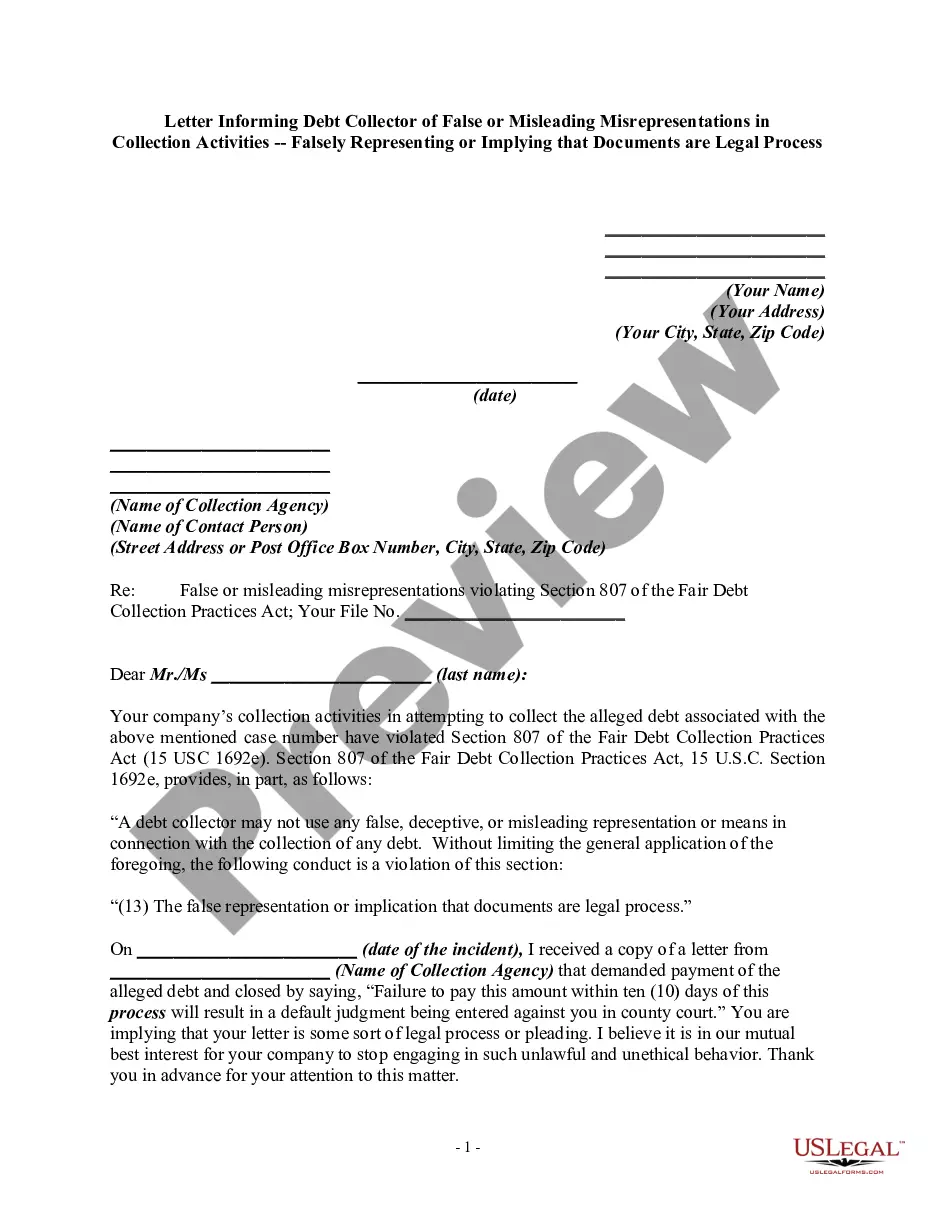
Hawaii Letter Informing Debt Collector of False or Misleading Misrepresentations in Collection Activities - Falsely Representing or Implying that Documents are Legal Process

State:
Multi-State
Control #:
US-DCPA-19.16BG
Format:
Word; 
Rich Text
Instant download

Description

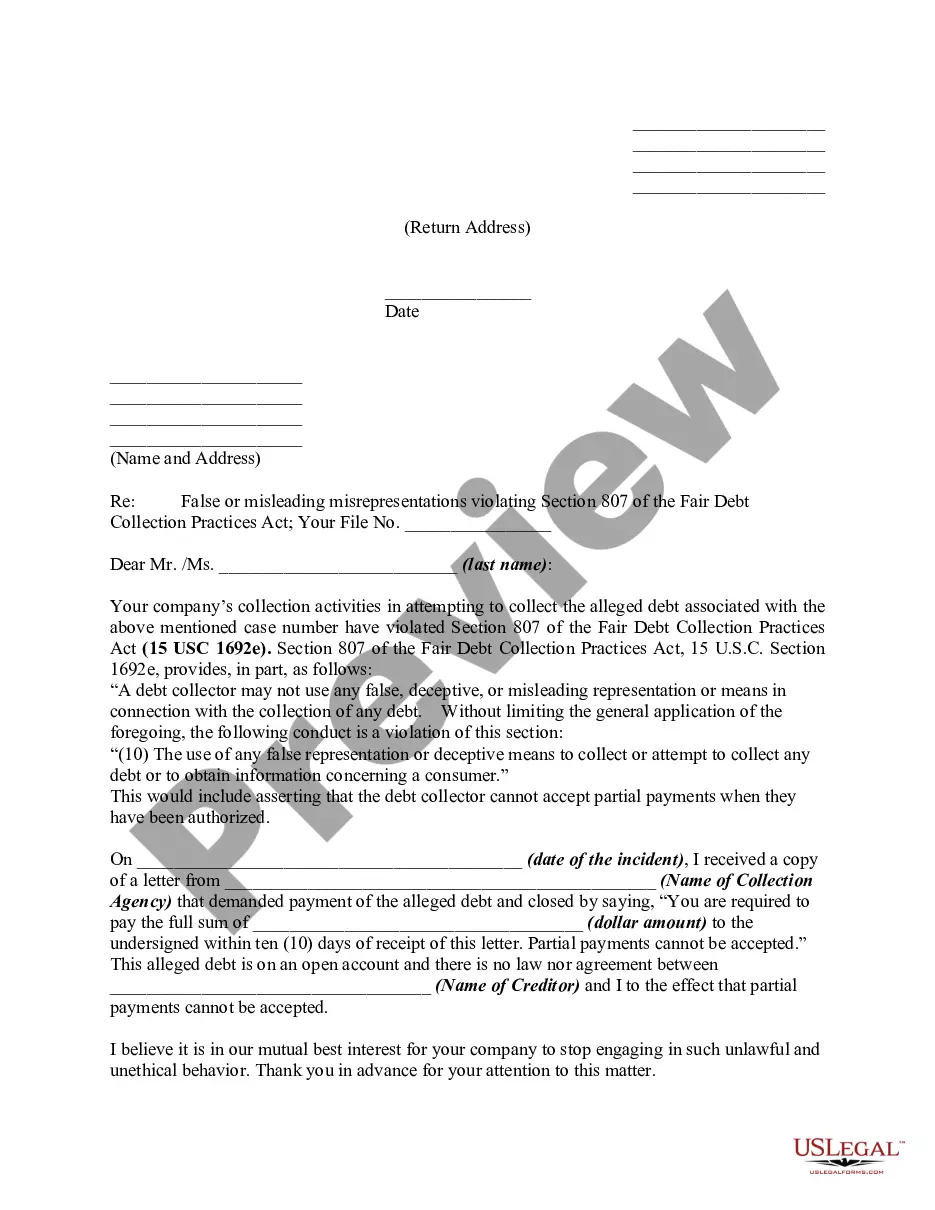
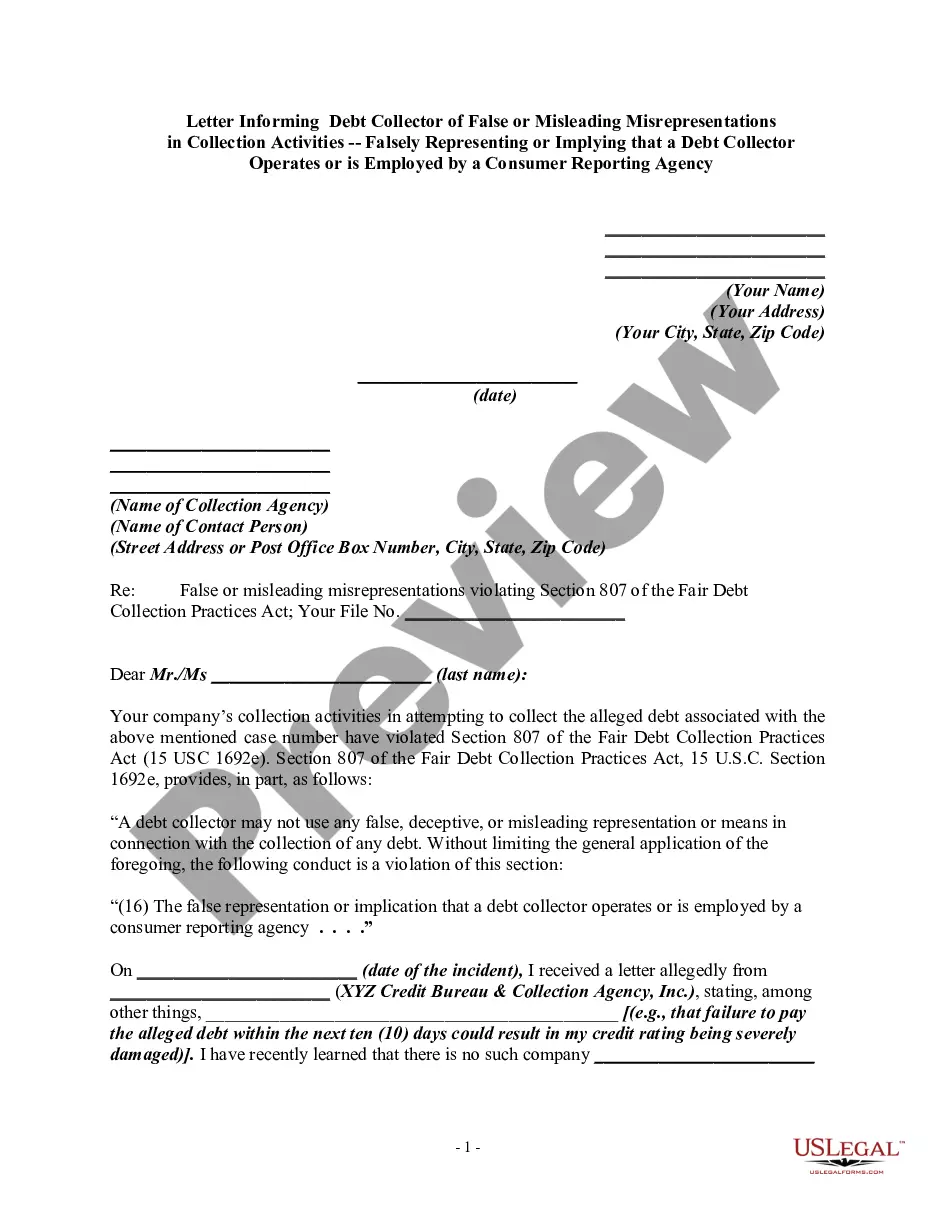
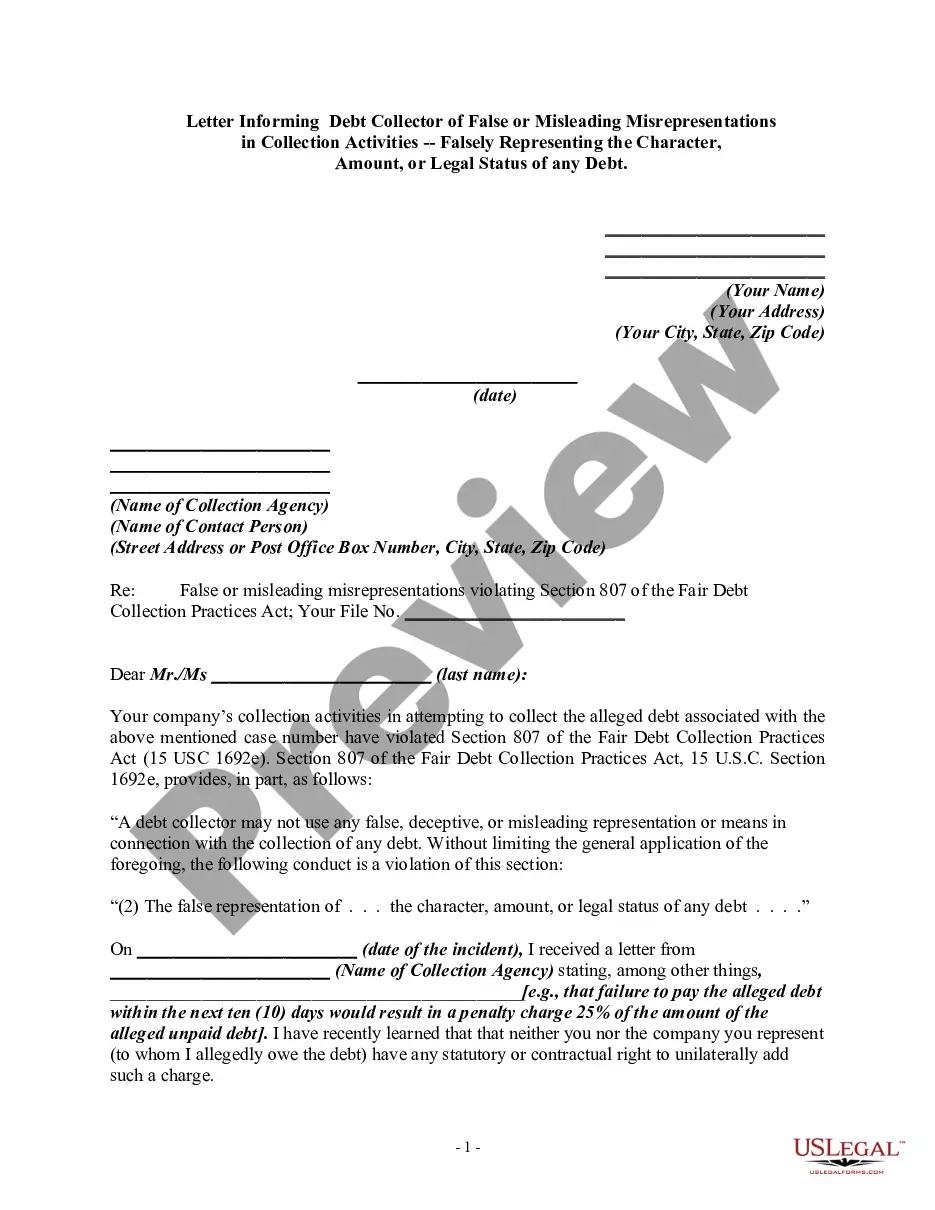
Section 807 of the Fair Debt Collection Practices Act, 15 U.S.C. Section 1692e, provides, in part, as follows: "A debt collector may not use any false, deceptive, or misleading representation or means in connection with the collection of any debt. Without limiting the general application of the foregoing, the following conduct is a violation of this section:


"(13) The false representation or implication that documents are legal process."
Free preview
  • Preview Letter Informing Debt Collector of False or Misleading Misrepresentations in Collection Activities - Falsely Representing or Implying that Documents are Legal Process
  • Preview Letter Informing Debt Collector of False or Misleading Misrepresentations in Collection Activities - Falsely Representing or Implying that Documents are Legal Process

Related forms

form-preview
Hawaii Letter Informing Debt Collector of False or Misleading Misrepresentations in Collection Activities

Hawaii Letter Informing Debt Collector of False or Misleading Misrepresentations in Collection Activities

View this form
form-preview
Hawaii Letter Informing Debt Collector of False or Misleading Misrepresentations in Collection Activities - Falsely Representing that Debtor has or is Committing Criminal Fraud by Nonpayment of a Debt

Hawaii Letter Informing Debt Collector of False or Misleading Misrepresentations in Collection Activities - Falsely Representing that Debtor has or is Committing Criminal Fraud by Nonpayment of a Debt

View this form
form-preview
Hawaii Letter Informing Debt Collector of False or Misleading Misrepresentations in Collection Activities - Using False Representation or Deceptive Means to Collect a Debt

Hawaii Letter Informing Debt Collector of False or Misleading Misrepresentations in Collection Activities - Using False Representation or Deceptive Means to Collect a Debt

View this form
form-preview
Hawaii Letter Informing Debt Collector of False or Misleading Misrepresentations in Collection Activities - Falsely Representing or Implying that a Debt Collector Operates or is Employed by a Consumer Reporting Agency

Hawaii Letter Informing Debt Collector of False or Misleading Misrepresentations in Collection Activities - Falsely Representing or Implying that a Debt Collector Operates or is Employed by a Consumer Reporting Agency

View this form
form-preview
Hawaii Letter Informing Debt Collector of False or Misleading Misrepresentations in Collection Activities - Falsely Representing the Character, Amount, or Legal Status of any Debt

Hawaii Letter Informing Debt Collector of False or Misleading Misrepresentations in Collection Activities - Falsely Representing the Character, Amount, or Legal Status of any Debt

View this form

How to fill out Letter Informing Debt Collector Of False Or Misleading Misrepresentations In Collection Activities - Falsely Representing Or Implying That Documents Are Legal Process?

It is feasible to spend time online searching for the legal document format that complies with the state and federal requirements you need.

US Legal Forms offers a vast array of legal forms that are reviewed by professionals.

You can download or print the Hawaii Letter Notifying Debt Collector of False or Misleading Statements in Collection Efforts - Falsely Representing or Implying that Documents are Legal Process through their services.

If available, use the Preview button to view the document format as well.

  1. If you have a US Legal Forms account, you can Log In and click on the Download button.
  2. Next, you can complete, modify, print, or sign the Hawaii Letter Notifying Debt Collector of False or Misleading Statements in Collection Efforts - Falsely Representing or Implying that Documents are Legal Process.
  3. Every legal document format you purchase is your property permanently.
  4. To acquire another copy of a purchased form, go to the My documents tab and click the relevant button.
  5. If you are using the US Legal Forms site for the first time, follow the straightforward instructions provided below.
  6. First, make sure you have selected the correct document format for the area/region you choose.
  7. Check the form description to verify you have selected the correct type.

Form popularity

FAQ

Under the Fair Credit Reporting Act (FCRA) (15 U.S.C. § 1681 and following), you may sue a credit reporting agency for negligent or willful noncompliance with the law within two years after you discover the harmful behavior or within five years after the harmful behavior occurs, whichever is sooner.

Unfair practices are prohibitedDeposit or threaten to deposit a postdated check before your intended payment date. Take or threaten to take property if it's not allowed. Collect more than you owe on a debt, which may include fees and interest.

The Fair Debt Collection Practices Act (FDCPA) The FDCPA prohibits debt collection companies from using abusive, unfair or deceptive practices to collect debts from you.

Debt collectors are generally prohibited under federal law from using any false, deceptive, or misleading misrepresentation in collecting a debt. The federal law that prohibits this is called the Fair Debt Collection Practices Act (FDCPA).

Unfair practices are prohibitedDeposit or threaten to deposit a postdated check before your intended payment date. Take or threaten to take property if it's not allowed. Collect more than you owe on a debt, which may include fees and interest.

(1) The false representation or implication that the debt collector is vouched for, bonded by, or affiliated with the United States or any State, including the use of any badge, uniform, or facsimile thereof. (2) The false representation of -- (A) the character, amount, or legal status of any debt; or.

Debt collectors cannot harass or abuse you. They cannot swear, threaten to illegally harm you or your property, threaten you with illegal actions, or falsely threaten you with actions they do not intend to take. They also cannot make repeated calls over a short period to annoy or harass you.

Yes, you may be able to sue a debt collector or a debt collection agency if it engages in abusive, deceptive, or unfair behavior. A debt collector is generally someone who buys a debt from a creditor who, for whatever reason, has been unable to collect from a consumer.

7 Most Common FDCPA ViolationsContinued attempts to collect debt not owed.Illegal or unethical communication tactics.Disclosure verification of debt.Taking or threatening illegal action.False statements or false representation.Improper contact or sharing of info.Excessive phone calls.

Trusted and secure by over 3 million people of the world’s leading companies

Hawaii Letter Informing Debt Collector of False or Misleading Misrepresentations in Collection Activities - Falsely Representing or Implying that Documents are Legal Process