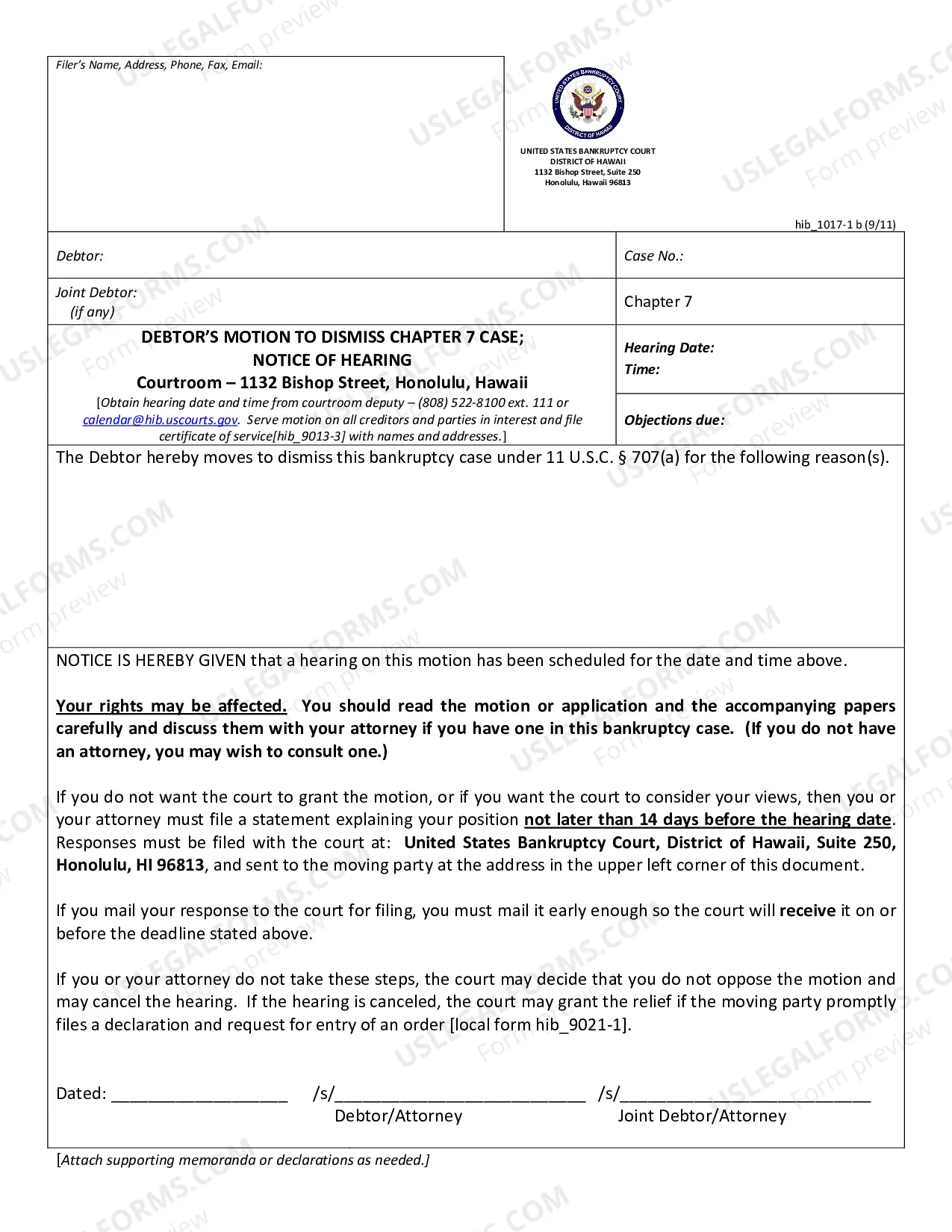
Hawaii Dismiss - Chapter 7 (Debtor's Motion)
Description
Get your form ready online
Our built-in tools help you complete, sign, share, and store your documents in one place.
Make edits, fill in missing information, and update formatting in US Legal Forms—just like you would in MS Word.
Download a copy, print it, send it by email, or mail it via USPS—whatever works best for your next step.
Sign and collect signatures with our SignNow integration. Send to multiple recipients, set reminders, and more. Go Premium to unlock E-Sign.
If this form requires notarization, complete it online through a secure video call—no need to meet a notary in person or wait for an appointment.
We protect your documents and personal data by following strict security and privacy standards.

Make edits, fill in missing information, and update formatting in US Legal Forms—just like you would in MS Word.

Download a copy, print it, send it by email, or mail it via USPS—whatever works best for your next step.

Sign and collect signatures with our SignNow integration. Send to multiple recipients, set reminders, and more. Go Premium to unlock E-Sign.

If this form requires notarization, complete it online through a secure video call—no need to meet a notary in person or wait for an appointment.

We protect your documents and personal data by following strict security and privacy standards.
Looking for another form?


How to fill out Hawaii Dismiss - Chapter 7 (Debtor's Motion)?
Drafting legal documentation can be quite a challenge unless you have accessible fillable formats. With the US Legal Forms online repository of official paperwork, you can be confident in the templates you receive, as all of them adhere to federal and state guidelines and are verified by our professionals.
Therefore, if you need to create the Hawaii Dismiss - Chapter 7 (Debtor's Motion), our platform is the ideal location to acquire it.
Here’s a brief guide for you: Document compliance verification. You should carefully review the content of the template you intend to use and ensure it fits your needs and aligns with your state legal requirements. Reviewing your document and checking its general description will assist you in this process.
- Obtaining your Hawaii Dismiss - Chapter 7 (Debtor's Motion) from our repository is as easy as pie.
- Previously registered members with an active subscription just need to Log In and click the Download button once they locate the right template.
- If necessary, users can retrieve the same document from the My documents section of their account.
- However, even if you are new to our service, setting up a valid subscription will only take a few moments.
Form popularity
FAQ
Most Chapter 7 bankruptcy cases take between 4 - 6 months to complete after filing the case with the court. The order erasing eligible debts can be granted as early as 90 days from the date the case was filed. No-asset cases are typically closed a couple of weeks after the discharge date.
It represents a formal order from the bankruptcy judge that all debts which can be eliminated or adjusted have been so modified. This order is binding on all state and federal courts and if a creditor attempts to collect on a discharged debt, you can sue that creditor for damages in a contempt proceeding.
Dismissal of a Bankruptcy Case ? Dismissal ordinarily means that the court stopped all proceedings in the main bankruptcy case AND in all adversary proceedings, and a discharge order was not entered. Dismissal can occur because a debtor requested the dismissal and qualifies for voluntary dismissal.
During a Chapter 7 bankruptcy, a court wipes away your qualifying debts. Unfortunately, your credit will also take a major hit. If you've gone through a Chapter 7 bankruptcy, you'll need to wait at least 4 years after a court discharges or dismisses your bankruptcy to qualify for a conventional loan.
Filers are usually hoping to get a bankruptcy discharge. That's the order that wipes out certain debts and gives you a fresh start. A dismissal is very different. It means your case has been stopped before the court granted a discharge.