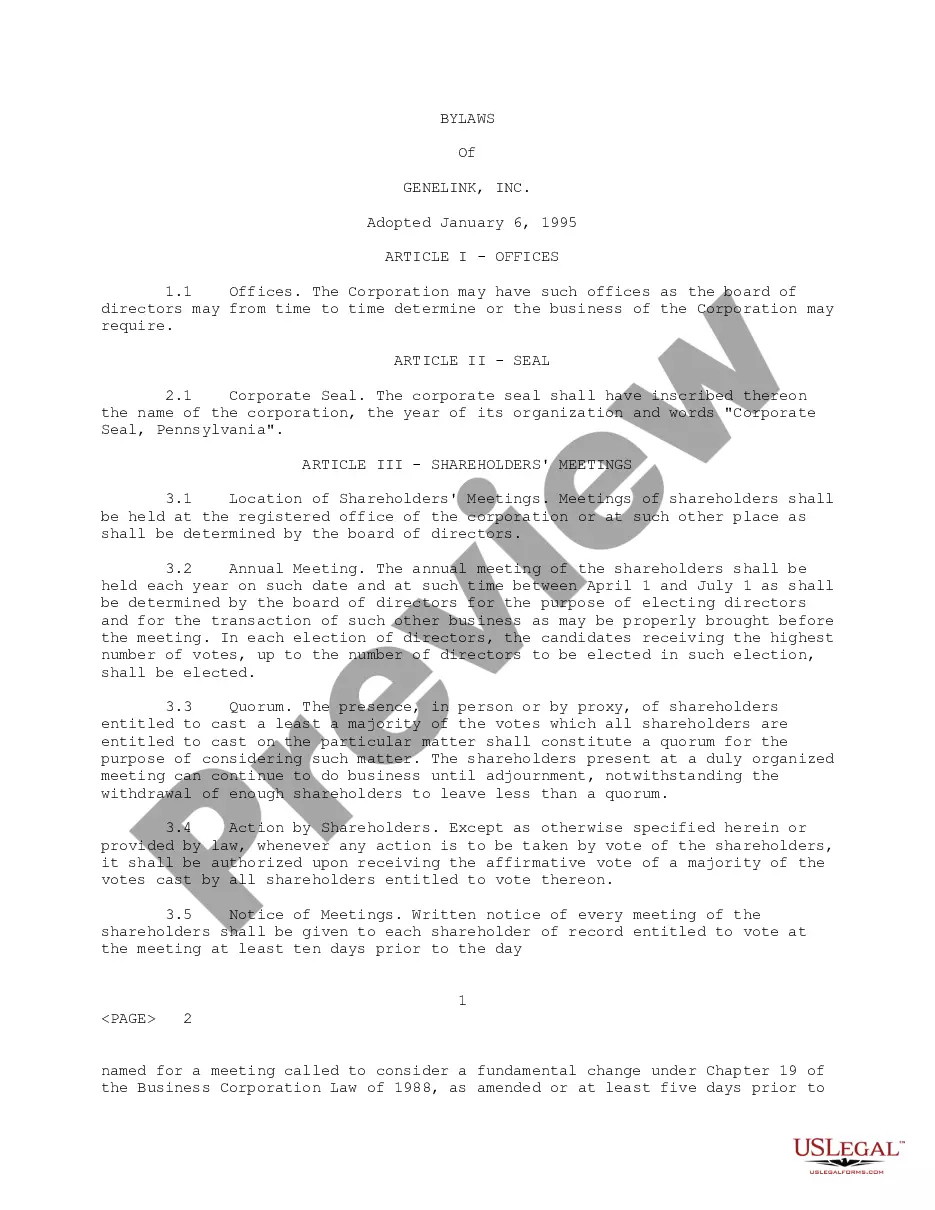
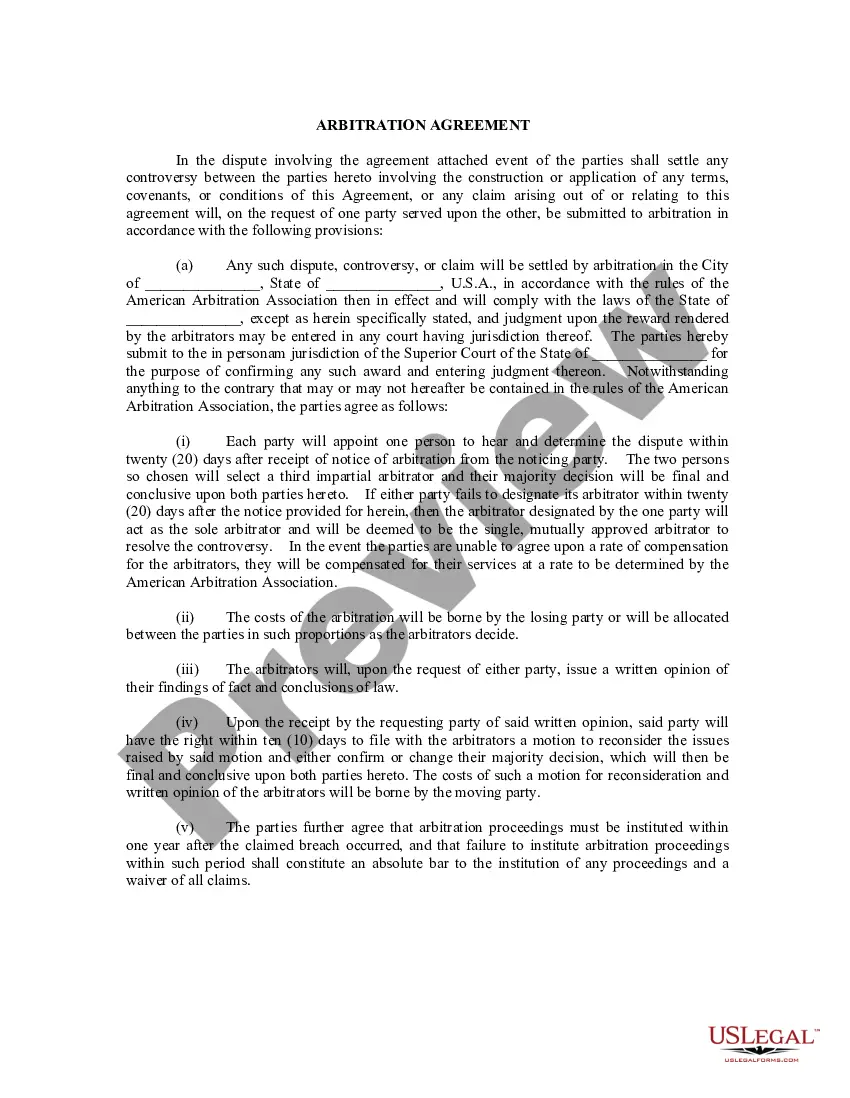
This form is an Arbitration Agreement. The form provides that each party will appoint one person to hear and determine the dispute within twenty days after receipt of notice of arbitration from the noticing party. The costs of the arbitration will be absorbed by the losing party or will be allocated between the parties in such proportions as the arbitrators decide.
Guam OEM Arbitration Agreement
Category:
State:
Multi-State
Control #:
US-KWP-0046
Format:
Word;
Rich Text
Instant download
Description

Get your form ready online
Our built-in tools help you complete, sign, share, and store your documents in one place.
Built-in online Word editor
Make edits, fill in missing information, and update formatting in US Legal Forms—just like you would in MS Word.
Export easily
Download a copy, print it, send it by email, or mail it via USPS—whatever works best for your next step.
E-sign your document
Sign and collect signatures with our SignNow integration. Send to multiple recipients, set reminders, and more. Go Premium to unlock E-Sign.
Notarize online 24/7
If this form requires notarization, complete it online through a secure video call—no need to meet a notary in person or wait for an appointment.
Store your document securely
We protect your documents and personal data by following strict security and privacy standards.

Make edits, fill in missing information, and update formatting in US Legal Forms—just like you would in MS Word.

Download a copy, print it, send it by email, or mail it via USPS—whatever works best for your next step.

Sign and collect signatures with our SignNow integration. Send to multiple recipients, set reminders, and more. Go Premium to unlock E-Sign.

If this form requires notarization, complete it online through a secure video call—no need to meet a notary in person or wait for an appointment.

We protect your documents and personal data by following strict security and privacy standards.
Looking for another form?


How to fill out OEM Arbitration Agreement?
US Legal Forms - one of the most prominent collections of legal documents in the United States - offers an extensive selection of legal template forms you can download or print.
By utilizing the website, you can discover countless forms for business and personal purposes, categorized by type, state, or keywords. You can find the latest versions of forms like the Guam OEM Arbitration Agreement in just a few minutes.
If you already have a membership, Log In and download the Guam OEM Arbitration Agreement from the US Legal Forms collection. The Download button will appear on every form you view. You can access all previously downloaded forms in the My documents section of your account.
Proceed with the transaction. Use your credit card or PayPal account to complete the purchase.
Choose the format and download the form to your device. Edit it. Fill out, modify, print, and sign the downloaded Guam OEM Arbitration Agreement. Every template you added to your account does not have an expiration date and is yours permanently. So, if you need to download or print another copy, just go to the My documents section and click on the form you need.
- First, ensure you have selected the correct form for your jurisdiction.
- Click the Review button to check the contents of the form.
- Examine the form details to ensure you have chosen the right form.
- If the form does not fulfill your requirements, use the Search bar at the top of the screen to find one that does.
- If you are satisfied with the form, confirm your choice by clicking the Purchase Now button.
- Then, select your preferred pricing plan and provide your details to register for an account.
Form popularity
FAQ
An arbitration agreement is considered valid when it meets certain legal requirements, including mutual consent, clearly defined terms, and the intention to arbitrate disputes. Additionally, it must comply with applicable laws and regulations. The Guam OEM Arbitration Agreement is designed to be robust, ensuring its enforceability and protecting your rights in any potential disputes.
Arbitration agreements generally fall into two categories: pre-dispute agreements and post-dispute agreements. Pre-dispute agreements are formulated before any conflict arises, often included in contracts, while post-dispute agreements are created after a dispute has occurred. The Guam OEM Arbitration Agreement fits as a pre-dispute agreement, promoting conflict avoidance.
The two main types of arbitration are binding and non-binding arbitration. Binding arbitration means the decision is final and enforceable in court, while non-binding arbitration allows parties the option to reject the decision and pursue litigation. Understanding these distinctions can aid stakeholders in making informed choices about the Guam OEM Arbitration Agreement.
The arbitration clause in an international agreement outlines the specific terms under which disputes will be resolved through arbitration. For instance, in the Guam OEM Arbitration Agreement, it specifies the procedures to follow, the governing rules, and the designated arbitration bodies. This clause ensures all parties understand their rights and obligations regarding dispute resolution.
Arbitration agreements are legal contracts in which two or more parties agree to settle their disputes outside of court. In the context of the Guam OEM Arbitration Agreement, it provides a structured method for resolving conflicts efficiently while minimizing legal costs. These agreements are particularly useful in business environments where prompt resolution is crucial.
To draft an effective arbitration agreement, first identify the key elements that need to be included, such as the parties involved and the nature of the disputes. Using resources like uslegalforms can provide guidance and templates tailored to meet your needs. It is important to review and customize the agreement to reflect the specific circumstances and intentions of both parties.
A good arbitration clause in a Guam OEM Arbitration Agreement clearly defines the scope of disputes subject to arbitration and specifies the rules to be followed. It should detail how the arbitrator will be chosen and the location of the arbitration. Including terms for confidentiality and procedural aspects can enhance the effectiveness of the clause.
Drafting a Guam OEM Arbitration Agreement requires clarity and specificity in its terms. Start by outlining the scope of arbitration, the rules that will govern the process, and the selection of an arbitrator. Consider using templates provided by platforms like uslegalforms to simplify the process and ensure compliance with legal standards.
In Guam, an arbitration agreement does not necessarily need to be stamped to be valid; however, having it notarized may provide additional legal strength. It is important to comply with any specific requirements set by local laws. A well-drafted Guam OEM Arbitration Agreement should clearly state the terms and conditions relevant to the dispute.
To enforce a Guam OEM Arbitration Agreement, parties must ensure that it is in writing and signed by both parties. Courts often look for clear consent and appropriate language within the agreement. Enforcing the agreement may involve bringing a motion to compel arbitration if one party refuses to comply with the arbitration process outlined.