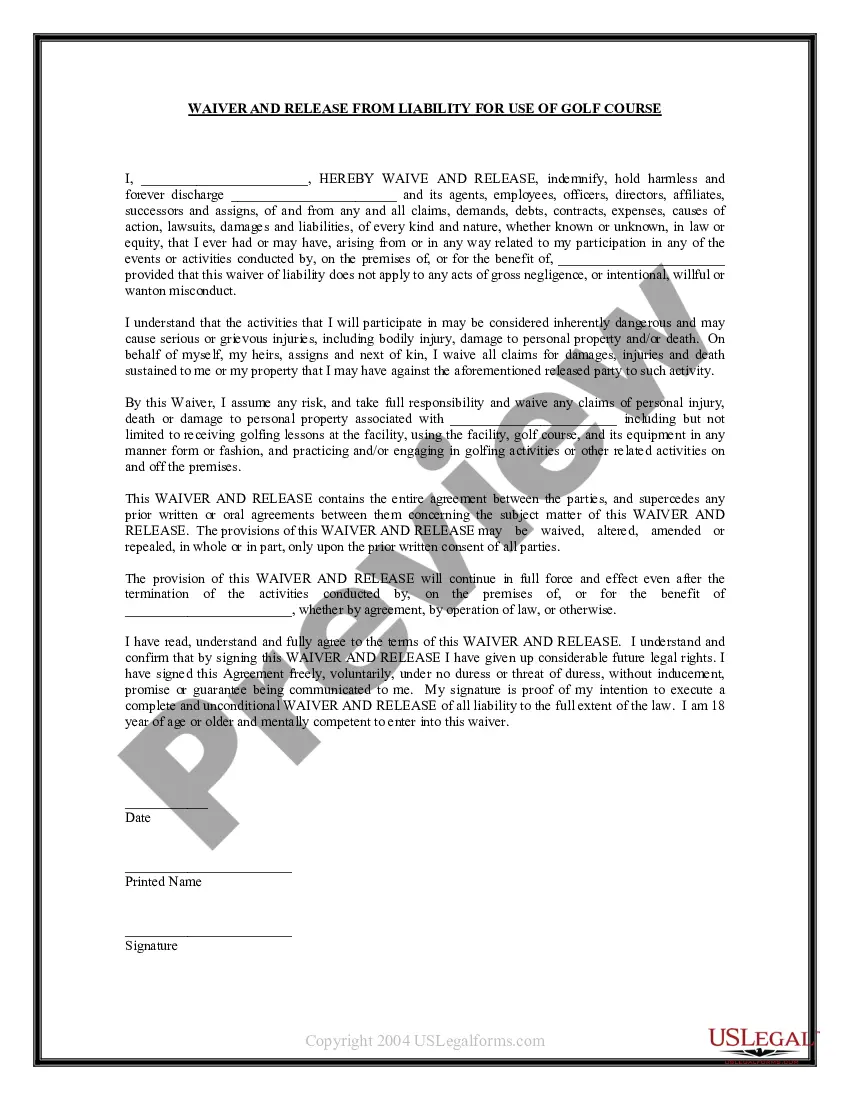
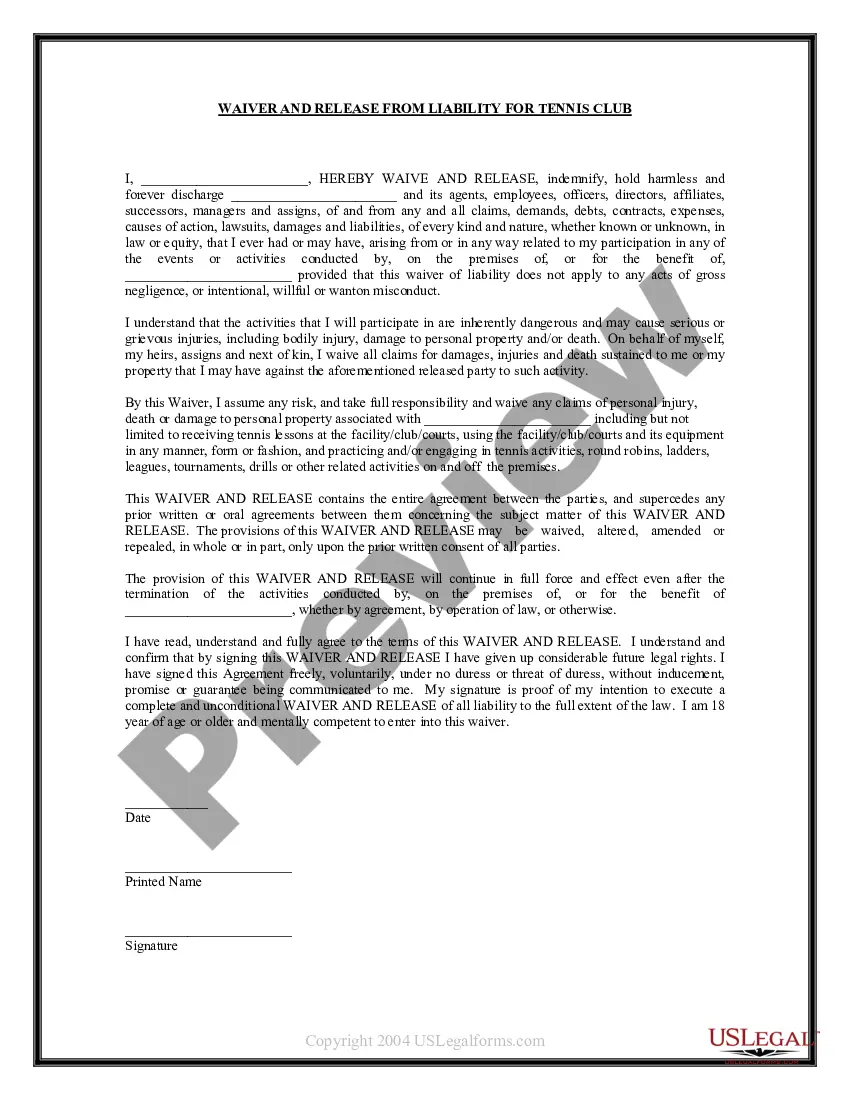
This form allows an adult to release a golf course from liability for injuries which may be incurred while on the premises, taking part in activities, etc.
Georgia Waiver and Release From Liability For Adult for Golf Course
Category:
State:
Multi-State
Control #:
US-WAV-07A
Format:
Word;
Rich Text
Instant download
Description
How to fill out Waiver And Release From Liability For Adult For Golf Course?
Locating the appropriate legal document template may pose a challenge.
Of course, there are numerous online templates accessible on the web, but how will you find the legal form you need.
Utilize the US Legal Forms website.
First, ensure you have selected the correct form for your city/county. You can review the document using the Review button and examine the form description to confirm this is the right one for you.
- The platform offers a vast array of templates, such as the Georgia Waiver and Release From Liability For Adult for Golf Course, suitable for business and personal purposes.
- All forms are verified by professionals and comply with federal and state regulations.
- If you are already a member, Log In to your account and click the Download button to acquire the Georgia Waiver and Release From Liability For Adult for Golf Course.
- Use your account to browse the legal forms you have previously purchased.
- Navigate to the My documents section of your account and download another copy of the document you need.
- If you are a new client of US Legal Forms, here are some simple guidelines to follow.
Form popularity
FAQ
A limited liability release in Georgia is a document that restricts the liability of a provider for specific activities, such as golfing. This type of release is designed to protect the provider from claims arising from ordinary negligence but does not cover instances of gross negligence or intentional harm. Understanding the nuances of a limited liability release can help you better manage risks associated with golf courses. For assistance, uslegalforms offers resources to help you draft effective liability releases.
Yes, you can write your own liability waiver, but it’s crucial to ensure that it meets legal standards. The Georgia Waiver and Release From Liability For Adult for Golf Course should be clear, comprehensive, and legally sound to be effective. If you're unsure about the language or structure, consider using uslegalforms for professionally crafted templates that can save you time and reduce legal risks.
To write a release of liability waiver, start by clearly stating the purpose, which in this case is the Georgia Waiver and Release From Liability For Adult for Golf Course. Include specific language that outlines the risks involved in golfing and informs participants about their rights. Make sure to have a section for signatures and dates to validate the document. Utilizing a reliable platform like uslegalforms can simplify this process by providing templates tailored to Georgia's legal requirements.
Yes, waivers are generally enforceable in Georgia, including the Georgia Waiver and Release From Liability For Adult for Golf Course. Courts typically uphold these documents as long as they are clear and unambiguous. However, certain conditions, such as gross negligence or willful misconduct, may void the waiver. It is essential to ensure that your waiver complies with state laws to provide maximum protection.
To write a simple release of liability, you should begin by clearly stating the purpose of the document, which is to release the golf course from any future claims related to injuries or accidents. Next, include the names of the parties involved and specify the activities covered by the Georgia Waiver and Release From Liability For Adult for Golf Course. It is crucial to use clear language that outlines the risks associated with golfing and ensure that the signer understands what they are agreeing to. Finally, have both parties sign and date the document to make it legally binding.
So, if an accident happens and injury occurs, is a Waiver effective in protecting the institution from liability and preventing a lawsuit from the injured party? The answer is that, if properly worded and signed, the Waiver is likely valid and will preclude legal claims for injuries.
You might think that since you signed a waiver acknowledging the risks of the activity, you have no legal leg to stand on to file a personal injury lawsuit. Waivers can make personal injury lawsuits more complex, but you can still seek damages for injuries that could have and should have been prevented.
Liability waivers are enforceable in California solely to the extent they shift to the customer the risk of ordinary negligence. Under California law, a liability waiver cannot excuse an injury caused by a defendant's gross negligence, recklessness or intentionally wrongful act.
As tempting as it may be, you should never write your own liability waiver. Unless you're a fully qualified lawyer with experience in this area, it's likely that you'll omit critical language that puts your business at risk for lawsuits.
A liability waiver, or release waiver, is a legal document that a company or organization requires members of the public to sign in order to protect their organization from being sued if you sustain an injury.