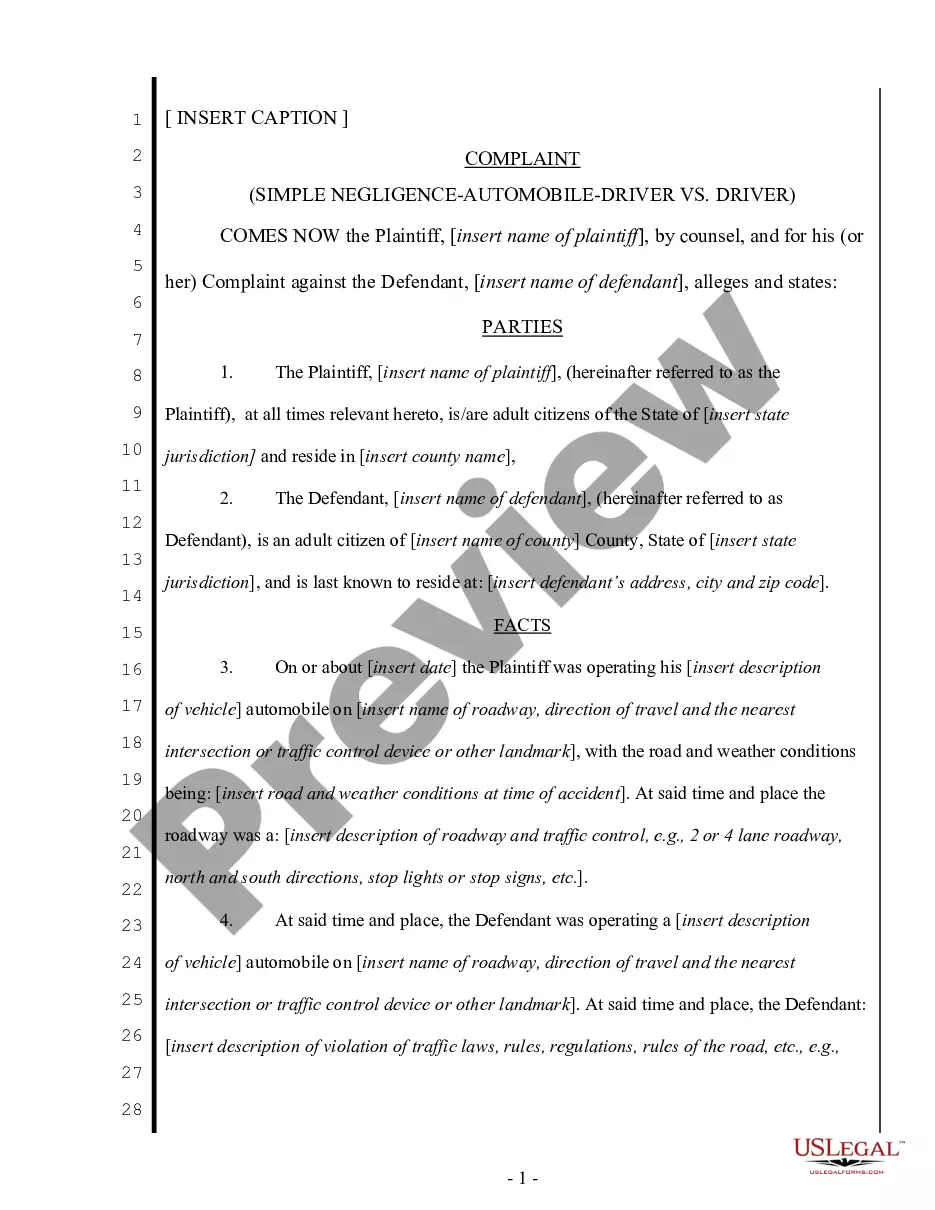
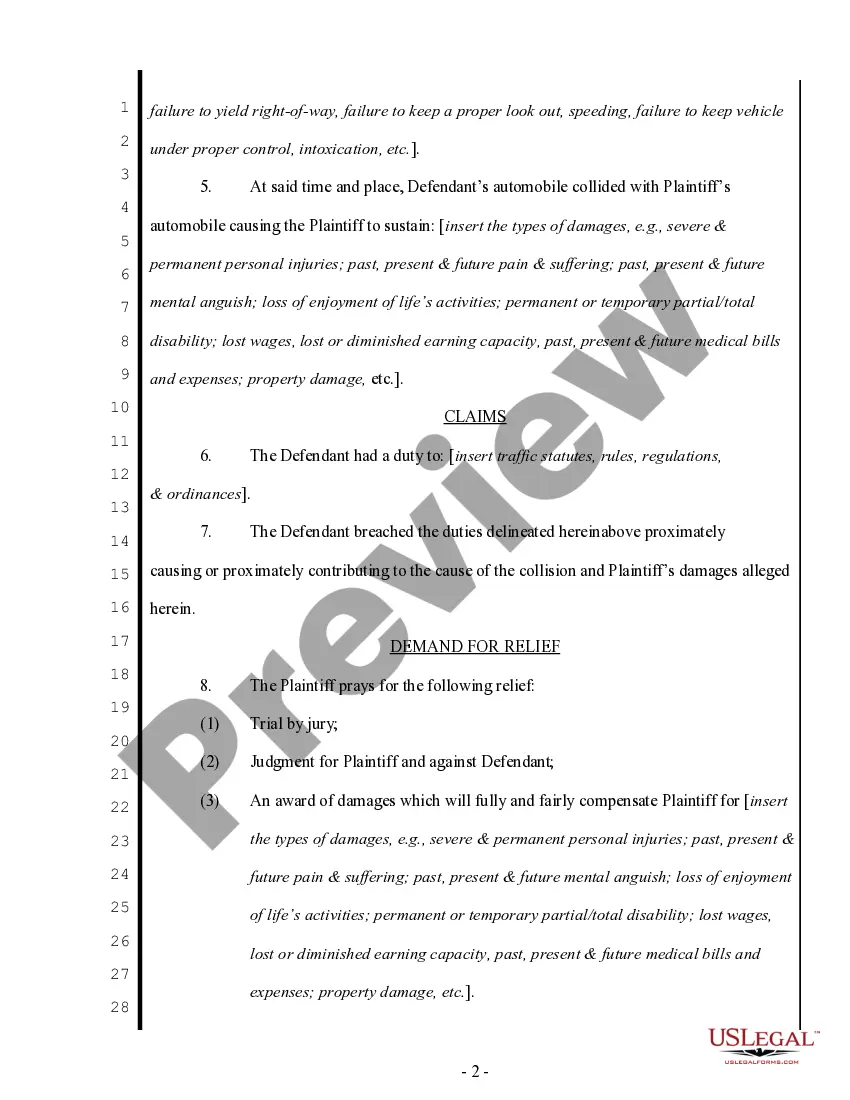
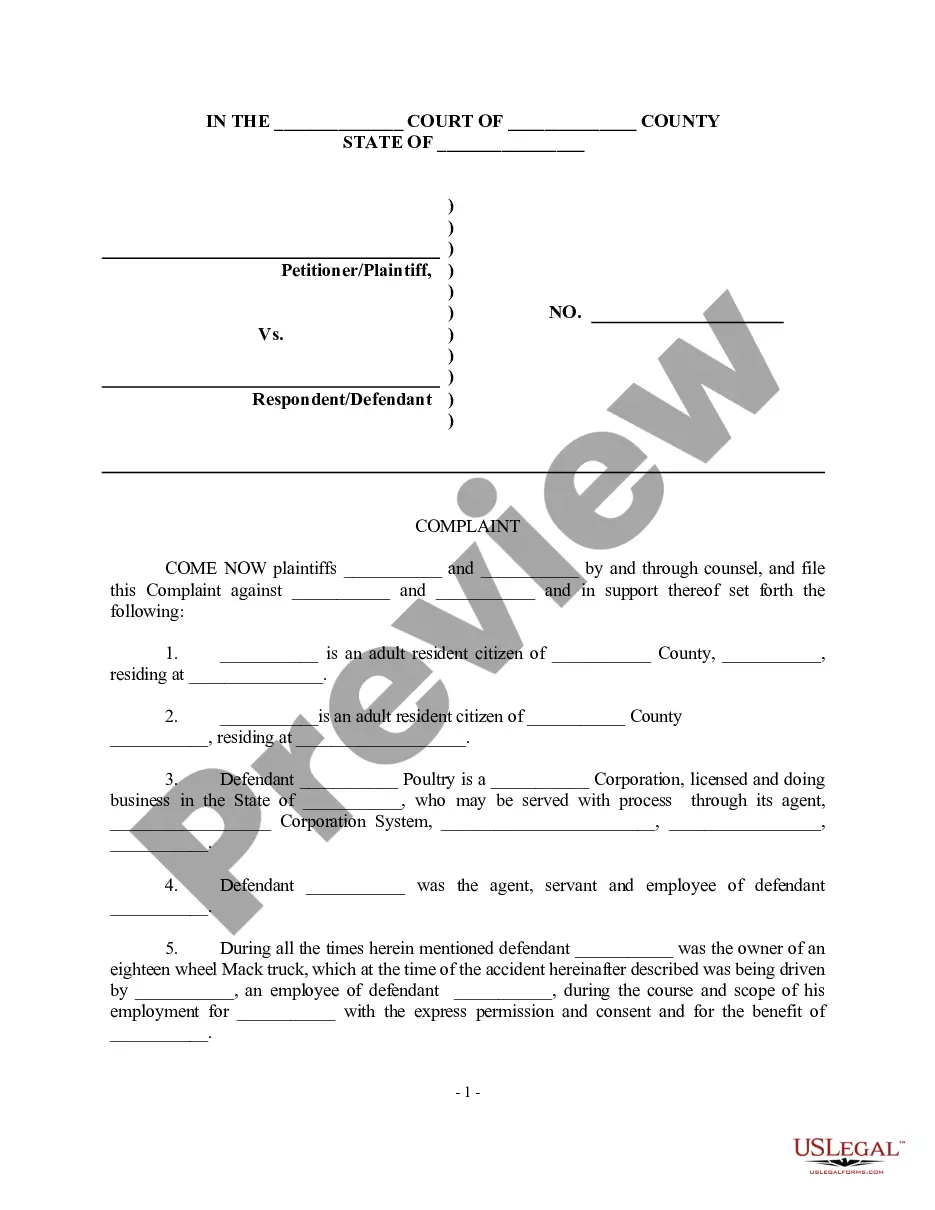
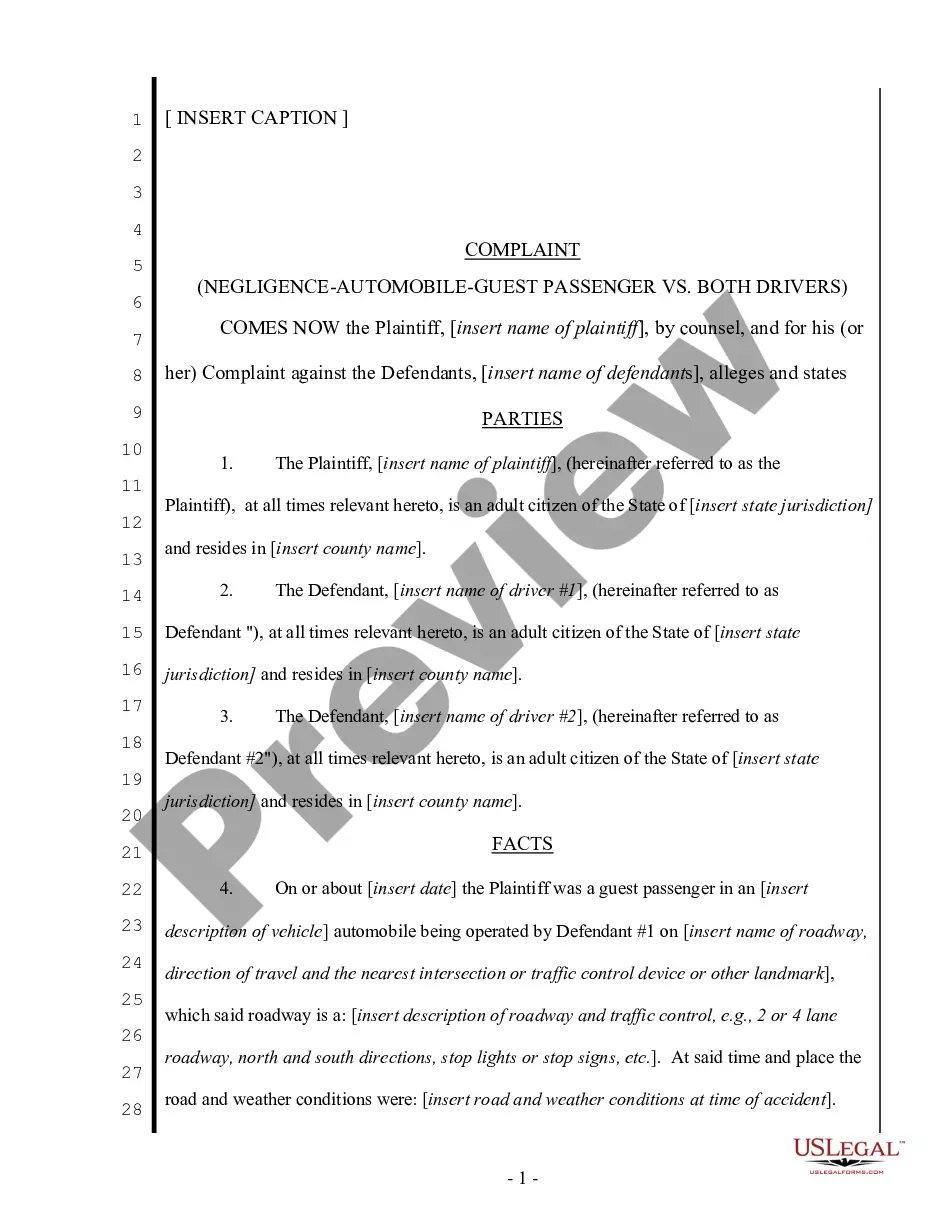
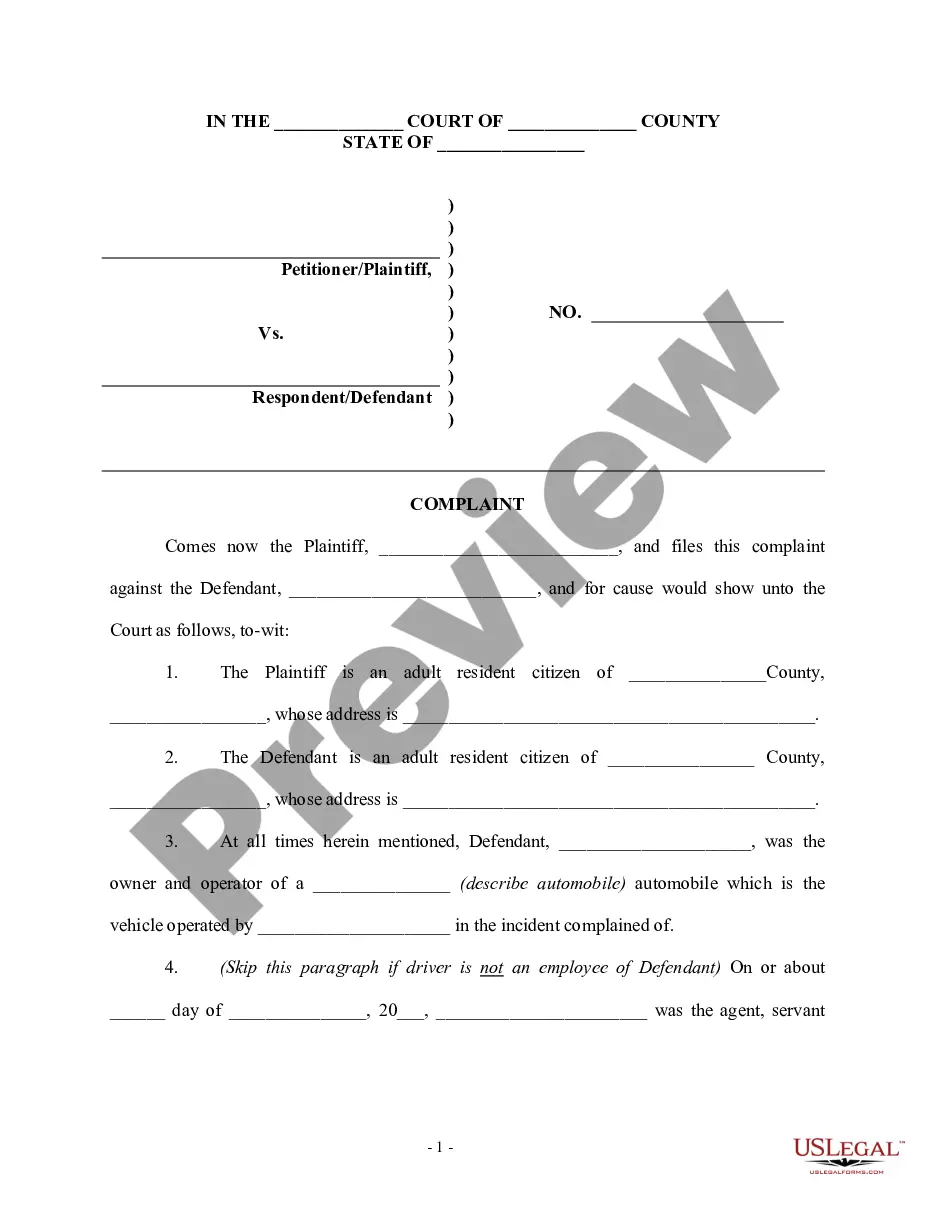
Georgia Complaint regarding Auto Accident for Negligence
Description

Get your form ready online
Our built-in tools help you complete, sign, share, and store your documents in one place.
Make edits, fill in missing information, and update formatting in US Legal Forms—just like you would in MS Word.
Download a copy, print it, send it by email, or mail it via USPS—whatever works best for your next step.
Sign and collect signatures with our SignNow integration. Send to multiple recipients, set reminders, and more. Go Premium to unlock E-Sign.
If this form requires notarization, complete it online through a secure video call—no need to meet a notary in person or wait for an appointment.
We protect your documents and personal data by following strict security and privacy standards.

Make edits, fill in missing information, and update formatting in US Legal Forms—just like you would in MS Word.

Download a copy, print it, send it by email, or mail it via USPS—whatever works best for your next step.

Sign and collect signatures with our SignNow integration. Send to multiple recipients, set reminders, and more. Go Premium to unlock E-Sign.

If this form requires notarization, complete it online through a secure video call—no need to meet a notary in person or wait for an appointment.

We protect your documents and personal data by following strict security and privacy standards.
Looking for another form?

How to fill out Complaint Regarding Auto Accident For Negligence?
It is possible to devote several hours on the web searching for the lawful papers design that suits the state and federal demands you require. US Legal Forms gives a huge number of lawful forms which can be reviewed by experts. You can actually download or printing the Georgia Complaint regarding Auto Accident for Negligence from our service.
If you have a US Legal Forms account, it is possible to log in and then click the Acquire switch. Afterward, it is possible to total, revise, printing, or sign the Georgia Complaint regarding Auto Accident for Negligence. Each lawful papers design you acquire is your own for a long time. To have one more copy associated with a purchased type, proceed to the My Forms tab and then click the corresponding switch.
If you are using the US Legal Forms web site the first time, keep to the easy instructions under:
- First, be sure that you have chosen the best papers design for that state/city of your choice. Look at the type outline to make sure you have chosen the proper type. If readily available, make use of the Review switch to appear from the papers design as well.
- If you would like discover one more edition of the type, make use of the Lookup area to discover the design that fits your needs and demands.
- Upon having discovered the design you need, just click Purchase now to carry on.
- Choose the prices program you need, key in your credentials, and register for a free account on US Legal Forms.
- Full the transaction. You may use your Visa or Mastercard or PayPal account to purchase the lawful type.
- Choose the structure of the papers and download it for your system.
- Make alterations for your papers if needed. It is possible to total, revise and sign and printing Georgia Complaint regarding Auto Accident for Negligence.
Acquire and printing a huge number of papers layouts while using US Legal Forms site, that offers the most important assortment of lawful forms. Use skilled and express-specific layouts to tackle your organization or specific requirements.
Form popularity
FAQ
Most civil lawsuits for injuries allege the wrongdoer was negligent. To win in a negligence lawsuit, the victim must establish 4 elements: (1) the wrongdoer owed a duty to the victim, (2) the wrongdoer breached the duty, (3) the breach caused the injury (4) the victim suffered damages.
The Four Elements of Negligence Are Duty, Breach of Duty, Damages, and Causation.
Proving Negligence. Most civil lawsuits for injuries allege the wrongdoer was negligent. To win in a negligence lawsuit, the victim must establish 4 elements: (1) the wrongdoer owed a duty to the victim, (2) the wrongdoer breached the duty, (3) the breach caused the injury (4) the victim suffered damages.
A negligence claim requires that the person bringing the claim (the plaintiff) establish four distinct elements: duty of care, breach, causation, and damages.
In a modified comparative negligence approach (the system that's in place in Georgia), the injured party can only recover as long as they are less than 50 percent at fault for the injuries sustained. However, the amount of the damages that they recover will be reduced in proportion to the amount of their fault.
Negligence?what are the key ingredients to establish a claim in negligence? duty of care. breach of that duty. damage (which is caused by the breach) foreseeability of such damage.
The statute of limitations for Georgia motor vehicle collisions is found in section 9-3-33 of the Georgia Code. A lawsuit for injuries caused by a car accident must be filed within 2 years after the right to sue ?accrues.? In car accident cases, the right to sue usually accrues on the date of the collision.
Proving negligence is required in most claims from accidents or injuries, such as car accidents or "slip and fall" cases. Negligence claims must prove four things in court: duty, breach, causation, and damages/harm.