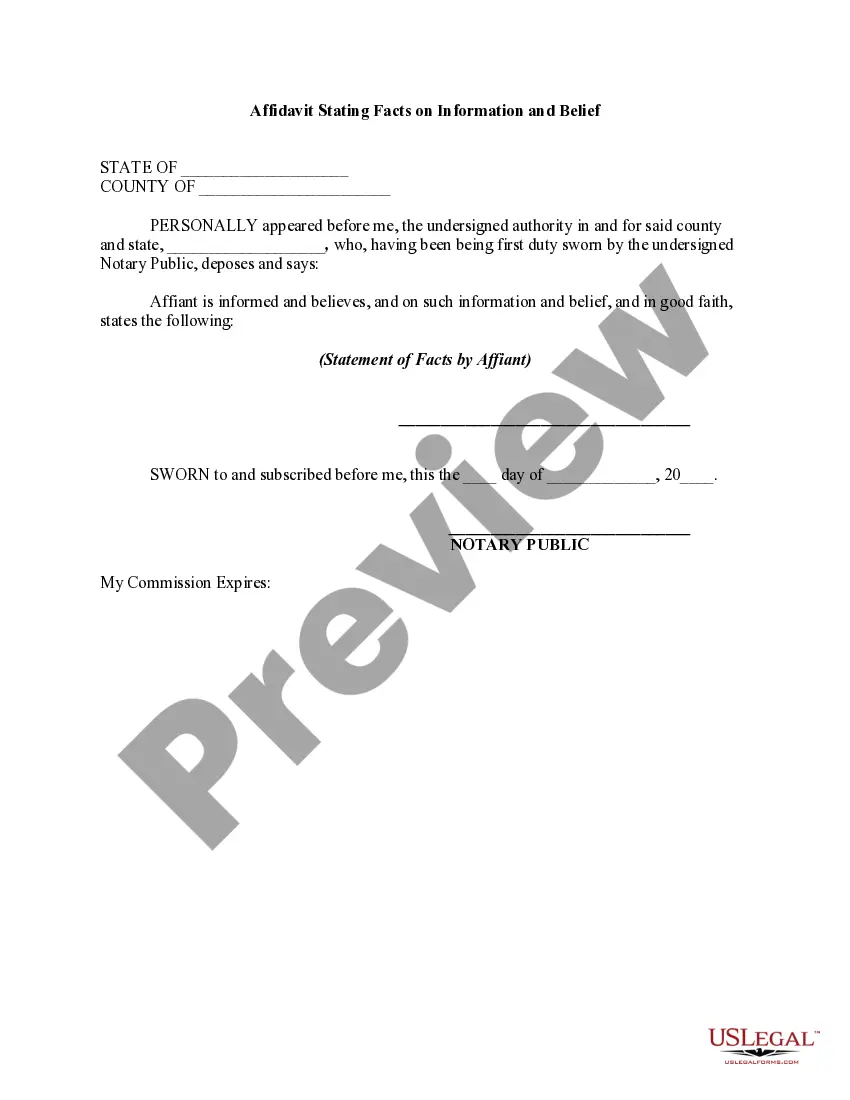
Georgia Affidavit Stating Facts on Information and Belief
Description
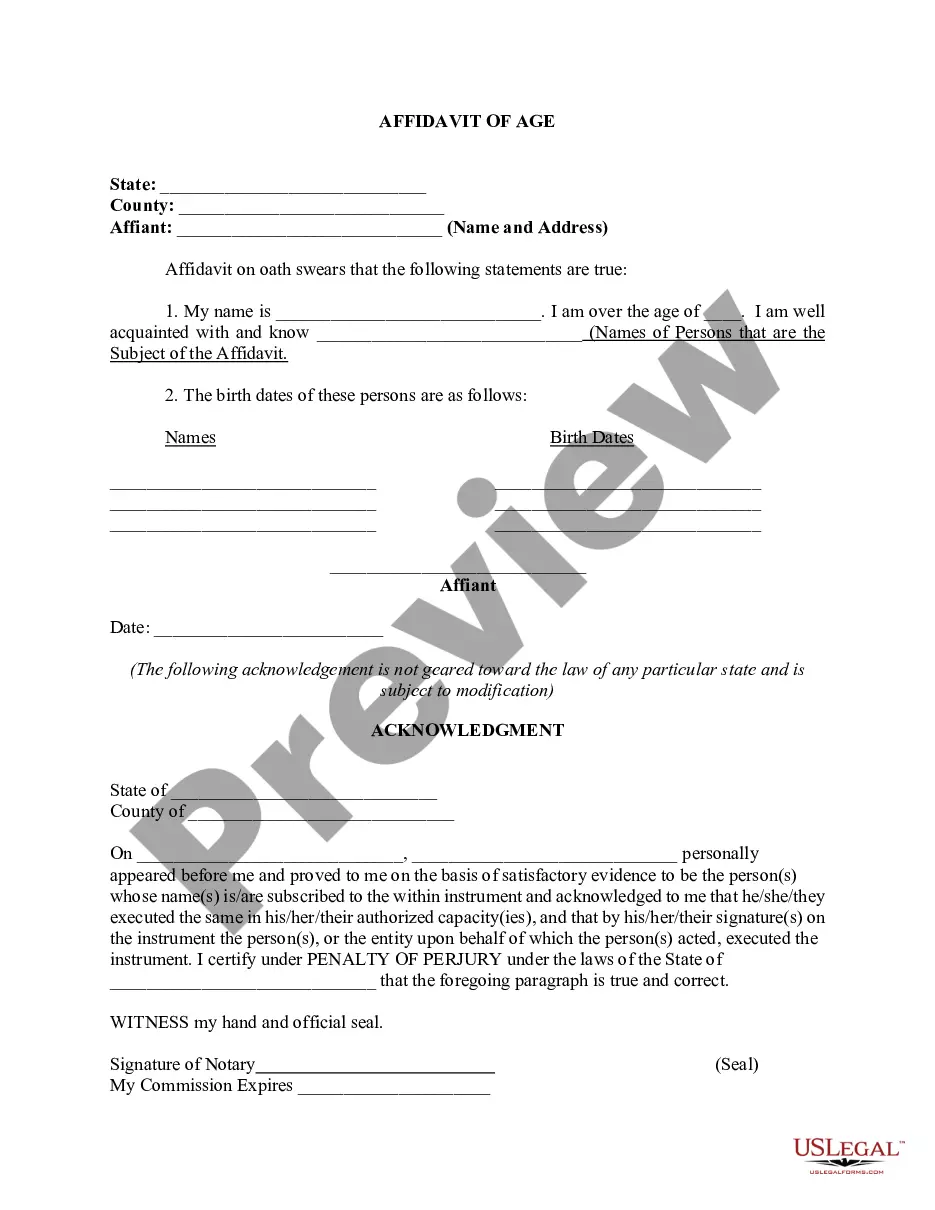

Get your form ready online
Our built-in tools help you complete, sign, share, and store your documents in one place.
Make edits, fill in missing information, and update formatting in US Legal Forms—just like you would in MS Word.
Download a copy, print it, send it by email, or mail it via USPS—whatever works best for your next step.
Sign and collect signatures with our SignNow integration. Send to multiple recipients, set reminders, and more. Go Premium to unlock E-Sign.
If this form requires notarization, complete it online through a secure video call—no need to meet a notary in person or wait for an appointment.
We protect your documents and personal data by following strict security and privacy standards.

Make edits, fill in missing information, and update formatting in US Legal Forms—just like you would in MS Word.

Download a copy, print it, send it by email, or mail it via USPS—whatever works best for your next step.

Sign and collect signatures with our SignNow integration. Send to multiple recipients, set reminders, and more. Go Premium to unlock E-Sign.

If this form requires notarization, complete it online through a secure video call—no need to meet a notary in person or wait for an appointment.

We protect your documents and personal data by following strict security and privacy standards.
Looking for another form?
How to fill out Affidavit Stating Facts On Information And Belief?
US Legal Forms - one of the largest collections of legal documents in the United States - offers a variety of legal document templates that you can obtain or create.
By using the website, you can access thousands of forms for business and personal purposes, categorized by types, states, or keywords. You can find the most recent versions of forms like the Georgia Affidavit Stating Facts on Information and Belief in seconds.
If you already have a subscription, Log In and get the Georgia Affidavit Stating Facts on Information and Belief from the US Legal Forms library. The Download button will appear on each form you view. You can access all previously downloaded forms from the My documents tab in your account.
Complete the transaction. Use your Visa, Mastercard, or PayPal account to finalize the transaction.
Select the format and download the form to your device. Make modifications. Fill out, edit, and print and sign the downloaded Georgia Affidavit Stating Facts on Information and Belief. Each form you add to your account does not expire and is yours indefinitely. Therefore, if you wish to download or print another copy, simply go to the My documents section and click on the form you need. Access the Georgia Affidavit Stating Facts on Information and Belief with US Legal Forms, the most extensive collection of legal document templates. Utilize thousands of professional and state-specific templates that meet your business or personal needs.
- If you want to use US Legal Forms for the first time, here are simple steps to get started.
- Make sure you have selected the correct form for your city/state. Click the Review button to check the form's details.
- Read the form description to ensure you have chosen the right form.
- If the form doesn't meet your requirements, use the Search field at the top of the screen to find one that does.
- Once you are satisfied with the form, confirm your selection by clicking the Buy now button.
- Then, choose the pricing plan you prefer and provide your information to register for an account.
Form popularity
FAQ
Actual knowledge can be proven by direct or circumstantial evidence. Some examples of actual knowledge include when: A property owner testifies that he was aware of a broken stair or when maintenance records show that a company was aware of a hole in its parking lot.
If you say that something is true to your knowledge or to the best of your knowledge, you mean that you believe it to be true but it is possible that you do not know all the facts. Alec never carried a gun to my knowledge. To the best of my knowledge, Gloria did not make these comments.
The following are six critical sections that must be included: Title. This is either your name (?Affidavit of Jane Doe?) or the specific case information. Statement of identity. The next paragraph tells the court about yourself. ... Statement of truth. ... Statement of facts. ... Closing statement of truth. ... Sign and notarize.
The term ?to the best of my knowledge and belief? is used in affidavits and court documents to indicate that statements being made are not knowingly false.
Affidavits can occur any time a formal promise is made, and they are often used as a form of documentation tied to a specific person in the proceedings. They are often used in court to serve as evidence toward a singular side in a dispute, or to affirm a claim that someone is making.
The most important criteria for an affiant is that he or she have personal knowledge of the information that must be offered in the affidavit. If that knowledge is limited to how records are made and kept, the witness should keep his or her testimony limited to those subjects and let the records do the talking.
The law attaches harsh penalties to lying under oath, so you must always be sure the facts stated in your signed affidavit are true so far as you know. When including facts in your affidavit, you should write in the first person, expressing your personal knowledge, and be as complete?yet concise?as possible.
The use of the term, "to the best of my knowledge and belief," recognizes it is impossible for any person to legitimately provide absolute assurances or guarantees. Individuals can only make assertions on what they know or have knowledge of, not to what they don't know.