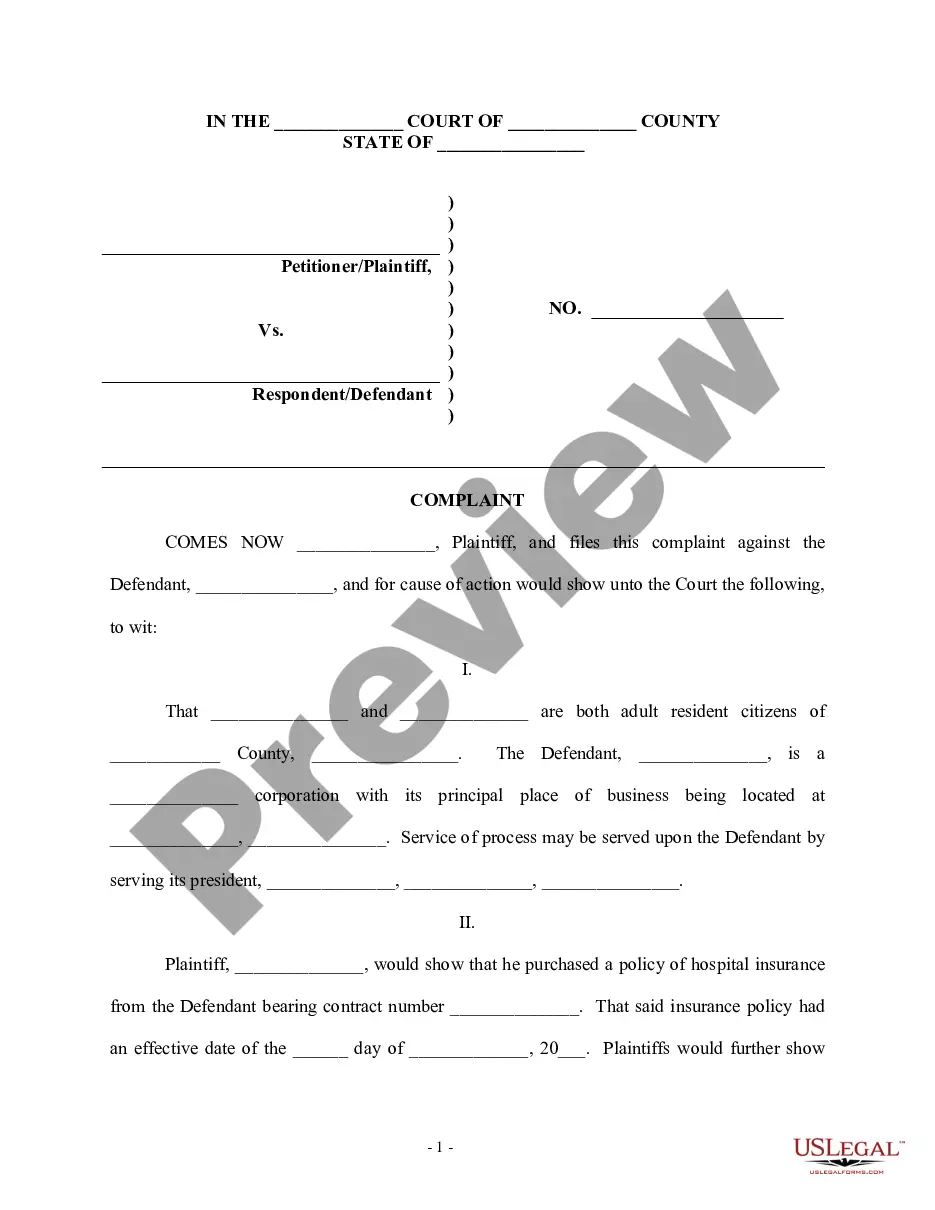
This form for use in litigation against an insurance company for bad faith breach of contract. Adapt this model form to fit your needs and specific law. Not recommended for use by non-attorney.
Georgia Complaint For Failure Of Insurer To pay Benefits - Jury Trial Demand
Instant download
This website is not affiliated with any governmental entity
Public form
Description


How to fill out Complaint For Failure Of Insurer To Pay Benefits - Jury Trial Demand?
Choosing the right legal record format can be quite a struggle. Naturally, there are a lot of templates available on the Internet, but how would you find the legal develop you require? Make use of the US Legal Forms site. The assistance offers a huge number of templates, such as the Georgia Complaint For Failure Of Insurer To pay Benefits - Jury Trial Demand, which you can use for enterprise and personal needs. All the forms are inspected by specialists and meet state and federal demands.
In case you are currently authorized, log in to the account and click on the Down load key to have the Georgia Complaint For Failure Of Insurer To pay Benefits - Jury Trial Demand. Make use of your account to look from the legal forms you might have acquired previously. Proceed to the My Forms tab of your respective account and have one more copy of the record you require.
In case you are a new user of US Legal Forms, listed here are basic recommendations so that you can follow:
- Very first, make sure you have selected the appropriate develop for the metropolis/region. You may check out the shape utilizing the Review key and read the shape explanation to guarantee this is basically the best for you.
- When the develop will not meet your expectations, use the Seach industry to discover the correct develop.
- When you are certain that the shape is acceptable, select the Get now key to have the develop.
- Opt for the pricing program you want and enter in the essential details. Design your account and purchase an order making use of your PayPal account or bank card.
- Select the data file format and download the legal record format to the device.
- Full, modify and print and indicator the attained Georgia Complaint For Failure Of Insurer To pay Benefits - Jury Trial Demand.
US Legal Forms is the largest catalogue of legal forms where you can discover various record templates. Make use of the service to download appropriately-made files that follow state demands.
Form popularity
FAQ
The two types of bad faith are first-party bad faith and third-party bad faith. First-party bad faith occurs when an insurer fails to uphold its obligations to its policyholder, while third-party bad faith arises when an insurer does not defend its insured against claims from others. Both types can be addressed effectively through a Georgia Complaint For Failure Of Insurer To pay Benefits - Jury Trial Demand.
An insurer can be liable for bad faith if it unjustly denies a claim, fails to investigate a claim properly, or delays payment without reasonable justification. Understanding these liability factors is essential when preparing your case. You can leverage a Georgia Complaint For Failure Of Insurer To pay Benefits - Jury Trial Demand to hold the insurer accountable for such actions.
To prove that an insurance company acted in bad faith, you need to gather evidence showing the insurer's unreasonable actions. This can include documentation of claims, communication records, and expert testimonies. A robust case can support a Georgia Complaint For Failure Of Insurer To pay Benefits - Jury Trial Demand, increasing your chances of a successful resolution.
When writing a complaint letter against an insurance company, start by clearly stating your policy details and the nature of your complaint. Include any relevant documentation and specify the resolution you seek. A well-structured letter can serve as a precursor to a Georgia Complaint For Failure Of Insurer To pay Benefits - Jury Trial Demand, making your case more compelling.
The elements of bad faith in insurance generally include the insurer's unreasonable refusal to pay a valid claim, lack of a reasonable basis for denying benefits, and the insurer's knowledge of its wrongdoing. These elements are crucial when preparing a Georgia Complaint For Failure Of Insurer To pay Benefits - Jury Trial Demand. Establishing these factors can strengthen your case significantly.
To file a complaint against an insurance company in Georgia, you should first document all interactions with the insurer. Then, you can submit your complaint to the Georgia Office of Insurance and Safety Fire Commissioner, either online or by mail. Using a Georgia Complaint For Failure Of Insurer To pay Benefits - Jury Trial Demand can streamline this process and enhance your chances of a favorable outcome.
In a case related to a Georgia Complaint For Failure Of Insurer To pay Benefits - Jury Trial Demand, you can seek both compensatory and punitive damages. Compensatory damages may cover direct losses, while punitive damages aim to punish the insurer for egregious behavior. These damages serve as a powerful tool to hold insurers accountable.
A Rule 68 offer in Georgia allows a defendant to make a settlement offer to the plaintiff before a trial, aiming to encourage resolution before litigation. Accepting this offer can lead to a smoother resolution process, while rejecting it may have implications for costs if the case proceeds to trial. If you face delays or issues with your insurer, consider how a Georgia Complaint For Failure Of Insurer To Pay Benefits - Jury Trial Demand fits into your overall strategy.
A Holt demand in Georgia is a formal request made to an insurer to pay a claim, which can prompt quicker responses. This demand can play a vital role in your strategy, especially if you plan to escalate to a Georgia Complaint For Failure Of Insurer To Pay Benefits - Jury Trial Demand. Utilizing a Holt demand effectively can strengthen your case and highlight your determination to receive benefits.
The average personal injury settlement in Georgia varies significantly based on the case specifics, often ranging from thousands to millions of dollars. Factors influencing these settlements include the extent of injuries, medical expenses, and lost wages. If you find yourself needing to file a Georgia Complaint For Failure Of Insurer To Pay Benefits - Jury Trial Demand, knowing settlement averages can help you set realistic expectations.