Georgia Quitclaim Deed from a Trust to an Individual
Overview of this form
The Quitclaim Deed from a Trust to an Individual is a legal document that allows a trust (the Grantor) to transfer any ownership interest in a property directly to an individual (the Grantee). Unlike a warranty deed, the quitclaim deed does not guarantee that the Grantor holds any valid title, making it essential for specific transfer situations where the trust wishes to convey property rights without warranties of ownership. This form complies with state statutory laws and is a straightforward way to modify property ownership.
Key parts of this document
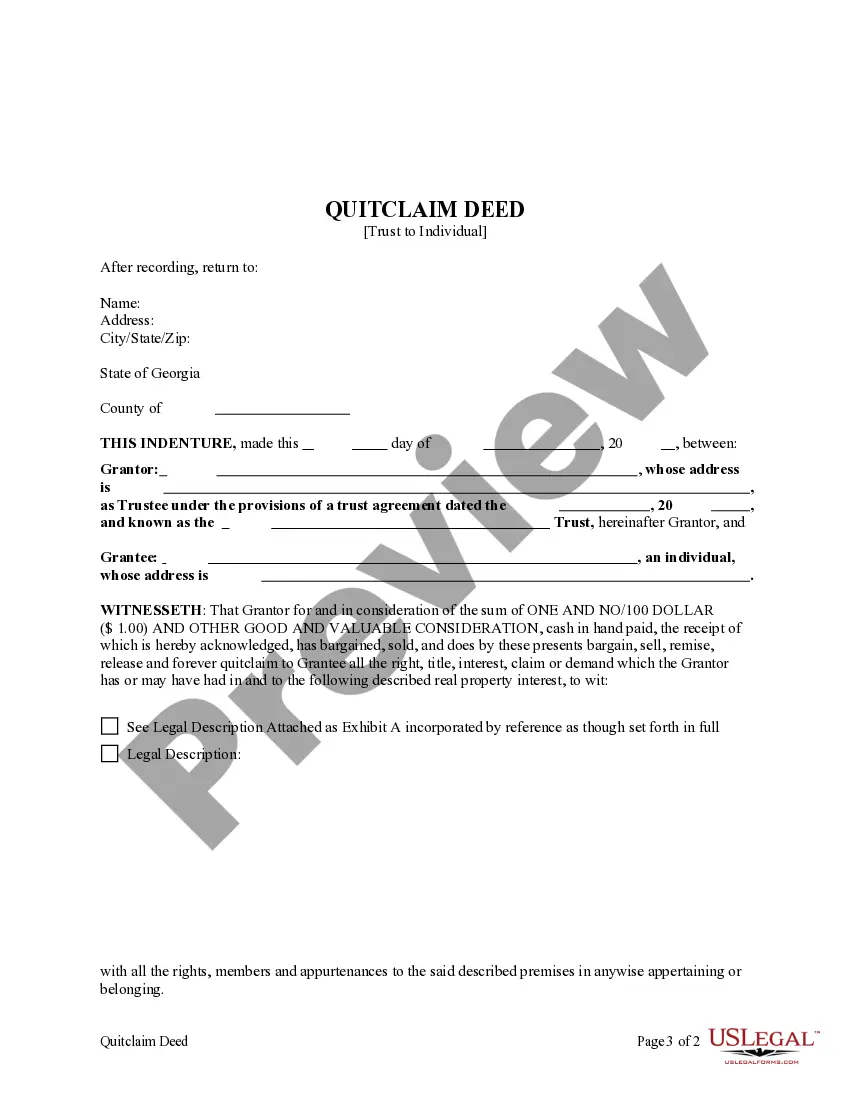
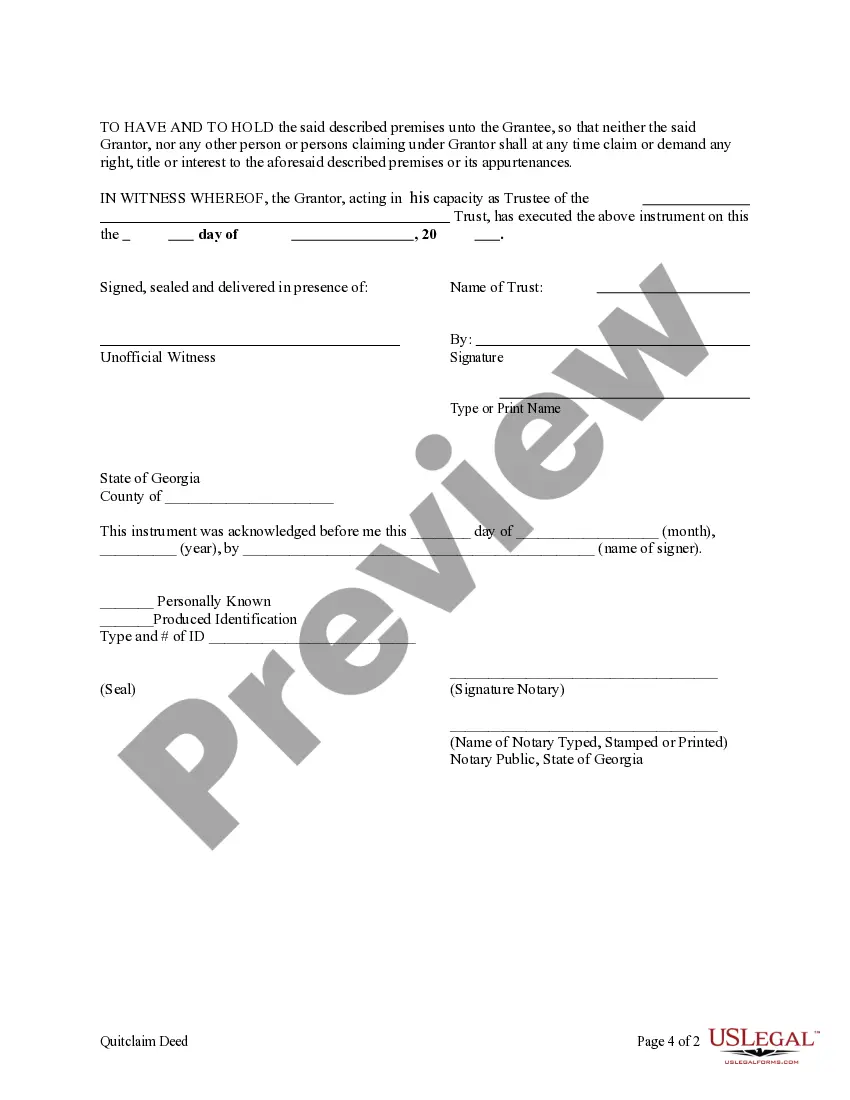
- Grantor and Grantee information: names and contact details of both parties.
- Property description: legal description of the property being transferred.
- Effective date: the date when the transfer will become effective.
- Signatures: required signatures of the Grantor, witnesses, and notary.
- Exhibit A: inclusion of legal description of the property.






When to use this document
This form is typically used when a trust wants to transfer real estate property to an individual. This may occur during estate planning, asset transfer among family members, or when simplifying property ownership without the complexities of warranty deeds. It is particularly useful in situations where the trust is liquidating assets or distributing property to beneficiaries.
Who can use this document
- Trustees of a trust who are authorized to transfer property.
- Individuals receiving property from a trust.
- Beneficiaries of a trust looking to gain direct ownership of real estate.
- Anyone involved in an estate planning process using a trust to manage assets.
Instructions for completing this form
- Identify the Grantor (trust) and Grantee (individual) by entering their names and contact information.
- Specify the property being transferred by including its legal description.
- Indicate the effective date of the deed transfer.
- Have the Grantor sign the deed in the presence of an official witness and a notary public.
- Attach Exhibit A, which contains a detailed legal description of the property, if required.
Notarization requirements for this form
To make this form legally binding, it must be notarized. Our online notarization service, powered by Notarize, lets you verify and sign documents remotely through an encrypted video session.
Get your form ready online
Our built-in tools help you complete, sign, share, and store your documents in one place.
Make edits, fill in missing information, and update formatting in US Legal Forms—just like you would in MS Word.
Download a copy, print it, send it by email, or mail it via USPS—whatever works best for your next step.
Sign and collect signatures with our SignNow integration. Send to multiple recipients, set reminders, and more. Go Premium to unlock E-Sign.
If this form requires notarization, complete it online through a secure video call—no need to meet a notary in person or wait for an appointment.
We protect your documents and personal data by following strict security and privacy standards.

Make edits, fill in missing information, and update formatting in US Legal Forms—just like you would in MS Word.

Download a copy, print it, send it by email, or mail it via USPS—whatever works best for your next step.

Sign and collect signatures with our SignNow integration. Send to multiple recipients, set reminders, and more. Go Premium to unlock E-Sign.

If this form requires notarization, complete it online through a secure video call—no need to meet a notary in person or wait for an appointment.

We protect your documents and personal data by following strict security and privacy standards.
Typical mistakes to avoid
- Failing to include a proper legal description of the property.
- Not obtaining the necessary signatures from witnesses and a notary.
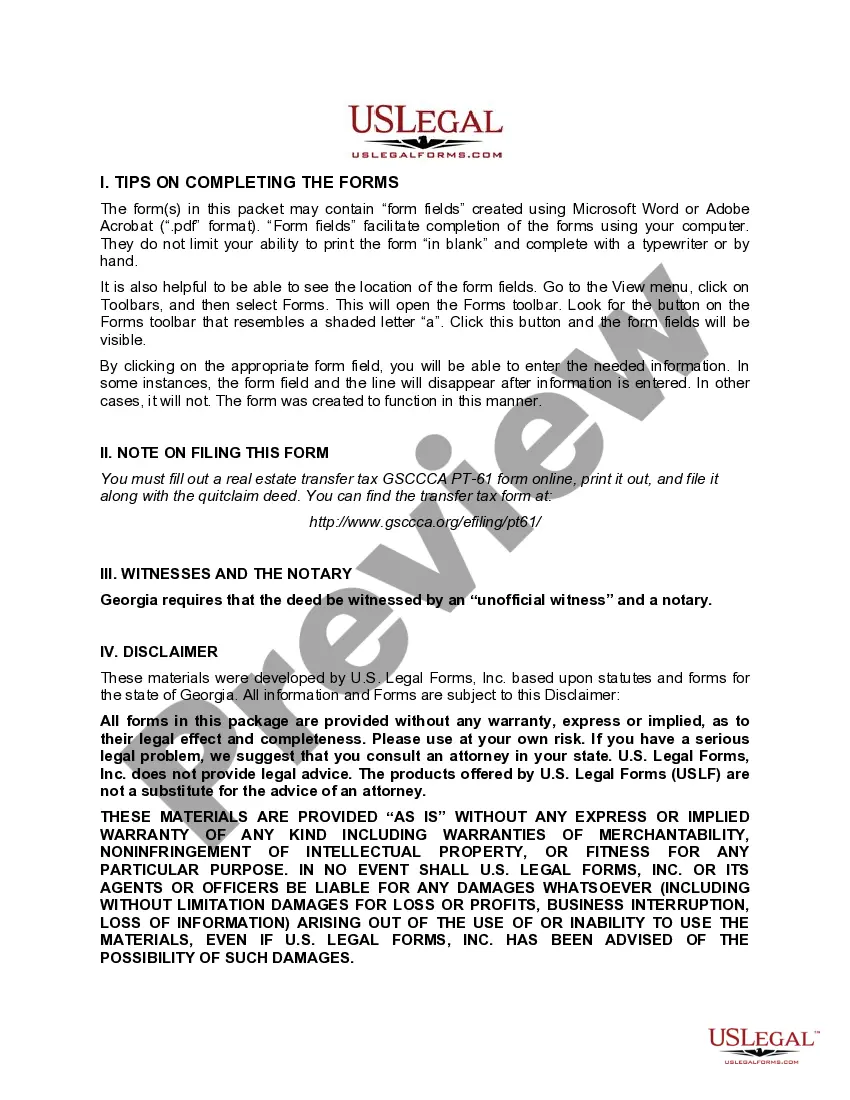
- Neglecting to file the required transfer tax form along with the quitclaim deed.
- Using outdated or incorrect forms not compliant with current state laws.
Quick recap
- The Quitclaim Deed from a Trust to an Individual is essential for transferring property interest without guarantees.
- It requires careful completion, including signatures from witnesses and a notary.
- State-specific requirements, such as filing a transfer tax form, must be followed in Georgia.
- Using this form can simplify property transfers during estate management or family distributions.
Looking for another form?
Form popularity
FAQ
A quitclaim deed may not be appropriate in several situations, such as when you need to guarantee clear title to the property or when the property is encumbered by liens without proper disclosures. It is also unsuitable for transfers involving complex legal disputes or when ownership verification is required. By choosing a more secure method such as a warranty deed, individuals ensure clearer title protection compared to relying on a quitclaim deed.
Yes, a quitclaim deed can effectively transfer property out of a trust. When using a Georgia Quitclaim Deed from a Trust to an Individual, the trustee must sign the deed to convey the property rights to the designated individual. This process is straightforward and allows for efficient transfer while ensuring all legal requirements are met, thus protecting all parties involved.
Filling out a Georgia Quitclaim Deed from a Trust to an Individual involves several key steps. Begin by obtaining the correct form, ensuring it includes all necessary information such as the names of the parties, the property description, and the trust details. Next, fill in this information accurately, check for any required witnesses or notarization, and finally, file the deed with the local county clerk's office to make it effective.
Yes, you can transfer assets out of a trust, but the process may depend on the type of trust. For an irrevocable trust, specific procedures must be followed, often involving a Georgia Quitclaim Deed from a Trust to an Individual. This deed facilitates the official transfer of assets according to the trust's terms. Engaging with a platform like USLegalForms can streamline the creation and filing of necessary documents.
To remove someone from a deed of trust, you typically need to execute a quitclaim deed that specifically states the change in ownership. If the trust holds the property, a Georgia Quitclaim Deed from a Trust to an Individual should be prepared to reflect this update. This process requires clear documentation to prevent any future disputes regarding ownership. Having a legal professional involved can simplify these procedures.
While it is not legally required to hire a lawyer for a quitclaim deed in Georgia, consulting one can be beneficial. A legal professional can guide you through the intricacies of the process, ensuring accuracy in the Georgia Quitclaim Deed from a Trust to an Individual. Additionally, they can help address any potential complications related to your specific situation. Utilizing these resources can provide peace of mind.
A quitclaim deed from a trust to an individual is a document used to transfer ownership of property from a trust to a specific person. This type of deed releases any claim the trust had to the property and conveys it directly to the individual. It is a straightforward way to ensure that the intended party receives the property without warranties. The Georgia Quitclaim Deed from a Trust to an Individual makes this transfer simple and efficient.
To transfer property out of an irrevocable trust, you typically need to execute a Georgia Quitclaim Deed from a Trust to an Individual. This legal document formally transfers the property to the intended individual. You may also require the trust's governing documents to ensure compliance with any specific provisions. Consider consulting with a legal expert to facilitate a smooth transfer process.
When comparing a trust and a Georgia Quitclaim Deed from a Trust to an Individual, it's essential to consider your specific needs. A trust provides a layer of asset protection and can help with estate planning, while a quitclaim deed simplifies the process of transferring property ownership without the need for extensive legal formalities. If you aim for flexibility and ease in transferring property rights, a Georgia Quitclaim Deed from a Trust to an Individual often proves advantageous. However, if you seek asset protection and detailed estate management, establishing a trust might be the better option for you.
Yes, you can prepare your own quitclaim deed in Georgia. By following the required steps, you can ensure the document meets state standards. Utilizing a template for a Georgia Quitclaim Deed from a Trust to an Individual can simplify this task and help you avoid common pitfalls. Nonetheless, it's always wise to have your paperwork reviewed by a legal professional.