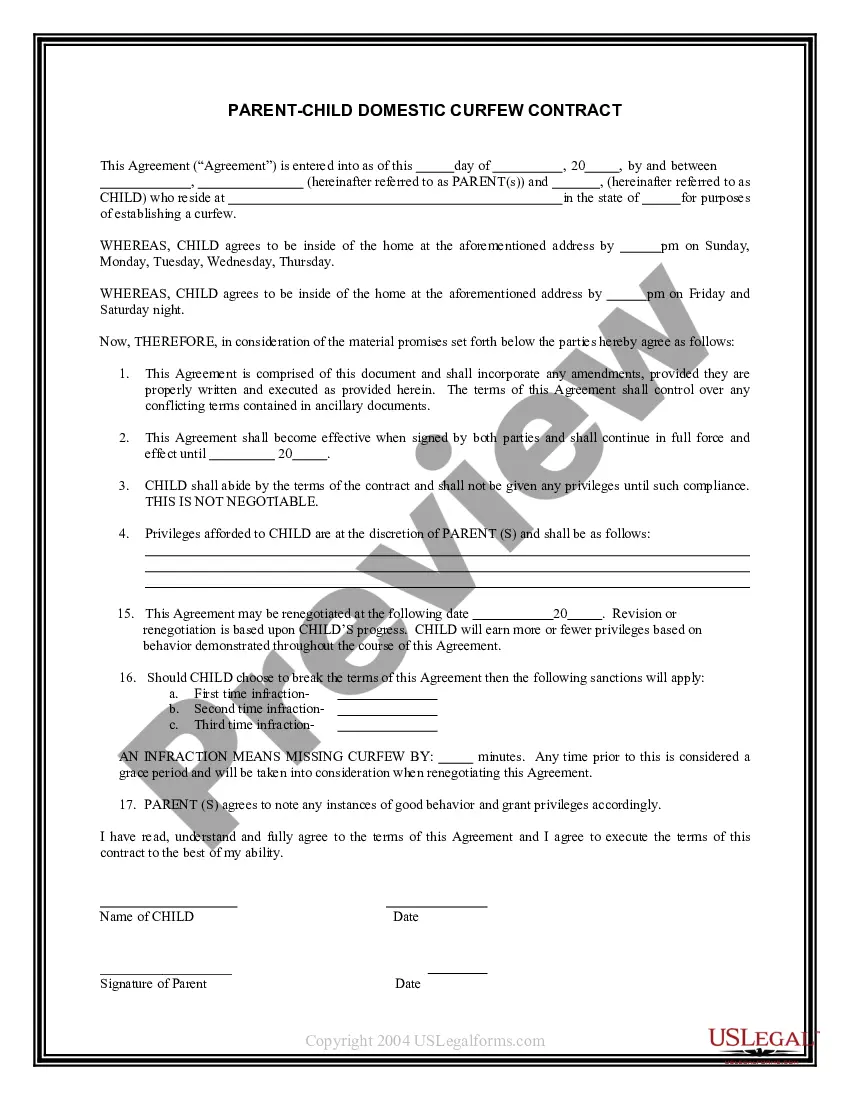
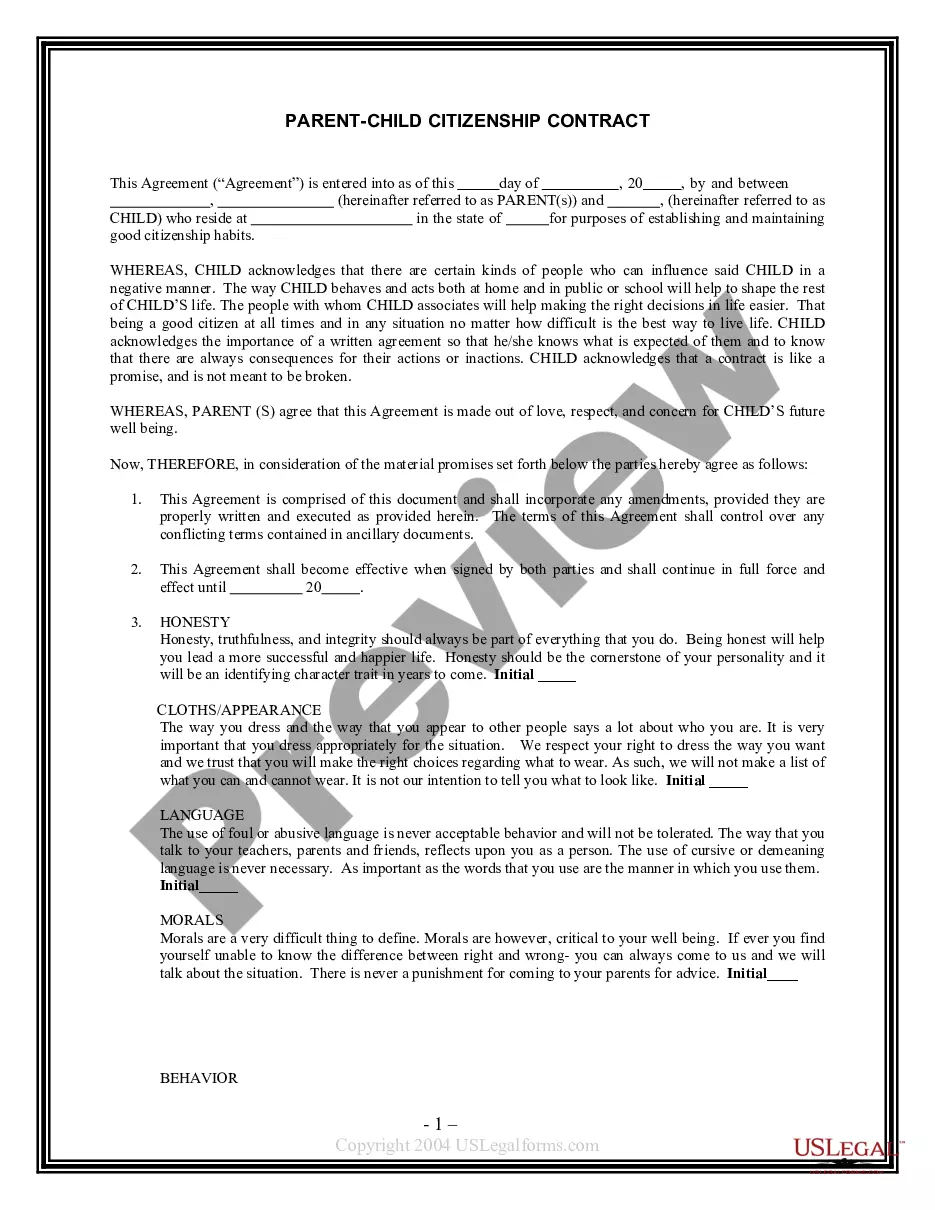
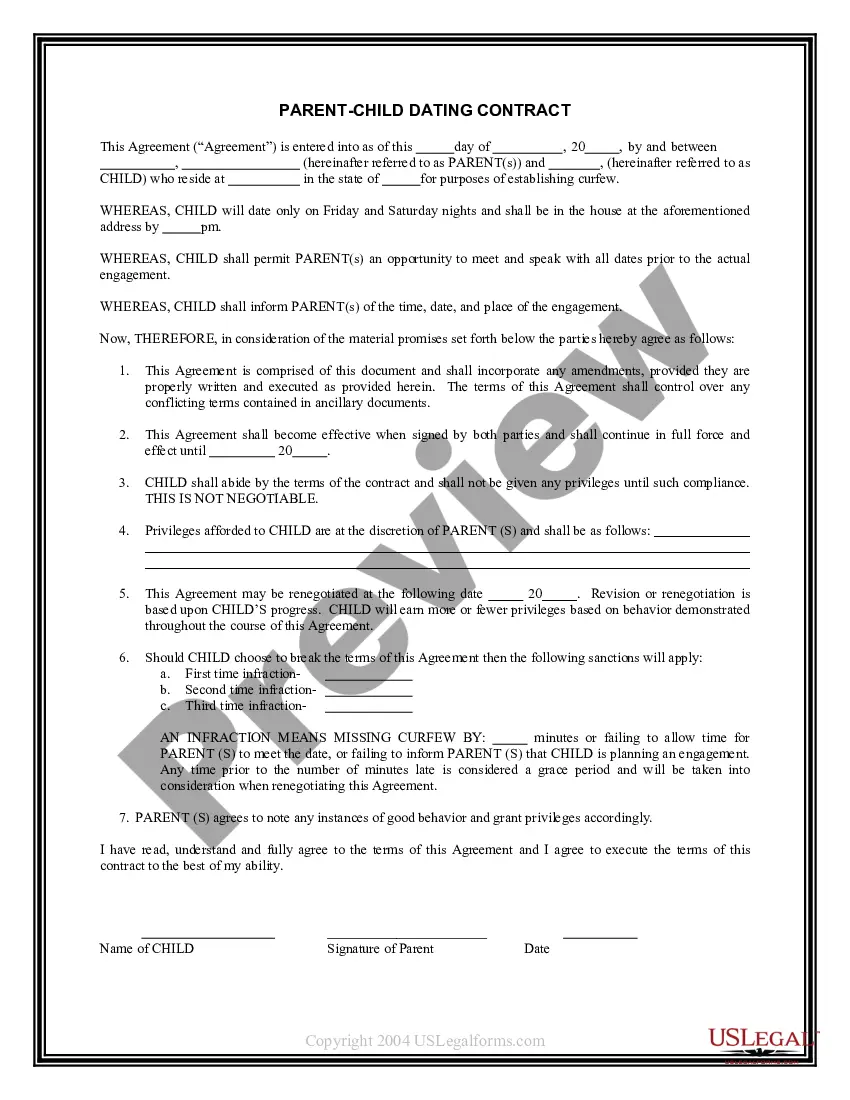
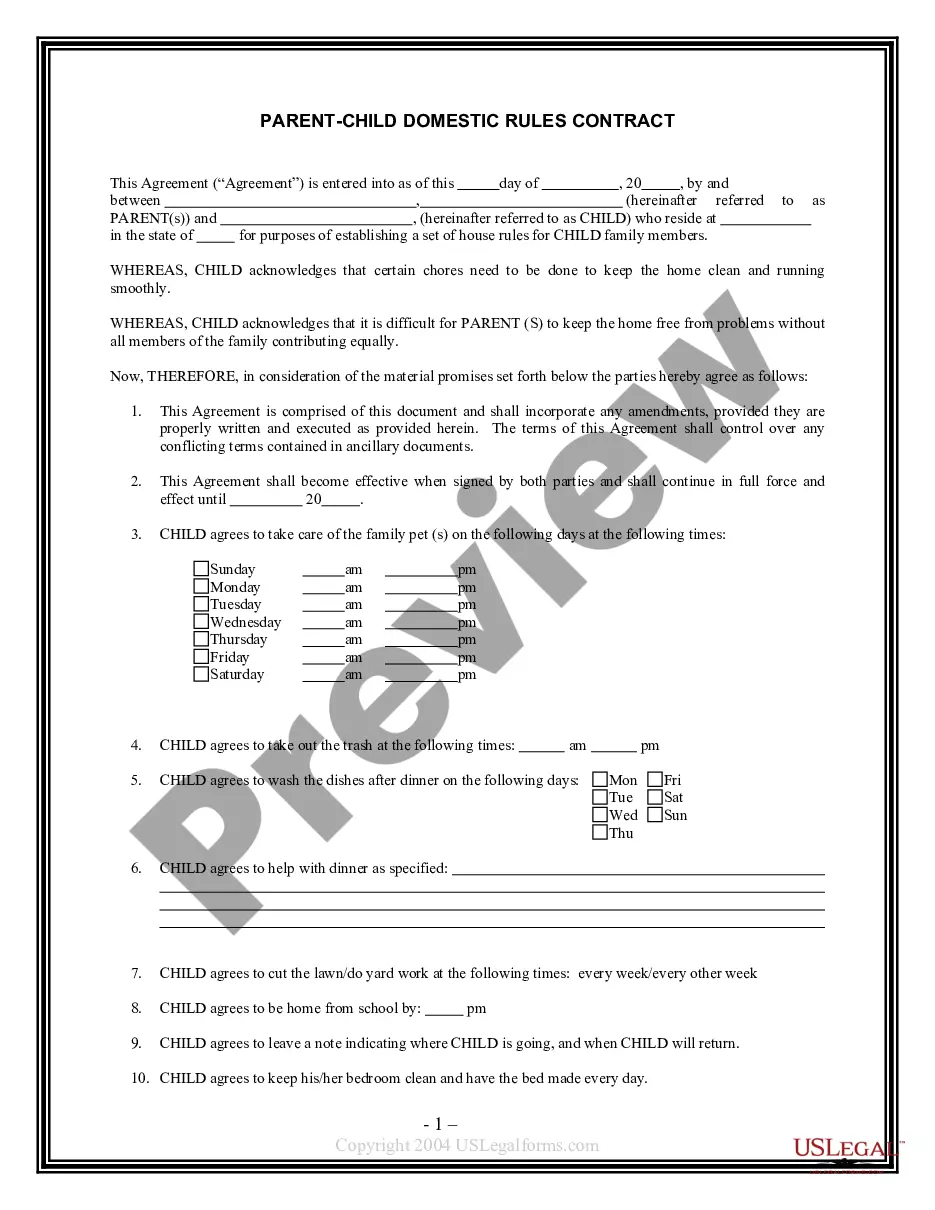
This is a contract between parent(s) and child detailing the terms of a daily curfew by which child must abide. The contract also indicates which privileges will be afforded to child for keeping the terms of the contract and the repercussions for failing to abide by those terms.
Florida Parent - Child Domestic Curfew Contract
Category:
State:
Multi-State
Control #:
US-PC03
Format:
Word;
Rich Text
Instant download
Description
Get your form ready online
Our built-in tools help you complete, sign, share, and store your documents in one place.
Built-in online Word editor
Make edits, fill in missing information, and update formatting in US Legal Forms—just like you would in MS Word.
Export easily
Download a copy, print it, send it by email, or mail it via USPS—whatever works best for your next step.
E-sign your document
Sign and collect signatures with our SignNow integration. Send to multiple recipients, set reminders, and more. Go Premium to unlock E-Sign.
Notarize online 24/7
If this form requires notarization, complete it online through a secure video call—no need to meet a notary in person or wait for an appointment.
Store your document securely
We protect your documents and personal data by following strict security and privacy standards.

Make edits, fill in missing information, and update formatting in US Legal Forms—just like you would in MS Word.

Download a copy, print it, send it by email, or mail it via USPS—whatever works best for your next step.

Sign and collect signatures with our SignNow integration. Send to multiple recipients, set reminders, and more. Go Premium to unlock E-Sign.

If this form requires notarization, complete it online through a secure video call—no need to meet a notary in person or wait for an appointment.

We protect your documents and personal data by following strict security and privacy standards.
Looking for another form?

How to fill out Parent - Child Domestic Curfew Contract?
US Legal Forms - one of the largest collections of legal documents in the United States - provides a vast selection of legal document templates that you can download or print.
By using the website, you can discover thousands of forms for business and personal purposes, organized by categories, states, or keywords. You can find the latest versions of forms such as the Florida Parent - Child Domestic Curfew Contract in just minutes.
If you already have a membership, Log In and obtain the Florida Parent - Child Domestic Curfew Contract from your US Legal Forms library. The Download button will appear on each document you view. You can access all previously downloaded forms in the My documents section of your account.
Process the payment. Use your credit card or PayPal account to complete the transaction.
Select the format and download the form to your device. Make modifications. Fill out, edit, print, and sign the downloaded Florida Parent - Child Domestic Curfew Contract. Each template you added to your account has no expiration date and is yours permanently. Therefore, if you wish to download or print another copy, simply navigate to the My documents section and click on the form you need. Access the Florida Parent - Child Domestic Curfew Contract with US Legal Forms, the most extensive collection of legal document templates. Utilize thousands of professional and state-specific templates that cater to your business or personal requirements.
- If you are using US Legal Forms for the first time, here are simple instructions to help you get started.
- Make sure you have selected the correct form for your city/state.
- Click the Review button to check the form's content.
- Review the form details to ensure you have chosen the right form.
- If the form does not meet your needs, use the Search box at the top of the page to find the one that does.
- If you are satisfied with the form, confirm your selection by clicking the Get now button.
- Then, select the payment plan you prefer and provide your credentials to register for an account.
Form popularity
FAQ
The five elements necessary for a legally binding contract in Florida are offer, acceptance, consideration, legal purpose, and competent parties. Each element plays a crucial role in ensuring the contract holds up in court. When you create a Florida Parent - Child Domestic Curfew Contract, it is vital to include all these elements to protect the interests of both parent and child.
The four requirements for a valid enforceable contract in Florida include mutual consent, a lawful object, consideration, and the capability of the parties involved. Mutual consent means both parties agree to the terms, while lawful object ensures the contract's purpose is legal. When drafting a Florida Parent - Child Domestic Curfew Contract, fulfilling these criteria is essential for its validity.
A contract is legally binding in Florida when it includes all essential elements: an offer, acceptance, consideration, legal purpose, and competent parties. Each party must agree to the terms knowingly and willingly, ensuring that they understand their rights and obligations. A well-structured Florida Parent - Child Domestic Curfew Contract provides clarity on expectations, which strengthens its binding nature.
For a contract to be enforceable in Florida, it must have a clear offer, acceptance, and consideration. Both parties should intend to create a legal obligation, and the terms must be legal and possible to perform. When creating a Florida Parent - Child Domestic Curfew Contract, being clear about responsibilities helps ensure it remains enforceable.
A contract can be voided in Florida if it lacks mutual consent, if one party was coerced, or if it involves illegal activities. Additionally, contracts signed by minors or individuals deemed mentally incompetent can also be void. In the context of a Florida Parent - Child Domestic Curfew Contract, ensure both parties fully understand and agree to the terms to avoid any issues.
In Florida, there are no specific laws that prohibit a child from sharing a room with their parents. This arrangement is common and often practical, especially for younger children. However, when creating a Florida Parent - Child Domestic Curfew Contract, parents may want to outline expectations regarding privacy and personal space. This contract can help establish boundaries and promote a healthy family dynamic.
In Florida, there is no specific age at which a child can independently make custody decisions. However, children aged 12 and older may have their wishes considered more seriously in court. Using a Florida Parent - Child Domestic Curfew Contract can help establish a structured environment where children feel heard and valued. This contract can guide parents in making custody decisions that prioritize the child's well-being and preferences.
An 11-year-old does not have the legal authority to make the final decision about visitation in Florida. However, their preferences can be considered by the court, especially if they express strong feelings about visiting a parent. A Florida Parent - Child Domestic Curfew Contract can help clarify visitation expectations and promote collaboration between parents and children. This proactive approach can address concerns and foster a supportive environment for the child.
A child does not have an absolute right to refuse visitation in Florida, but their wishes can be influential in certain circumstances. Courts often consider the child's age, maturity, and the reasons for their refusal. The Florida Parent - Child Domestic Curfew Contract can provide a framework for understanding and addressing a child's feelings about visitation. By fostering open dialogue, parents can work towards a solution that respects the child's needs and maintains healthy relationships.
If your 14-year-old does not want to see her father, it is important to consider her feelings and the reasons behind them. While she may not have the legal authority to refuse visitation outright, her preferences should be taken into account during discussions. Utilizing a Florida Parent - Child Domestic Curfew Contract can assist in setting clear expectations and boundaries, helping to navigate this sensitive situation. Communication is key to resolving conflicts and ensuring the child's best interests are prioritized.