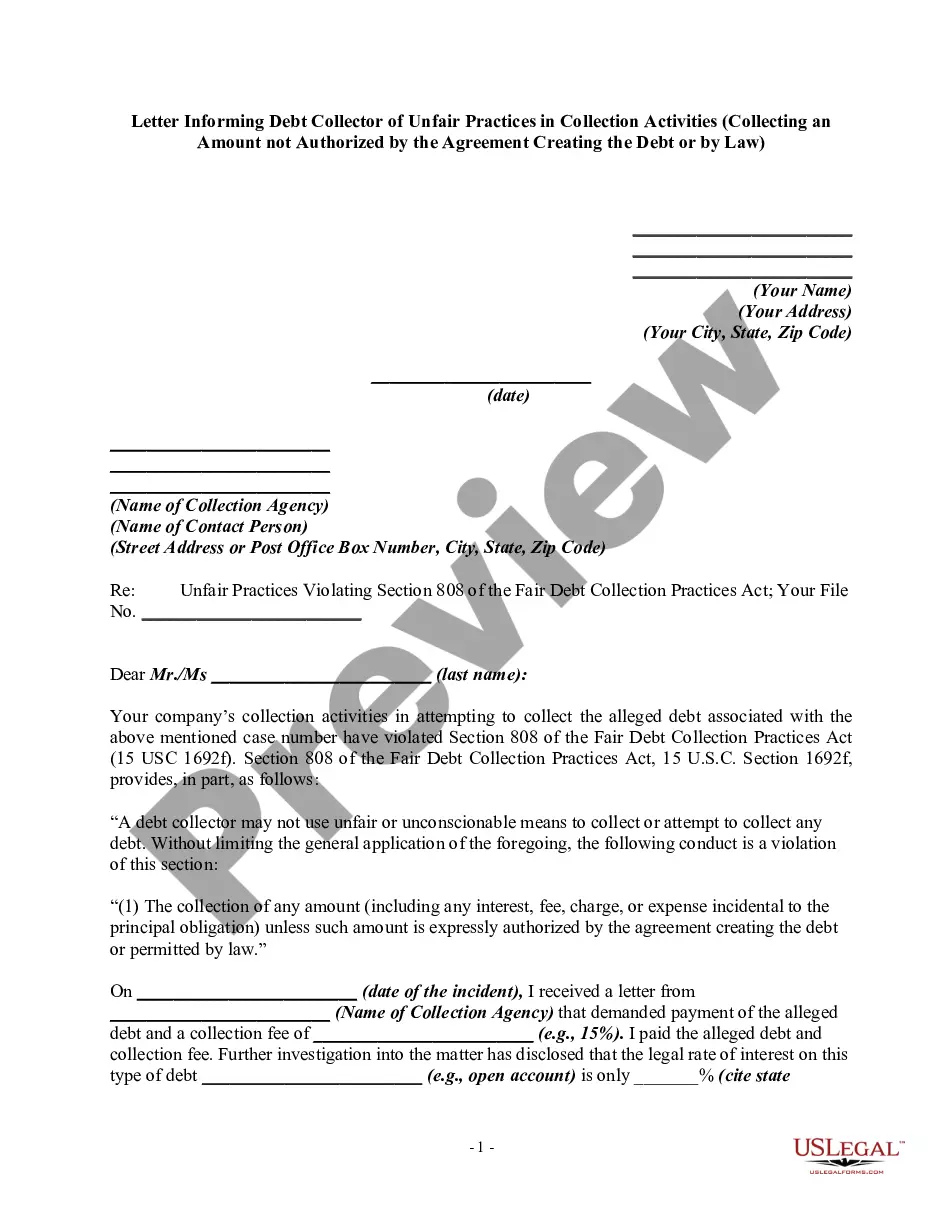
Florida Letter Informing Debt Collector of Unfair Practices in Collection Activities - Taking, or Threatening to Take, any Nonjudicial Action Where there is no Present Right or Intent to Exercise such Rights

State:
Multi-State
Control #:
US-DCPA-20.4BG
Format:
Word; 
Rich Text
Instant download

Description

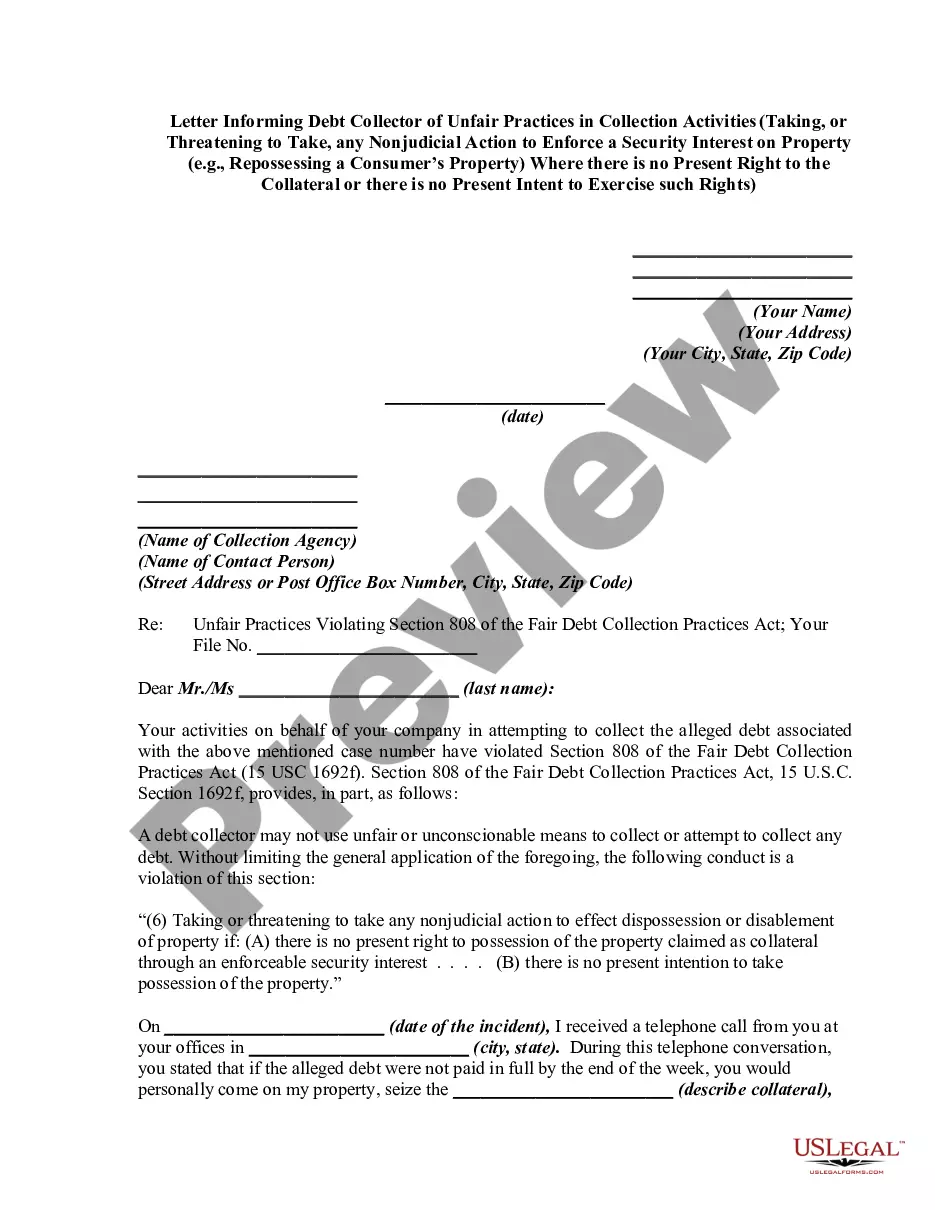
A debt collector may not use unfair or unconscionable means to collect or attempt to collect any debt. Without limiting the general application of the foregoing, the following conduct is a violation of this section:


"(6) Taking or threatening to take any nonjudicial action to effect dispossession or disablement of property if: (A) there is no present right to possession of the property claimed as collateral through an enforceable security interest . . . . (B) there is no present intention to take possession of the property."
Free preview
  • Preview Letter Informing Debt Collector of Unfair Practices in Collection Activities - Taking, or Threatening to Take, any Nonjudicial Action Where there is no Present Right or Intent to Exercise such Rights
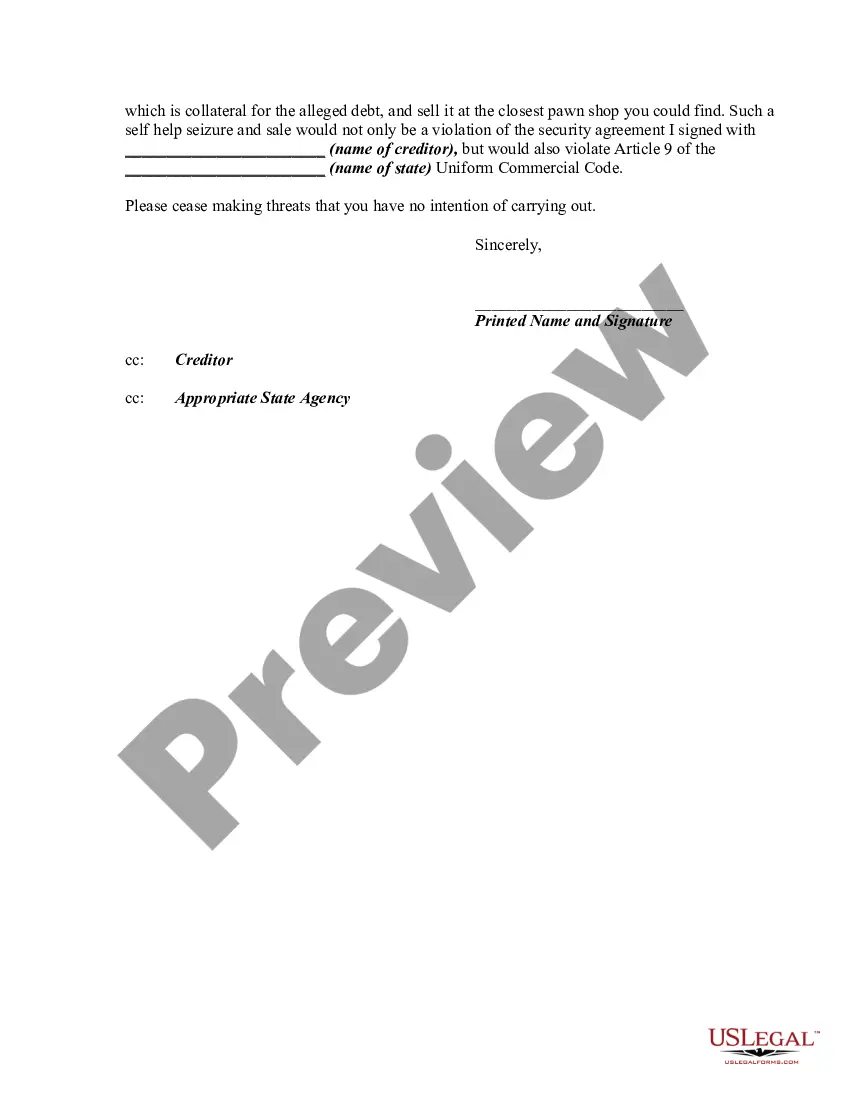
  • Preview Letter Informing Debt Collector of Unfair Practices in Collection Activities - Taking, or Threatening to Take, any Nonjudicial Action Where there is no Present Right or Intent to Exercise such Rights

Related forms

form-preview
Florida Letter Informing Debt Collector of Unfair Practices in Collection Activities

Florida Letter Informing Debt Collector of Unfair Practices in Collection Activities

View this form
form-preview
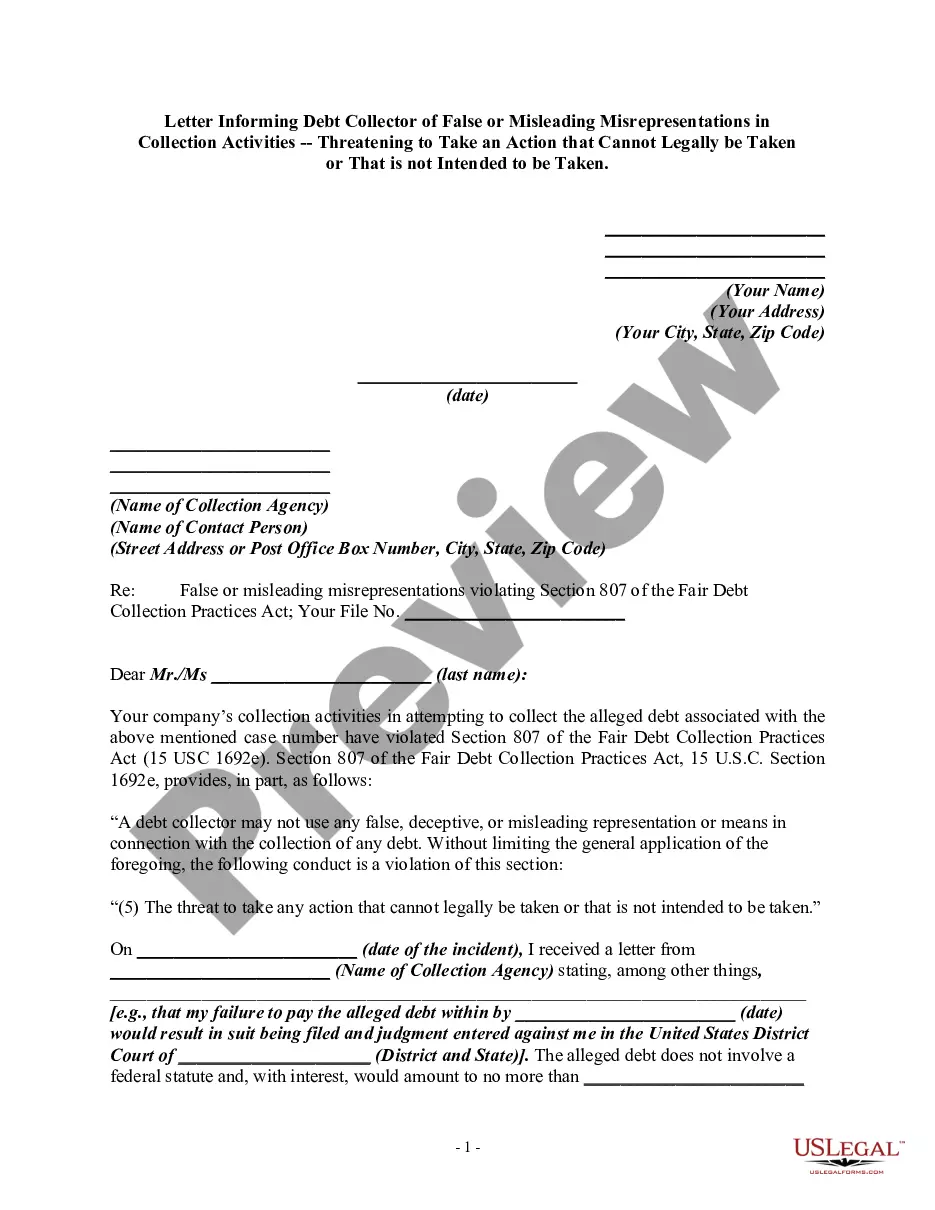
Florida Letter Informing Debt Collector of False or Misleading Misrepresentations in Collection Activities - Threatening to Take an Action that Cannot Legally be Taken or That is not Intended to be Taken

Florida Letter Informing Debt Collector of False or Misleading Misrepresentations in Collection Activities - Threatening to Take an Action that Cannot Legally be Taken or That is not Intended to be Taken

View this form
form-preview
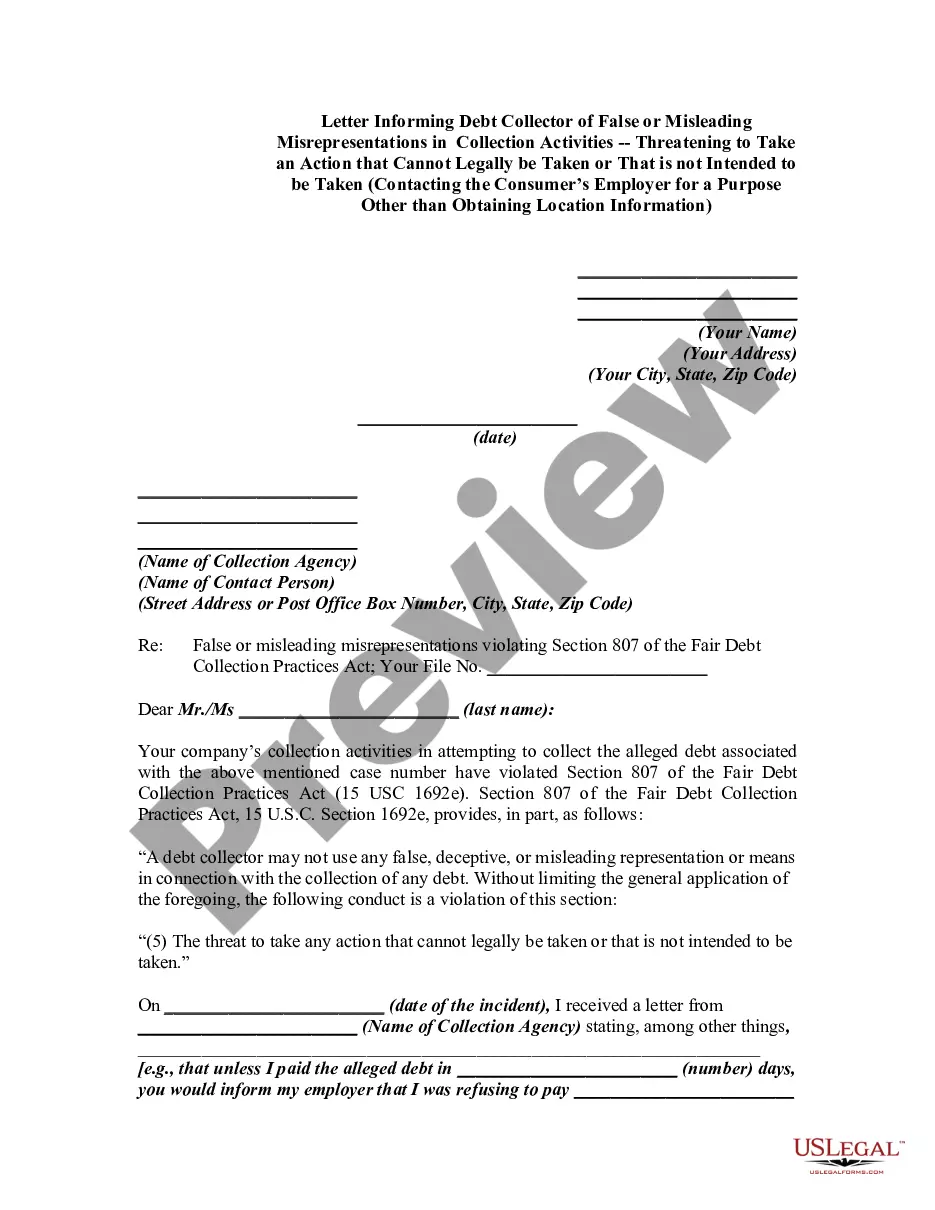
Florida Letter Informing Debt Collector of False or Misleading Misrepresentations in Collection Activities - Threatening to Take an Action that Cannot Legally be Taken or That is not Intended to be Taken - Contacting the Consumer’s Employer

Florida Letter Informing Debt Collector of False or Misleading Misrepresentations in Collection Activities - Threatening to Take an Action that Cannot Legally be Taken or That is not Intended to be Taken - Contacting the Consumer’s Employer

View this form
form-preview
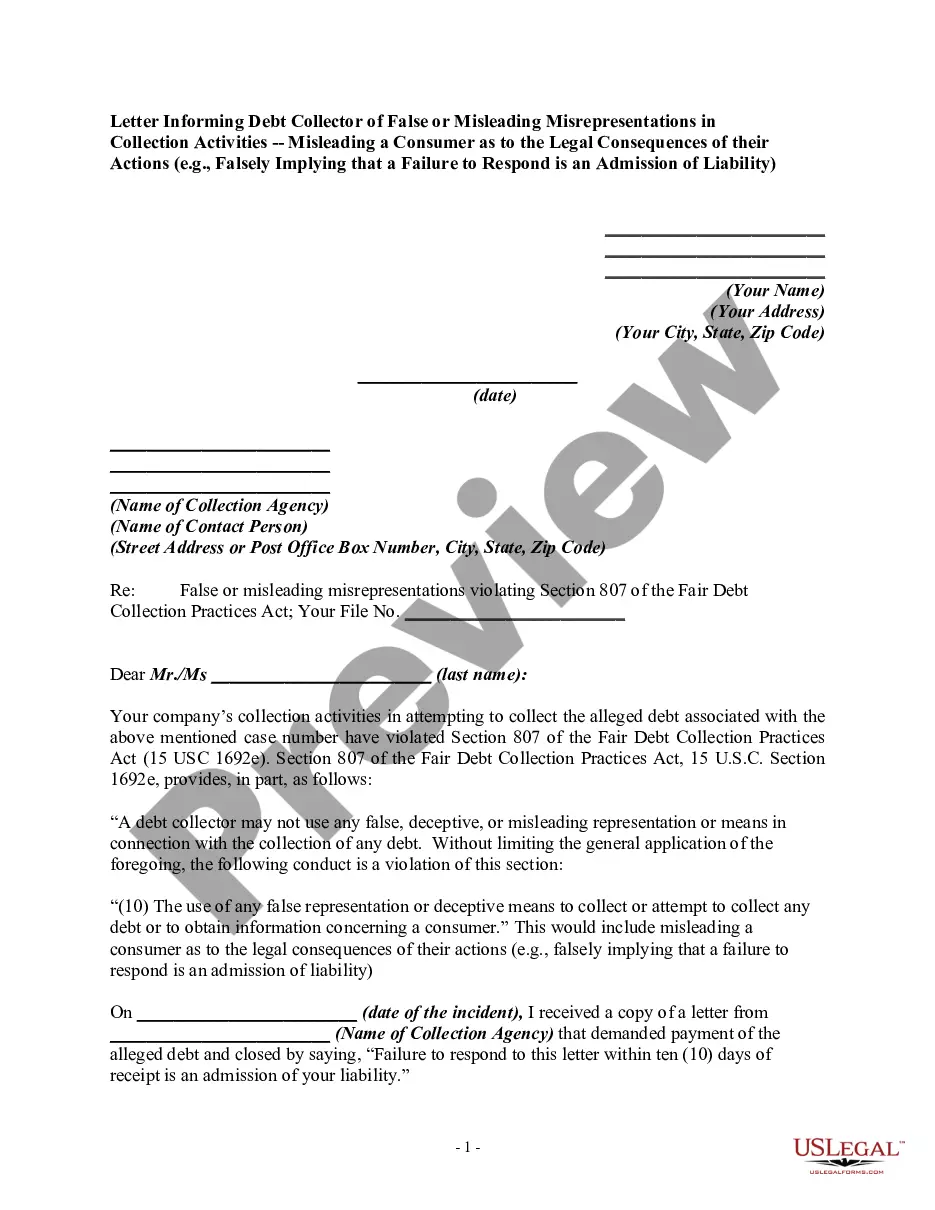
Florida Letter Informing Debt Collector of False or Misleading Misrepresentations in Collection Activities - Misleading a Consumer as to the Legal Consequences of their Actions - e.g., Falsely Implying that a Failure to Respond is an Admission of Liability

Florida Letter Informing Debt Collector of False or Misleading Misrepresentations in Collection Activities - Misleading a Consumer as to the Legal Consequences of their Actions - e.g., Falsely Implying that a Failure to Respond is an Admission of Liability

View this form
form-preview
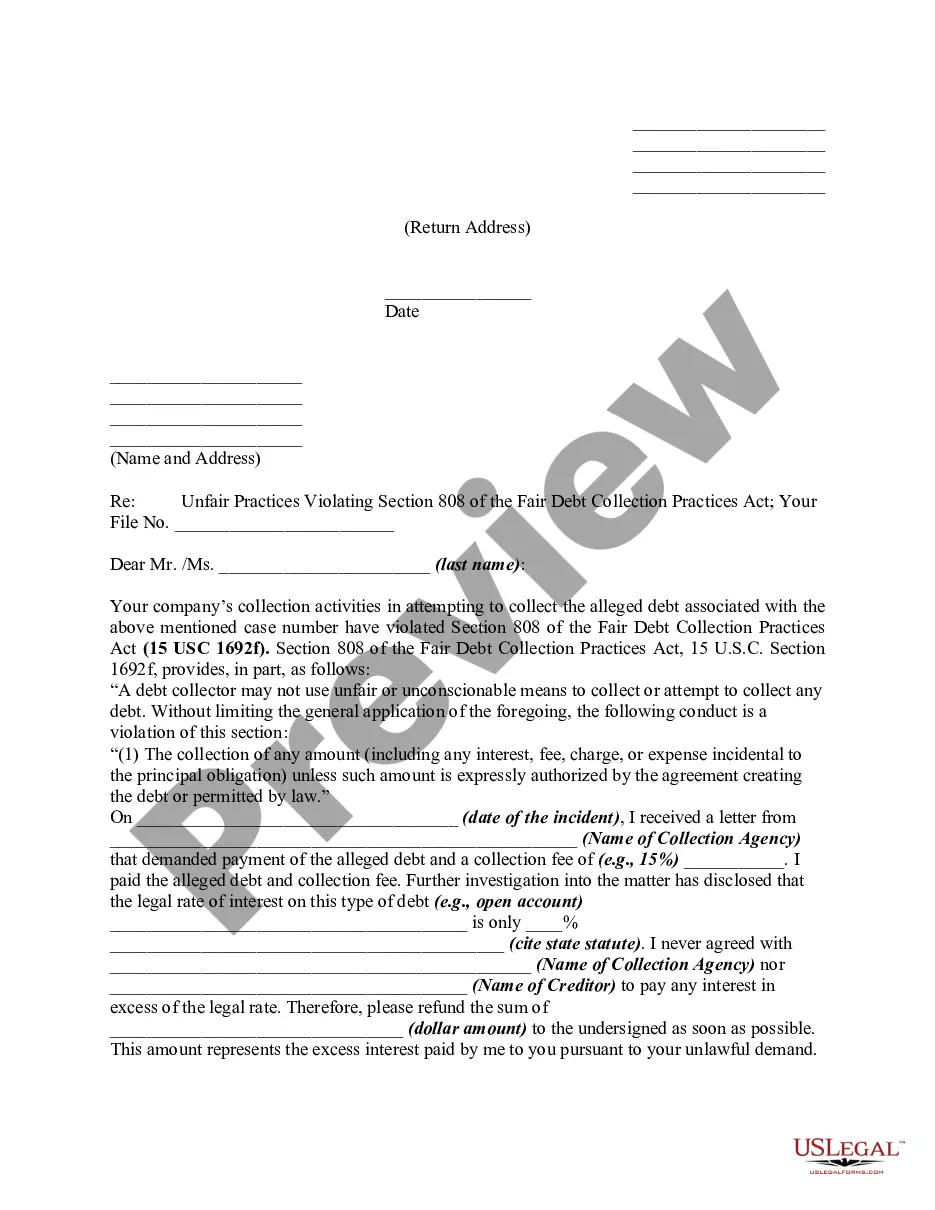
Florida Letter Informing Debt Collector of Unfair Practices in Collection Activities - Collecting an Amount not Authorized by the Agreement Creating the Debt or by Law

Florida Letter Informing Debt Collector of Unfair Practices in Collection Activities - Collecting an Amount not Authorized by the Agreement Creating the Debt or by Law

View this form

How to fill out Letter Informing Debt Collector Of Unfair Practices In Collection Activities - Taking, Or Threatening To Take, Any Nonjudicial Action Where There Is No Present Right Or Intent To Exercise Such Rights?

Have you ever found yourself in a scenario where you require documents for both business or personal purposes almost daily.

There are numerous reliable document templates available online, but finding forms you can rely on is challenging.

US Legal Forms offers thousands of template forms, such as the Florida Letter Informing Debt Collector of Unfair Practices in Collection Activities - Taking, or Threatening to Take, any Nonjudicial Action Where there is no Current Right or Intention to Exercise such Rights, which can be drafted to fulfill state and federal requirements.

Select a convenient document format and download your copy.

You can access all the document templates you have bought in the My documents section. You can acquire an additional copy of the Florida Letter Informing Debt Collector of Unfair Practices in Collection Activities - Taking, or Threatening to Take, any Nonjudicial Action Where there is no Current Right or Intention to Exercise such Rights at any point if necessary. Simply click the required form to download or print the document template.

  1. If you are already familiar with the US Legal Forms website and have an account, simply Log In.
  2. Then, you can download the Florida Letter Informing Debt Collector of Unfair Practices in Collection Activities - Taking, or Threatening to Take, any Nonjudicial Action Where there is no Current Right or Intention to Exercise such Rights template.
  3. If you do not have an account and wish to start using US Legal Forms, follow these instructions.
  4. Locate the form you need and ensure it is for the appropriate city/county.
  5. Utilize the Preview option to review the form.
  6. Read the details to confirm you have selected the appropriate form.
  7. If the form is not what you are seeking, use the Lookup field to find the form that meets your needs.
  8. Once you find the correct form, click on Get now.
  9. Choose the pricing plan you require, complete the necessary information to create your account, and pay for your order using your PayPal or credit card.

Form popularity

FAQ

The 7-7-7 rule in debt collection refers to the timeline used to follow up with debtors. Collectors typically contact the debtor seven days after the initial attempt, again seven days later, and finally seven days after that if no response is received. This systematic approach can sometimes be misused, leading to unfair practices, which is why a Florida Letter Informing Debt Collector of Unfair Practices in Collection Activities - Taking, or Threatening to Take, any Nonjudicial Action Where there is no Present Right or Intent to Exercise such Rights serves as a crucial tool for your defense.

There are 3 ways to remove collections without paying: 1) Write and mail a Goodwill letter asking for forgiveness, 2) study the FCRA and FDCPA and craft dispute letters to challenge the collection, and 3) Have a collections removal expert delete it for you.

7 Most Common FDCPA ViolationsContinued attempts to collect debt not owed.Illegal or unethical communication tactics.Disclosure verification of debt.Taking or threatening illegal action.False statements or false representation.Improper contact or sharing of info.Excessive phone calls.16-Sept-2020

The definition of debt collection harassment is to intimidate, abuse, coerce, bully or browbeat consumers into paying off debt. This happens most often over the phone, but harassment could come in the form of emails, texts, direct mail or talking to friends or neighbors about your debt.

7 Most Common FDCPA ViolationsContinued attempts to collect debt not owed.Illegal or unethical communication tactics.Disclosure verification of debt.Taking or threatening illegal action.False statements or false representation.Improper contact or sharing of info.Excessive phone calls.16 Sept 2020

Unfair practices are prohibitedDeposit or threaten to deposit a postdated check before your intended payment date. Take or threaten to take property if it's not allowed. Collect more than you owe on a debt, which may include fees and interest.

No harassment The Fair Debt Collection Practices Act (FDCPA) says debt collectors can't harass, oppress, or abuse you or anyone else they contact. Some examples of harassment are: Repetitious phone calls that are intended to annoy, abuse, or harass you or any person answering the phone. Obscene or profane language.

Among the insider tips, Ulzheimer shared with the audience was this: if you are being pursued by debt collectors, you can stop them from calling you ever again by telling them '11-word phrase'. This simple idea was later advertised as an '11-word phrase to stop debt collectors'.

Your credit card debt, auto loans, medical bills, student loans, mortgage, and other household debts are covered under the FDCPA.

The law makes it illegal for debt collectors to harass debtors in other ways, including threats of bodily harm or arrest. They also cannot lie or use profane or obscene language. Additionally, debt collectors cannot threaten to sue a debtor unless they truly intend to take that debtor to court.

Trusted and secure by over 3 million people of the world’s leading companies

Florida Letter Informing Debt Collector of Unfair Practices in Collection Activities - Taking, or Threatening to Take, any Nonjudicial Action Where there is no Present Right or Intent to Exercise such Rights