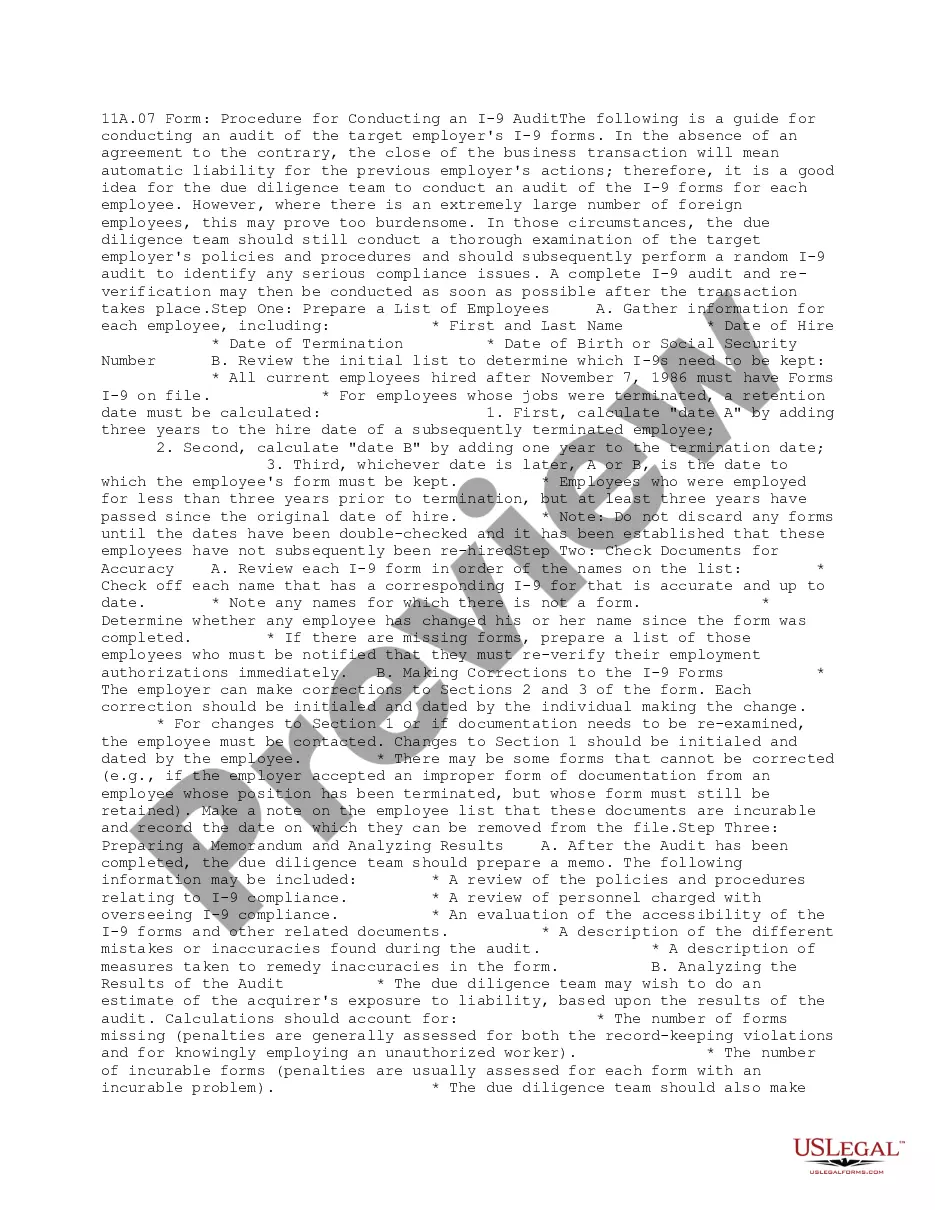
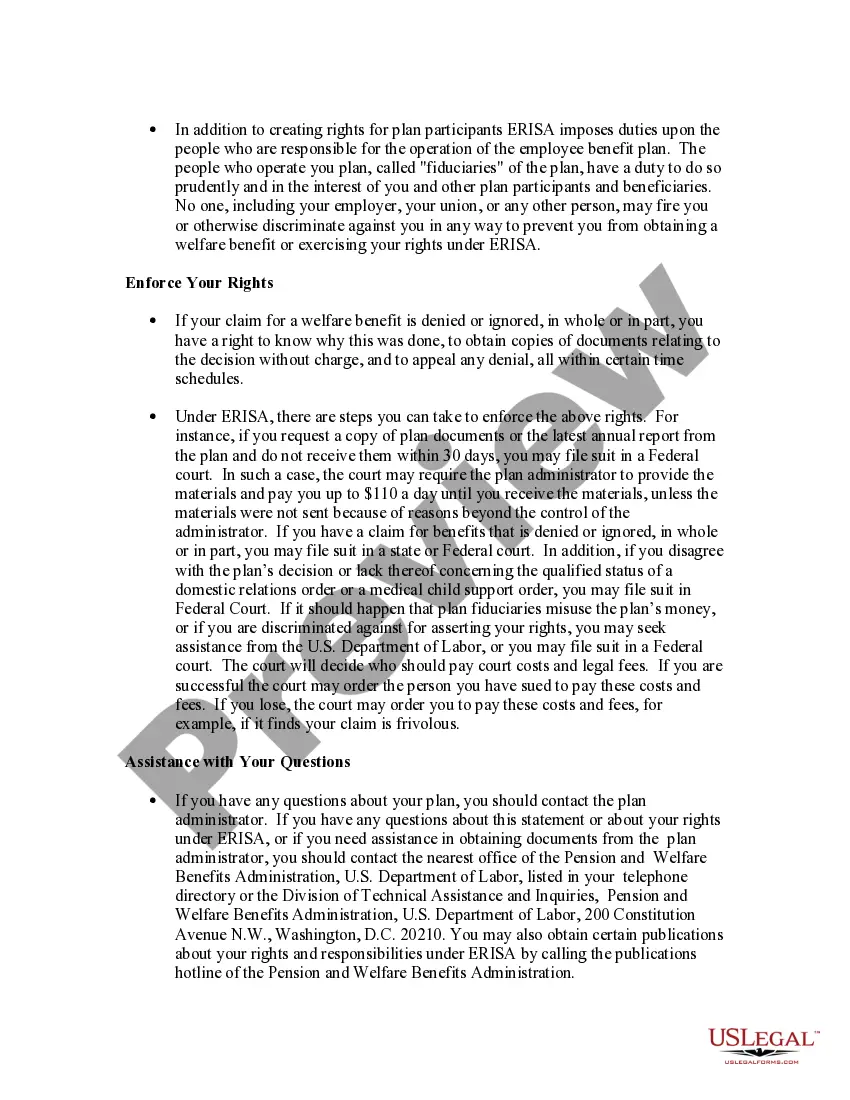
Florida Model Statement of ERISA Rights
Description
Get your form ready online
Our built-in tools help you complete, sign, share, and store your documents in one place.
Make edits, fill in missing information, and update formatting in US Legal Forms—just like you would in MS Word.
Download a copy, print it, send it by email, or mail it via USPS—whatever works best for your next step.
Sign and collect signatures with our SignNow integration. Send to multiple recipients, set reminders, and more. Go Premium to unlock E-Sign.
If this form requires notarization, complete it online through a secure video call—no need to meet a notary in person or wait for an appointment.
We protect your documents and personal data by following strict security and privacy standards.

Make edits, fill in missing information, and update formatting in US Legal Forms—just like you would in MS Word.

Download a copy, print it, send it by email, or mail it via USPS—whatever works best for your next step.

Sign and collect signatures with our SignNow integration. Send to multiple recipients, set reminders, and more. Go Premium to unlock E-Sign.

If this form requires notarization, complete it online through a secure video call—no need to meet a notary in person or wait for an appointment.

We protect your documents and personal data by following strict security and privacy standards.
Looking for another form?
How to fill out Model Statement Of ERISA Rights?
You can invest numerous hours online trying to discover the sanctioned document template that complies with the federal and state regulations you need.
US Legal Forms offers a vast array of legal documents that are vetted by professionals.
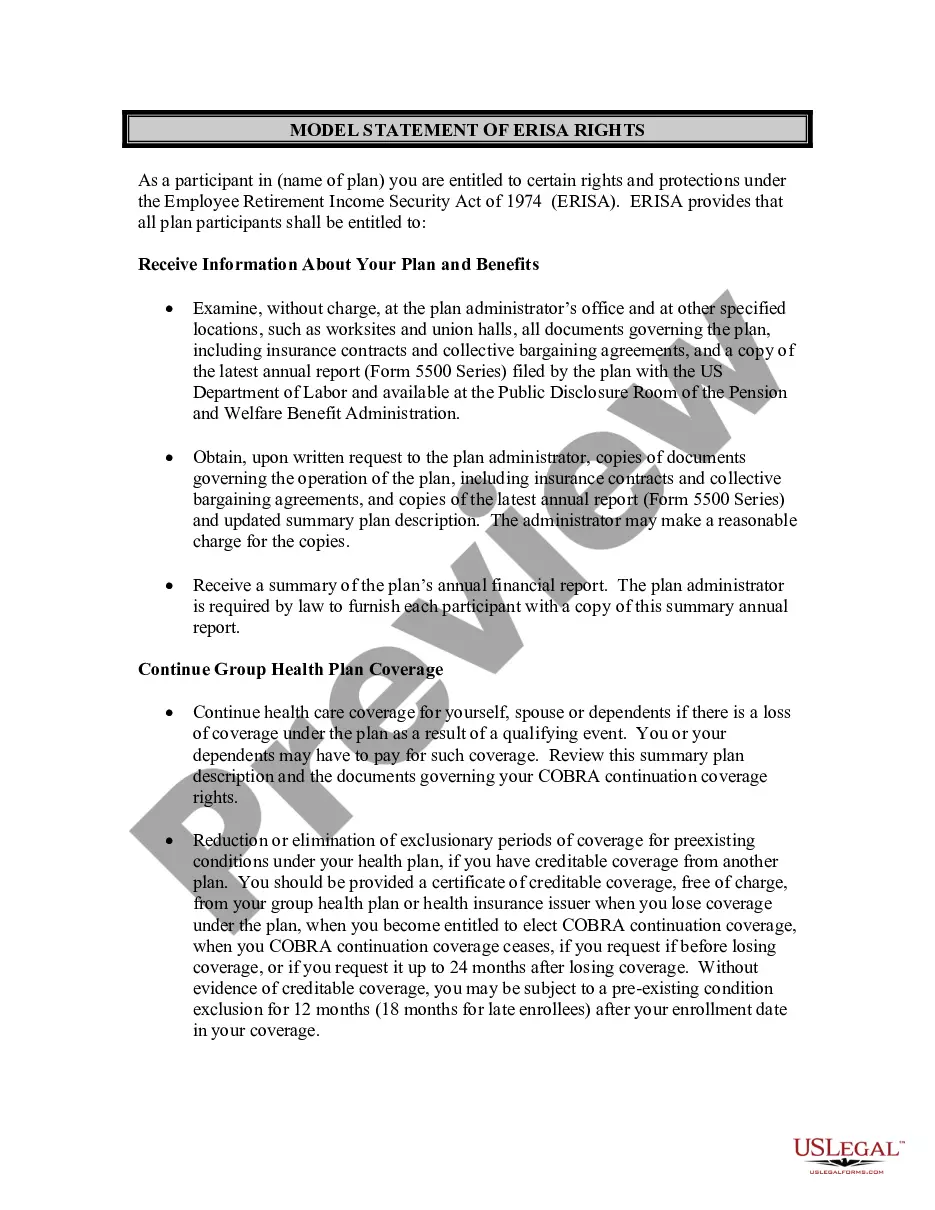
It's easy to access or create the Florida Model Statement of ERISA Rights from our services.
If available, use the Review button to preview the document template as well.
- If you already have a US Legal Forms account, you can Log In and click the Obtain button.
- Then, you can fill out, modify, print, or sign the Florida Model Statement of ERISA Rights.
- Every legal document template you acquire is permanently yours.
- To obtain another copy of any downloaded form, go to the My documents tab and click the appropriate button.
- If you are visiting the US Legal Forms website for the first time, follow the simple instructions below.
- First, ensure you've selected the correct document template for your chosen state/region.
- Review the document outline to confirm you’ve selected the right form.
Form popularity
FAQ
ERISA requires plans to provide participants with plan information including important information about plan features and funding; sets minimum standards for participation, vesting, benefit accrual and funding; provides fiduciary responsibilities for those who manage and control plan assets; requires plans to
Accounts Covered by ERISA ERISA can cover both defined-benefit and defined-contribution plans offered by employers. Common types of employer-sponsored retirement accounts that fall under ERISA include 401(k) plans, pensions, deferred-compensation plans, and profit-sharing plans.
ERISA requires a formal written plan document, a summary plan description (SPD), and a summary of benefits & coverage (SBC). Each of these requirements is discussed in more detail below. A formal plan document is required for every ERISA plan.
ERISA requires plans to provide participants with plan information including important information about plan features and funding; sets minimum standards for participation, vesting, benefit accrual and funding; provides fiduciary responsibilities for those who manage and control plan assets; requires plans to
Federal law (ERISA) requires that employers provide certain documents relating to their employee benefit plans to the people who are covered by the plans.
The plan document describes the plan's terms and conditions related to the operation and administration of the plan. It is required for each welfare benefit plan an employer maintains which is subject to ERISA, and it must be in writing.
ERISA requires plans to provide participants with plan information including important information about plan features and funding; sets minimum standards for participation, vesting, benefit accrual and funding; provides fiduciary responsibilities for those who manage and control plan assets; requires plans to
The Employee Retirement Income Security Act of 1974 (ERISA) is a federal law that sets minimum standards for most voluntarily established retirement and health plans in private industry to provide protection for individuals in these plans.
Under ERISA, anyone who exercises discretionary authority over plan assets or plan management has a fiduciary duty toward the plan's participants. As a result, fiduciaries must run the plan solely for the benefit of its participants, and failure to do so is an ERISA violation.
ERISA prohibits fiduciaries from misusing funds and also sets minimum standards for participation, vesting, benefit accrual, and funding of retirement plans. It also grants retirement plan participants the right to sue for benefits and breaches of fiduciary duty.