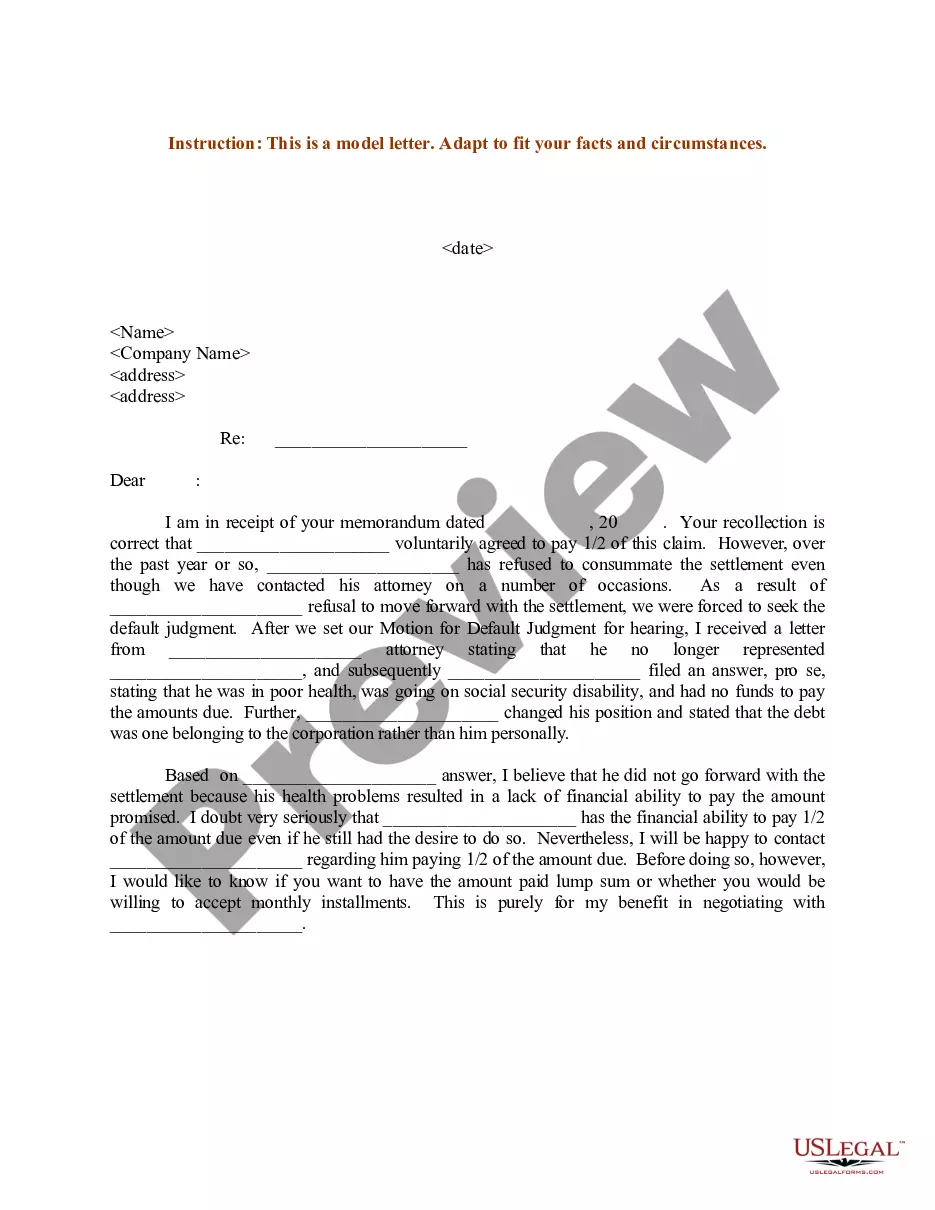
Florida Sample Letter for Payment of Judgment
Description




Get your form ready online
Our built-in tools help you complete, sign, share, and store your documents in one place.
Make edits, fill in missing information, and update formatting in US Legal Forms—just like you would in MS Word.
Download a copy, print it, send it by email, or mail it via USPS—whatever works best for your next step.
Sign and collect signatures with our SignNow integration. Send to multiple recipients, set reminders, and more. Go Premium to unlock E-Sign.
If this form requires notarization, complete it online through a secure video call—no need to meet a notary in person or wait for an appointment.
We protect your documents and personal data by following strict security and privacy standards.

Make edits, fill in missing information, and update formatting in US Legal Forms—just like you would in MS Word.

Download a copy, print it, send it by email, or mail it via USPS—whatever works best for your next step.

Sign and collect signatures with our SignNow integration. Send to multiple recipients, set reminders, and more. Go Premium to unlock E-Sign.

If this form requires notarization, complete it online through a secure video call—no need to meet a notary in person or wait for an appointment.

We protect your documents and personal data by following strict security and privacy standards.
Looking for another form?






How to fill out Sample Letter For Payment Of Judgment?
If you need to finalize, acquire, or print legal document templates, utilize US Legal Forms, the largest collection of legal forms available online.
Employ the site's straightforward and user-friendly search to locate the documents you need. An assortment of templates for commercial and personal uses are categorized by types and states, or keywords.
Utilize US Legal Forms to find the Florida Sample Letter for Payment of Judgment with just a few clicks.
Every legal document template you purchase is yours permanently. You have access to every document you acquired within your account. Visit the My documents section and select a form to print or download again.
Be proactive and obtain, and print the Florida Sample Letter for Payment of Judgment with US Legal Forms. There are thousands of professional and state-specific forms you can utilize for your business or personal needs.
- If you are currently a US Legal Forms user, Log In to your account and click the Download button to obtain the Florida Sample Letter for Payment of Judgment.
- You can also access forms you previously acquired from the My documents tab of your account.
- If you are using US Legal Forms for the first time, follow the steps below.
- Step 1. Ensure you have selected the form for the correct region/state.
- Step 2. Use the Review option to review the form's content. Remember to read the summary.
- Step 3. If you are not satisfied with the form, use the Search field at the top of the screen to find alternative versions in the legal form template.
- Step 4. Once you have located the form you need, select the Purchase now button. Choose the pricing plan you prefer and enter your details to register for the account.
- Step 5. Process the transaction. You can use your credit card or PayPal account to complete the transaction.
- Step 6. Choose the format of the legal document and download it to your device.
- Step 7. Fill out, modify, and print or sign the Florida Sample Letter for Payment of Judgment.
Form popularity
FAQ
In most cases, you cannot go to jail simply for not paying a court judgment. However, failing to comply with court orders related to the judgment may lead to contempt of court charges. This could potentially result in penalties, including fines or even jail time. To avoid such situations, consider reaching out with a Florida Sample Letter for Payment of Judgment to discuss payment options or arrangements.
A demand letter in Florida must clearly state the amount owed and the reason for the debt. It should also include a deadline for payment and mention the potential consequences of non-payment. By utilizing a Florida Sample Letter for Payment of Judgment, you can ensure that your demand letter follows legal standards and effectively communicates your intent to resolve the issue.
Ignoring a lawsuit can lead to serious consequences. The court may issue a default judgment against you, which means the other party wins automatically. This can result in garnished wages or seized assets to satisfy the judgment. To protect yourself, consider using a Florida Sample Letter for Payment of Judgment to communicate with the other party.
To write a legal letter demanding payment, start by stating the amount owed and the reason for the debt. Clearly outline any previous communications regarding the payment. A Florida Sample Letter for Payment of Judgment can serve as an excellent template, allowing you to format your demand professionally. Using this resource will help you maintain a serious tone while increasing the likelihood of a prompt response.
To write a judgment proof letter, start by clearly stating your situation and explaining why you cannot make the payment. Include specific details about your financial status, such as income and expenses, to support your claim. You can refer to a Florida Sample Letter for Payment of Judgment for guidance on structure and tone. This resource will help you convey your message effectively and professionally.
You can't go to jail for failing to pay a debt or a judgment. However, if you do not pay a debt, or if a judgment is entered against you, this information can be reported to credit bureaus and made a part of your credit history. This information can be reported for up to seven years on your credit reports.
If the judgment debtor does not pay, you are entitled to get the sheriff to seize the judgment debtor's property. The seizing of property by the sheriff is called a levy. Once the sheriff has levied on the property, the sheriff will then sell it, and pay you out of the money the sheriff receives from the sale.
In the state of Florida, you can't be put in jail for failing to pay a debt or judgment.
File Bankruptcy If all else fails, a person can avoid paying a judgement by filing for Chapter 7 bankruptcy. Chapter 7 bankruptcy enables a debtor to discharge all their unsecured debt, including monetary judgements. The bankruptcy debtor must in exchange turn over to the bankruptcy trustee all their non-exempt assets.
Clearly state that you are writing a judgment proof letter and explain the purpose of the letter, which is to demonstrate your inability to pay the judgment. Provide a brief explanation of your current financial situation, including any income, assets, or debts you may have.