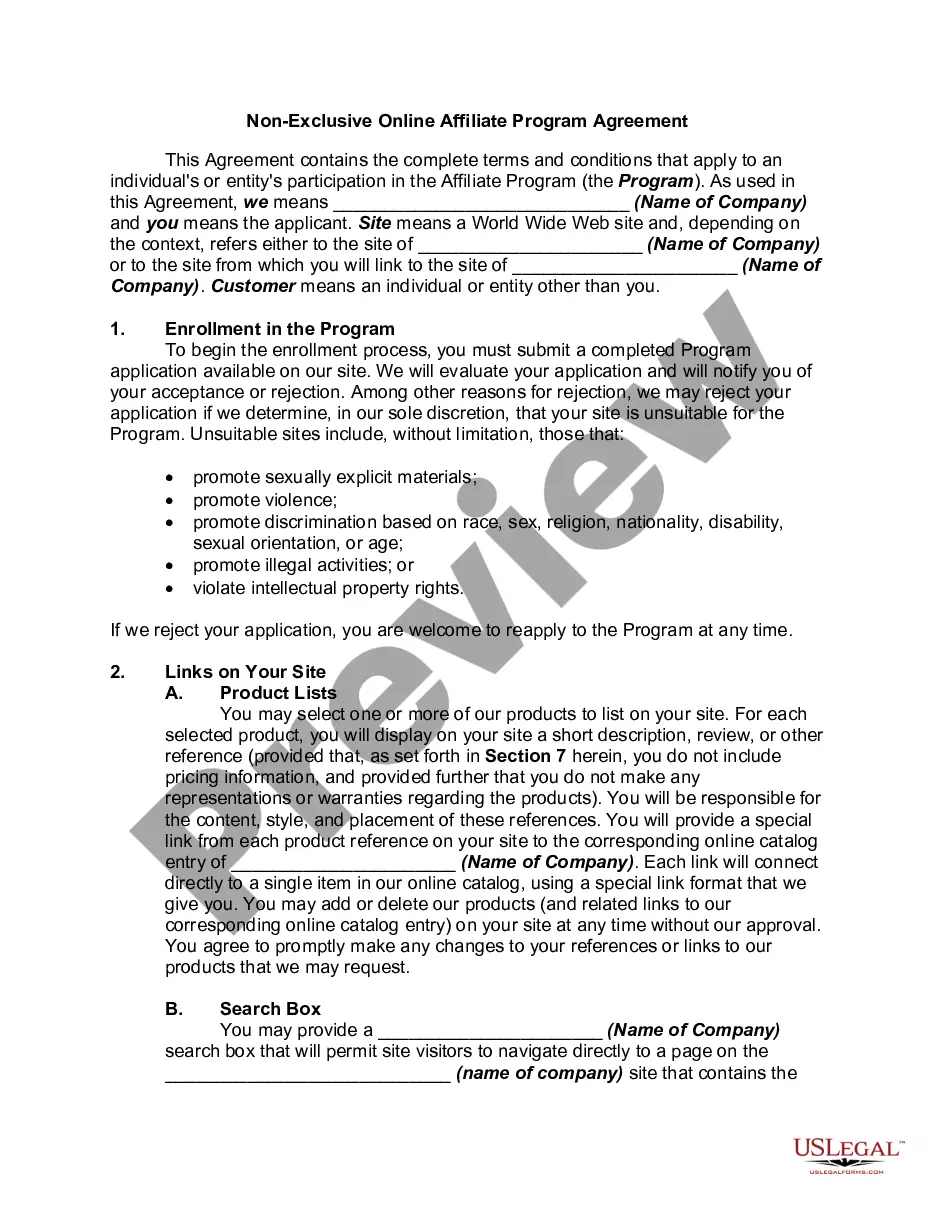
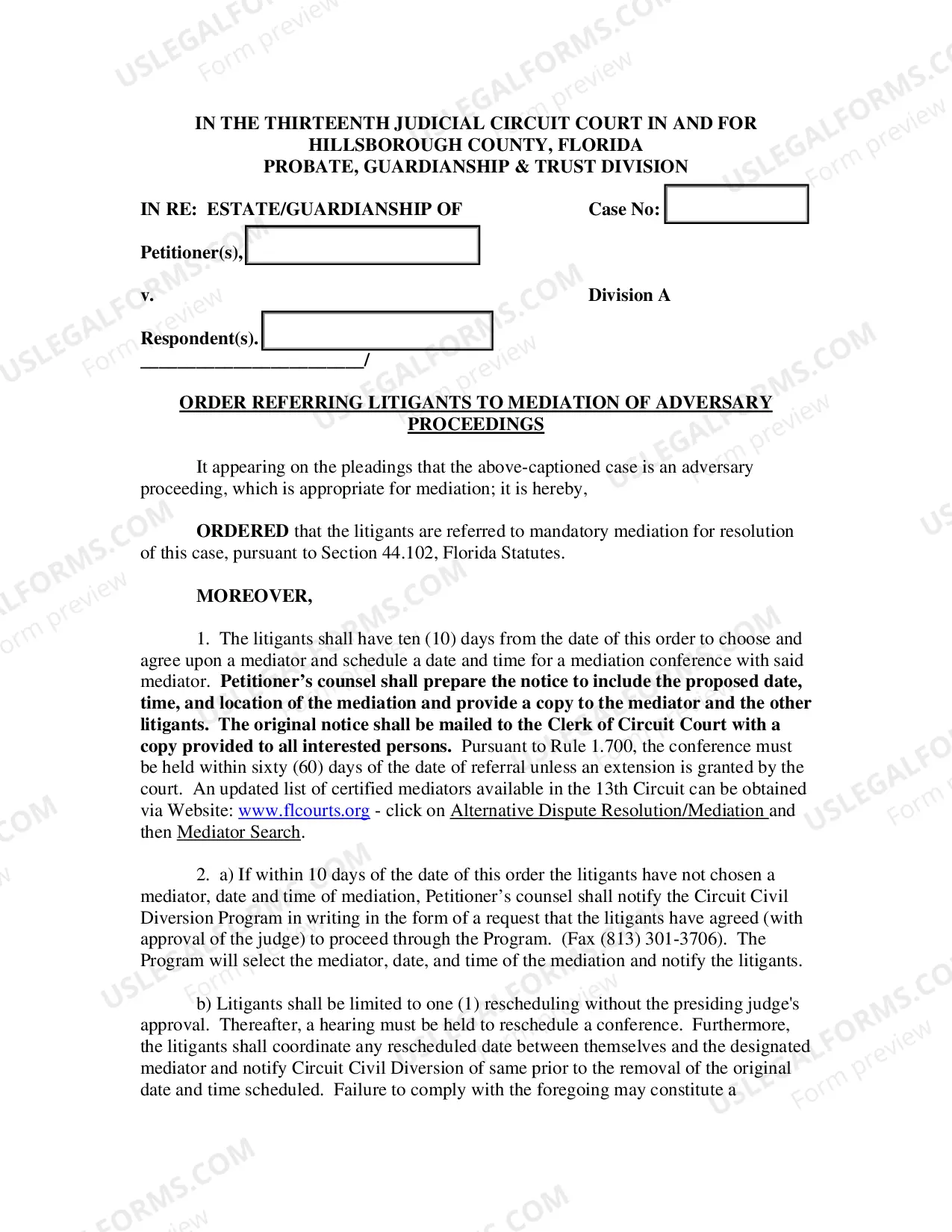
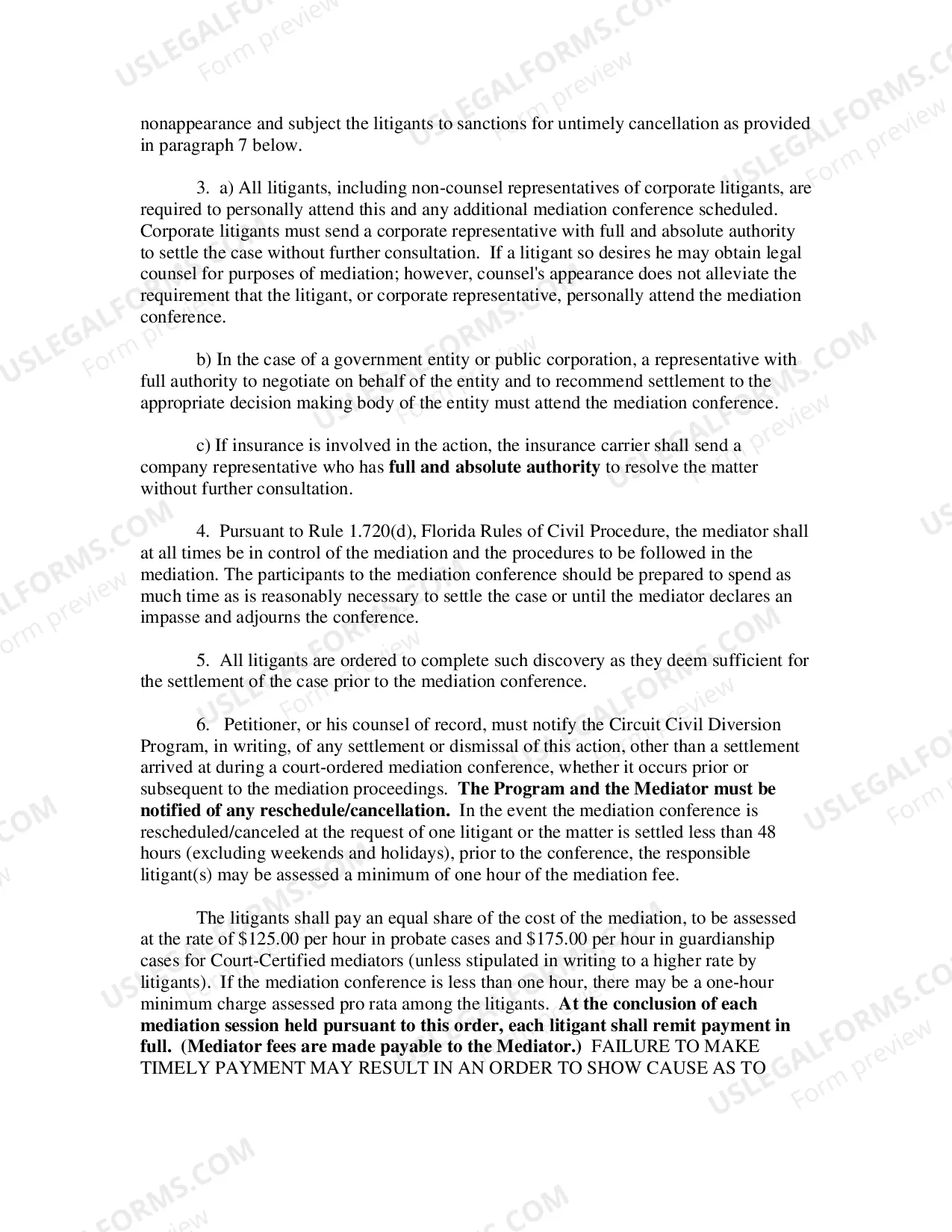
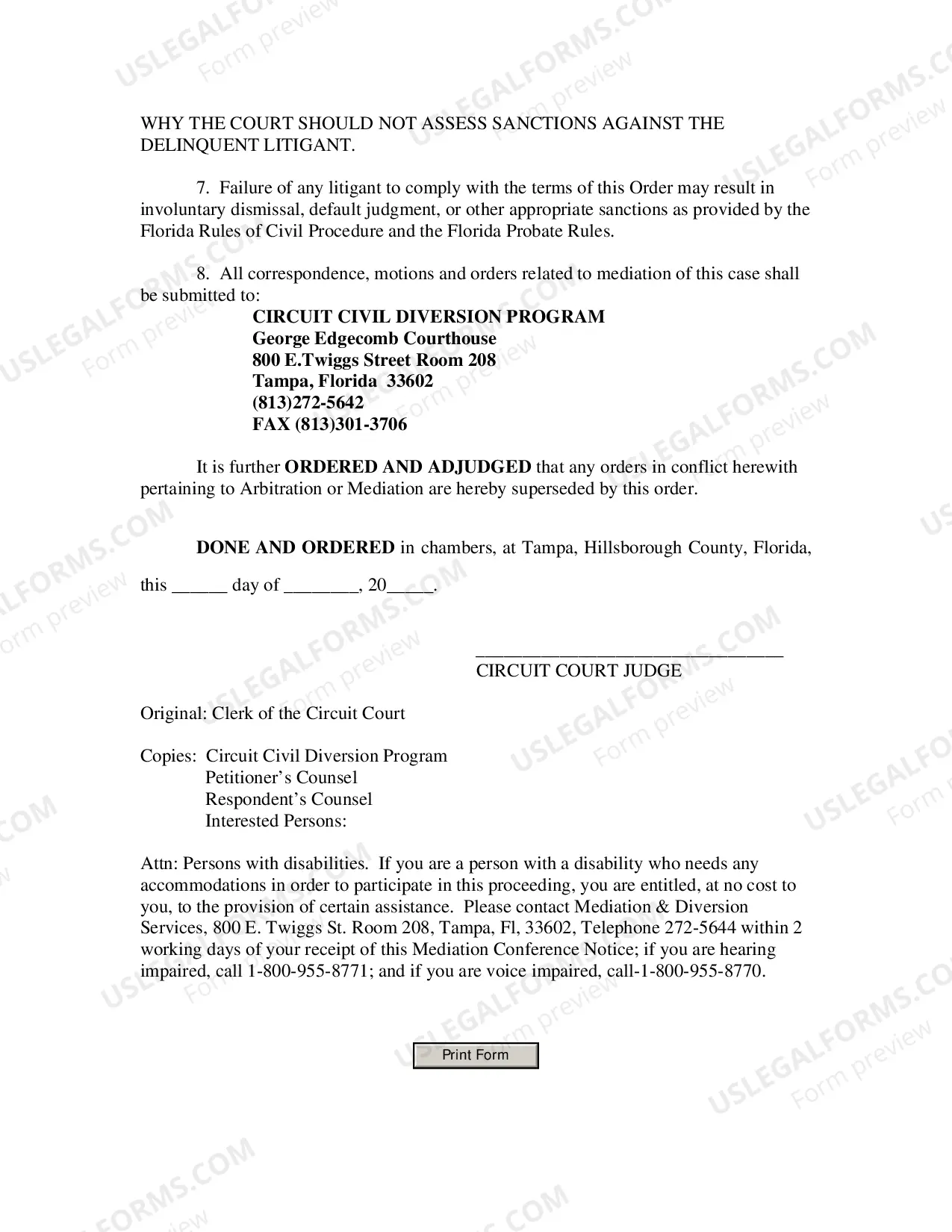
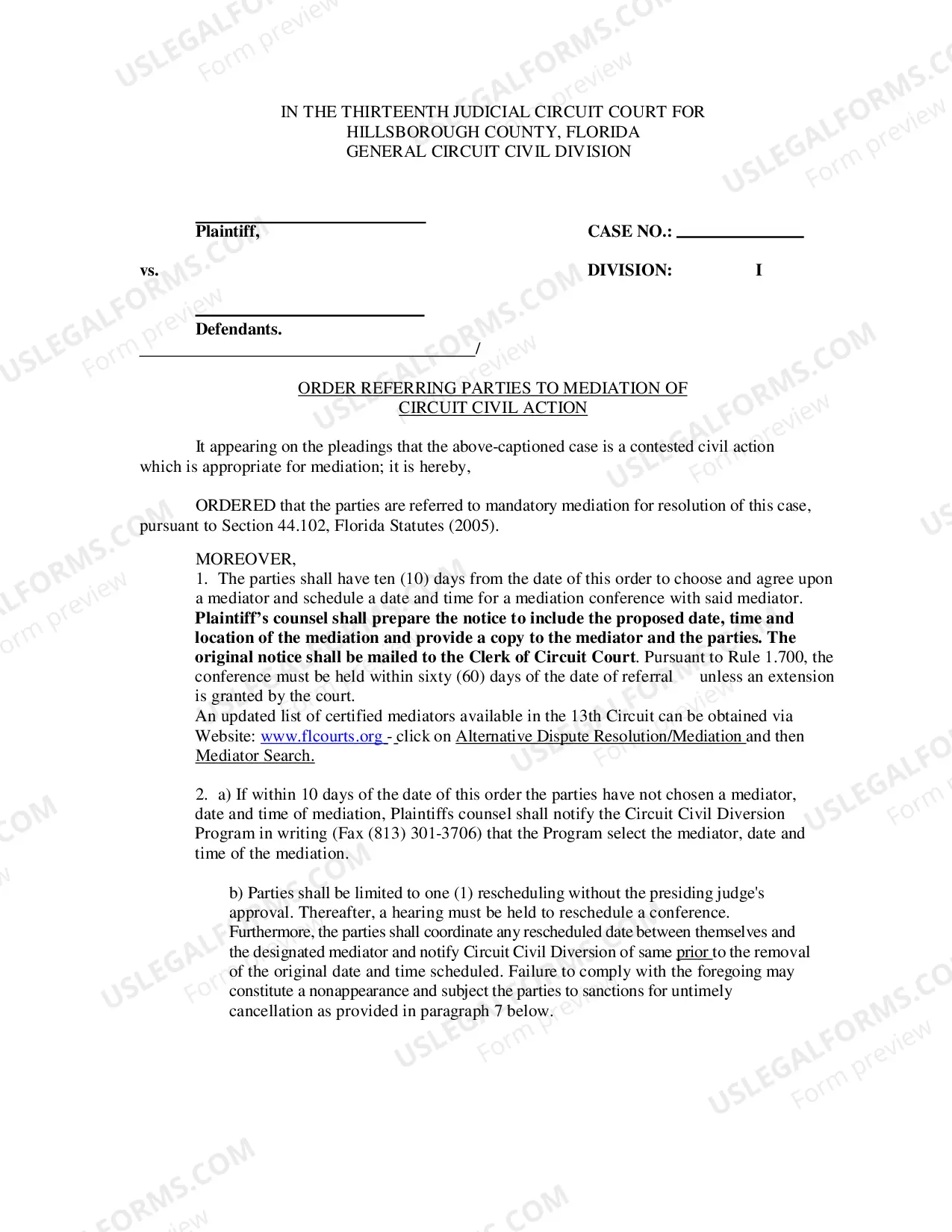
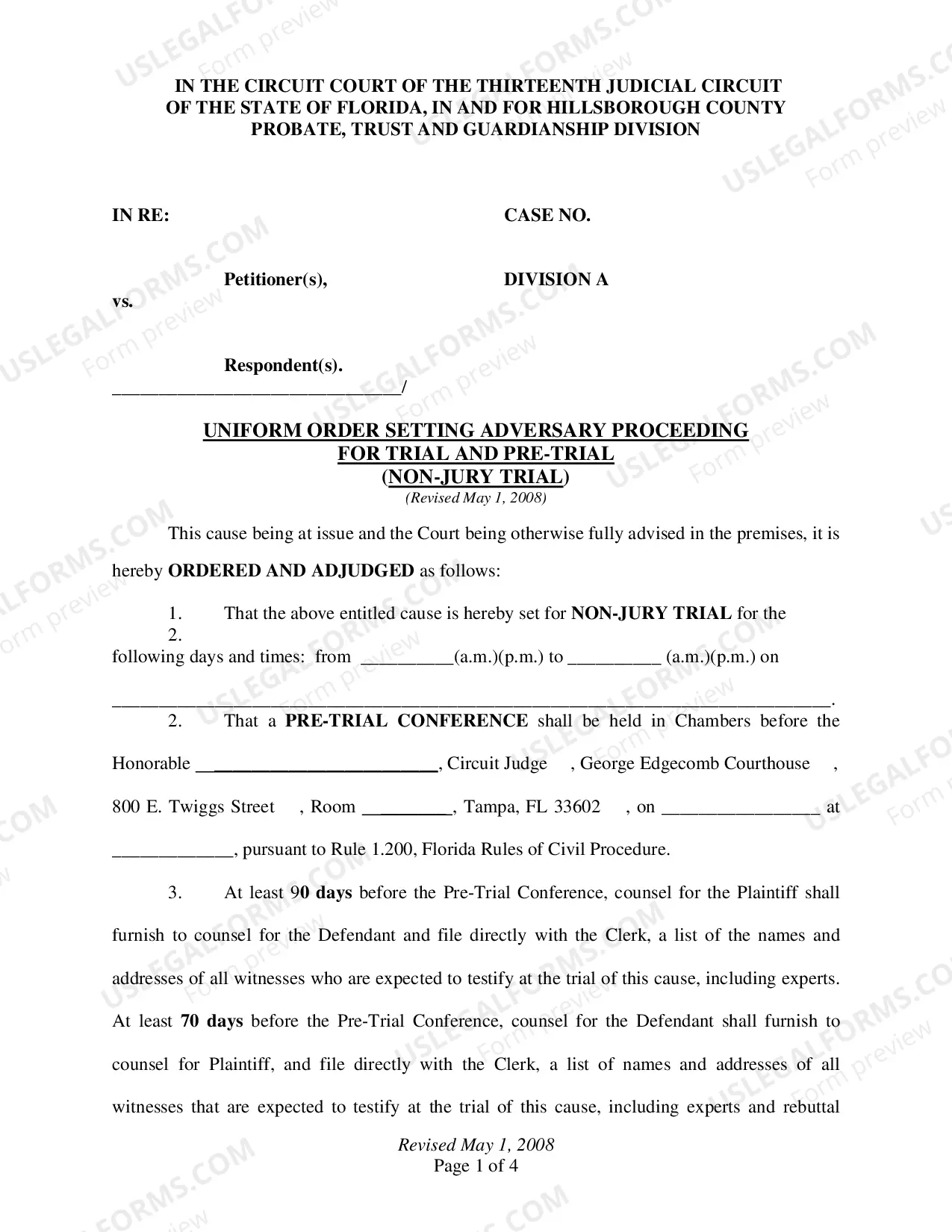
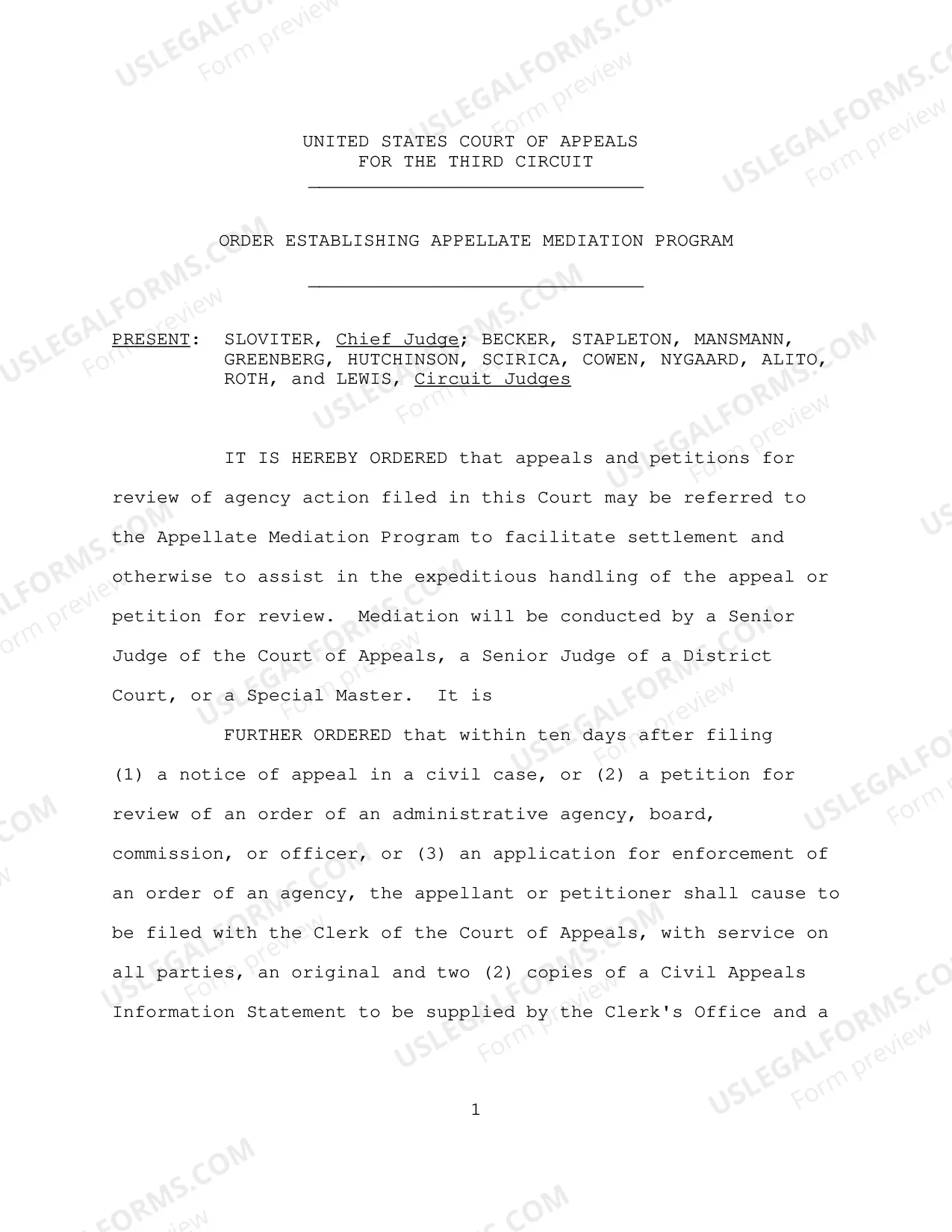
Florida Order Referring To Mediation (Adversary Proceedings) is a court order that requires the parties in a civil dispute to attend mediation before the court proceeds with the dispute. This order is usually issued in cases where the parties cannot reach an agreement on their own and need a neutral third party to help facilitate a resolution. Mediation is a process in which a mediator, who is an impartial third party, meets with the parties to help them reach a mutually agreeable resolution. The Florida Order Referring To Mediation (Adversary Proceedings) can also be used to resolve disputes between two individuals or businesses. The two types of Florida Order Referring To Mediation (Adversary Proceedings) are: 1. Mandatory Mediation: This type of order requires the parties to attend mediation before the court will hear their case. The mediator will act as a neutral third party to help the parties reach a resolution. 2. Voluntary Mediation: This type of order allows the parties to agree to enter mediation voluntarily. The mediator will help the parties negotiate and reach a resolution, but the parties can still decide to move forward with the trial if they are unsatisfied with the results of mediation.
Florida Order Referring To Mediation (Adversary Proceedings)
Description
Get your form ready online
Our built-in tools help you complete, sign, share, and store your documents in one place.
Make edits, fill in missing information, and update formatting in US Legal Forms—just like you would in MS Word.
Download a copy, print it, send it by email, or mail it via USPS—whatever works best for your next step.
Sign and collect signatures with our SignNow integration. Send to multiple recipients, set reminders, and more. Go Premium to unlock E-Sign.
If this form requires notarization, complete it online through a secure video call—no need to meet a notary in person or wait for an appointment.
We protect your documents and personal data by following strict security and privacy standards.

Make edits, fill in missing information, and update formatting in US Legal Forms—just like you would in MS Word.

Download a copy, print it, send it by email, or mail it via USPS—whatever works best for your next step.

Sign and collect signatures with our SignNow integration. Send to multiple recipients, set reminders, and more. Go Premium to unlock E-Sign.

If this form requires notarization, complete it online through a secure video call—no need to meet a notary in person or wait for an appointment.

We protect your documents and personal data by following strict security and privacy standards.
Looking for another form?

How to fill out Florida Order Referring To Mediation (Adversary Proceedings)?
US Legal Forms is the easiest and most cost-effective method to locate suitable official templates.
It hosts the most comprehensive online collection of corporate and personal legal documents composed and verified by lawyers.
Here, you can discover printable and fillable forms that adhere to federal and state regulations - just like your Florida Order Referring To Mediation (Adversary Proceedings).
Examine the form description or preview the document to ensure you’ve located the one that suits your needs, or search for another using the search bar above.
Click Buy now when you’re confident in its alignment with all the requirements, and choose the subscription plan that appeals to you the most.
- Acquiring your template takes only a few straightforward steps.
- Users who already possess an account with an active subscription need only to Log In to the service and download the document onto their device.
- Subsequently, they can locate it in their profile under the My documents section.
- And here’s how you can receive a properly prepared Florida Order Referring To Mediation (Adversary Proceedings) if this is your first experience with US Legal Forms.
Form popularity
FAQ
The mediation rule 1.720 in Florida establishes the framework for mediation in civil cases, including adversary proceedings. It mandates that parties must engage in mediation before proceeding with litigation, promoting resolution outside the courtroom. This rule emphasizes the importance of a Florida Order Referring To Mediation (Adversary Proceedings), ensuring that disputes are addressed collaboratively. By utilizing mediation, you can often achieve quicker, more satisfactory outcomes while conserving resources and time.
ADR, or Alternative Dispute Resolution, refers to various methods for resolving disputes outside of traditional courtroom litigation, including mediation, arbitration, and negotiation. Mediation is a specific form of ADR that emphasizes negotiation between parties with the guidance of a mediator. Understanding this distinction is important when considering the Florida Order Referring To Mediation (Adversary Proceedings) as a dispute resolution avenue.
During mediation, parties will meet with a neutral mediator who guides the discussion and helps identify issues, interests, and potential solutions. The mediator facilitates communication, encourages cooperation, and works to meet both parties' needs. The goal is to reach a voluntary agreement, which may prevent the need for a trial. This dynamic process is central to the Florida Order Referring To Mediation (Adversary Proceedings).
Dispute resolution encompasses a variety of processes designed to resolve conflicts, one of which is mediation. Mediation is a specific method within the broader framework of dispute resolution that focuses on negotiation facilitated by a neutral party. Clarifying this distinction is vital for individuals involved in the Florida Order Referring To Mediation (Adversary Proceedings) who may be exploring their options.
Rule 1.700 of the Florida Rules of Civil Procedure defines general mediation procedures, including confidentiality and the role of mediators. It outlines both the responsibilities of the parties and the mediators throughout the mediation process. Understanding Rule 1.700 is crucial for parties involved in the Florida Order Referring To Mediation (Adversary Proceedings) to ensure compliance and effective participation.
No, mediation does not produce a final decision like a court ruling would. Instead, it seeks to create a voluntary agreement between parties through negotiation. If parties reach a consensus, they can formalize it in a written agreement, which can then be submitted to the court. This process is particularly relevant in the context of the Florida Order Referring To Mediation (Adversary Proceedings).
Mediation involves a neutral mediator who facilitates discussions between parties, helping them reach a mutually agreeable resolution. In contrast, arbitration involves an arbitrator who makes binding decisions after hearing evidence and arguments from both sides. Both serve as forms of ADR, but knowing their differences can influence which process is best for your needs related to the Florida Order Referring To Mediation (Adversary Proceedings).
'Referred to mediation' indicates that a court has recommended or ordered parties to participate in mediation to resolve their conflict. This step aims to encourage communication and negotiation to arrive at a settlement rather than proceeding to trial. The Florida Order Referring To Mediation (Adversary Proceedings) serves as a structured approach to dispute resolution through this process.
Rule 1.170 of the Florida Rules of Civil Procedure relates to the joining of parties and the amendment of pleadings. It allows for adjustments in the legal documents throughout the proceedings, ensuring all relevant parties can participate in mediation and any subsequent legal processes. Familiarizing yourself with Rule 1.170 can benefit parties who are involved in the Florida Order Referring To Mediation (Adversary Proceedings).
When a case is referred to mediation, it means that the court has directed the parties to engage in mediation to resolve their dispute without a trial. This process involves a neutral mediator who helps facilitate discussions and seeks to find common ground. Referring a case to mediation aims to reduce court congestion and encourage amicable settlements. The Florida Order Referring To Mediation (Adversary Proceedings) underscores the importance of this approach.