Florida Quitclaim Deed - Individual to Two Individuals as Tenants in Common
About this form
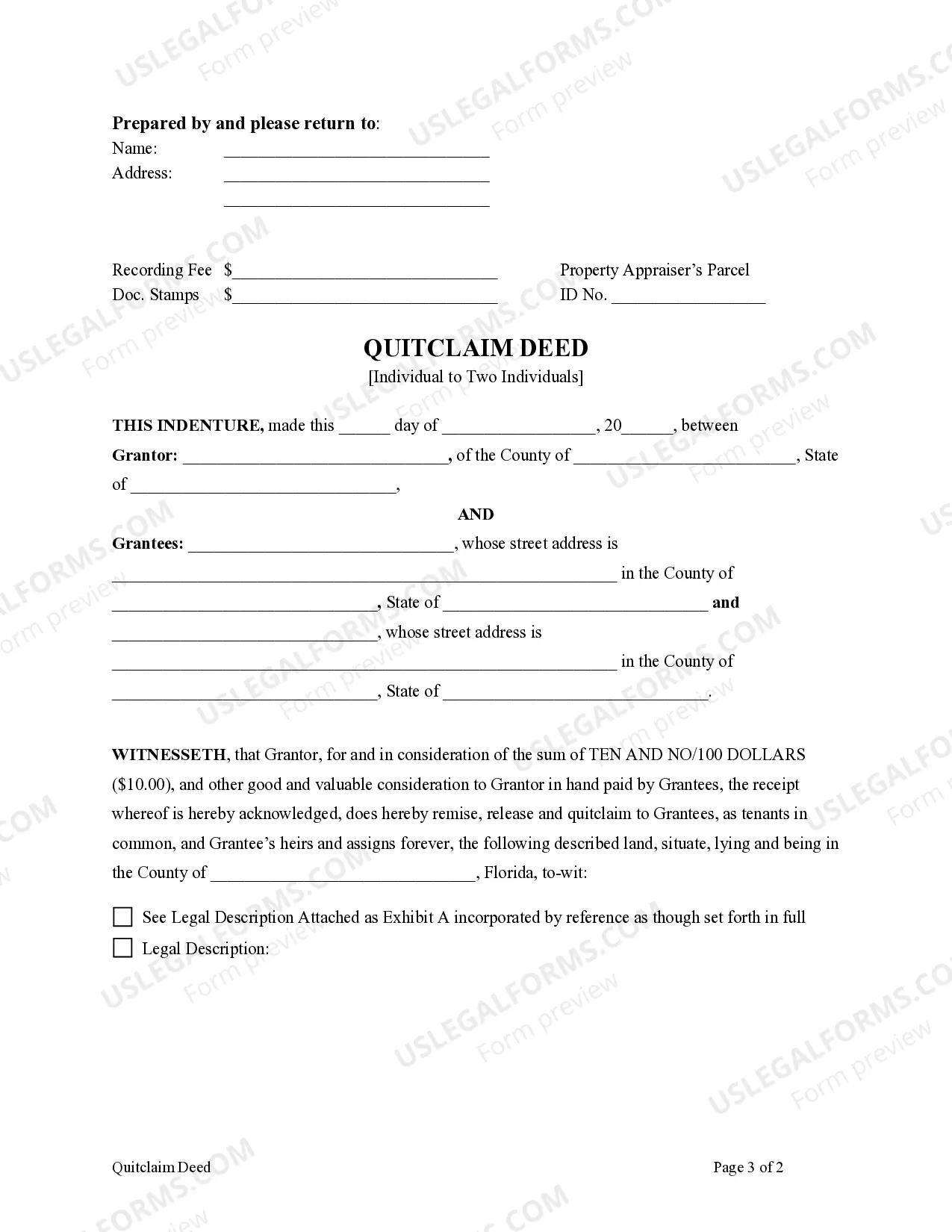
The Quitclaim Deed - Individual to Two Individuals as Tenants in Common is a legal document used when one individual (the Grantor) transfers property rights to two individuals (the Grantees). Unlike other property transfer documents, a quitclaim deed does not guarantee that the Grantor holds clear title to the property; it simply conveys whatever interest the Grantor may have. This form is particularly useful in situations where property ownership needs to be divided between two parties who will share ownership as tenants in common.
Key components of this form
- Grantor details: Information about the individual transferring the property.
- Grantee details: Information about the two individuals receiving the property.
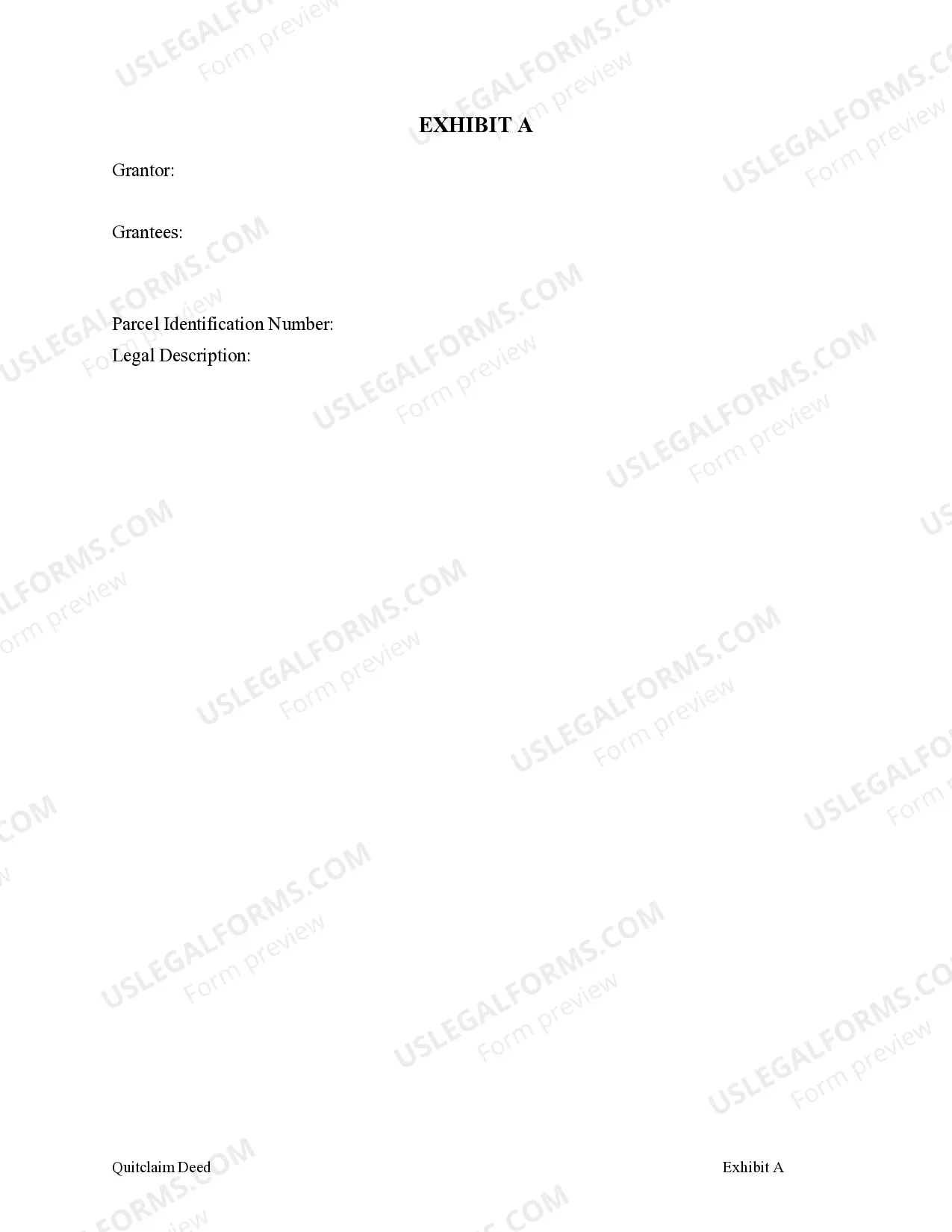
- Property description: A legal description of the property being conveyed.
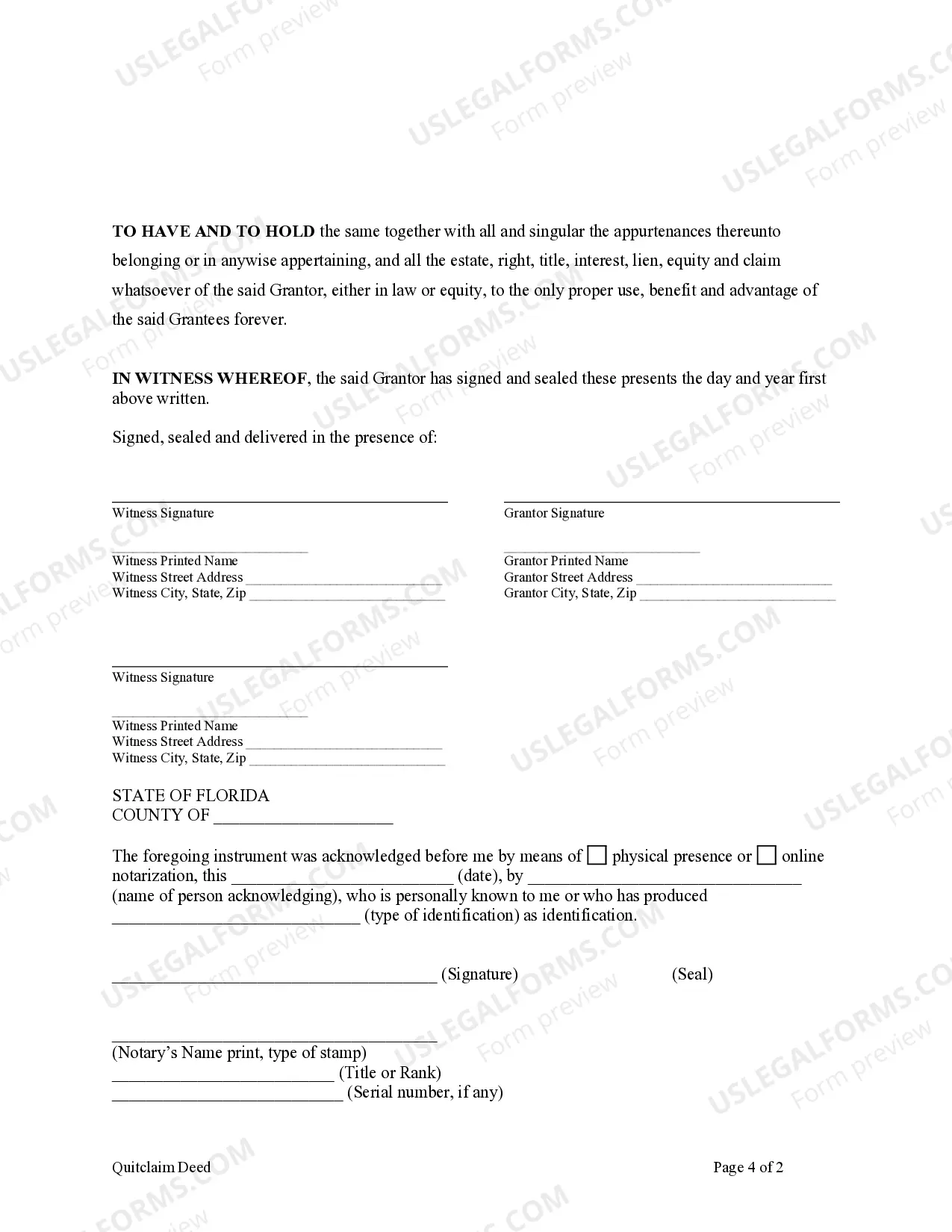
- Execution clause: Specifies the signing and witnessing of the document.
- Tenants in common clause: Indicates that the Grantees will own the property jointly, without right of survivorship.





When this form is needed
This quitclaim deed is appropriate in various scenarios, including but not limited to: transferring property between family members, settling disputes over ownership, or dividing inherited property among heirs. It can also be used when one owner wants to add another person as a co-owner of the property.
Intended users of this form
This quitclaim deed is designed for:
- Individuals who own property and want to transfer their interest to two other individuals.
- Co-owners of a property who wish to formalize their ownership agreement.
- Family members engaged in property transactions.
- Heirs needing to divide inherited property among themselves.
How to complete this form
- Identify the parties: Enter the names of the Grantor and the two Grantees.
- Specify the property: Provide a complete legal description of the property being transferred.
- Fill out the date: Enter the date on which the deed is executed.
- Add signatures: The Grantor must sign the deed in the presence of witnesses.
- File the deed: Record the signed deed with the appropriate county office to make the transfer official.
Is notarization required?
This document requires notarization to meet legal standards. US Legal Forms provides secure online notarization powered by Notarize, allowing you to complete the process through a verified video call, available 24/7.
Get your form ready online
Our built-in tools help you complete, sign, share, and store your documents in one place.
Make edits, fill in missing information, and update formatting in US Legal Forms—just like you would in MS Word.
Download a copy, print it, send it by email, or mail it via USPS—whatever works best for your next step.
Sign and collect signatures with our SignNow integration. Send to multiple recipients, set reminders, and more. Go Premium to unlock E-Sign.
If this form requires notarization, complete it online through a secure video call—no need to meet a notary in person or wait for an appointment.
We protect your documents and personal data by following strict security and privacy standards.

Make edits, fill in missing information, and update formatting in US Legal Forms—just like you would in MS Word.

Download a copy, print it, send it by email, or mail it via USPS—whatever works best for your next step.

Sign and collect signatures with our SignNow integration. Send to multiple recipients, set reminders, and more. Go Premium to unlock E-Sign.

If this form requires notarization, complete it online through a secure video call—no need to meet a notary in person or wait for an appointment.

We protect your documents and personal data by following strict security and privacy standards.
Mistakes to watch out for
- Failing to provide a complete and accurate property description.
- Not getting the deed properly witnessed or notarized when required.
- Omitting the names of all Grantees involved in the transaction.
- Not filing the deed with the local government office after execution.
Benefits of using this form online
- Convenience: Complete the form at your own pace from anywhere.
- Editability: Easily update and customize the form as needed before downloading.
- Reliability: Forms are drafted by licensed attorneys, ensuring conformity to legal standards.
Looking for another form?
Form popularity
FAQ
You do not necessarily need a lawyer to file a quitclaim deed in Florida, but it is highly recommended. Creating and filing the Florida Quitclaim Deed - Individual to Two Individuals as Tenants in Common requires careful attention to detail to ensure legality and avoid future disputes. Using an online platform, such as uslegalforms, can simplify this process and provide resources to guide you.
A lady bird deed does not inherently avoid capital gains tax upon the sale of the property. Instead, it allows for a step-up in basis, which can reduce capital gains taxes for beneficiaries. If you're looking to understand how property transfer affects taxes, consider consulting with a legal expert or using the Florida Quitclaim Deed - Individual to Two Individuals as Tenants in Common for a clear path in property ownership.
A lady bird deed is not the same as a quitclaim deed. While a quitclaim deed transfers property interest without warranties, a lady bird deed allows the original owner to keep rights to the property until death. If you are considering transferring property to two individuals as tenants in common, exploring the Florida Quitclaim Deed - Individual to Two Individuals as Tenants in Common may be more appropriate.
One disadvantage of a lady bird deed is the potential for complications if the owner incurs substantial debts or files for bankruptcy. In such cases, creditors might claim the property before it transfers to beneficiaries. Additionally, this deed may not provide the same level of clarity as the Florida Quitclaim Deed - Individual to Two Individuals as Tenants in Common regarding shared ownership among multiple parties.
A lady bird deed and a transfer on death deed serve similar purposes, but they are not the same. A lady bird deed allows the property owner to retain control during their lifetime while designating beneficiaries who receive ownership upon death. The Florida Quitclaim Deed - Individual to Two Individuals as Tenants in Common, however, transfers interest in property without retaining control like a lady bird deed does.
No, joint tenancy and tenants in common are distinct forms of property ownership in Florida. While joint tenants share equal ownership and rights of survivorship, tenants in common can have varying ownership percentages and no rights of survivorship. Understanding this difference is crucial when considering a Florida Quitclaim Deed - Individual to Two Individuals as Tenants in Common, ensuring that all parties know their rights and options in the property.
In Florida, joint tenants own property together with equal shares and rights, including rights of survivorship, which allows the property to pass directly to the surviving owner upon death. Conversely, tenants in common can hold unequal shares of property and do not have survivorship rights; instead, each can pass their share to heirs. Choosing the right arrangement, like using a Florida Quitclaim Deed - Individual to Two Individuals as Tenants in Common, directly impacts how you and your co-owner can manage or transfer your interests.
Filling out a Florida Quitclaim Deed involves several key steps. First, include the names of the granter and the grantee, along with the property description. Clearly state the interest being transferred, typically in the form of 'Tenants in Common' if transferring to two individuals. Lastly, make sure to sign in the presence of a notary and file the deed with your county for it to be effective.
For married couples, joint tenancy with right of survivorship often serves as the best option. This arrangement allows both spouses to own the property equally, and if one spouse passes away, the other automatically inherits the entire property. However, if you want each spouse to have the option to transfer interest separately, consider a Florida Quitclaim Deed - Individual to Two Individuals as Tenants in Common. This provides more flexibility.
To add a person to a deed in Florida, you typically need to prepare a new Florida Quitclaim Deed - Individual to Two Individuals as Tenants in Common. This deed will express your intent to transfer interest in the property while naming both individuals as owners. After drafting the deed, you must sign it before a notary and record it with the county recorder's office. This process ensures that the new ownership is officially recognized.