Florida General Notice of Default for Contract for Deed
What this document covers
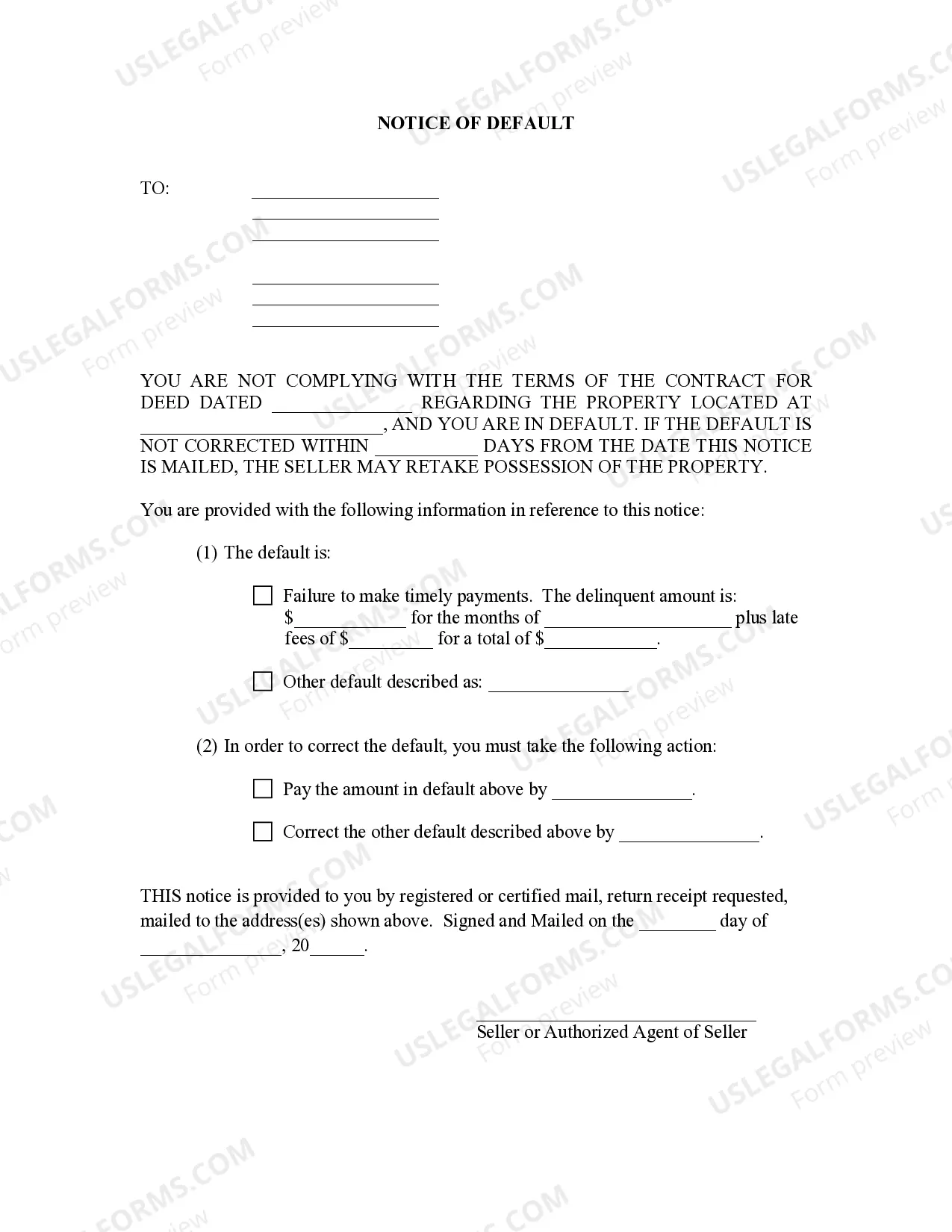
The General Notice of Default for Contract for Deed is a legal document used by the seller to inform the purchaser that they are in default of the terms outlined in the contract for deed. This form specifies the reasons for the default, the actions required to rectify the situation, and the seller's proposed remedies if the default is not cured. It serves to establish clear communication and expectations between parties, distinguishing itself from other notices like eviction notices or termination letters.
Form components explained
- Identification of the seller and purchaser involved in the contract.
- Clear statement of the default and the specific reasons for it.
- Instructions on how the purchaser can cure the default.
- Details on the seller's remedies if the default remains unaddressed.
- Signatures of the seller and any witnesses, if required.
Situations where this form applies
This form is essential when a seller needs to officially notify a purchaser that they have not upheld their responsibilities as outlined in the contract for deed. It is commonly used when payments are missed or conditions of the contract have not been met. Issuing a General Notice of Default is a critical step in the process before any legal actions or foreclosure can be pursued.
Who can use this document
This form is intended for:
- Property sellers who have entered into a contract for deed with a buyer.
- Real estate professionals managing contracts for deed transactions.
- Any party needing to document a default for potential legal proceedings.
How to prepare this document
- Identify the parties: Clearly state the names and addresses of both the seller and the purchaser.
- Specify the property: Describe the property that is subject to the contract for deed.
- State the default: Clearly articulate the reasons for the default, referencing specific agreement terms.
- Outline remedies: Indicate what the seller will do if the purchaser does not remedy the default.
- Sign and date: Ensure the form is signed by the seller and dated appropriately.
Notarization requirements for this form
To make this form legally binding, it must be notarized. Our online notarization service, powered by Notarize, lets you verify and sign documents remotely through an encrypted video session.
Get your form ready online
Our built-in tools help you complete, sign, share, and store your documents in one place.
Make edits, fill in missing information, and update formatting in US Legal Forms—just like you would in MS Word.
Download a copy, print it, send it by email, or mail it via USPS—whatever works best for your next step.
Sign and collect signatures with our SignNow integration. Send to multiple recipients, set reminders, and more. Go Premium to unlock E-Sign.
If this form requires notarization, complete it online through a secure video call—no need to meet a notary in person or wait for an appointment.
We protect your documents and personal data by following strict security and privacy standards.

Make edits, fill in missing information, and update formatting in US Legal Forms—just like you would in MS Word.

Download a copy, print it, send it by email, or mail it via USPS—whatever works best for your next step.

Sign and collect signatures with our SignNow integration. Send to multiple recipients, set reminders, and more. Go Premium to unlock E-Sign.

If this form requires notarization, complete it online through a secure video call—no need to meet a notary in person or wait for an appointment.

We protect your documents and personal data by following strict security and privacy standards.
Common mistakes
- Failing to include complete details about the default.
- Not providing clear instructions for curing the default.
- Omitting signatures or dates, which can invalidate the form.
- Not updating the form for local state requirements.
Why use this form online
- Convenience of downloading and completing the form from home.
- Editability allows for quick adjustments if needed.
- Reliability of using templates drafted by licensed attorneys.
- Accessible guidance helps ensure correct completion and filing.
Quick recap
- The General Notice of Default is vital for notifying purchasers of contract breaches.
- Understanding the form's structure helps ensure effective use.
- Timeliness and clarity in the notice can prevent further legal complications.
Looking for another form?
Form popularity
FAQ
When a buyer defaults on a real estate contract, the seller may send a Florida General Notice of Default for Contract for Deed to formally address the issue. This notice notifies the buyer of their default and provides options to remedy the situation. If the buyer does not respond appropriately, the seller could pursue legal action to enforce the contract or reclaim the property. Understanding the implications of a default can be crucial for both parties involved.
When a buyer defaults on a land contract in Florida, the seller typically issues a Florida General Notice of Default for Contract for Deed. This notice serves as an official communication, giving the buyer an opportunity to correct the default. If the buyer fails to address the issue, the seller may initiate legal proceedings to regain possession of the property. It’s important for buyers to understand their rights and responsibilities in this process.
Filling out a land contract form involves several steps. Start with the names and addresses of both parties, followed by a detailed description of the property. Make sure to outline the payment structure and include any applicable legal clauses. For additional support, US Legal Forms offers templates that can help you effectively incorporate necessary details, like the Florida General Notice of Default for Contract for Deed.
Yes, you can write your own land contract, but it's crucial to include all necessary legal elements to make it enforceable. Make sure to outline payment schedules, property details, and contingencies for default. If you’re unfamiliar with legal language or terms like Florida General Notice of Default for Contract for Deed, consider using templates from US Legal Forms to ensure accuracy and compliance.
When filling out a land contract form, include essential details like the property description, payment terms, and the duration of the agreement. Specify the responsibilities of both parties regarding taxes and maintenance. Additionally, ensure both parties sign and date the contract. Using resources from US Legal Forms can simplify this process and help you incorporate aspects like a Florida General Notice of Default for Contract for Deed.
To fill out a contract form, start by providing your name and the other party's name. Next, include the details of the agreement, such as the terms and conditions. Be sure to sign and date the form at the end. If you need help navigating the intricacies of a Florida General Notice of Default for Contract for Deed, consider using US Legal Forms for guidance.
Defaulting on a land contract can initiate a challenging process for both the buyer and seller. The seller typically issues a Florida General Notice of Default for Contract for Deed to formally notify the buyer of the breach. If the buyer does not take corrective action, the seller may pursue legal avenues to reclaim the property. This highlights the importance of understanding and adhering to the terms of your contract.
If you stop paying on a land contract, the seller has the right to enforce the terms of the agreement. This often begins with the seller sending a Florida General Notice of Default for Contract for Deed, which informs you of your payment deficiency. Failure to respond or address the missed payments could lead to legal actions, including possible eviction or foreclosure. It's crucial to communicate with the seller to explore options before the situation escalates.
A land contract is legally binding once it is signed by both parties, and it typically includes enforceable terms and conditions. Both the buyer and seller are obligated to follow the agreed-upon terms unless the contract is voided or terminated. If a default occurs, issuing a Florida General Notice of Default for Contract for Deed may be necessary to address the situation. Legal recourse is available for the injured party, ensuring protection under state law.
A land contract can be voided for numerous reasons, including failure to meet contractual obligations. If one party does not follow through with payment agreements or other key terms, this can lead to a void. It's essential to issue a Florida General Notice of Default for Contract for Deed, which formally outlines the breach. Additionally, legal issues such as misrepresentation or lack of capacity may also render the contract void.