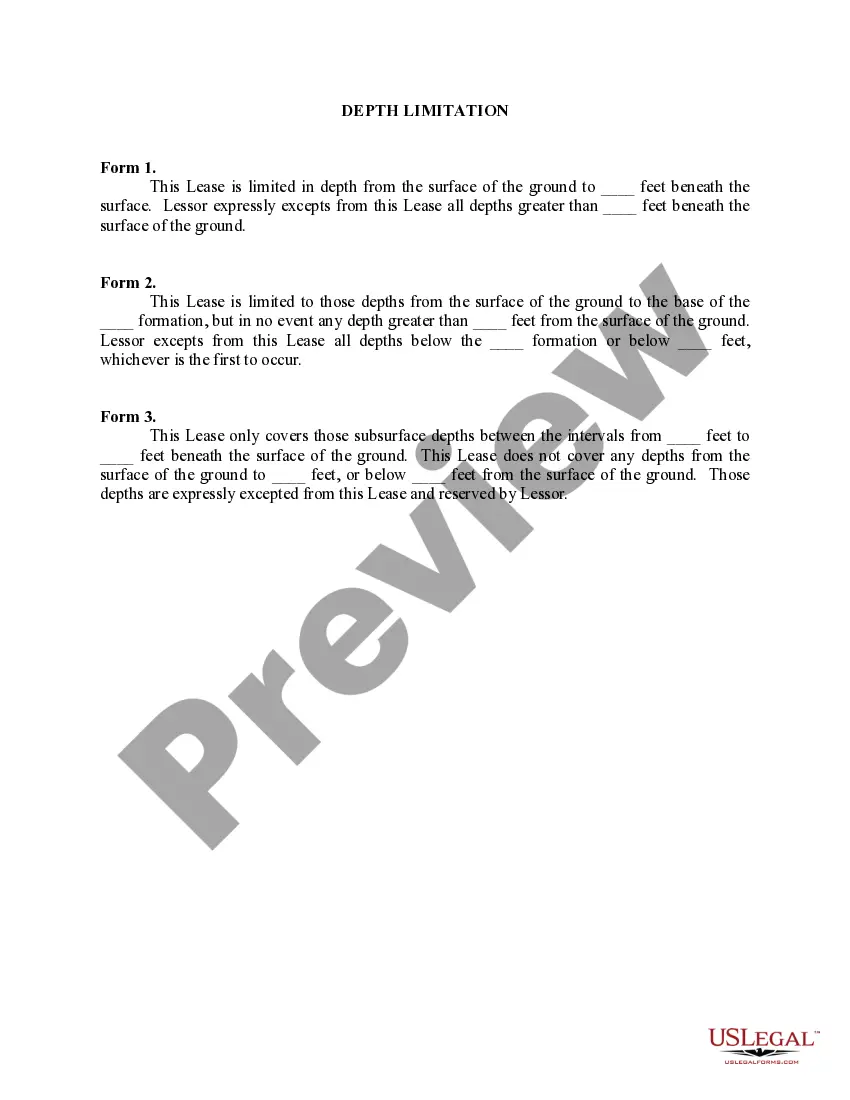
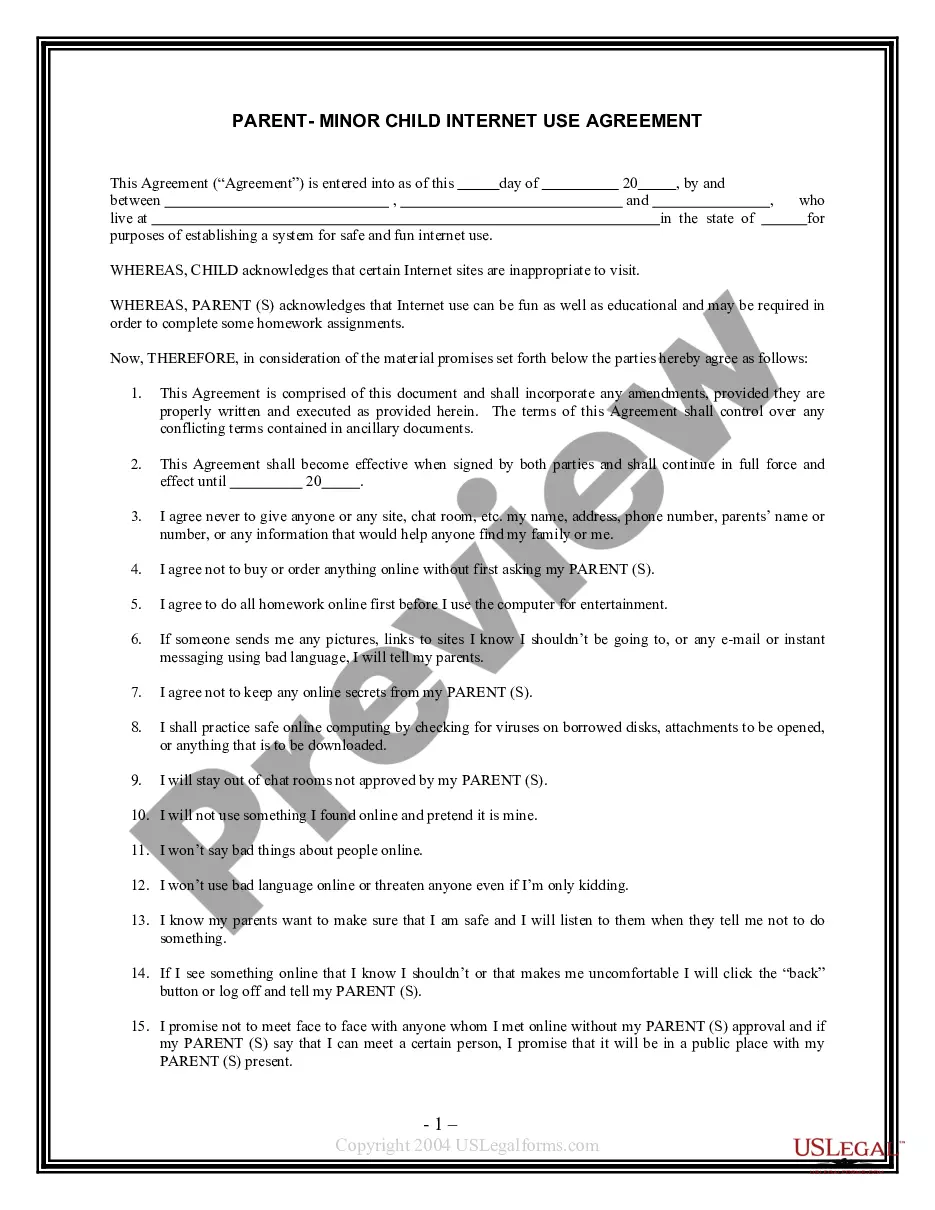
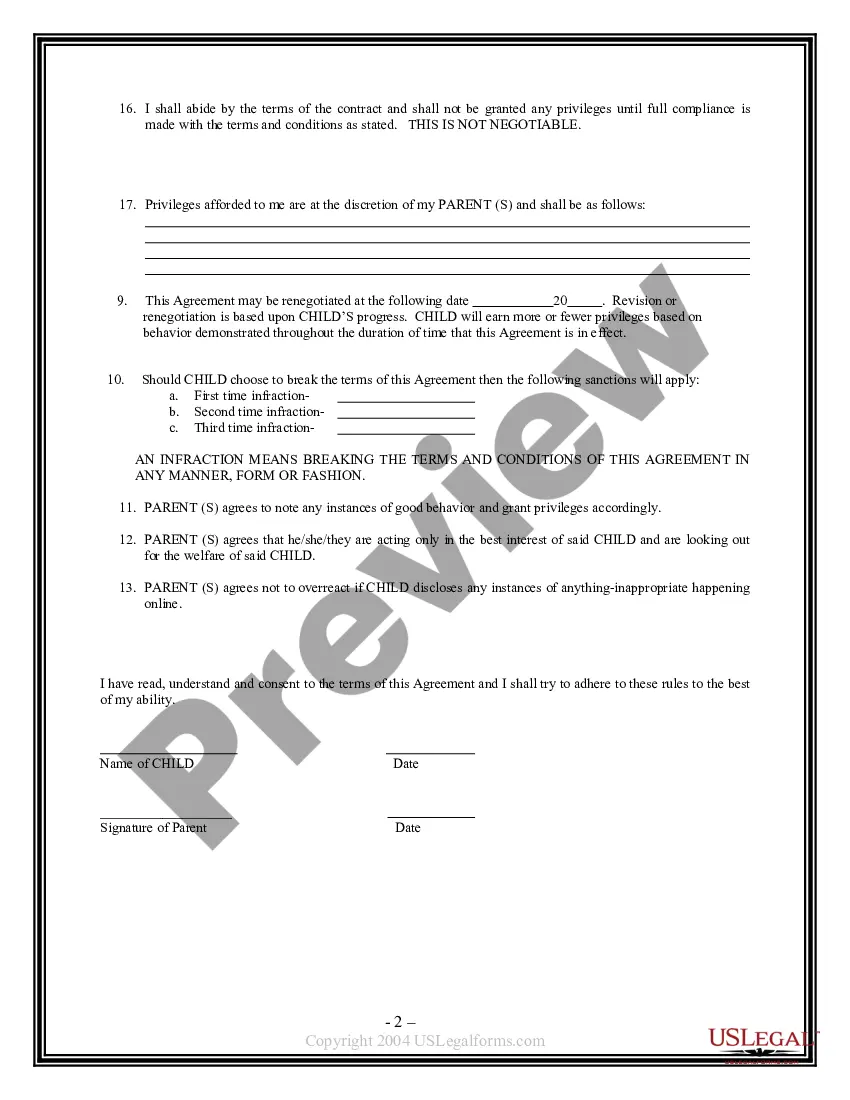
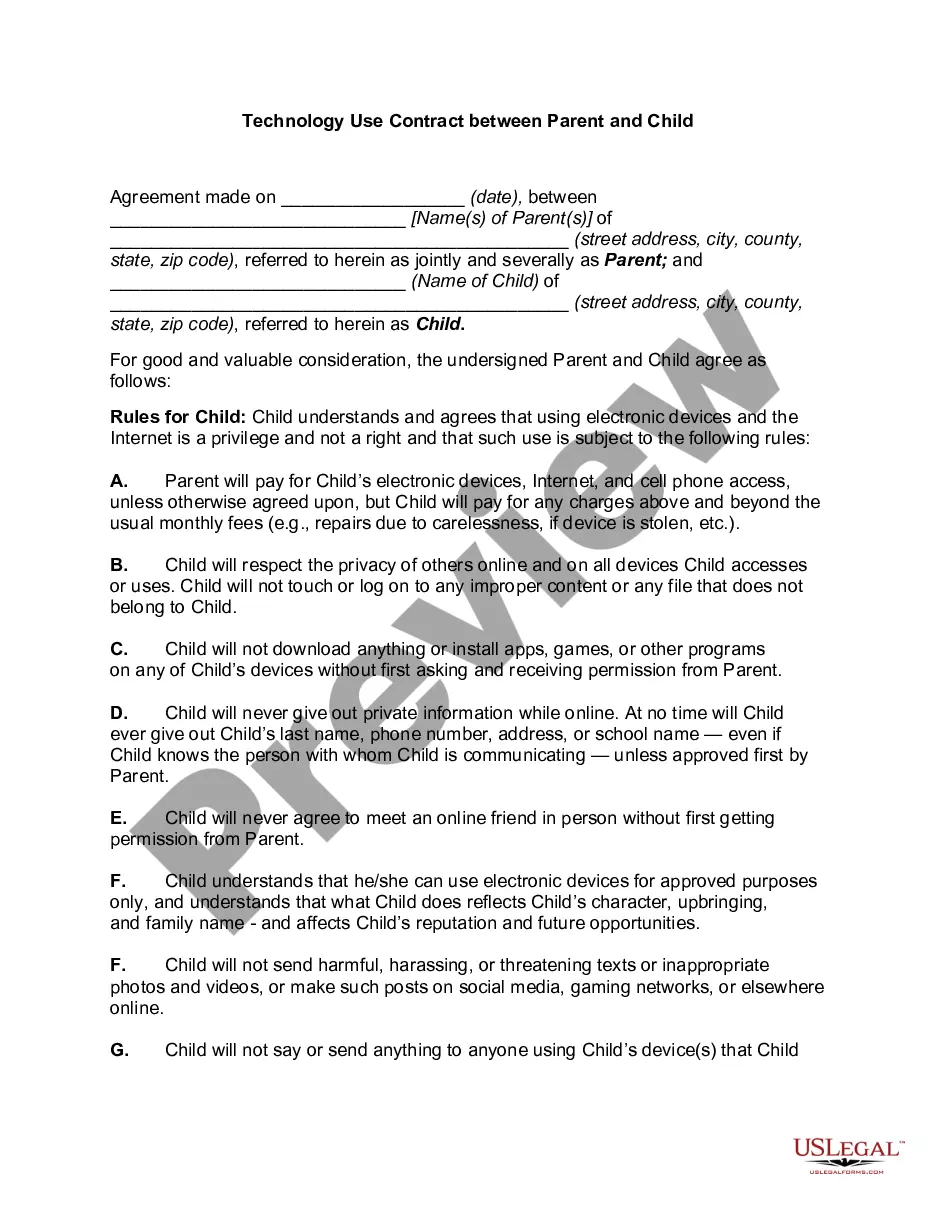
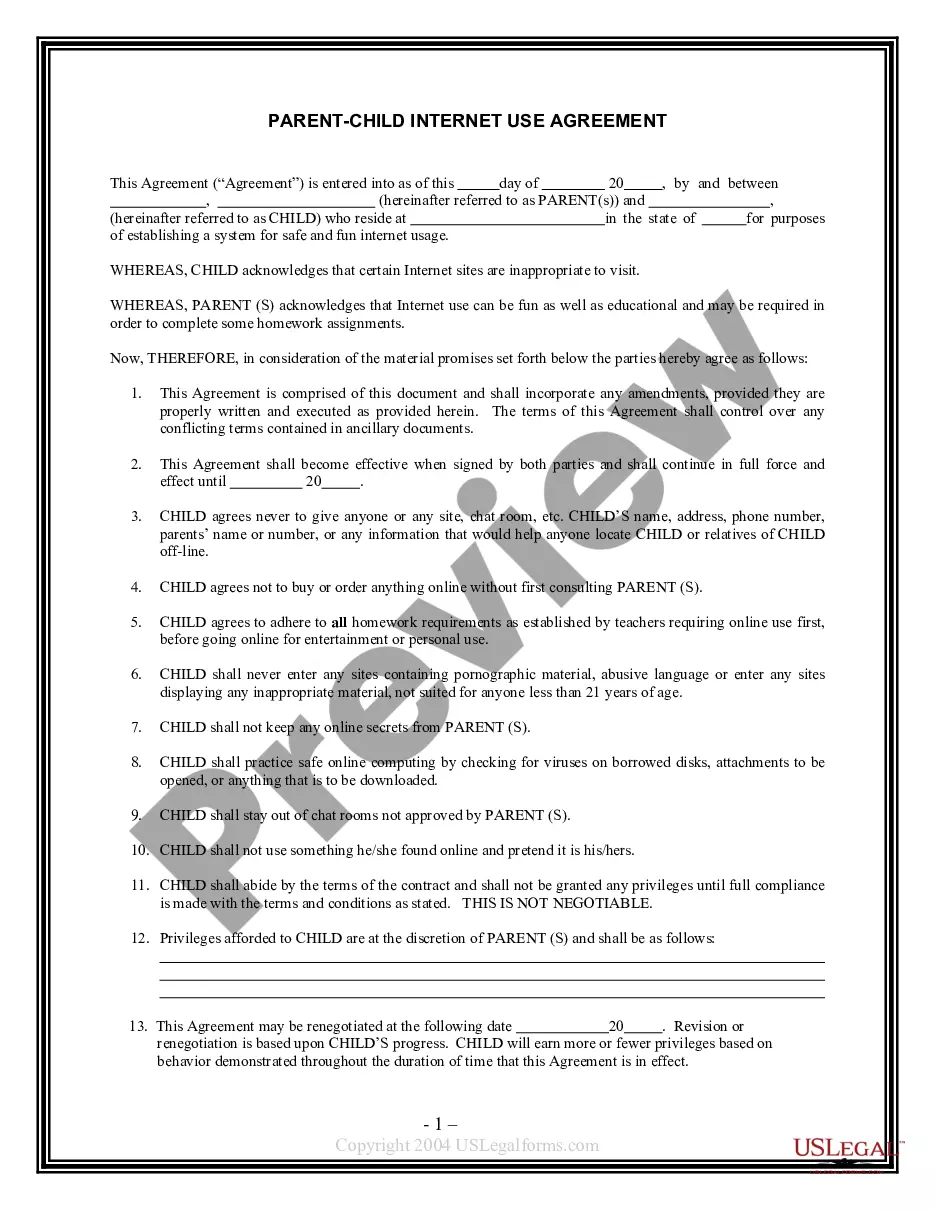
This is a contract between parent(s) and a younger child introducing child to Internet safety by describing what types of sites child should not contact and other general rules for Internet use.
Delaware Parent - Minor Child Internet Use Agreement
Category:
State:
Multi-State
Control #:
US-PC10
Format:
Word;
Rich Text
Instant download
Description
Free preview
Get your form ready online
Our built-in tools help you complete, sign, share, and store your documents in one place.
Built-in online Word editor
Make edits, fill in missing information, and update formatting in US Legal Forms—just like you would in MS Word.
Export easily
Download a copy, print it, send it by email, or mail it via USPS—whatever works best for your next step.
E-sign your document
Sign and collect signatures with our SignNow integration. Send to multiple recipients, set reminders, and more. Go Premium to unlock E-Sign.
Notarize online 24/7
If this form requires notarization, complete it online through a secure video call—no need to meet a notary in person or wait for an appointment.
Store your document securely
We protect your documents and personal data by following strict security and privacy standards.

Make edits, fill in missing information, and update formatting in US Legal Forms—just like you would in MS Word.

Download a copy, print it, send it by email, or mail it via USPS—whatever works best for your next step.

Sign and collect signatures with our SignNow integration. Send to multiple recipients, set reminders, and more. Go Premium to unlock E-Sign.

If this form requires notarization, complete it online through a secure video call—no need to meet a notary in person or wait for an appointment.

We protect your documents and personal data by following strict security and privacy standards.
Looking for another form?



How to fill out Parent - Minor Child Internet Use Agreement?
If you wish to finish, obtain, or print authentic document templates, utilize US Legal Forms, the most extensive assortment of legitimate forms available online.
Take advantage of the website's straightforward and convenient search to find the documents you need.
Many templates for business and personal purposes are organized by categories and claims, or keywords. Use US Legal Forms to obtain the Delaware Parent - Minor Child Internet Use Agreement in just a few clicks.
Step 5. Process the transaction. You can use your credit card or PayPal account to complete the transaction.
Step 6. Select the format of the legitimate form and download it to your device. Step 7. Complete, modify, and print or sign the Delaware Parent - Minor Child Internet Use Agreement. Every legitimate document template you purchase is yours for a lifetime. You have access to every form you acquired in your account. Click on the My documents section and select a form to print or download again. Finish and obtain, and print the Delaware Parent - Minor Child Internet Use Agreement with US Legal Forms. There are thousands of professional and state-specific forms you can use for your business or personal needs.
- If you are already a US Legal Forms customer, Log In to your account and then click the Obtain button to get the Delaware Parent - Minor Child Internet Use Agreement.
- You can also access forms you previously acquired within the My documents tab of your account.
- If you are using US Legal Forms for the first time, follow the steps below.
- Step 1. Ensure you have selected the form for the correct city/state.
- Step 2. Use the Preview option to review the form's content. Remember to read through the summary.
- Step 3. If you are not satisfied with the form, utilize the Search area at the top of the screen to find other versions of the legitimate form template.
- Step 4. Once you have found the form you need, click on the Acquire now button. Choose your preferred pricing plan and enter your details to register for an account.
Form popularity
FAQ
No, holding your phone in your hand while driving is generally prohibited. This regulation is in place to minimize distractions and enhance road safety. To keep your family safe, it is essential to model responsible behavior behind the wheel. As part of a comprehensive approach, consider a Delaware Parent - Minor Child Internet Use Agreement to discuss safe driving practices, including the use of mobile devices.
The no touch law in Delaware focuses on preventing unwanted physical contact and harassment. This law is crucial for protecting minors in various environments, including schools and online spaces. Parents should take an active role in discussing these issues with their children. Establishing a Delaware Parent - Minor Child Internet Use Agreement can help reinforce the importance of mutual respect and consent in all interactions.
In Delaware, there is no specific law that dictates the exact age a child can be left home alone. However, it is generally recommended that children under the age of 12 should not be left unsupervised for extended periods. Parents should assess their child's maturity and ability to handle emergencies. Incorporating a Delaware Parent - Minor Child Internet Use Agreement can add clarity to discussions about safety and responsibility while home alone.
The touch law in Delaware pertains to regulations regarding inappropriate physical contact. It is important for parents to educate their children about boundaries and consent. Understanding these laws can empower families to foster healthy relationships. Creating a Delaware Parent - Minor Child Internet Use Agreement can provide a framework for discussing these sensitive topics.
The Delaware Online Privacy Protection Act is designed to protect the personal information of minors online. It requires websites to obtain parental consent before collecting data from children under 18. This law aligns with the need for families to safeguard their children's online presence. A Delaware Parent - Minor Child Internet Use Agreement can complement this act by establishing clear guidelines on internet use.
Data Consent and Children Article 8 GDPR specifically deals with the issue of providing consent and children. When information society services are provided directly to a child that needs to give consent, the processing of personal data of a child can be lawful if the child is at least 16 years old.
What are the possible penalties for violating COPPA? The Rule allows for civil penalties of up to $42,530 per violation, but the FTC considers a number of factors in determining the appropriate amount, including a company's financial condition and the impact a penalty could have on its ability to stay in business.
For a company to become COPPA-compliant, it must ensure that personal information collected from minors isn't stored for longer than necessary. When getting rid of the data, measures should be put in place to avoid exposure or loss. Parents are allowed to review data collected from their kids.
The operators of 20 online virtual worlds have agreed to pay $3 million to settle Federal Trade Commission charges that they violated COPPA by illegally collecting and disclosing personal information from hundreds of thousands of children under age 13 without their parents' prior consent.
The GDPR sets a general age of consent at 16, which means you can't legally process the data of a data subject 15 years-old or younger. In cases where you work with the data of children under 16, you can only process the data with permission from their parent or guardian.