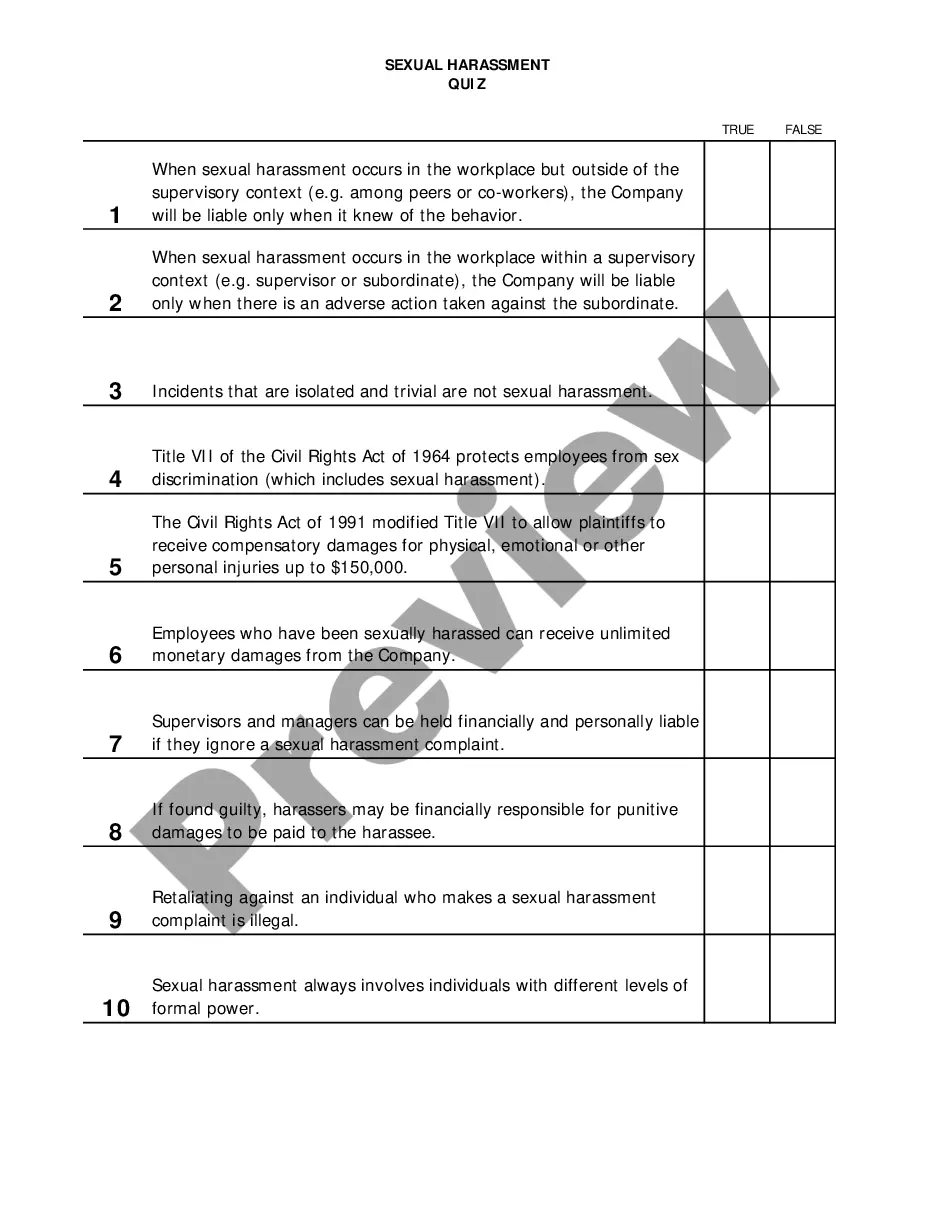
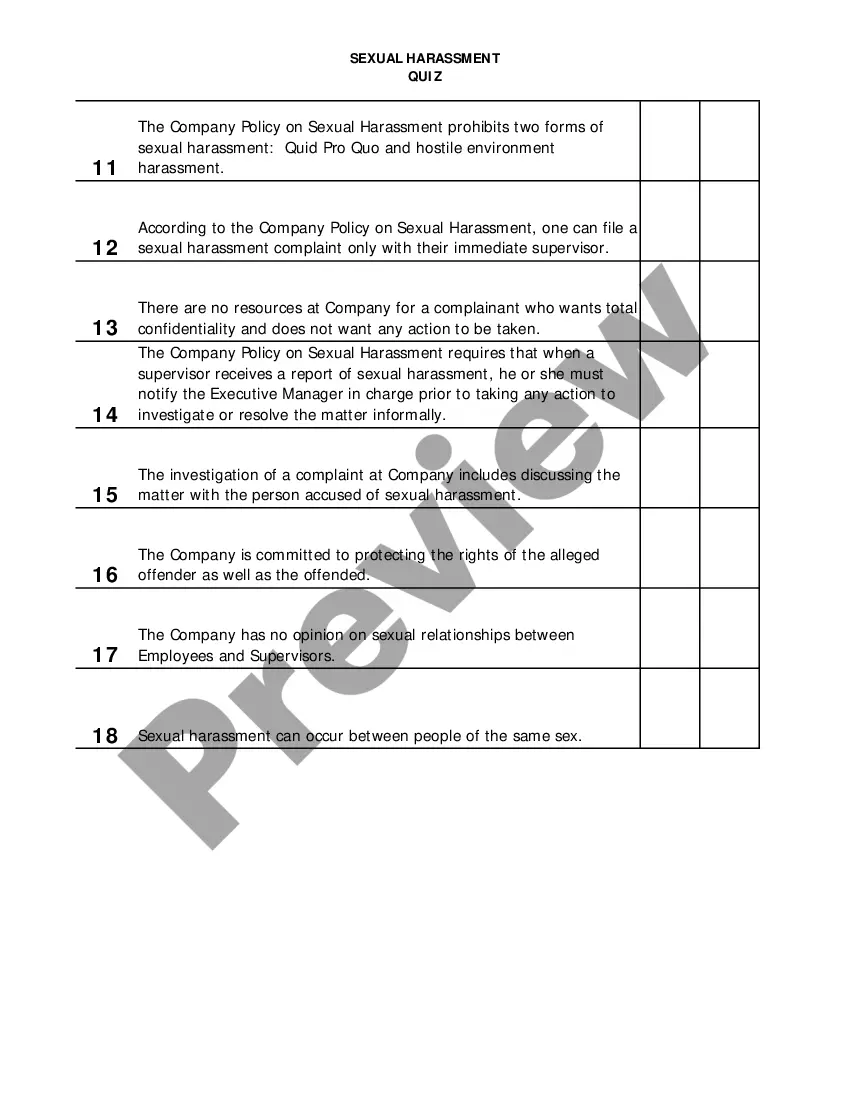
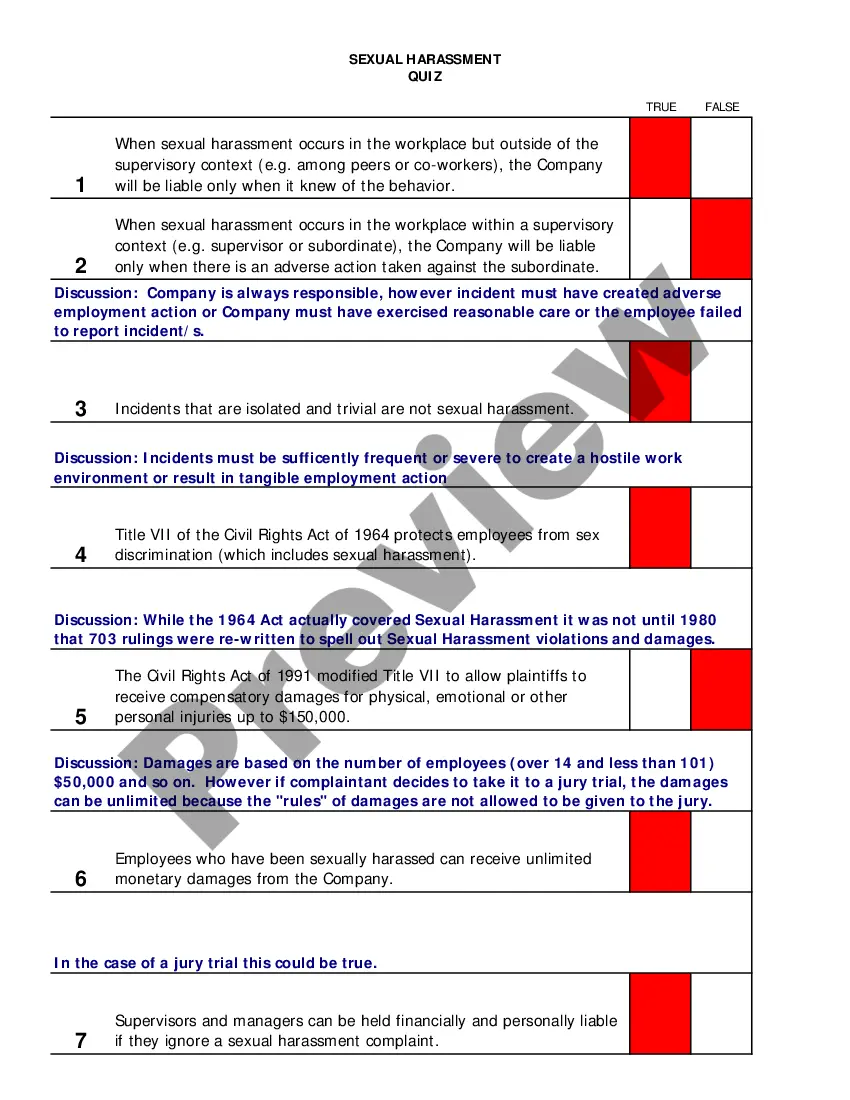
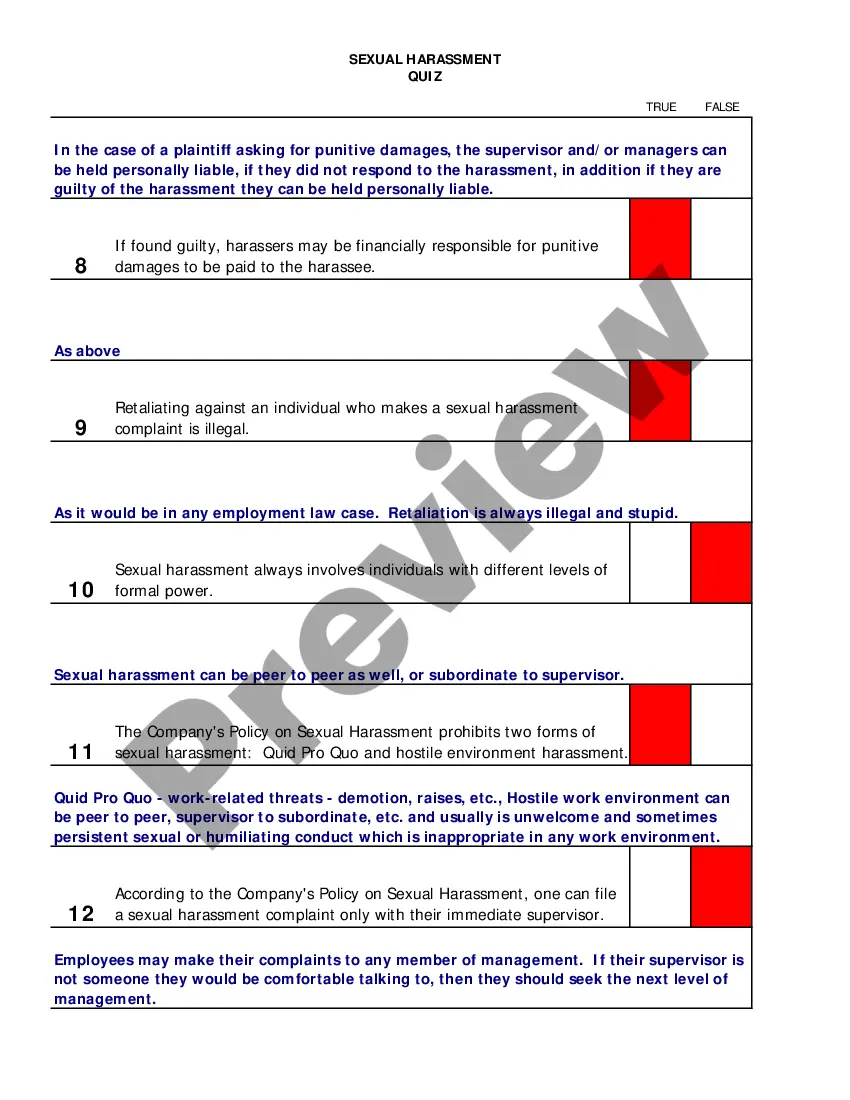
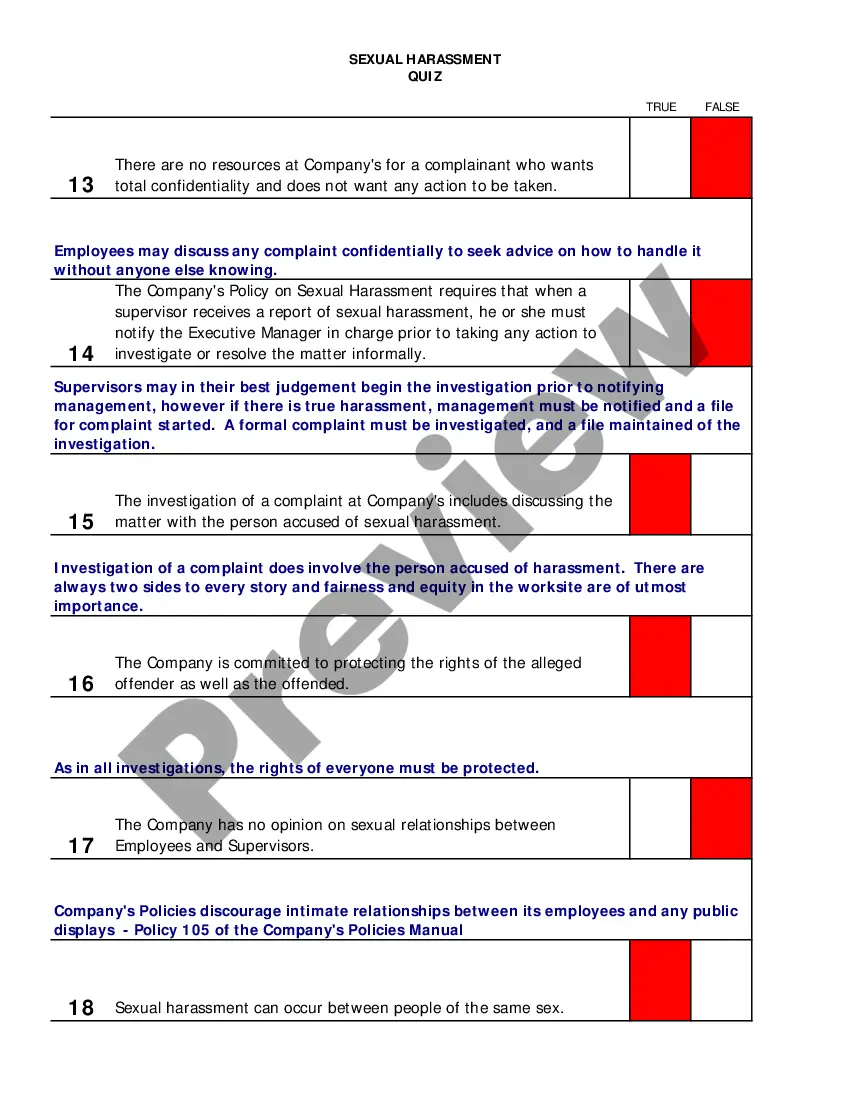
Test your skills Quiz on Sexual Harassment.
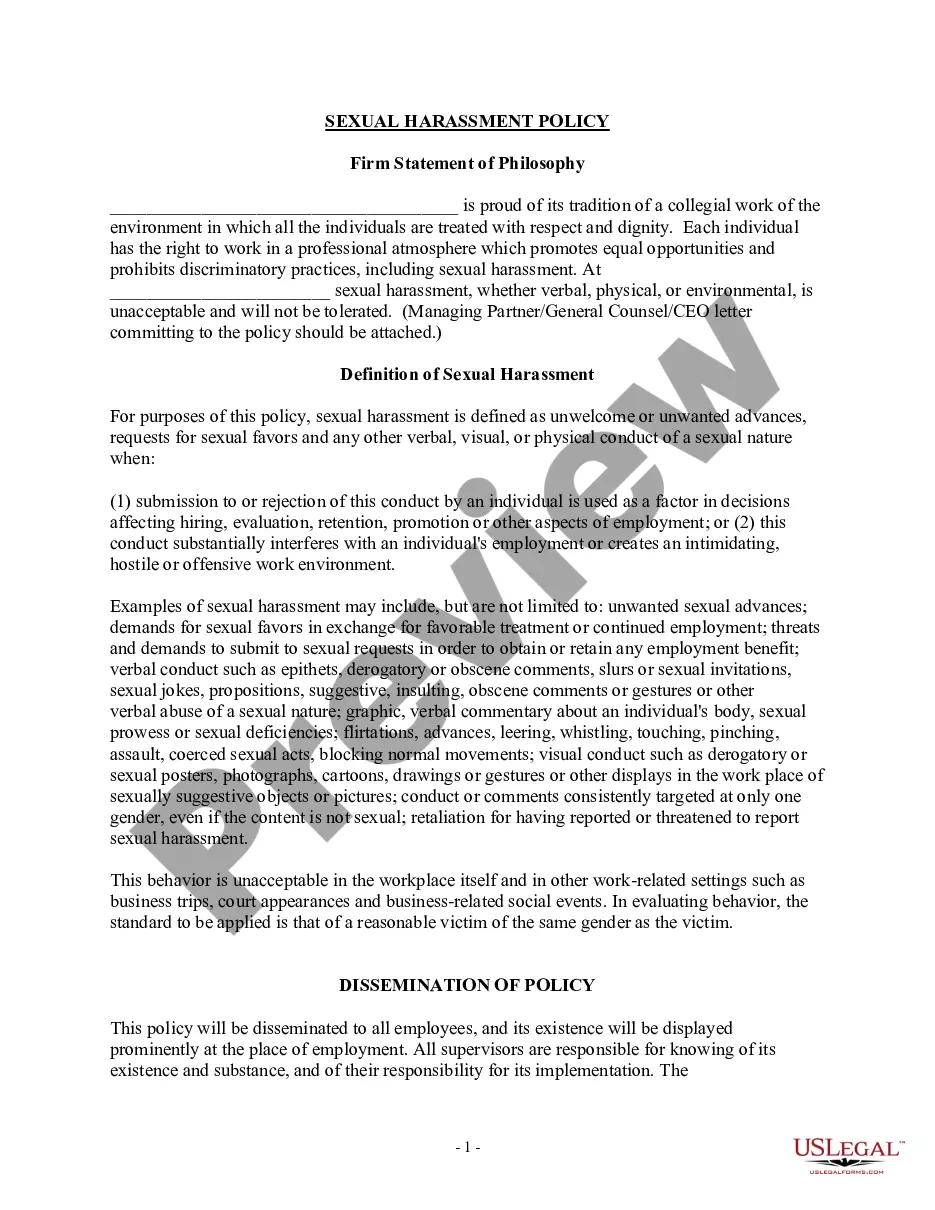
Delaware Sexual Harassment Quiz with Answer Key - Workplace
71 downloads
Description
Free preview
Get your form ready online
Our built-in tools help you complete, sign, share, and store your documents in one place.
Built-in online Word editor
Make edits, fill in missing information, and update formatting in US Legal Forms—just like you would in MS Word.
Export easily
Download a copy, print it, send it by email, or mail it via USPS—whatever works best for your next step.
E-sign your document
Sign and collect signatures with our SignNow integration. Send to multiple recipients, set reminders, and more. Go Premium to unlock E-Sign.
Notarize online 24/7
If this form requires notarization, complete it online through a secure video call—no need to meet a notary in person or wait for an appointment.
Store your document securely
We protect your documents and personal data by following strict security and privacy standards.

Make edits, fill in missing information, and update formatting in US Legal Forms—just like you would in MS Word.

Download a copy, print it, send it by email, or mail it via USPS—whatever works best for your next step.

Sign and collect signatures with our SignNow integration. Send to multiple recipients, set reminders, and more. Go Premium to unlock E-Sign.

If this form requires notarization, complete it online through a secure video call—no need to meet a notary in person or wait for an appointment.

We protect your documents and personal data by following strict security and privacy standards.
Looking for another form?
How to fill out Sexual Harassment Quiz With Answer Key - Workplace?
You may spend several hours on the web attempting to find the legitimate document format that fits the state and federal needs you need. US Legal Forms offers a large number of legitimate forms that are reviewed by specialists. It is possible to obtain or printing the Delaware Sexual Harassment Quiz with Answer Key - Workplace from your services.
If you have a US Legal Forms profile, you can log in and click on the Download button. Following that, you can complete, change, printing, or indicator the Delaware Sexual Harassment Quiz with Answer Key - Workplace. Every legitimate document format you buy is yours permanently. To have one more backup of the bought kind, visit the My Forms tab and click on the related button.
Should you use the US Legal Forms web site initially, keep to the straightforward instructions below:
- Very first, make certain you have chosen the best document format for your area/town of your choice. See the kind explanation to ensure you have picked out the right kind. If readily available, make use of the Preview button to look throughout the document format also.
- In order to get one more version from the kind, make use of the Lookup industry to get the format that suits you and needs.
- Upon having identified the format you would like, click Acquire now to carry on.
- Select the pricing strategy you would like, type your qualifications, and sign up for a merchant account on US Legal Forms.
- Full the purchase. You can utilize your Visa or Mastercard or PayPal profile to cover the legitimate kind.
- Select the format from the document and obtain it to your system.
- Make adjustments to your document if necessary. You may complete, change and indicator and printing Delaware Sexual Harassment Quiz with Answer Key - Workplace.
Download and printing a large number of document themes while using US Legal Forms web site, that offers the greatest selection of legitimate forms. Use professional and status-specific themes to take on your small business or individual needs.
Form popularity
FAQ
Workplace Harassment Examples Sending emails with offensive jokes or graphics about race or religion. Repeatedly requesting dates or sexual favors in person or through text. Asking about family history of illnesses or genetic disorders. Making derogatory comments about someone's disability or age.
Questions to Ask the Complainant: Who, what, when, where, and how: Who committed the alleged harassment? What exactly occurred or was said? When did it occur and is it still ongoing? Where did it occur?
Final answer: Under federal law, three factors commonly used to determine whether conduct is considered unlawful workplace harassment are: physical violence, interference with job performance, and severity or pervasiveness.
The reasonable person standard aims to avoid the potential for parties to claim they suffered harassment when most people would not find such instances offensive if they themselves were the subject of such acts. See, Equal Employment Opportunity Commission (EEOC) Enforcement Guidance.
Harassment occurs when someone Threatens or intimidates you because of your race, religion, sex, age, disability or any other of the grounds of discrimination; Makes unwelcome physical contact with you, such as touching, patting, or pinching.
This means employers must consider both the harasser's knowledge of how their behaviour would be received and how a "reasonable person" would interpret the behaviour. Typically, for a behaviour to be considered harassment, a series of incidents must occur.
The test for workplace harassment is therefore, whether the Respondent's conduct was ?vexatious? and ?known or ought reasonably to be known to be unwelcome.? In making this determination, an objective standard is used. The Human Rights Tribunal of Ontario articulated this standard in Vipond v.
Questions to Ask the Complainant: Who, what, when, where, and how: Who committed the alleged harassment? ... How did you react? ... How did the harassment affect you? ... Are there any persons who have relevant information? ... Did the person who harassed you harass anyone else?