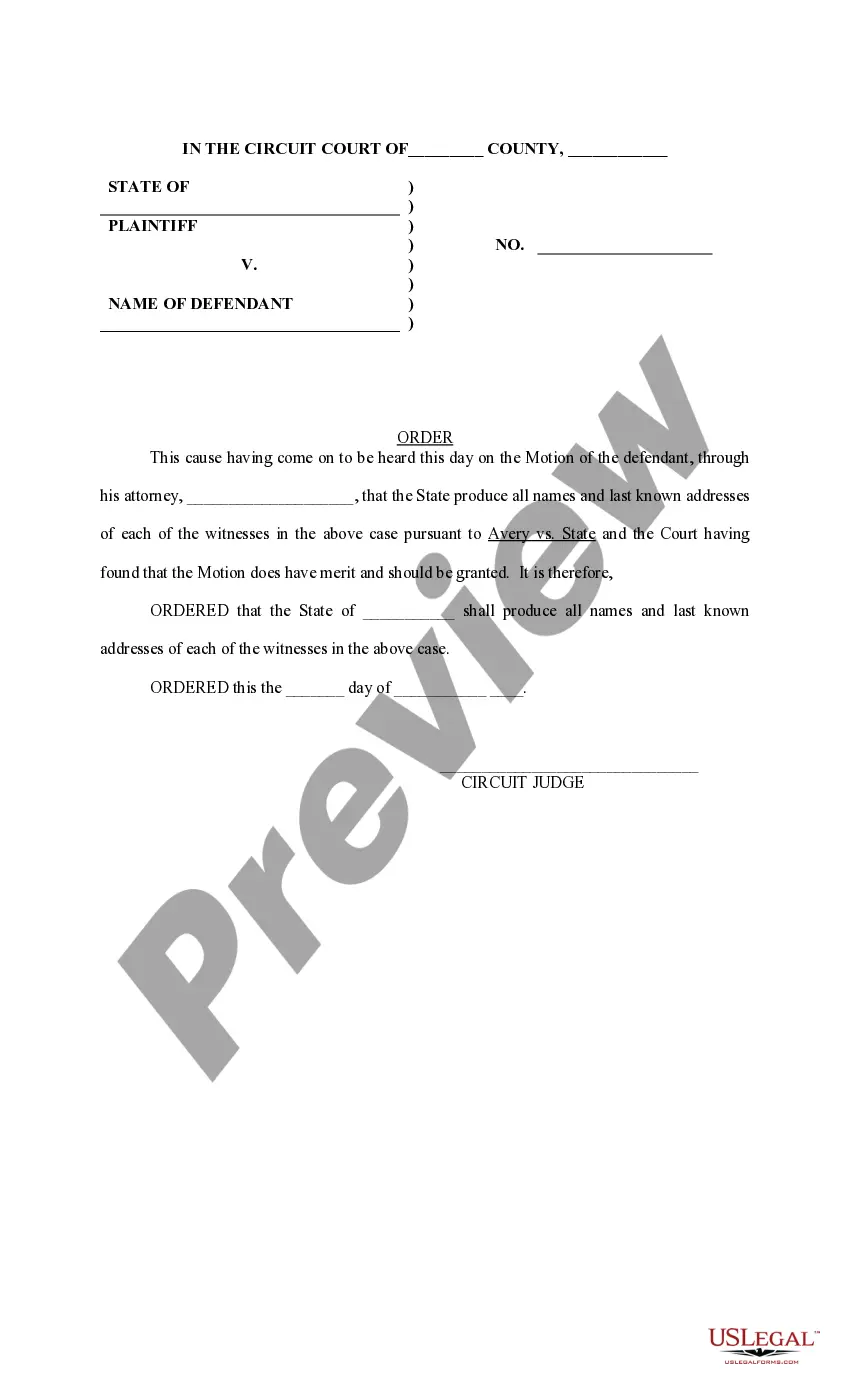
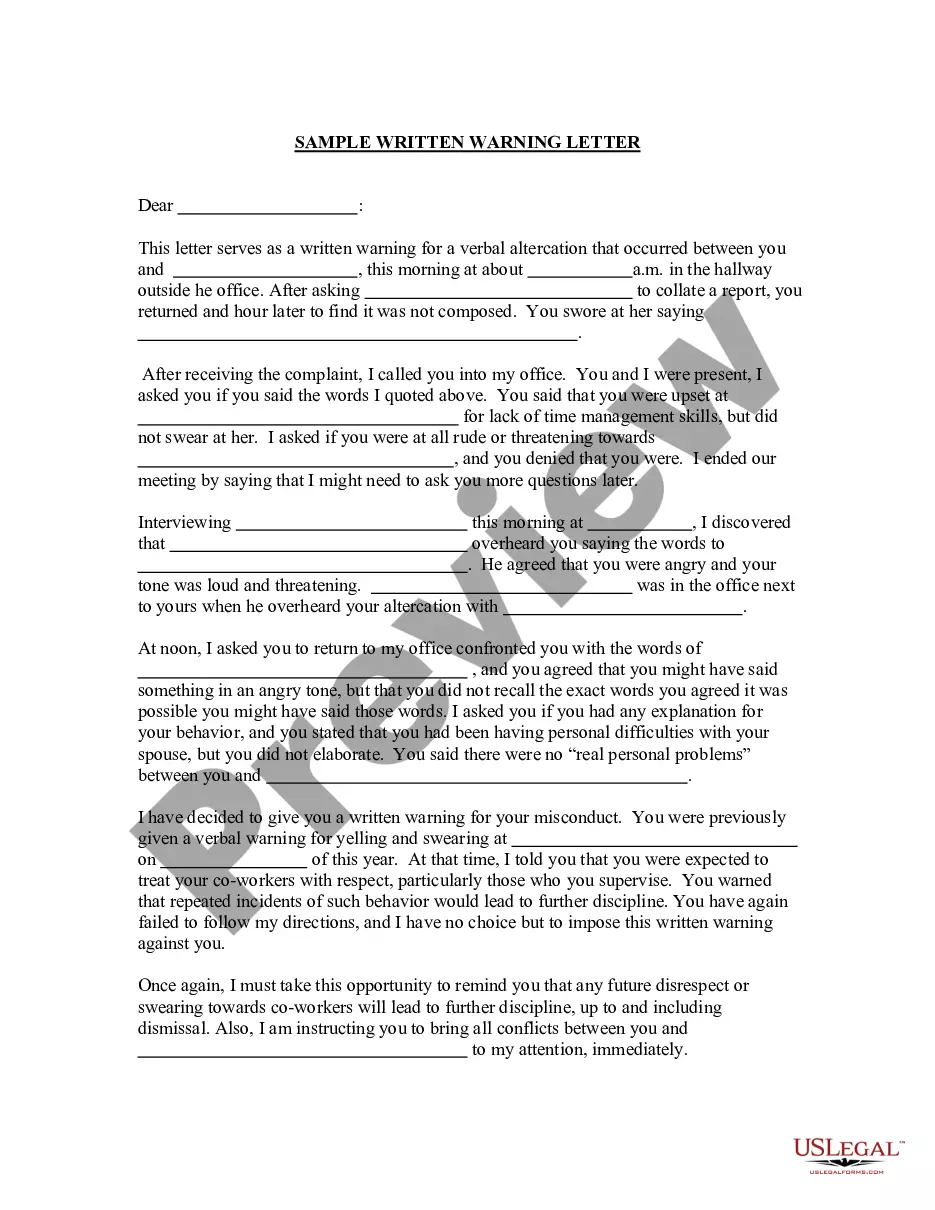
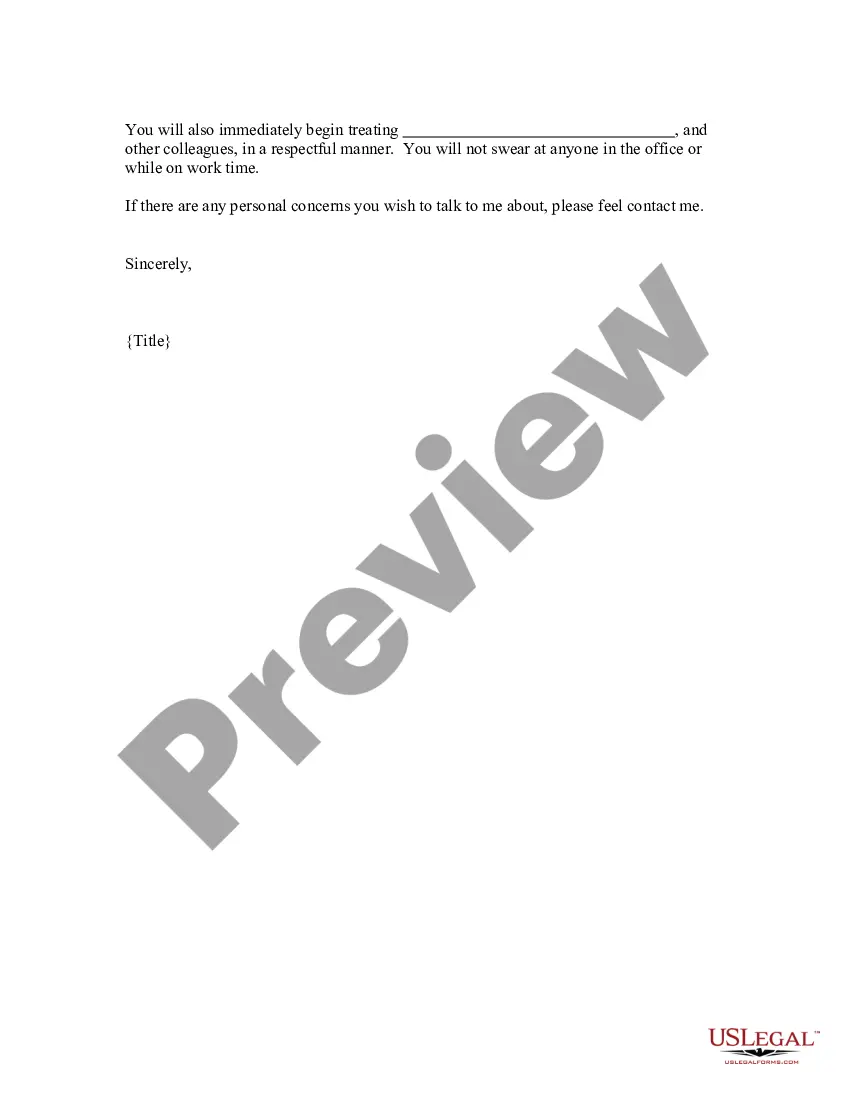
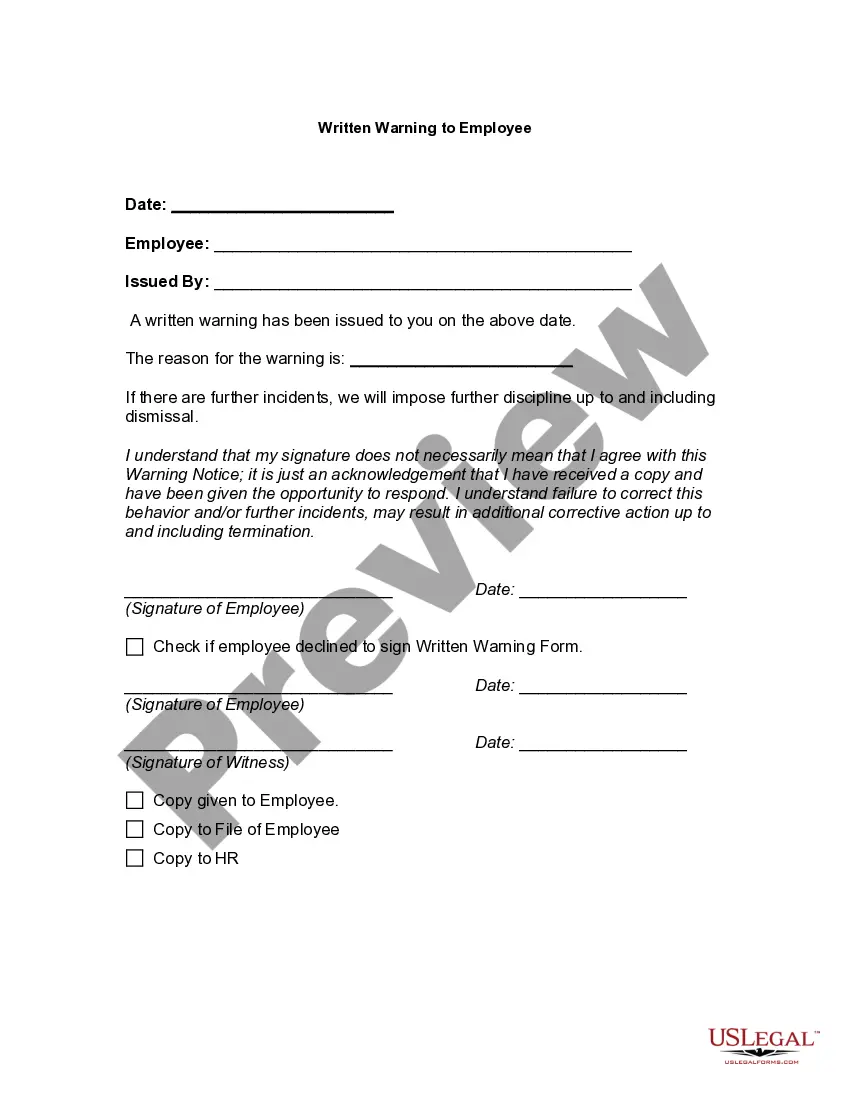
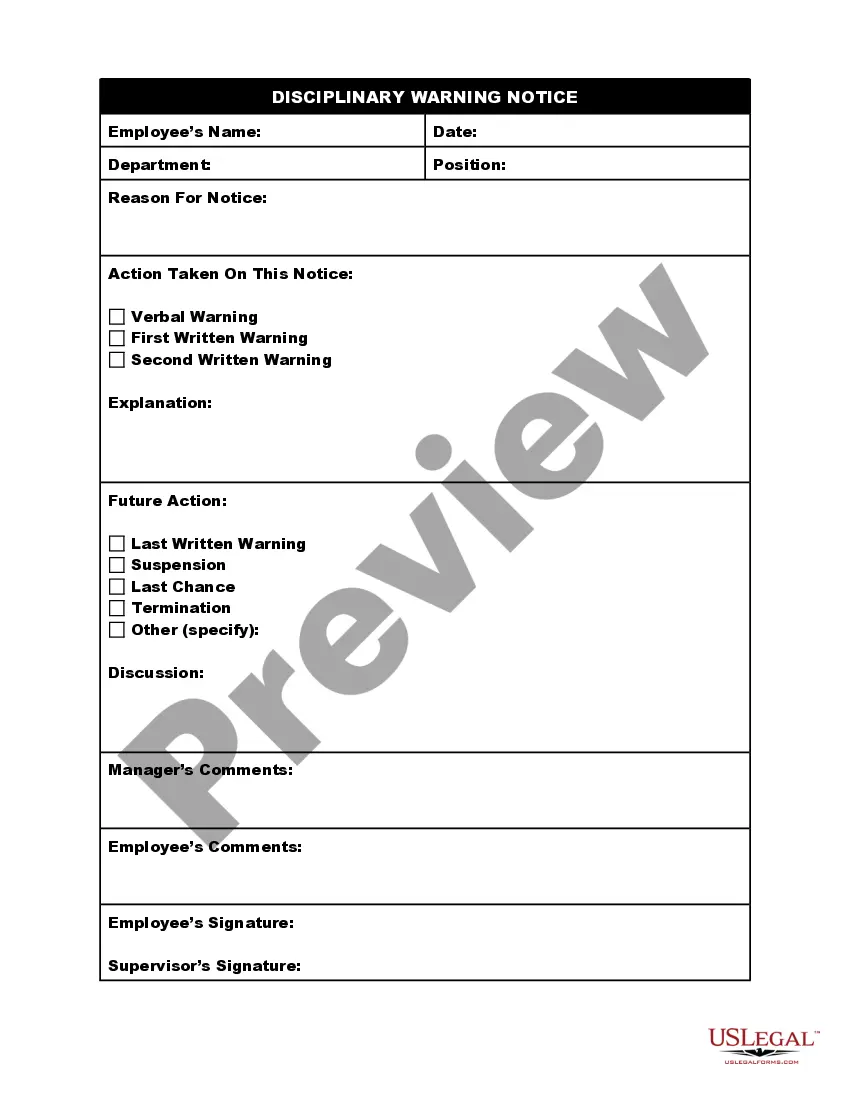
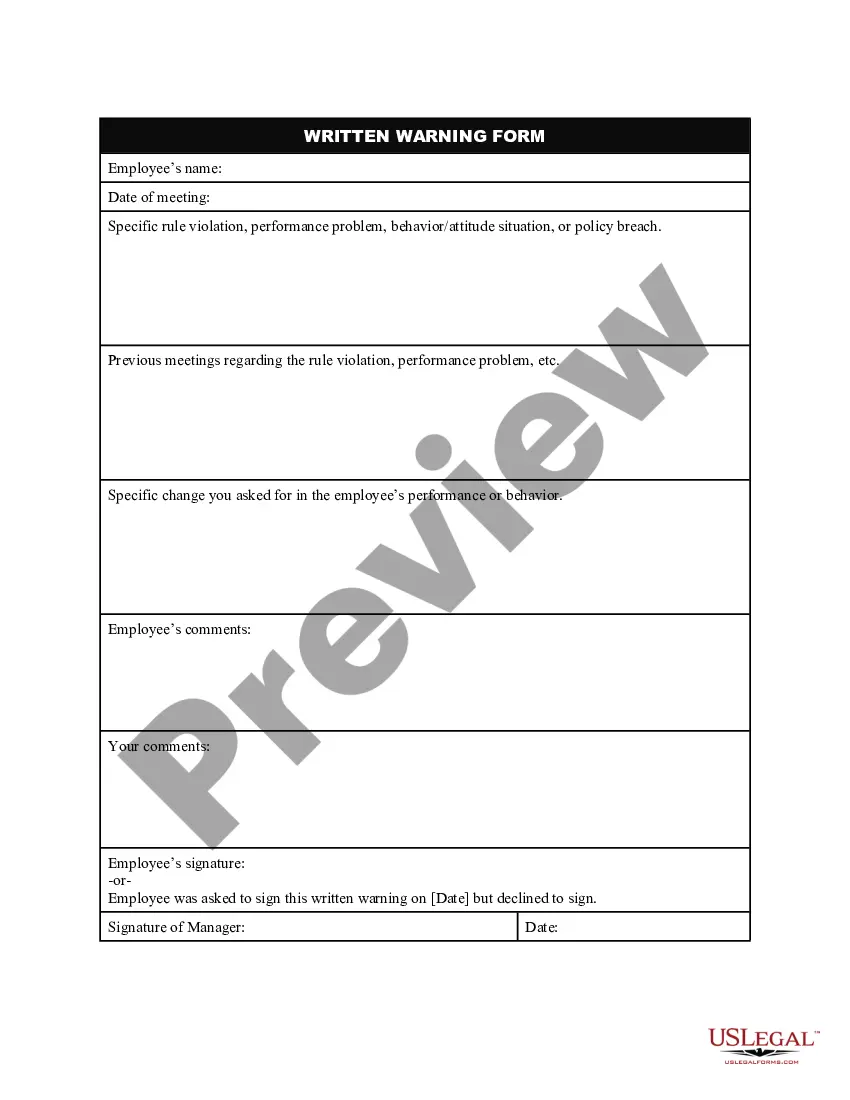
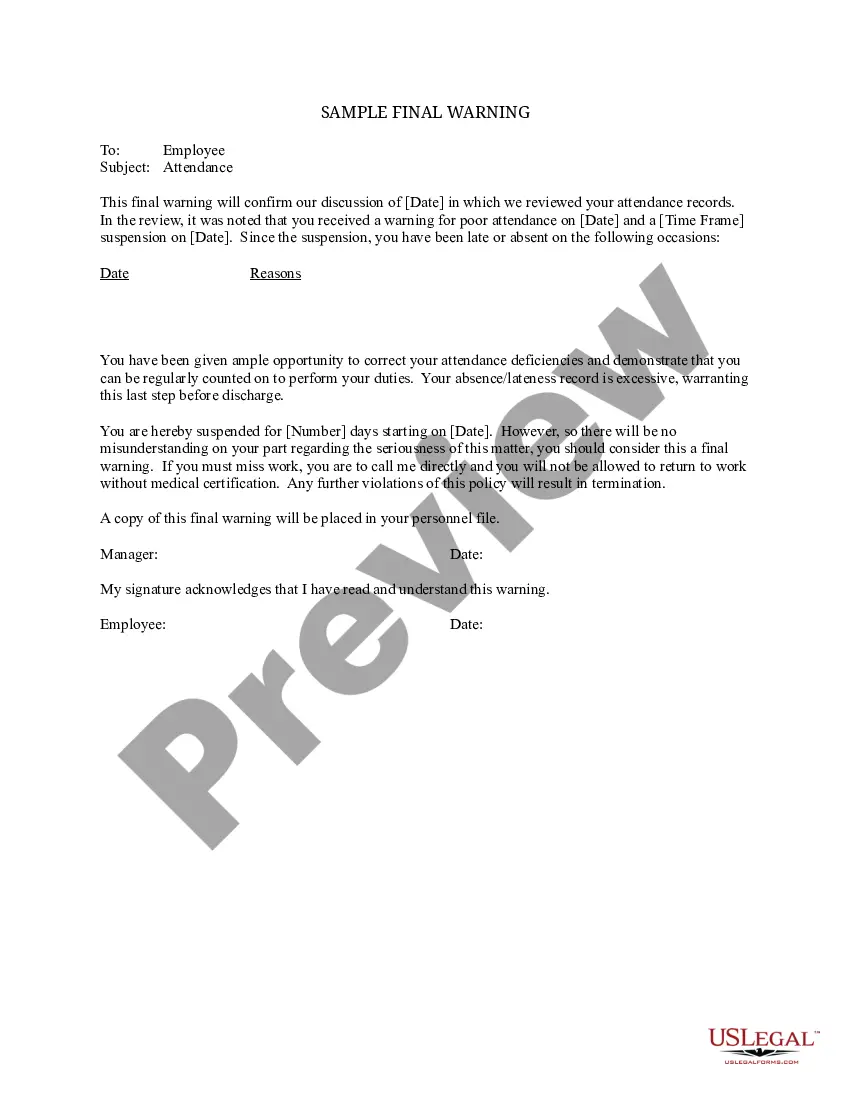
Delaware Sample Written Warning Letter
Description
Get your form ready online
Our built-in tools help you complete, sign, share, and store your documents in one place.
Make edits, fill in missing information, and update formatting in US Legal Forms—just like you would in MS Word.
Download a copy, print it, send it by email, or mail it via USPS—whatever works best for your next step.
Sign and collect signatures with our SignNow integration. Send to multiple recipients, set reminders, and more. Go Premium to unlock E-Sign.
If this form requires notarization, complete it online through a secure video call—no need to meet a notary in person or wait for an appointment.
We protect your documents and personal data by following strict security and privacy standards.

Make edits, fill in missing information, and update formatting in US Legal Forms—just like you would in MS Word.

Download a copy, print it, send it by email, or mail it via USPS—whatever works best for your next step.

Sign and collect signatures with our SignNow integration. Send to multiple recipients, set reminders, and more. Go Premium to unlock E-Sign.

If this form requires notarization, complete it online through a secure video call—no need to meet a notary in person or wait for an appointment.

We protect your documents and personal data by following strict security and privacy standards.
Looking for another form?
How to fill out Sample Written Warning Letter?
You can put in multiple hours online trying to locate the authentic document template that aligns with the local and national standards you require.
US Legal Forms offers a vast array of authentic forms that are vetted by professionals.
You can obtain or print the Delaware Sample Written Warning Letter from the service.
To find another version of the form, utilize the Search field to locate the template that fits your needs and specifications.
- If you have a US Legal Forms account, you may sign in and press the Download button.
- After that, you may complete, modify, print, or sign the Delaware Sample Written Warning Letter.
- Each authentic document template you buy belongs to you for years.
- To get another copy of the acquired form, go to the My documents section and click the respective button.
- If you are using the US Legal Forms site for the first time, follow the simple steps below.
- Firstly, confirm that you have selected the correct document template for the area/city of your choice. Refer to the form summary to ensure you have selected the accurate form.
Form popularity
FAQ
As you may remember, Maryland made substantial changes to its mini-WARN Act, the Economic Stabilization Act, in 2020.
Does an employer have to give a verbal warning before a written warning? There are no written rules about how employers must give out warnings. While, typically, an employer will give you one verbal warning before giving you a written warning, they may dismiss the verbal warning if your misconduct is severe enough.
Those sixteen states with so-called mini-WARN acts are: California, Connecticut, Hawaii, Illinois, Kansas, Maine, Massachusetts, Michigan, Minnesota, New Hampshire, New Jersey, Oregon, Rhode Island, South Carolina, Tennessee and Wisconsin. These mini-WARN's vary greatly in scope and effect.
Delaware Layoff: What you need to knowDelaware has enacted its own version of the federal Worker Adjustment and Retraining Notification Act (WARN Act). Effective January 7, 2019, Delaware's law requires covered employers to provide at least 60 days' notice of mass layoffs, plant closings, and relocations.
Overview of State Mini-WARN LawPennsylvania has no mini- Worker Adjustment and Retraining Notification Act or other notice requirements for group layoffs.
A verbal warning typically comes before a written warning since a write-up at work tends to be more serious. If the same issue happens again after the verbal warning or the employee doesn't improve, you might issue a written warning. However, you can skip the verbal warning, especially for a serious issue.
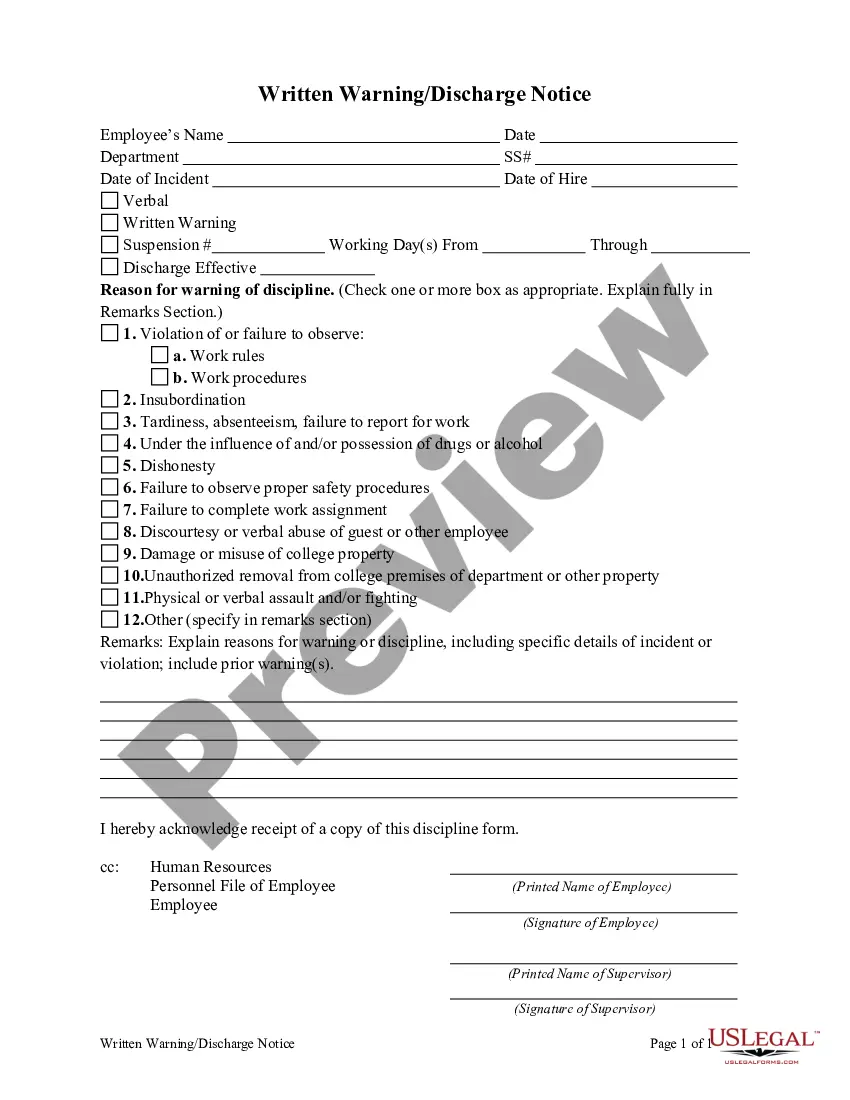
Share this Insightthe date of the warning;the name of the employee;the name and position of the person issuing the discipline;the level/type of discipline (e.g., written warning or written warning with three-day suspension);a detailed description of the misconduct or incident, including the date of occurrence;More items...?
Here are the 10 guidelines for drafting a written warning.Document verbal warnings first. Track all verbal warnings and disciplinary measures in writing at the time they are given.Determine tone.Consult with manager.Formalities.State company policy.Describe what happened.State expectations.Outline consequences.More items...
The Warn Act: Warning of Layoffs to Employees - The Federal and California Law. The Worker Adjustment and Retraining Notification Act (WARN Act) is a federal act that requires certain employers to give advance notice of significant layoffs to their employees.
Can you go straight to a final written warning? An employer may be justified in going straight to a final written warning, without a verbal or first written warning, if the matter complained of is sufficiently serious. This could be, for example, a serious misconduct or performance issue.