Delaware Statutory Uniform Anatomical Gift Act Donation By Next of Kin or Other Authorized Person
What is this form?
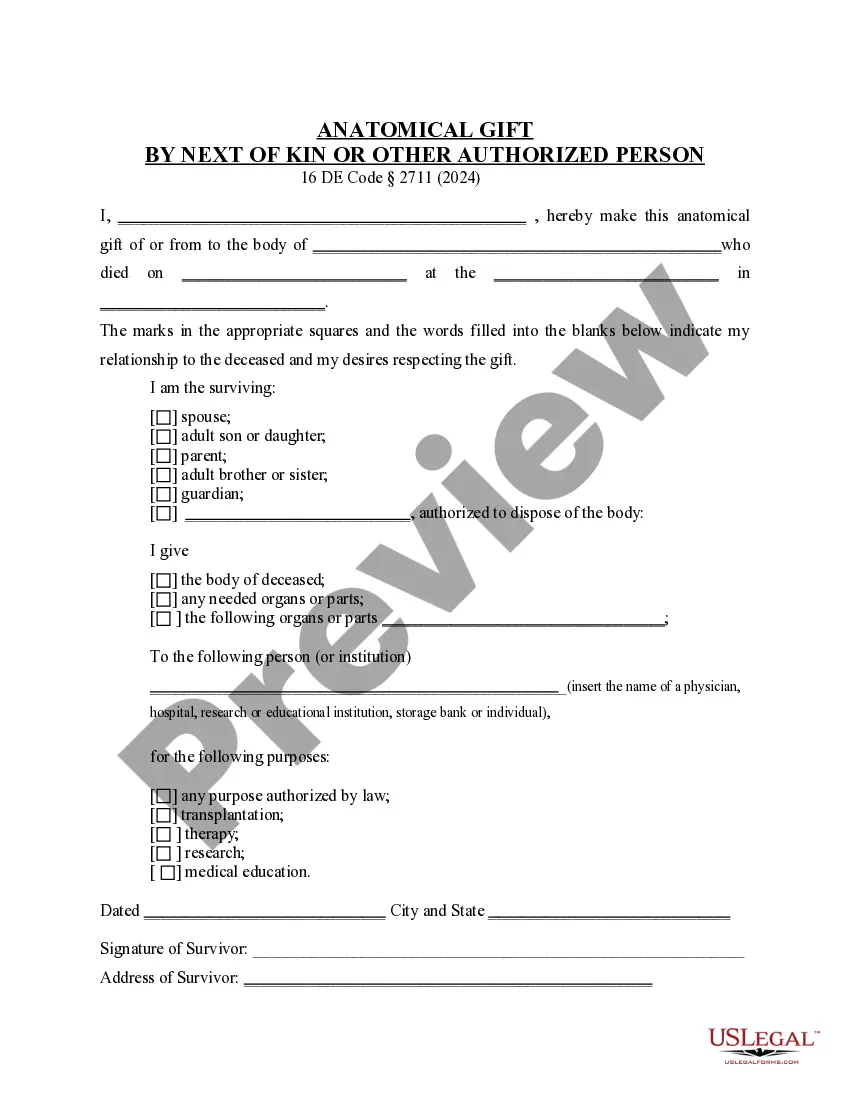
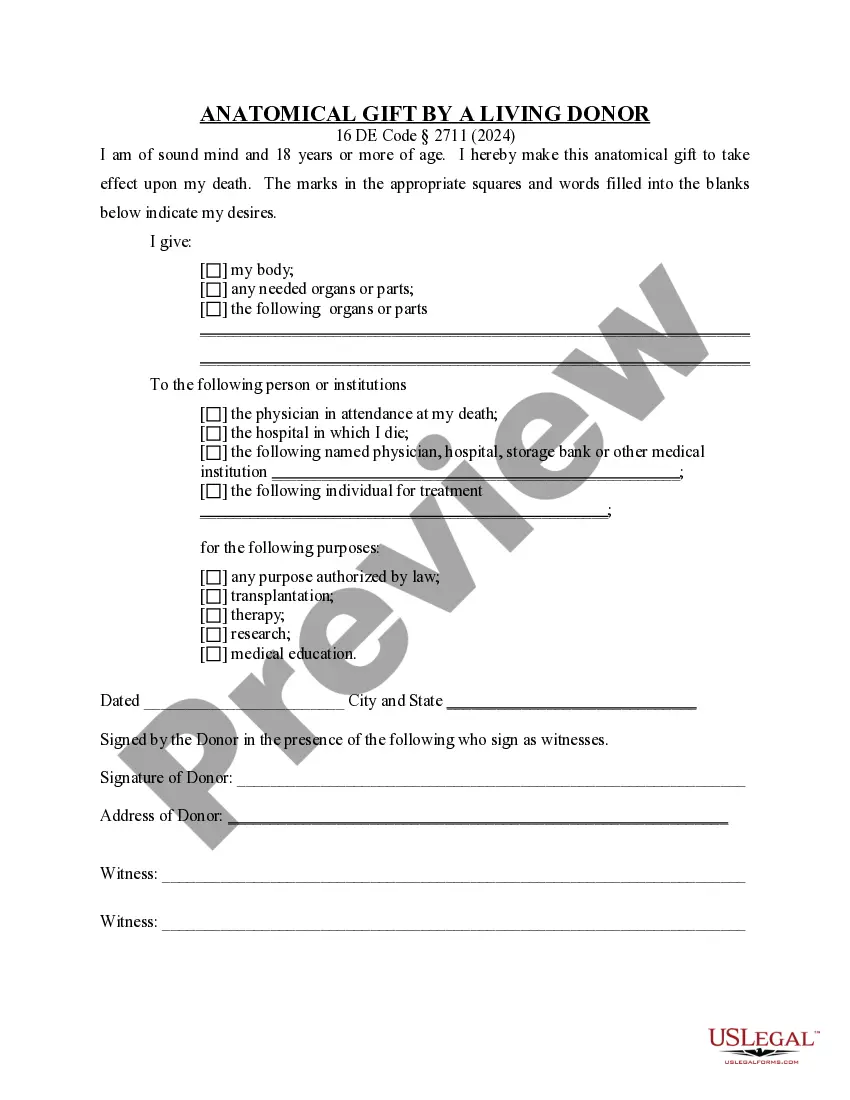
The Statutory Uniform Anatomical Gift Act Donation By Next of Kin or Other Authorized Person form allows an individual, typically a next of kin, to specify the body parts or organs they wish to donate from a deceased person. This form is essential in situations where the decedent's wishes may not be known, ensuring that the authorized individual's intentions regarding organ donation are formally documented. Unlike other estate planning forms, this document focuses specifically on anatomical gifts, facilitating a respectful and legal transfer of donations for medical or educational purposes.
Form components explained
- Identifies the deceased individual and the donor's relationship to them.
- Outlines specific organs or parts to be donated.
- Designates the recipient of the anatomical gift (e.g., hospital, research institution).
- States the purposes for which the donation is intended (e.g., therapy, research).
- Includes the signature of the authorized person and their contact information.
Common use cases
This form should be used when a person wishes to make an anatomical gift after the death of a loved one. It is particularly relevant in cases where the deceased did not provide prior consent for organ donation. Families facing the loss of a relative may use this form to ensure that their loved one's organs and tissue can be used for transplantation or research, following legal protocols to honor their memory effectively.
Who should use this form
- Next of kin of the deceased, including spouses, children, or parents.
- Individuals designated as guardians of the decedent.
- Any close relatives authorized to make decisions regarding organ donations.
- Hospitals or medical institutions seeking authorization for organ procurement.
How to prepare this document
- Enter the name of the deceased, along with the date and place of death.
- Identify your relationship to the deceased by selecting the appropriate option provided.
- Specify which organs or parts you wish to donate.
- Include the name of the recipient individual or institution that will receive the donation.
- Indicate the intended purpose of the anatomical gift.
- Sign and date the form, and provide your contact address.
Does this form need to be notarized?
This form does not typically require notarization unless specified by local law. However, having the form notarized can add an extra layer of authenticity and may be recommended for your records.
Get your form ready online
Our built-in tools help you complete, sign, share, and store your documents in one place.
Make edits, fill in missing information, and update formatting in US Legal Forms—just like you would in MS Word.
Download a copy, print it, send it by email, or mail it via USPS—whatever works best for your next step.
Sign and collect signatures with our SignNow integration. Send to multiple recipients, set reminders, and more. Go Premium to unlock E-Sign.
If this form requires notarization, complete it online through a secure video call—no need to meet a notary in person or wait for an appointment.
We protect your documents and personal data by following strict security and privacy standards.

Make edits, fill in missing information, and update formatting in US Legal Forms—just like you would in MS Word.

Download a copy, print it, send it by email, or mail it via USPS—whatever works best for your next step.

Sign and collect signatures with our SignNow integration. Send to multiple recipients, set reminders, and more. Go Premium to unlock E-Sign.

If this form requires notarization, complete it online through a secure video call—no need to meet a notary in person or wait for an appointment.

We protect your documents and personal data by following strict security and privacy standards.
Common mistakes to avoid
- Failing to clearly specify the organs or parts to be donated.
- Not signing or dating the form, which can invalidate the document.
- Leaving out the recipient's details, causing confusion regarding where the donation should be directed.
- Using unclear language when stating the purposes for the donation.
Why complete this form online
- Convenient access to the form allows for immediate download and completion.
- Editable format helps adapt the form to specific needs without legal confusion.
- Reliable and professionally drafted by licensed attorneys, ensuring legal compliance.
Legal use & context
The Statutory Uniform Anatomical Gift Act is a legally recognized way to honor the deceased's wishes about organ donation. This form can help mitigate any disputes among family members regarding the deceased's desires and is supported by Delaware laws governing anatomical gifts.
Quick recap
- The anatomical gift form is essential for documenting organ donation wishes following a death.
- Eligibility to use this form includes close relatives and authorized individuals.
- It's crucial to complete the form accurately to ensure the intended gifts are honored.
Looking for another form?
Form popularity
FAQ
The Uniform Anatomical Gift Act is applicable for facilitating organ and tissue donations after death. It establishes a legal framework that allows an individual to donate their organs to save or enhance the lives of others. This law covers the consent process, making it vital for family members and authorized representatives to understand their rights under the Delaware Statutory Uniform Anatomical Gift Act Donation By Next of Kin or Other Authorized Person. By leveraging US Legal Forms, you can easily access the necessary documents and information related to this act.
The Delaware Statutory Uniform Anatomical Gift Act Donation By Next of Kin or Other Authorized Person outlines clear procedures for postmortem organ donations. This act ensures that family members or authorized individuals can make decisions regarding organ donation after a person's death. They can consent to the donation by following the necessary legal protocols, which ultimately helps save lives. Additionally, our platform, US Legal Forms, provides resources to assist families in navigating these important decisions effectively.
The Uniform Anatomical Gifts Act outlines the procedures for postmortem organ donation, ensuring that donations are respected and managed properly. It allows for designated individuals, including next of kin or other authorized persons, to make donation decisions according to the deceased's wishes. The Delaware Statutory Uniform Anatomical Gift Act Donation By Next of Kin or Other Authorized Person helps guide this process, protecting both donors and recipients. This legislation underscores the importance of clear communication about organ donation preferences, making it easier to facilitate these vital acts of generosity.
An anatomical gift refers to the act of donating organs or tissues for medical use after death. To indicate your wish to donate, you can complete a donor registration form or express your intent on your driver's license. Under the Delaware Statutory Uniform Anatomical Gift Act Donation By Next of Kin or Other Authorized Person, family members or authorized individuals can also make donations on your behalf. This process helps ensure that your wishes are honored, providing vital resources for those in need.
Bodies donated to medical schools are used for educational purposes, helping to train future medical professionals. Under the Delaware Statutory Uniform Anatomical Gift Act Donation By Next of Kin or Other Authorized Person, these donations are treated with the utmost respect and care. After the educational period, the remains are typically cremated, and the families may receive the ashes, providing closure and honoring the donor's contribution to medical education.
Several facts govern the donation of body parts under the Uniform Anatomical Gift Act, including consent requirements and the designation of authorized individuals to make decisions on behalf of the deceased. The Delaware Statutory Uniform Anatomical Gift Act Donation By Next of Kin or Other Authorized Person clarifies who can authorize anatomical gifts, ensuring that all donations are legally sound and respected. Understanding these facts is crucial for families considering this selfless act.
Yes, organ donation can still occur after an autopsy, depending on the condition of the organs and the circumstances surrounding the death. The Delaware Statutory Uniform Anatomical Gift Act Donation By Next of Kin or Other Authorized Person provides guidelines to ensure that the donation process can continue post-autopsy, offering hope to patients awaiting transplants. It is essential to work with medical professionals to assess the viability of the organs.
After organ donation, the deceased's body undergoes a respectful and careful process to ensure all organs are removed without causing unnecessary harm. The Delaware Statutory Uniform Anatomical Gift Act Donation By Next of Kin or Other Authorized Person emphasizes the respectful treatment of the body throughout this process. After organ removal, the body is usually prepared for burial or cremation according to the family's wishes.
The main legal document governing anatomical gifts is the Uniform Anatomical Gift Act, which outlines the procedures for making and honoring these donations. Under the Delaware Statutory Uniform Anatomical Gift Act Donation By Next of Kin or Other Authorized Person, individuals can express their intent to donate through a will, an organ donor card, or by having a conversation with their family. It is essential to document one's wishes to ensure clarity and legal compliance.
The anatomical gift act allows individuals to donate their organs and tissues after death, facilitating life-saving transplants. In the context of the Delaware Statutory Uniform Anatomical Gift Act Donation By Next of Kin or Other Authorized Person, this process mandates that consent is obtained from the deceased's next of kin or other authorized persons. This ensures that the wishes of the deceased are respected and that potential recipients receive the necessary transplants.