Delaware Quitclaim Deed from Individual to Two Individuals in Joint Tenancy
What this document covers
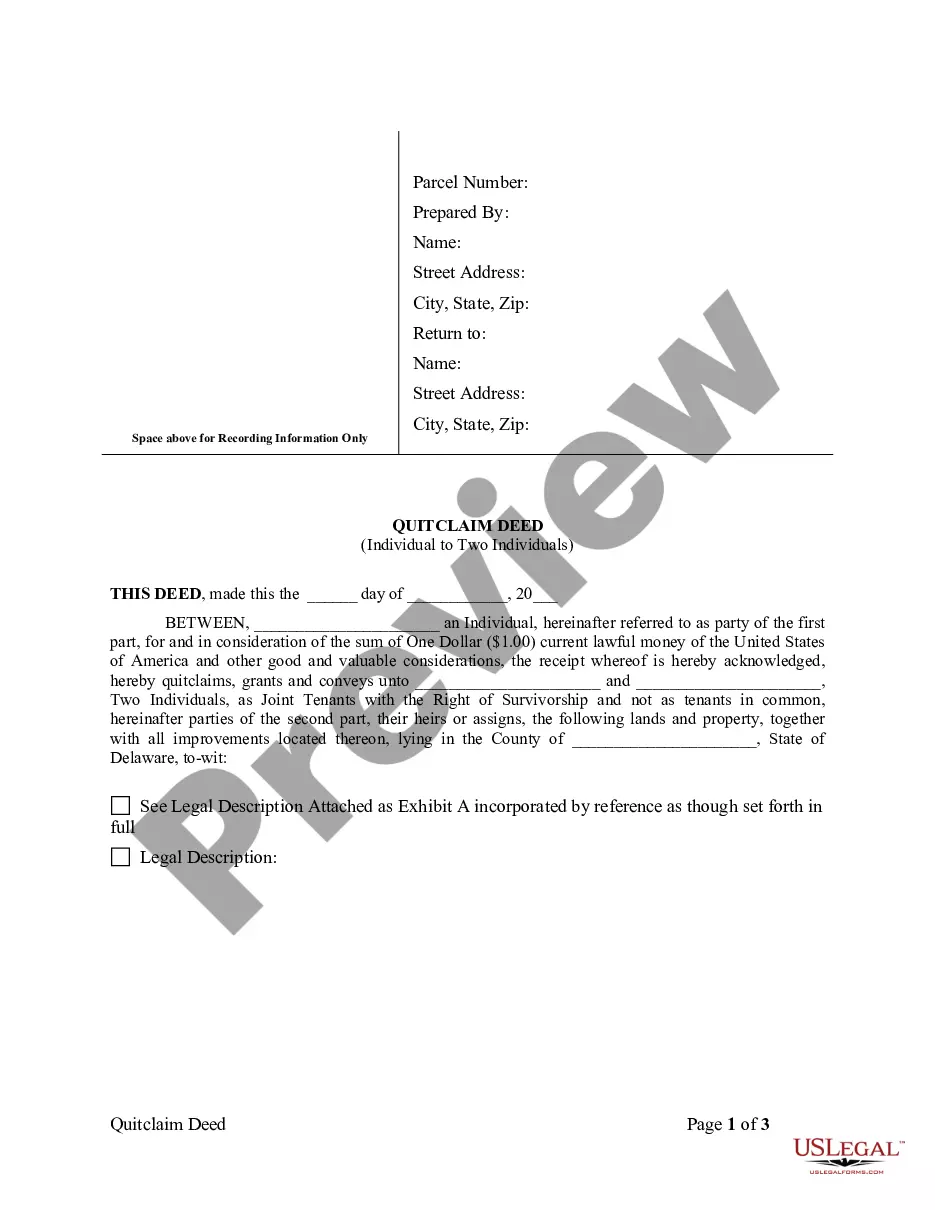
The Quitclaim Deed from Individual to Two Individuals in Joint Tenancy is a legal document that allows an individual (the Grantor) to transfer their property rights to two individuals (the Grantees) as joint tenants. This form conveys ownership while relinquishing any claim the Grantor has on the property, ensuring that if one Grantee passes away, ownership automatically transfers to the surviving Grantee(s). This document is distinct from a warranty deed, which provides guarantees about the propertyâs title.
Main sections of this form
- Identification of the Grantor and Grantees involved in the transaction.
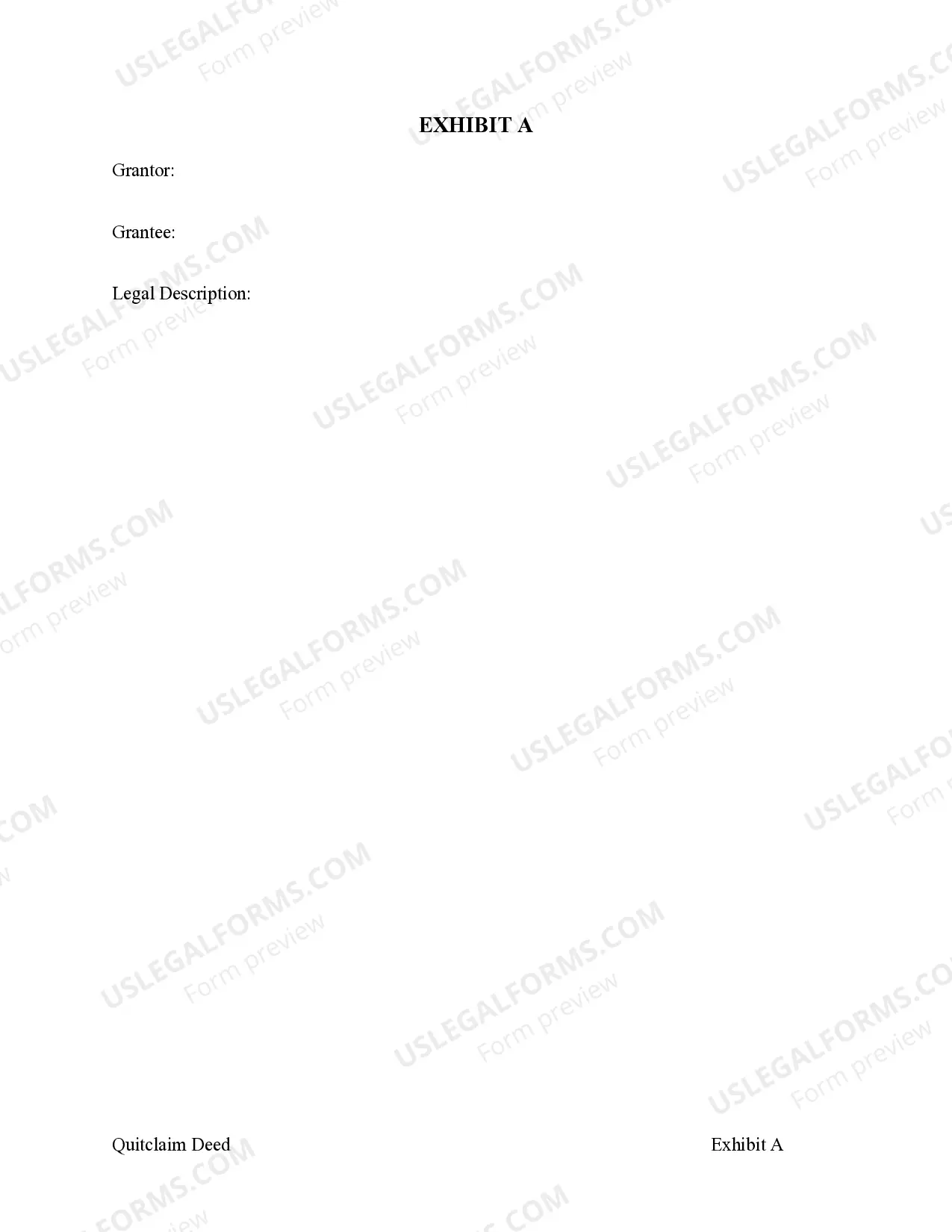
- A detailed legal description of the property being conveyed.
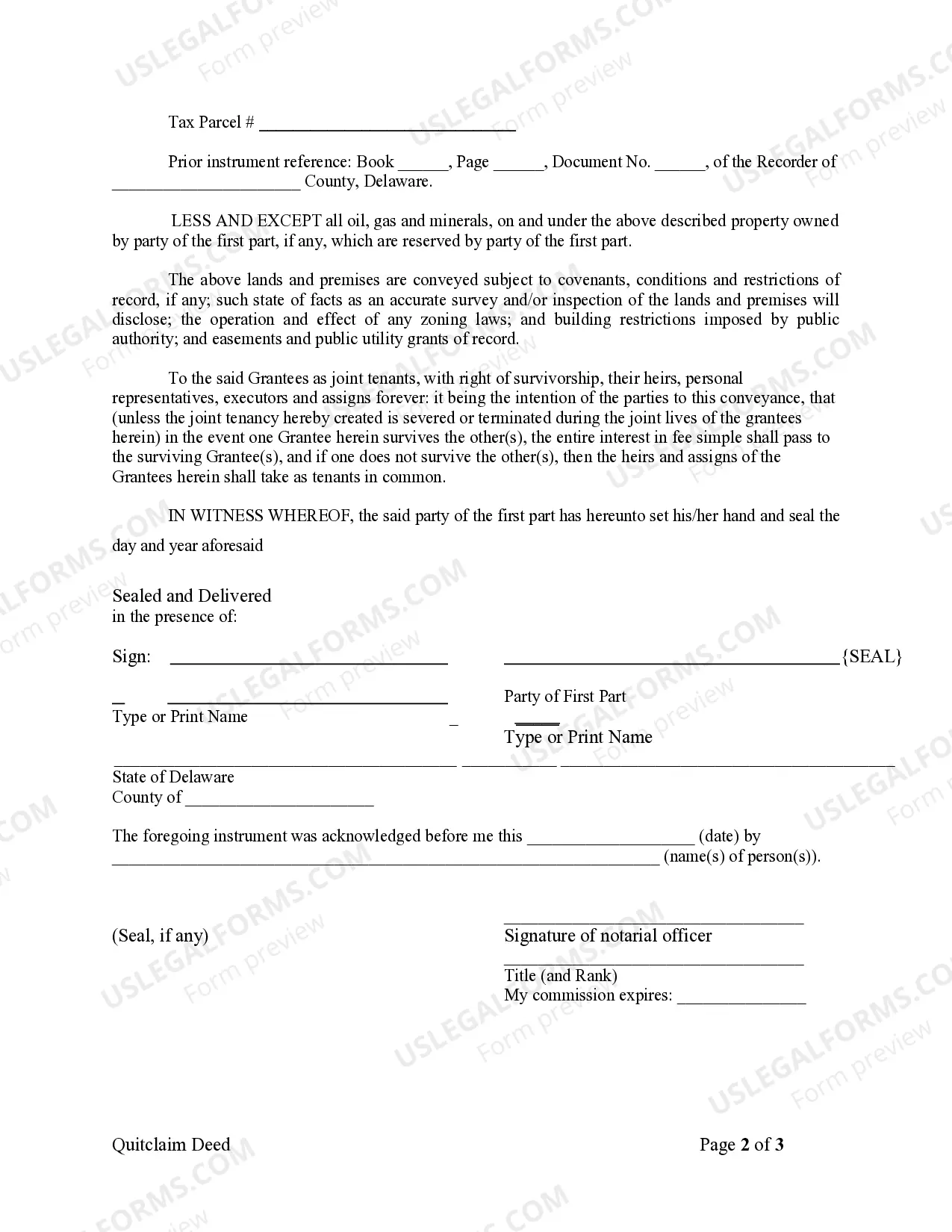
- Provisions that reserve oil, gas, and minerals found beneath the property for the Grantor.
- A statement establishing the joint tenancy with rights of survivorship.
- Signature section for the Grantor, witnesses, and notary public.




Common use cases
This Quitclaim Deed is typically used when an individual wants to transfer property ownership to two other individuals, particularly in situations such as gifting property to family members. It is also useful in estate planning where joint ownership is desired to ensure that the property passes seamlessly to the surviving owner upon death.
Who can use this document
- Individuals wishing to transfer real estate property to two persons as joint tenants.
- Those involved in estate planning intending to establish a joint ownership arrangement.
- Grantors who aim to reserve rights to any minerals in the property being transferred.
How to complete this form
- Identify the parties involved by filling in the names and addresses of the Grantor and Grantees.
- Provide a detailed legal description of the property being conveyed.
- Specify the reservation of rights for oil, gas, and minerals as applicable.
- Ensure all Grantees are listed and that the language indicates joint tenancy.
- Have the Grantor sign the form in the presence of a notary public and any required witnesses.
Notarization guidance
This form needs to be notarized to ensure legal validity. US Legal Forms provides secure online notarization powered by Notarize, allowing you to complete the process through a verified video call, available anytime.
Common mistakes to avoid
- Failing to provide a complete legal description of the property.
- Not properly indicating the rights of survivorship for the joint tenants.
- Omitting notarization or witness signatures, when required.
Why complete this form online
- Convenience of immediate access to customizable legal documents.
- Editability allows users to tailor the form to their specific needs.
- Reliability, as forms are drafted by licensed attorneys ensuring compliance with legal standards.

Form popularity
FAQ
Individuals looking to facilitate a quick transfer of property ownership often benefit the most from a Delaware Quitclaim Deed from Individual to Two Individuals in Joint Tenancy. This tool is particularly advantageous for family members or friends wanting to add co-owners with little fuss. However, both parties should be aware of their rights and responsibilities involved in the transfer.
To add someone to your deed in Delaware, you would execute a new Delaware Quitclaim Deed from Individual to Two Individuals in Joint Tenancy. This process involves preparing the deed, having it notarized, and then recording it with the county recorder. If you're uncertain about the steps or the implications of this transfer, platforms like US Legal Forms can simplify the process and ensure your documents are correctly prepared.
The main dangers of a Delaware Quitclaim Deed from Individual to Two Individuals in Joint Tenancy include lack of title assurance and possible liability for existing liens. Since this deed transfers ownership without guarantees, buyers may find themselves responsible for debts tied to the property. It’s essential to thoroughly investigate the property's title before proceeding with this type of transaction to avoid unexpected issues.
While it is possible to prepare a Delaware Quitclaim Deed from Individual to Two Individuals in Joint Tenancy without a lawyer, having one can ensure accuracy and compliance with local laws. A lawyer can help you navigate potential pitfalls and address specific concerns about your property. If you choose to proceed without legal assistance, consider using platforms like US Legal Forms, which offer resources to guide you in preparing your deed correctly.
You should not use a Delaware Quitclaim Deed from Individual to Two Individuals in Joint Tenancy for situations involving the sale of real estate, as this deed lacks protective warranties. It is also not suitable for transferring property to an LLC or for properties facing foreclosure or significant legal issues. In such cases, a warranty deed or other legal instruments might be more appropriate.
A Delaware Quitclaim Deed from Individual to Two Individuals in Joint Tenancy can create challenges if not prepared carefully. For instance, it does not guarantee the seller's ownership of the property, leaving the buyer vulnerable to potential claims. Additionally, this type of deed offers no warranties against liens or other encumbrances, which could lead to unpleasant surprises down the road.
You do not necessarily need a lawyer to add someone to a deed, especially when using a Delaware Quitclaim Deed from Individual to Two Individuals in Joint Tenancy. However, consulting with a legal expert can help you understand the implications of this transfer and ensure that you complete everything correctly. UsLegalForms offers resources and templates that simplify the deed process, making it accessible for you to add an individual without extensive legal knowledge. Nevertheless, if your situation is complex, seeking professional legal advice might still be beneficial.
Yes, you can accomplish a quitclaim deed yourself, particularly if you feel comfortable with the process and legal terminology. However, it is recommended to utilize resources like USLegalForms to ensure that you have the correct forms and instructions for your situation. When dealing with a Delaware Quitclaim Deed from Individual to Two Individuals in Joint Tenancy, using a reliable platform can help prevent mistakes and ensure a valid transfer.
To do a quitclaim deed in Delaware, begin by preparing the deed that outlines your intention to transfer property rights. It is critical to include details such as the names of the grantor and grantee, along with a clear description of the property. After signing the deed in front of a notary, you must record it at your local Recorder of Deeds. If you want a Delaware Quitclaim Deed from Individual to Two Individuals in Joint Tenancy, make sure to state that specifically in the deed.
To file a quitclaim deed in Delaware, start by completing the deed form accurately, ensuring it includes pertinent information about the property and the parties involved. Once completed, you will need to have the document signed in front of a notary public. Finally, file the deed with the Recorder of Deeds in the county where the property is located. If your goal is a Delaware Quitclaim Deed from Individual to Two Individuals in Joint Tenancy, following this process will ensure a smooth transfer.