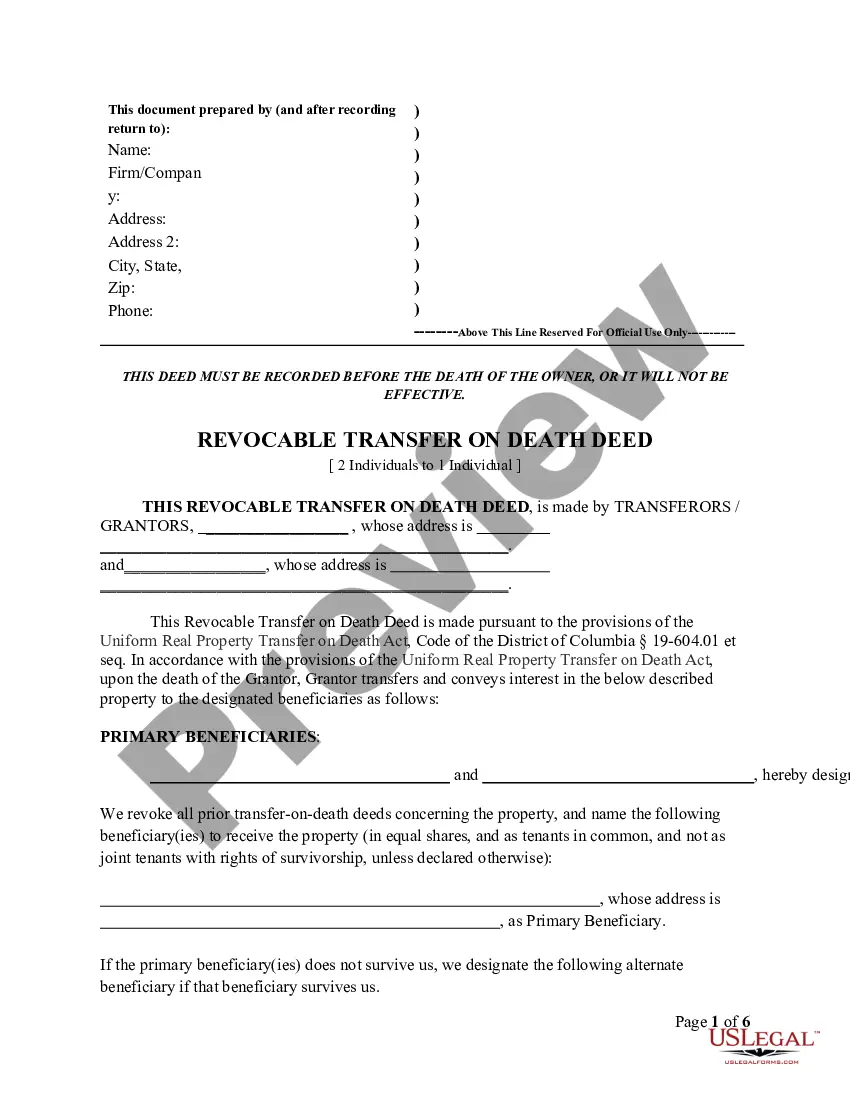
District of Columbia Transfer on Death Deed or TOD - Beneficiary Deed for Two Individuals to One Individual
About this form
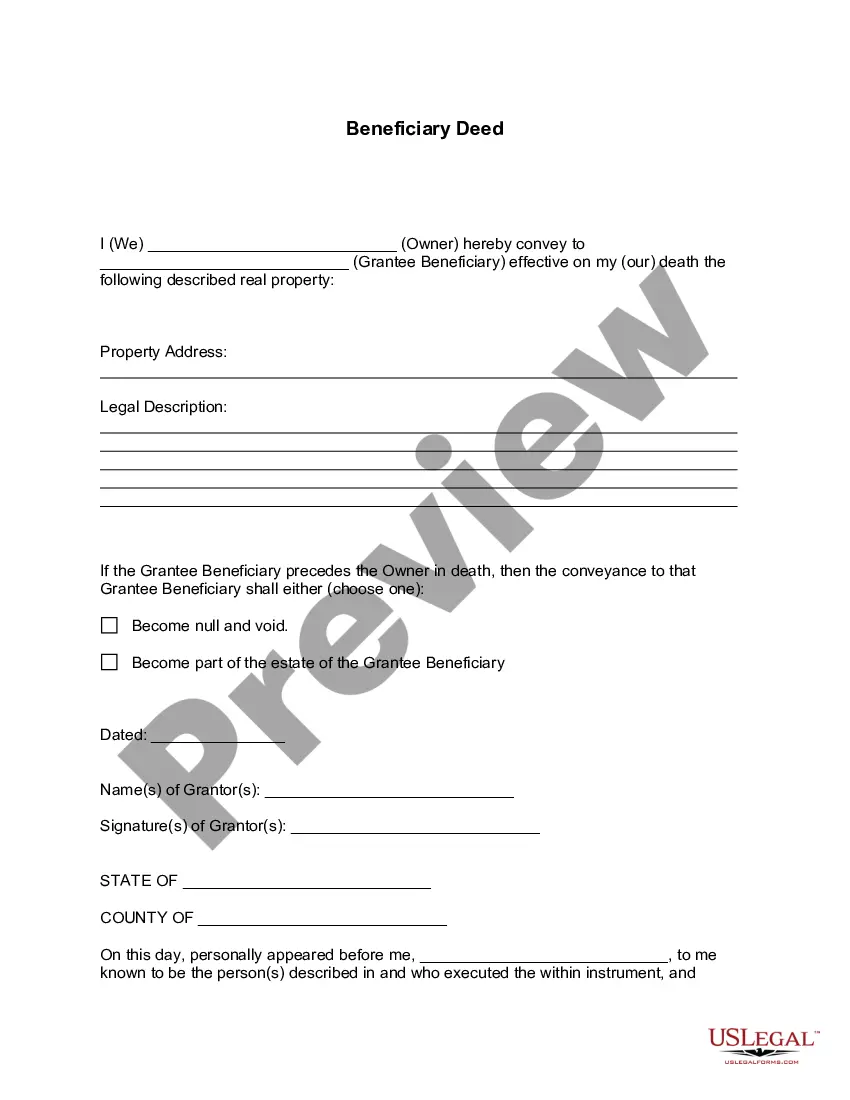
The Transfer on Death Deed, also known as a TOD deed, is a legal document that allows property owners to designate a beneficiary who will receive ownership of the property upon the owner's death. This deed ensures that the property does not go through probate, as the title transfers directly to the named beneficiary. Unlike a traditional deed, it does not transfer any ownership interest while the owner is still alive, and it can be revoked at any time.
Key parts of this document
- Names and addresses of the Grantor(s) (property owners).
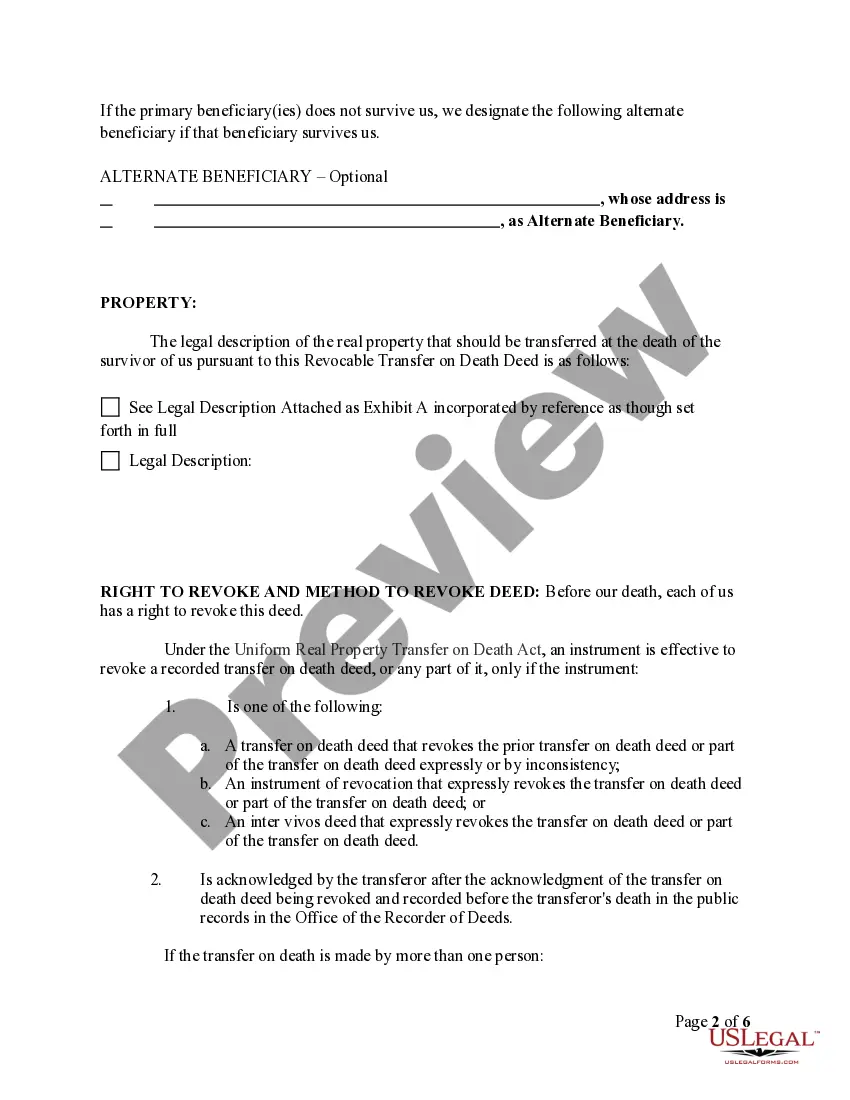
- Names and addresses of the designated primary and alternate beneficiaries.
- Legal description of the property to be transferred.
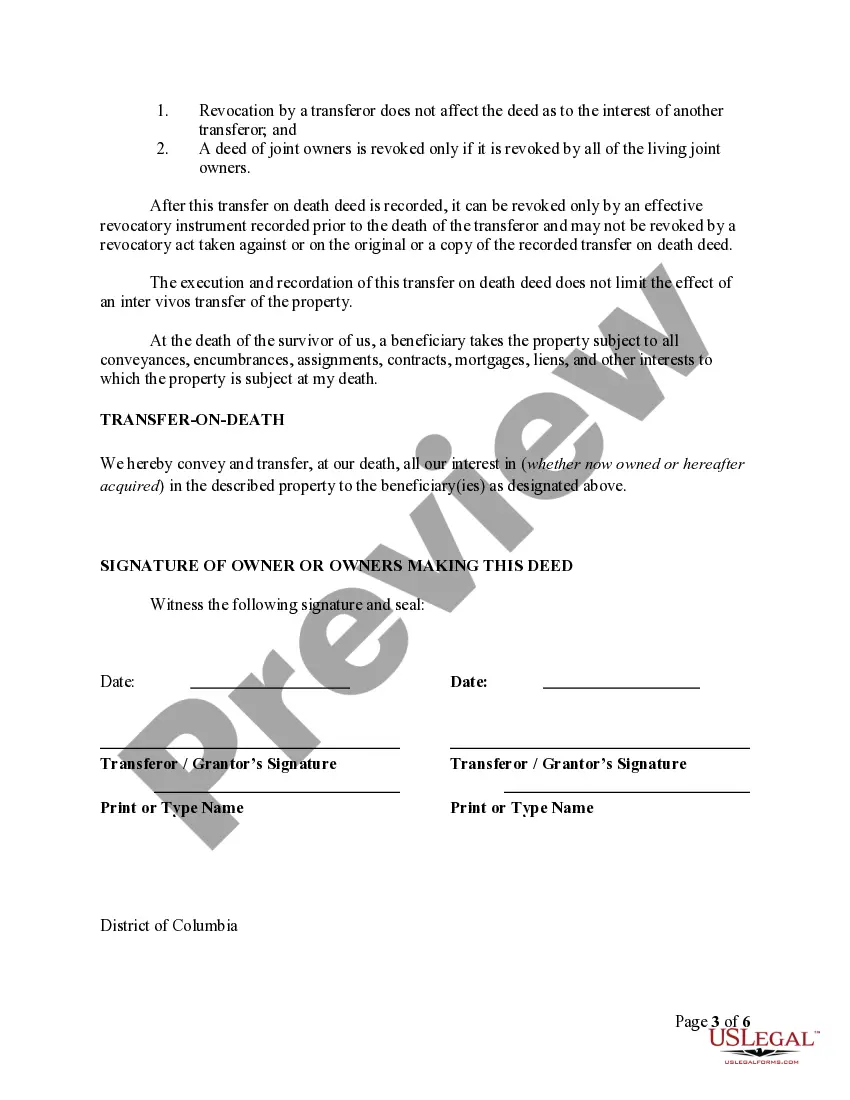
- Revocation clause to outline how this deed can be revoked.
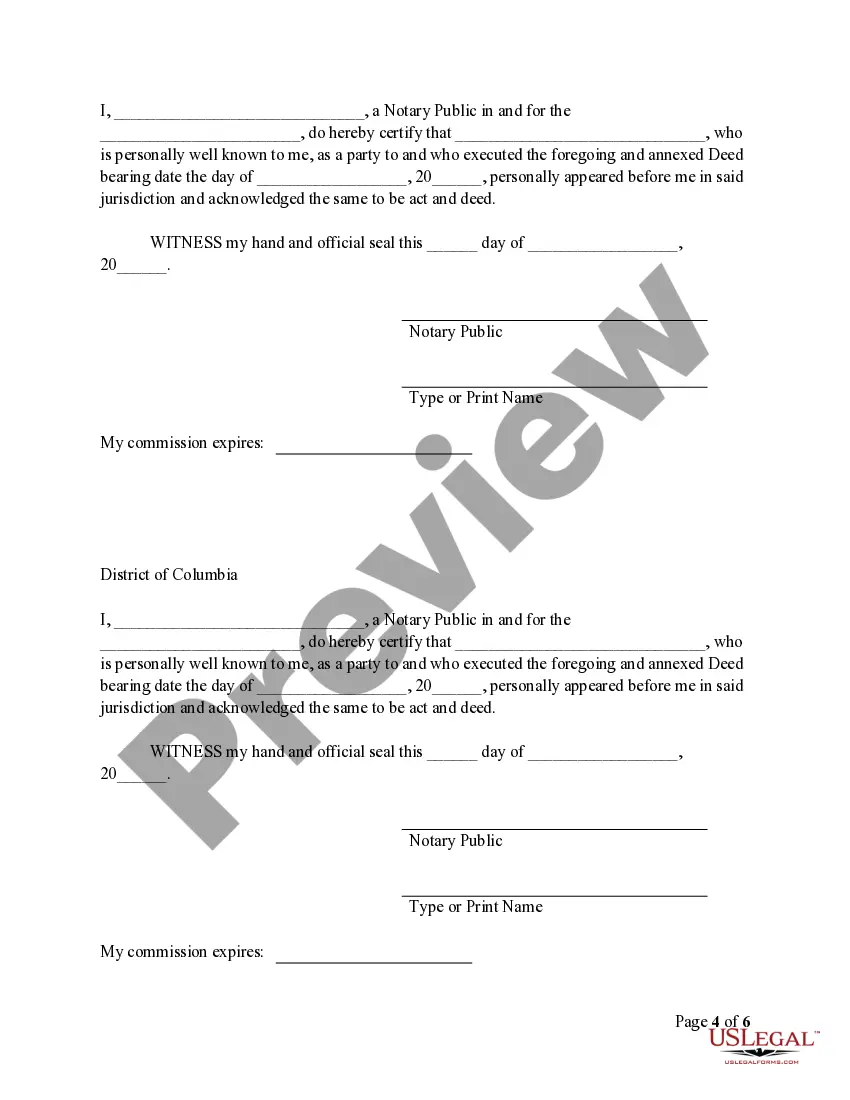
- Signature section for the Grantor(s) and a notarization section.




When to use this document
This form is useful when property owners want to ensure that their real estate is passed directly to a specific individual or individuals upon their death without undergoing probate. It can be beneficial for couples wishing to transfer their shared property to one individual after the death of both owners. This deed should be recorded before the death of the grantors to ensure its validity.
Who should use this form
This form is suitable for:
- Property owners who want to designate a beneficiary for their real estate.
- Couples or co-owners wishing to streamline the transfer of their property.
- Individuals seeking to avoid the probate process after their death.
How to complete this form
- Identify the Grantor(s) by entering names and addresses at the top of the form.
- Designate the primary beneficiary or beneficiaries and include their addresses.
- If desired, specify an alternate beneficiary in case the primary does not survive the Grantors.
- Provide a legal description of the property that will be transferred.
- Each Grantor should sign and date the deed to finalize it.
- Consider having the deed notarized to ensure its legality.
Notarization guidance
Yes, this form must be notarized to be legally valid. US Legal Forms offers integrated online notarization services available 24/7 through secure video calls. This process ensures your document is legally equivalent to traditional notarization without the need for travel.
Get your form ready online
Our built-in tools help you complete, sign, share, and store your documents in one place.
Make edits, fill in missing information, and update formatting in US Legal Forms—just like you would in MS Word.
Download a copy, print it, send it by email, or mail it via USPS—whatever works best for your next step.
Sign and collect signatures with our SignNow integration. Send to multiple recipients, set reminders, and more. Go Premium to unlock E-Sign.
If this form requires notarization, complete it online through a secure video call—no need to meet a notary in person or wait for an appointment.
We protect your documents and personal data by following strict security and privacy standards.

Make edits, fill in missing information, and update formatting in US Legal Forms—just like you would in MS Word.

Download a copy, print it, send it by email, or mail it via USPS—whatever works best for your next step.

Sign and collect signatures with our SignNow integration. Send to multiple recipients, set reminders, and more. Go Premium to unlock E-Sign.

If this form requires notarization, complete it online through a secure video call—no need to meet a notary in person or wait for an appointment.

We protect your documents and personal data by following strict security and privacy standards.
Avoid these common issues
- Failing to record the deed before the death of the Grantors.
- Not providing the complete legal description of the property.
- Neglecting to revoke any prior transfer-on-death deeds related to the property.
- Not including an alternate beneficiary if the primary beneficiary may pass away before the Grantors.
Benefits of using this form online
- Easy access to user-friendly templates created by legal professionals.
- Convenience of downloading and editing the form according to your needs.
- Reduces the likelihood of errors with clear instructions provided.
Key takeaways
- The Transfer on Death Deed allows for seamless property transfer upon death.
- It can be revoked any time before the Grantorâs death.
- Filing the deed correctly and on time is crucial for its effectiveness.
- Consider the potential for common mistakes to ensure the deedâs validity.
Looking for another form?

Form popularity
FAQ
One potential disadvantage of a District of Columbia Transfer on Death Deed or TOD - Beneficiary Deed for Two Individuals to One Individual is that it cannot address all estate planning needs. For instance, it does not allow for the management of the property during your lifetime. Additionally, if the beneficiaries disagree, conflicts may arise, leading to disputes. It’s wise to consider these factors when planning your estate.
While hiring an attorney is not a requirement for a District of Columbia Transfer on Death Deed or TOD - Beneficiary Deed for Two Individuals to One Individual, it is highly recommended. An attorney can provide valuable guidance and ensure that all legal requirements are met. By consulting with a professional, you can help prevent potential issues with the deed in the future. Ultimately, this may save you time and stress.
Yes, you can designate two beneficiaries on a District of Columbia Transfer on Death Deed or TOD - Beneficiary Deed for Two Individuals to One Individual. This arrangement allows for a smooth transfer of property upon your passing. By naming two beneficiaries, you ensure that your property is divided according to your wishes. However, keep in mind that both beneficiaries must agree on how to divide the property.
Choosing between a transfer on death deed and a beneficiary deed after death largely depends on your circumstances. A transfer on death deed offers a direct and simpler means of passing property without probate, while a beneficiary deed may provide different legal benefits. Ultimately, it is advisable to evaluate your estate planning goals and consult professionals to determine which option, the District of Columbia Transfer on Death Deed or TOD - Beneficiary Deed for Two Individuals to One Individual or otherwise, aligns best with your needs.
Transferring a property on death deed to two beneficiaries is relatively straightforward. You can list both beneficiaries on the deed itself, clearly stating each person’s share. This method ensures that both individuals receive their designated portion without complications, making the District of Columbia Transfer on Death Deed or TOD - Beneficiary Deed for Two Individuals to One Individual effective for dual beneficiaries.
Despite the advantages, there are some disadvantages to consider with transfer on death deeds. For instance, they do not provide protection from creditors, and the process can become complicated if there are disputes among beneficiaries. It's crucial to weigh these factors carefully, especially when contemplating the District of Columbia Transfer on Death Deed or TOD - Beneficiary Deed for Two Individuals to One Individual.
While you can fill out a transfer on death deed on your own, consulting with a lawyer is often beneficial. An attorney can provide guidance on the specific requirements of the District of Columbia Transfer on Death Deed or TOD - Beneficiary Deed for Two Individuals to One Individual and help you avoid potential pitfalls. Their expertise ensures that all legal obligations are met, leading to a smoother process.
Indeed, the District of Columbia permits the use of transfer on death deeds. This option simplifies the transfer of real estate, allowing owners to designate beneficiaries who will receive property without going through probate. For those engaging with the District of Columbia Transfer on Death Deed or TOD - Beneficiary Deed for Two Individuals to One Individual, this can streamline estate management.
Yes, the District of Columbia does allow transfer on death deeds. This legal mechanism provides a straightforward way to transfer property after death without the need for probate. It can be an excellent option for estate planning, particularly for those looking to utilize the District of Columbia Transfer on Death Deed or TOD - Beneficiary Deed for Two Individuals to One Individual.
Several states recognize transfers on death deeds, each with its own rules and regulations. States like Maryland, Texas, and California allow this option, and specific legislation governs how these deeds function. It is essential to check the laws of your state, especially if you are considering the District of Columbia Transfer on Death Deed or TOD - Beneficiary Deed for Two Individuals to One Individual.