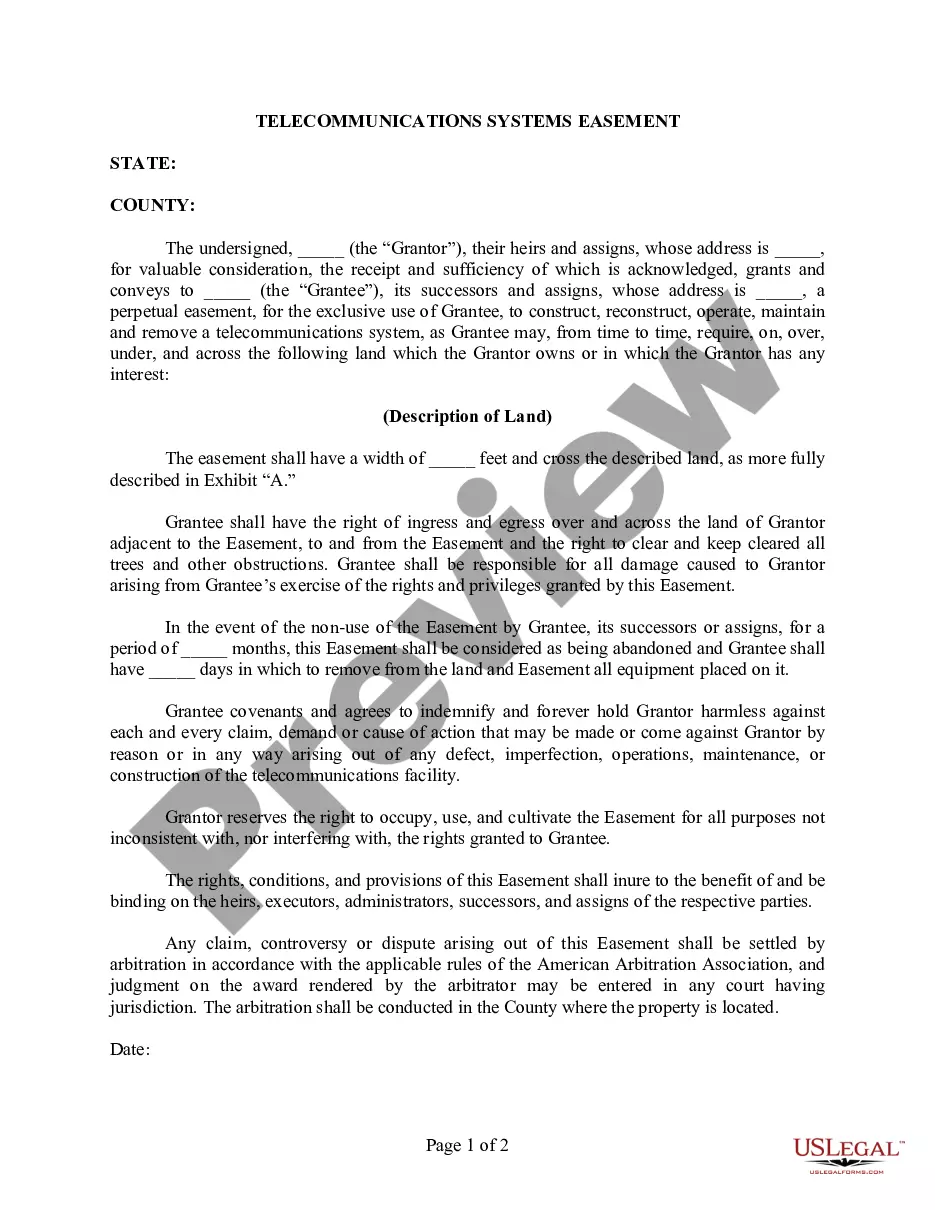
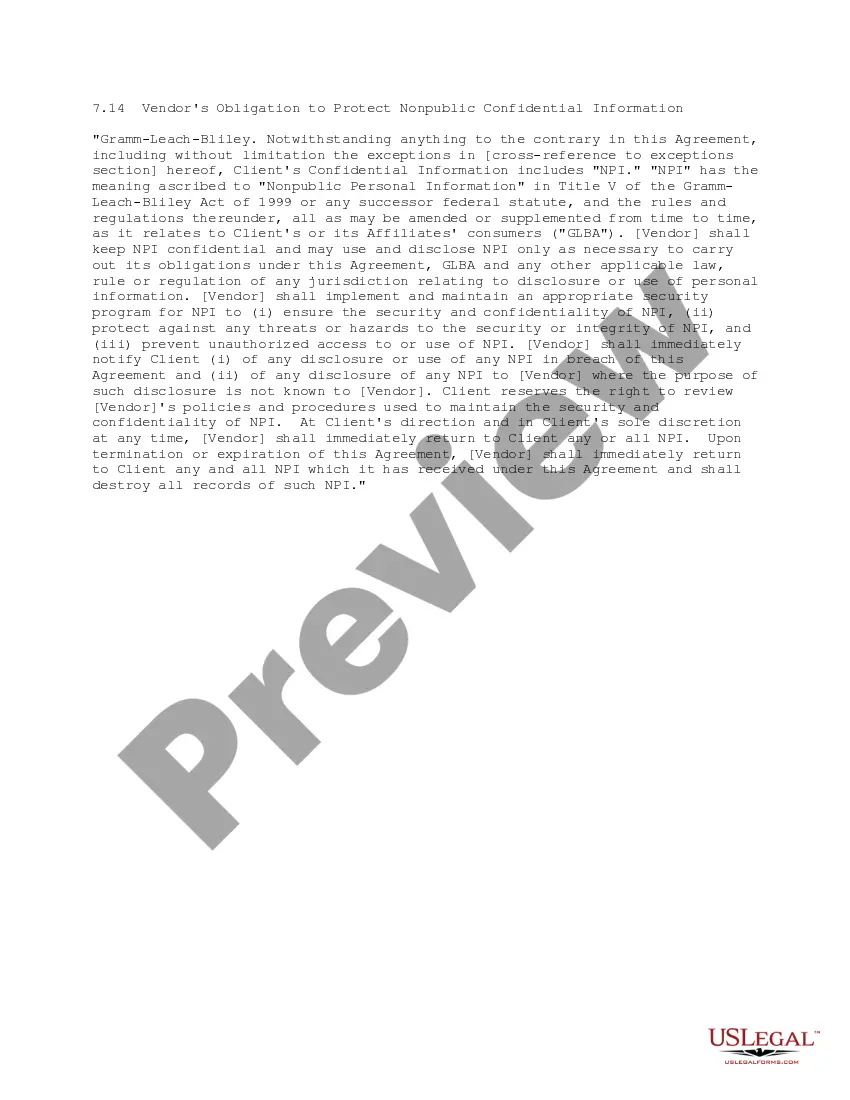
This form, a Vendor's Obligation to Protect Nonpublic Confidential Information, contains a clause for an agreement that establishes a vendors duty to protect private, personal, confidential or other sensitive information that it obtains during the course of its business relationship with the client company.
District of Columbia Vendor's Obligation to Protect Nonpublic Confidential Information
Category:
State:
Multi-State
Control #:
US-IP0714
Format:
Word;
PDF;
Rich Text
Instant download
Description
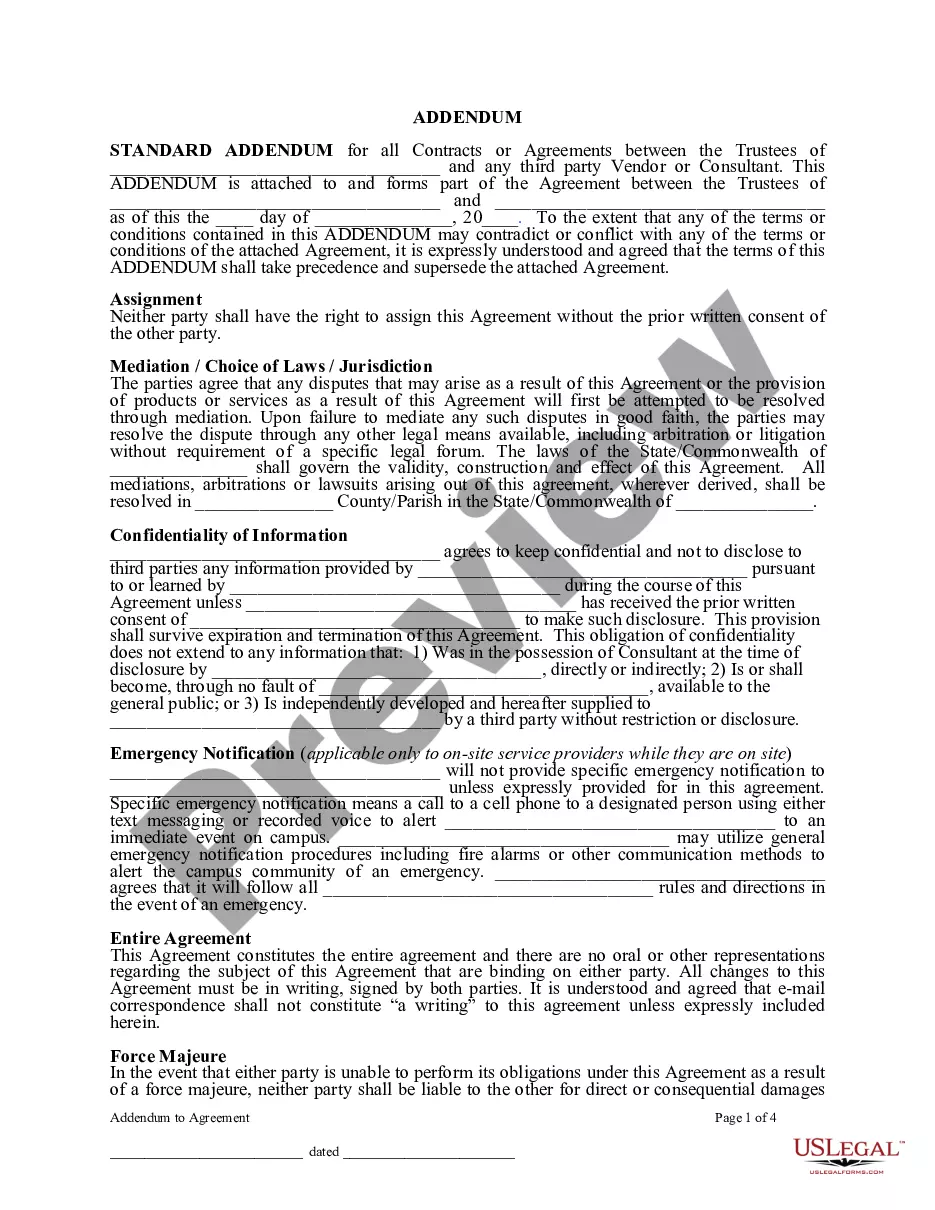
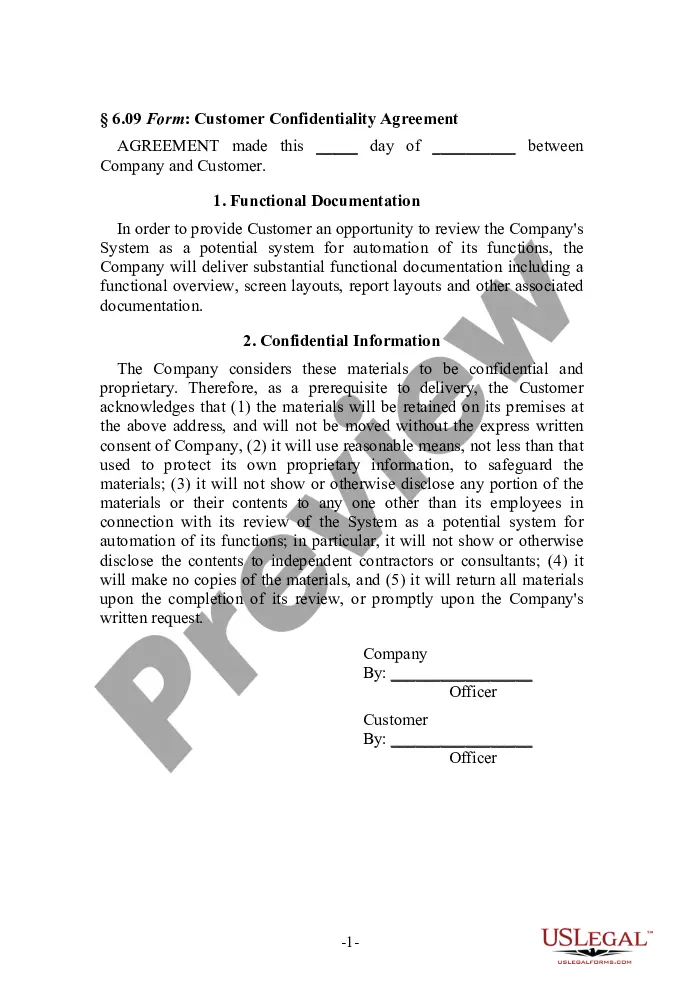

How to fill out Vendor's Obligation To Protect Nonpublic Confidential Information?
If you need to obtain, download, or print authorized document templates, utilize US Legal Forms, the largest selection of authorized forms available online.
Take advantage of the site's simple and convenient search to find the documents you require. Various templates for business and personal purposes are categorized by types and states, or keywords.
Use US Legal Forms to acquire the District of Columbia Vendor's Obligation to Safeguard Nonpublic Confidential Information in just a few clicks.
Step 5. Complete the transaction. You can use your credit card or PayPal account to finalize the purchase.
Step 6. Select the format of the legal form and download it to your device. Step 7. Complete, modify, and print or sign the District of Columbia Vendor's Obligation to Safeguard Nonpublic Confidential Information. Every legal document template you acquire is yours permanently. You have access to every form you downloaded in your account. Click the My documents section and select a form to print or download again. Compete and download, and print the District of Columbia Vendor's Obligation to Safeguard Nonpublic Confidential Information with US Legal Forms. There are thousands of professional and state-specific forms you can utilize for your business or personal needs.
- If you are already a US Legal Forms user, Log In to your account and click on the Download button to retrieve the District of Columbia Vendor's Obligation to Safeguard Nonpublic Confidential Information.
- You can also access forms you previously downloaded from the My documents tab of your account.
- If you are using US Legal Forms for the first time, follow the steps below.
- Step 1. Ensure you have chosen the form for the correct state/region.
- Step 2. Use the Review option to check the form's content. Don't forget to read the summary.
- Step 3. If you are not satisfied with the form, use the Search area at the top of the screen to find other versions of the legal form template.
- Step 4. Once you have found the form you need, click the Buy now button. Select the pricing plan you prefer and enter your information to register for the account.
Form popularity
FAQ
Personal information is defined in the Privacy Act as information or an opinion about an identified individual, or an individual who is reasonably identifiable: whether the information or opinion is true or not; and. whether the information or opinion is recorded in a material form or not.
(1)There must be a 'quality of confidence' to the information. The information must be objectively confidential, and not just treated or labelled as confidential by the holder.
Broadly stated, the purpose of the Privacy Act is to balance the government's need to maintain information about individuals with the rights of individuals to be protected against unwarranted invasions of their privacy stemming from federal agencies' collection, maintenance, use, and disclosure of personal information
Protected personal information means specific individual facts that, unless segregated, would otherwise be in a submitted document to identify a person submitting the document or another person beyond that person's name or to identify the financial activities of either and which the court is allowed or required by law
The Privacy Act only applies to EPA records that: contain information on individuals', are maintained by the EPA in a system of records; and. are retrieved by a personal identifier, such as a person's name, Social Security Number, biometrics, medical record number or other unique identifier.
There must be no disclosure of personal information to bodies outside NSW unless: the disclosure is to a jurisdiction with a recognised privacy law in place or the disclosure is otherwise authorised, or. the individual has consented, or.
"Confidential Information" means all material, non-public, business-related information, written or oral, whether or not it is marked as such, that is disclosed or made available to the receiving party, directly or indirectly, through any means of communication or observation.
What is not considered personal information under the CCPA? Personal information does not include publicly available information that is from federal, state, or local government records, such as professional licenses and public real estate/property records.
Here are some examples of confidential information:Name, date of birth, age, sex, and address.Current contact details of family.Bank information.Medical history or records.Personal care issues.Service records and file progress notes.Personal goals.Assessments or reports.More items...?12-Jan-2022
When the Privacy Act applies Personal information is information about an identifiable, living person. Anything that identifies you or is about someone who is identifiable could be personal information e.g. a photo, an email, or a recorded conversation.