District of Columbia Living Trust Property Record
Understanding this form
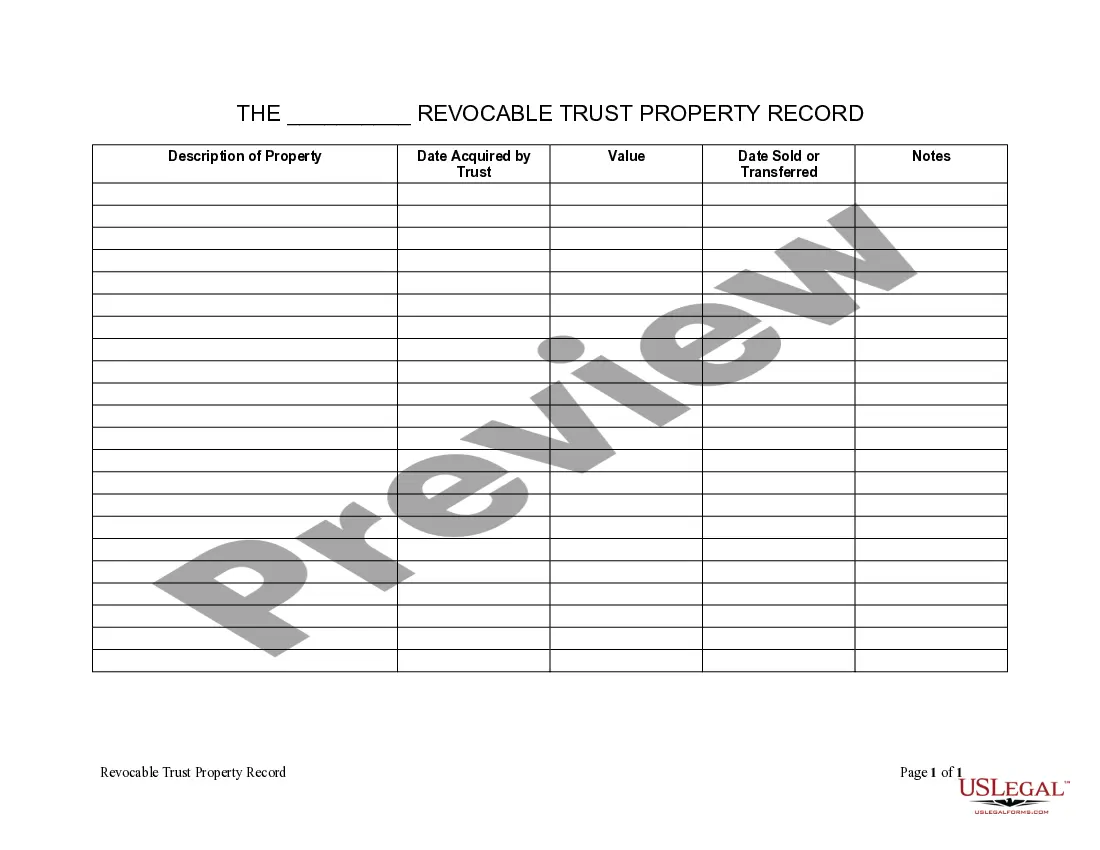
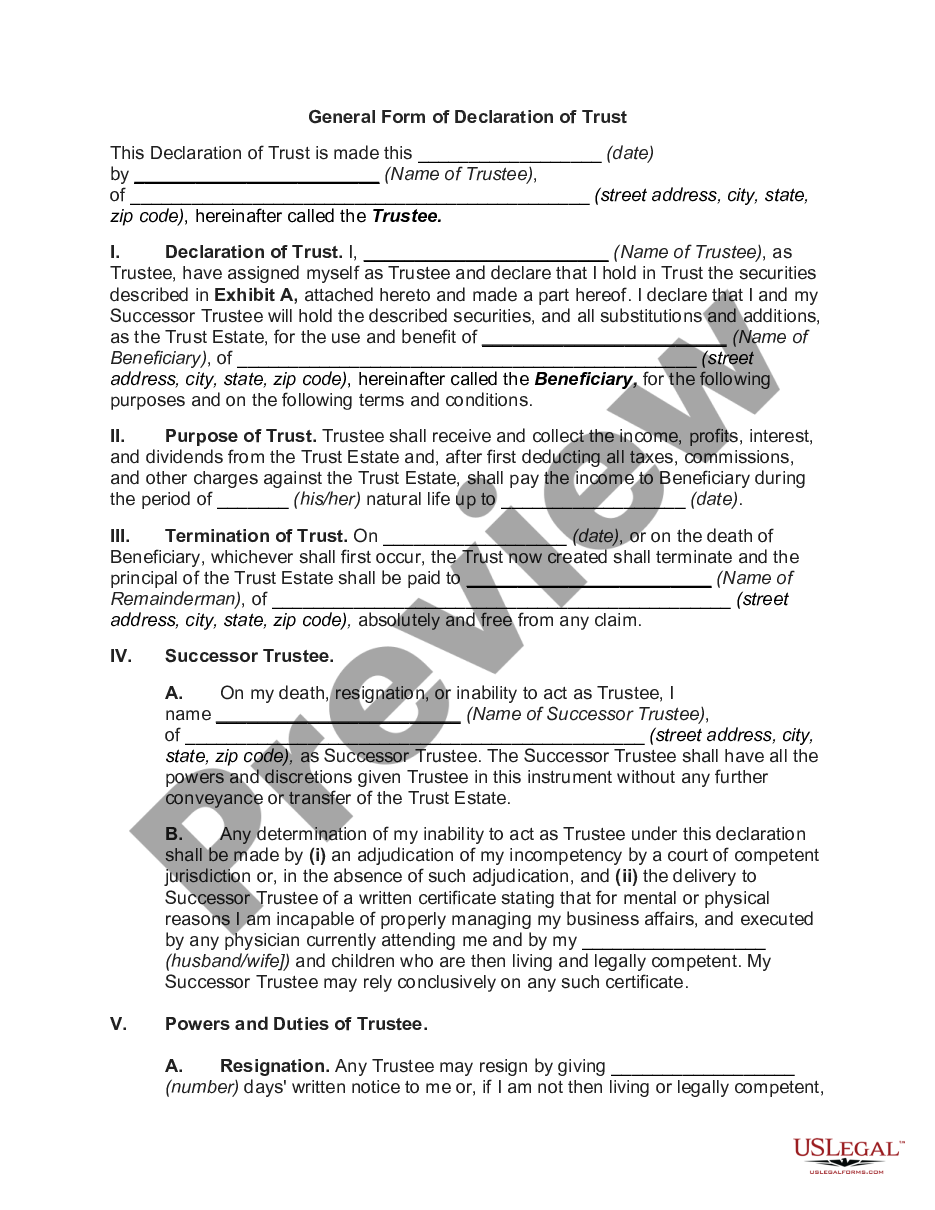
The Living Trust Property Record form is a crucial document for managing a living trust. A living trust allows individuals to place their assets and property into a trust during their lifetime for the purposes of effective estate planning. This form serves to document key details about the property held within the trust, including its description, date of acquisition, value, and any sales or transfers. Unlike other forms, this record focuses specifically on cataloging trust property to ensure accurate oversight and management by the Trustee.
Key components of this form
- Description of Property: A section to detail each asset within the trust.
- Date Acquired by Trust: This field records when each asset was placed in the trust.
- Value: An estimation of the property's worth at the time of entry into the trust.
- Date Sold or Transferred: A record of any changes in the ownership or status of assets.

Common use cases
This form is particularly useful when establishing or updating a living trust. It should be used whenever there are new assets to record, when existing assets are sold or transferred, or when conducting periodic reviews of the trust's property holdings. It is also essential during estate planning discussions to ensure that all assets are properly cataloged and managed by the Trustee.
Intended users of this form
The following individuals should consider using the Living Trust Property Record:
- Trustees managing a living trust who need to maintain accurate records of trust assets.
- Individuals establishing a living trust for the first time.
- Estate planners assisting clients in documenting assets within a trust.
Completing this form step by step
- Identify the property to be included in the trust by its description.
- Enter the date each asset was acquired by the trust.
- Specify the estimated value of each property at the time of entry into the trust.
- Record any relevant dates for when properties are sold or transferred out of the trust.
- Ensure that all fields are filled out accurately and completely for proper trust administration.
Does this document require notarization?
This form usually doesn’t need to be notarized. However, local laws or specific transactions may require it. Our online notarization service, powered by Notarize, lets you complete it remotely through a secure video session, available 24/7.
Get your form ready online
Our built-in tools help you complete, sign, share, and store your documents in one place.
Make edits, fill in missing information, and update formatting in US Legal Forms—just like you would in MS Word.
Download a copy, print it, send it by email, or mail it via USPS—whatever works best for your next step.
Sign and collect signatures with our SignNow integration. Send to multiple recipients, set reminders, and more. Go Premium to unlock E-Sign.
If this form requires notarization, complete it online through a secure video call—no need to meet a notary in person or wait for an appointment.
We protect your documents and personal data by following strict security and privacy standards.

Make edits, fill in missing information, and update formatting in US Legal Forms—just like you would in MS Word.

Download a copy, print it, send it by email, or mail it via USPS—whatever works best for your next step.

Sign and collect signatures with our SignNow integration. Send to multiple recipients, set reminders, and more. Go Premium to unlock E-Sign.

If this form requires notarization, complete it online through a secure video call—no need to meet a notary in person or wait for an appointment.

We protect your documents and personal data by following strict security and privacy standards.
Common mistakes
- Failing to update the property record after asset sales or transfers.
- Not providing complete descriptions of the assets.
- Using outdated values rather than current estimates for assets.
Advantages of online completion
- Convenience of downloading and completing the form at your own pace.
- Editability allows for easy updates if asset information changes.
- Access to reliable templates drafted by licensed attorneys, ensuring legal soundness.
Main things to remember
- The Living Trust Property Record helps manage and document trust assets effectively.
- Essential for individuals creating a living trust or trustees overseeing trust property.
- Maintaining accurate records can prevent disputes and ensure smooth estate management.
Looking for another form?
Form popularity
FAQ
To obtain a recorded deed, you can request it from the Recorder of Deeds office in the District of Columbia. Typically, you will need to provide the property address and possibly the book and page number associated with the District of Columbia Living Trust Property Record. Additionally, utilizing online platforms like US Legal Forms can simplify the process by providing access to forms and guidance, ensuring you have everything you need to obtain your recorded deed.
Recording a deed in the District of Columbia typically takes a few days to a couple of weeks. The exact duration can depend on the current workload of the Recorder of Deeds and any specific requirements for the District of Columbia Living Trust Property Record. It is beneficial to ensure that all required documents are accurate and complete to avoid delays. To expedite the process, consider using services that specialize in filing, such as US Legal Forms.
To determine property ownership in Washington, DC, access the online property database provided by the DC government. You can search using relevant details like the property's address or the name of the owner. If the property is held within a trust, it may appear under a District of Columbia Living Trust Property Record. For assistance and streamlined navigation, consider using the resources available through US Legal Forms.
Finding a property owner in Washington, DC, is straightforward with online resources. You can visit the DC Office of Tax and Revenue's website, where you can search by property address or owner name. Many properties are documented under the District of Columbia Living Trust Property Record, which may provide additional insights into ownership structures. For a more comprehensive search experience, check out US Legal Forms to simplify the process.
To find out who owns the property near you, utilize public property records available through the District of Columbia government website. You can search by address or parcel number to access ownership details. Many properties may also be listed under a District of Columbia Living Trust Property Record, reflecting ownership via a trust. If you need help navigating these records, consider using US Legal Forms for easy access and guidance.
The income limit for the DC tax abatement varies based on the specific abatement type, focusing primarily on lower-income residents. Each program has its guidelines, aimed at providing financial relief. Reviewing your circumstances against the District of Columbia Living Trust Property Record may help determine what options are available to you for sustainable property management.
Individuals who own and occupy their primary residence in DC may qualify for the homestead property tax credit. This credit reduces the assessed value of the property for tax purposes, easing the financial load on homeowners. Referencing the District of Columbia Living Trust Property Record can assist in confirming your eligibility for this beneficial program.
To place a lien on a property in DC, you must file specific legal documents through the proper channels. This includes submitting the lien with the District of Columbia's Recorder of Deeds. Knowing how to access the District of Columbia Living Trust Property Record can streamline this process, offering necessary insights into property ownership.
Eligibility for the DC property tax credit primarily includes homeowners who meet specified income levels and property ownership criteria. Additionally, persons with disabilities and senior citizens often qualify for enhanced benefits. Always refer to the District of Columbia Living Trust Property Record for the most accurate and personalized information.
In Washington, residents who meet certain income criteria and own property may qualify for tax credits. This can be quite beneficial for those looking to ease their financial responsibilities. It is advisable to check the District of Columbia Living Trust Property Record to ensure you meet all requirements for optimal benefits.