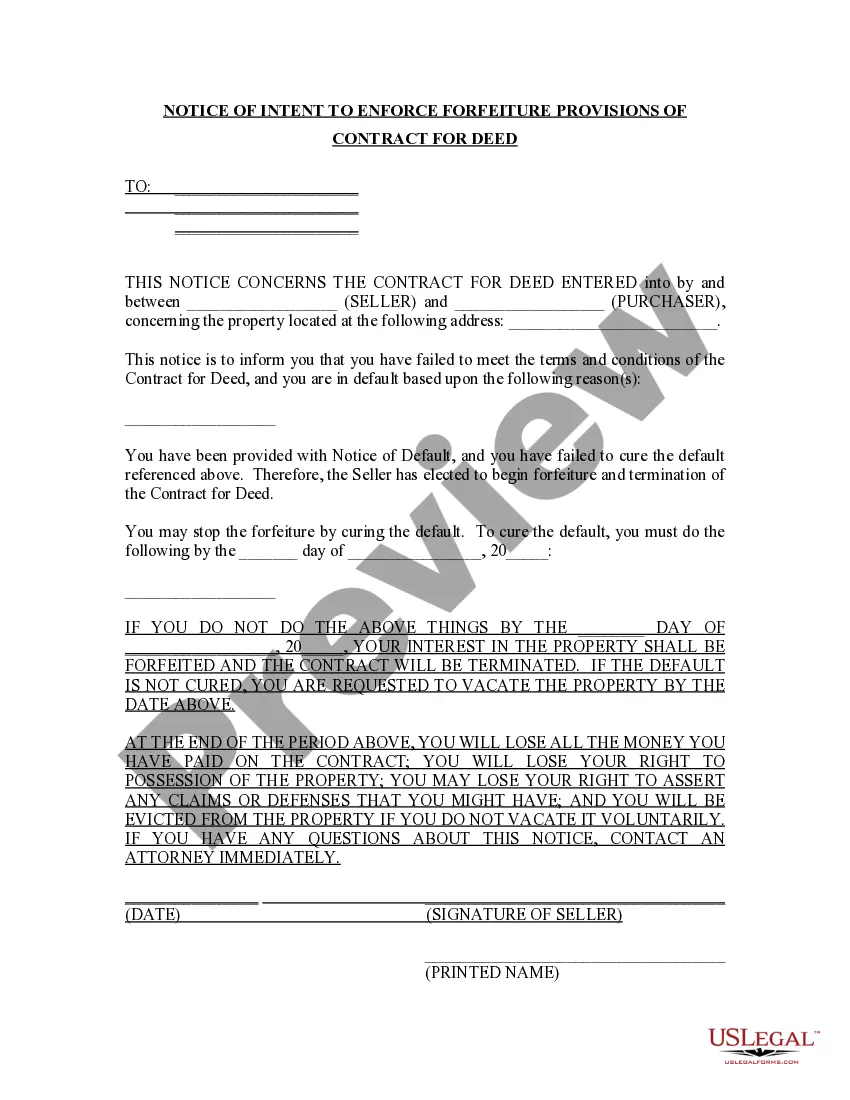
This Notice of Intent to Enforce Forfeiture Provisions of Contract for Deed is an initial notice of Seller's intent to enforce the forfeiture remedy of contract for deed if nonpayment or other breach is not cured. It is used specifically to inform the buyer that he/she has failed to meet the terms and conditions of the Contract for Deed and as a result, are in default based upon the reasons specified.
District of Columbia Notice of Intent to Enforce Forfeiture Provisions of Contact for Deed
State:
District of Columbia
Control #:
DC-00470-11
Format:
Word;
Rich Text
Instant download
Description




How to fill out District Of Columbia Notice Of Intent To Enforce Forfeiture Provisions Of Contact For Deed?
Utilize US Legal Forms to obtain a printable District of Columbia Notice of Intent to Enforce Forfeiture Clauses of Contract for Deed.
Our legally acceptable forms are created and frequently updated by proficient attorneys.
We offer the most extensive Forms library online, providing affordable and precise samples for consumers, attorneys, and small to medium-sized businesses.
Click Buy Now if it is the document you need. Create your account and make payment via PayPal or by card. Download the document to your device and feel free to reuse it multiple times. Use the Search field if you wish to obtain another document template. US Legal Forms provides thousands of legal and tax samples and packages for business and personal usage, including the District of Columbia Notice of Intent to Enforce Forfeiture Clauses of Contract for Deed. Over three million users have successfully utilized our platform. Choose your subscription plan and acquire high-quality documents in just a few clicks.
- The documents are organized into categories based on state, and some can be previewed before downloading.
- To download templates, users must have a subscription and need to Log In to their account.
- Click Download next to any form you wish to access and locate it in My documents.
- For those without a subscription, follow the instructions below to easily find and download the District of Columbia Notice of Intent to Enforce Forfeiture Clauses of Contract for Deed.
- Ensure the form you select corresponds to the necessary state.
- Examine the document by reviewing the description and utilizing the Preview option.
Form popularity
FAQ
DC Code 22 2701 pertains to the forfeiture of property and the processes involved in such legal actions. This code plays a crucial role in protecting both property owners and those seeking enforcement under a contract for deed. Understanding the provisions outlined in this code can enhance your comprehension of legal actions regarding forfeiture in D.C. Our platform, uslegalforms, offers practical tools to help you navigate and comply with these legal obligations effectively.
DC Code 3302 addresses various aspects related to property law, including the enforcement of agreements and conditions governing properties. This code helps clarify the legal implications of contracts for deed in the District of Columbia. Familiarizing yourself with this code can equip you with insights into potential forfeiture scenarios, aiding in informed decision-making. For detailed guidance on this code, consider exploring uslegalforms for comprehensive information and templates.
DC Code 22 407 outlines the legal framework regarding the Notice of Intent to Enforce Forfeiture Provisions of Contract for Deed in the District of Columbia. This code provides essential guidelines for property owners and potential claimants about their rights and responsibilities. Understanding this code is vital for anyone involved in property transactions in the District. Utilizing resources like uslegalforms can simplify your navigation of these legal requirements.
The DC code for civil forfeiture is set forth under Title 41 of the District of Columbia Official Code. This code outlines the procedures and grounds for initiating civil forfeiture actions, including the District of Columbia Notice of Intent to Enforce Forfeiture Provisions of Contact for Deed. Understanding this code can provide critical insights into how forfeiture affects your property rights. If you need assistance interpreting the law, consider platforms like uslegalforms, which provide resources to help you navigate these complexities.
In court, forfeiture refers to the legal process where the government takes ownership of property that it believes is connected to illegal activities. When discussing the District of Columbia Notice of Intent to Enforce Forfeiture Provisions of Contact for Deed, this can involve properties or assets that serve as collateral for unpaid debts or legal obligations. It's important to understand this process because it impacts both individuals and businesses. Legal avenues exist for contesting these actions and reclaiming seized property.
Yes, forfeiture is legal in the US, including the District of Columbia. It allows the government to seize property linked to criminal activity or to enforce financial agreements, such as the District of Columbia Notice of Intent to Enforce Forfeiture Provisions of Contact for Deed. However, the process must adhere to federal and state laws. There are protections in place to ensure that property is not unfairly taken without proper legal justification.
At a forfeiture hearing, the court examines the evidence and arguments from both sides regarding the District of Columbia Notice of Intent to Enforce Forfeiture Provisions of Contact for Deed. The goal is to determine whether the government has met its burden of proof in justifying the forfeiture. You can expect testimonies, document presentations, and possibly witnesses. After reviewing everything, the judge makes a decision based on the merits of the case.
A civil forfeiture complaint is a legal document filed by the government to seek the seizure of property believed to be linked to criminal activity. This document outlines the evidence and reasons for the government's claim, providing property owners with crucial information. If you encounter a District of Columbia Notice of Intent to Enforce Forfeiture Provisions of Contact for Deed, understanding the nature of a civil forfeiture complaint is essential for preparing your defense or response.
The Fifth Amendment of the US Constitution deals with forfeiture of property, as it includes protections against deprivation of property without due process. This amendment ensures that property owners have the right to challenge the government's claims and to receive fair procedures in civil forfeiture cases. If you have received a District of Columbia Notice of Intent to Enforce Forfeiture Provisions of Contact for Deed, it’s critical to recognize your rights under this amendment when navigating the forfeiture process.
The US government may file a civil forfeiture complaint whenever it gathers enough evidence proving that the property is tied to criminal activity. This usually follows a comprehensive investigation where the evidence points to illegal use or gain from the property. Receiving a District of Columbia Notice of Intent to Enforce Forfeiture Provisions of Contact for Deed suggests that such a complaint is in process, urging you to act promptly and seek legal assistance.