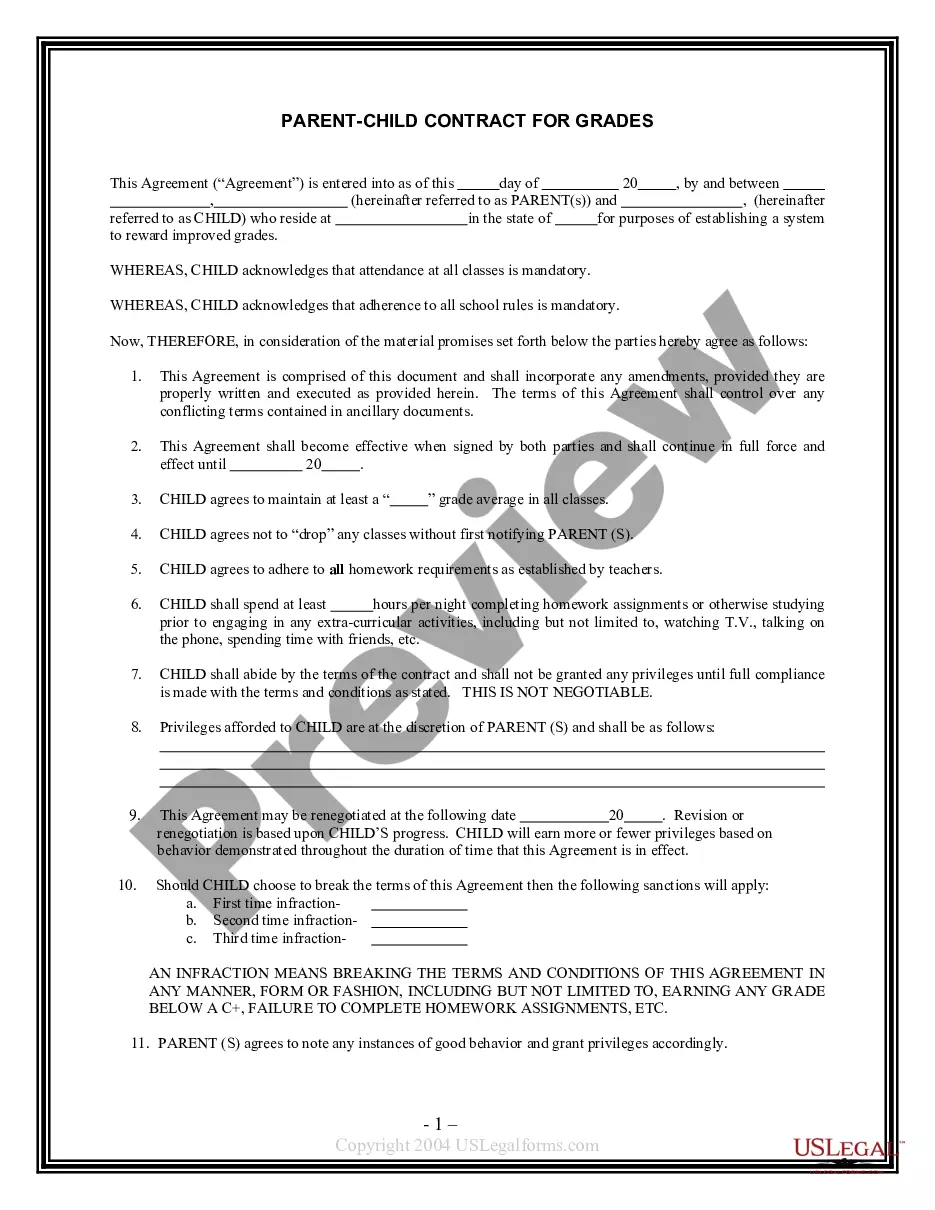
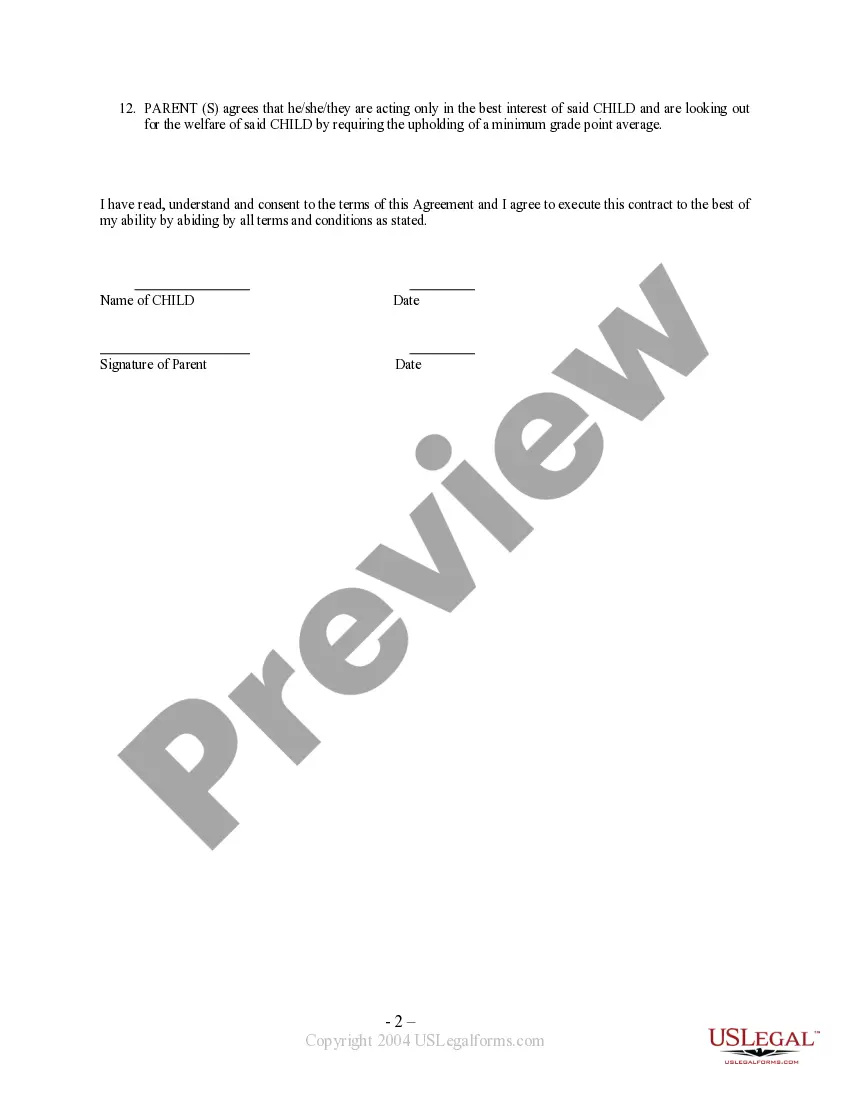
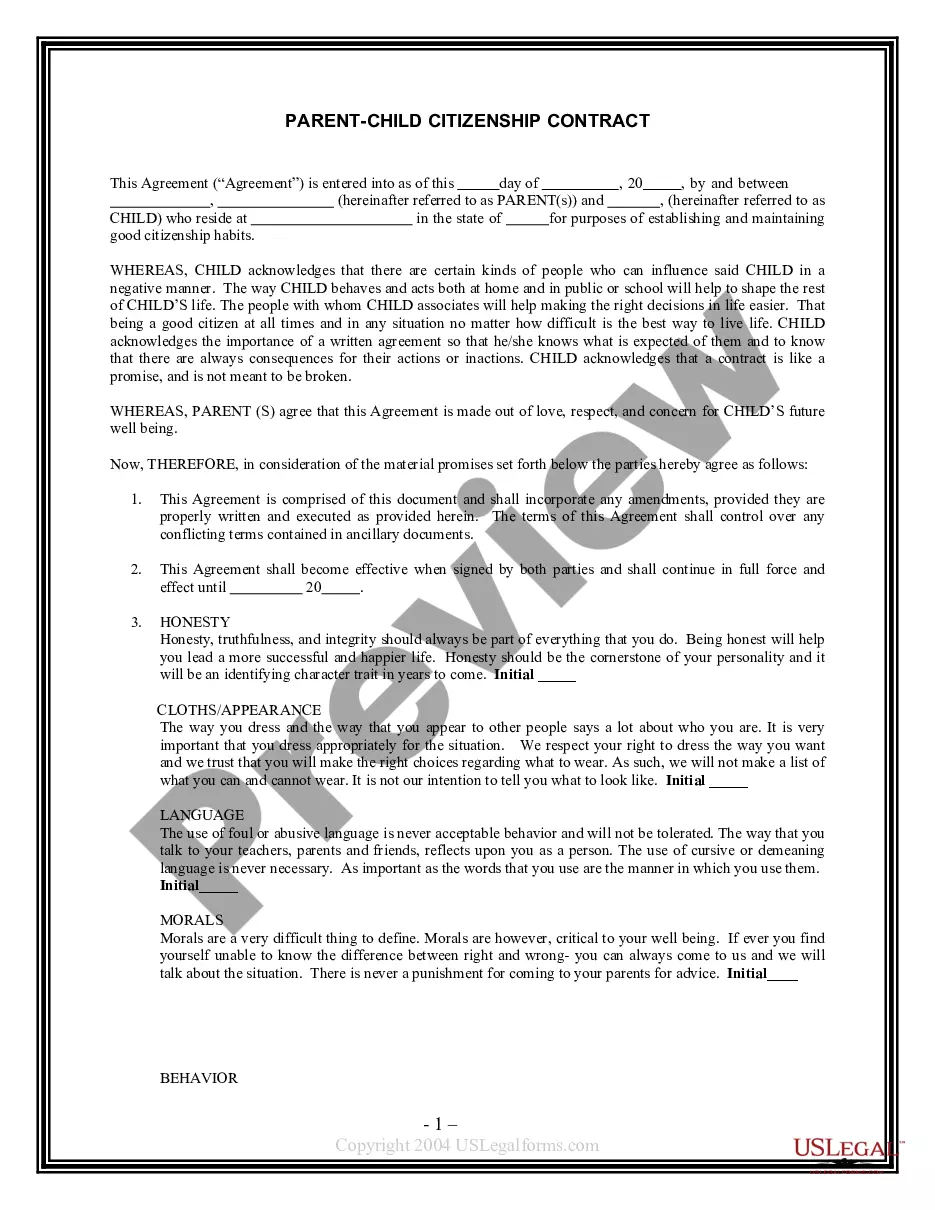
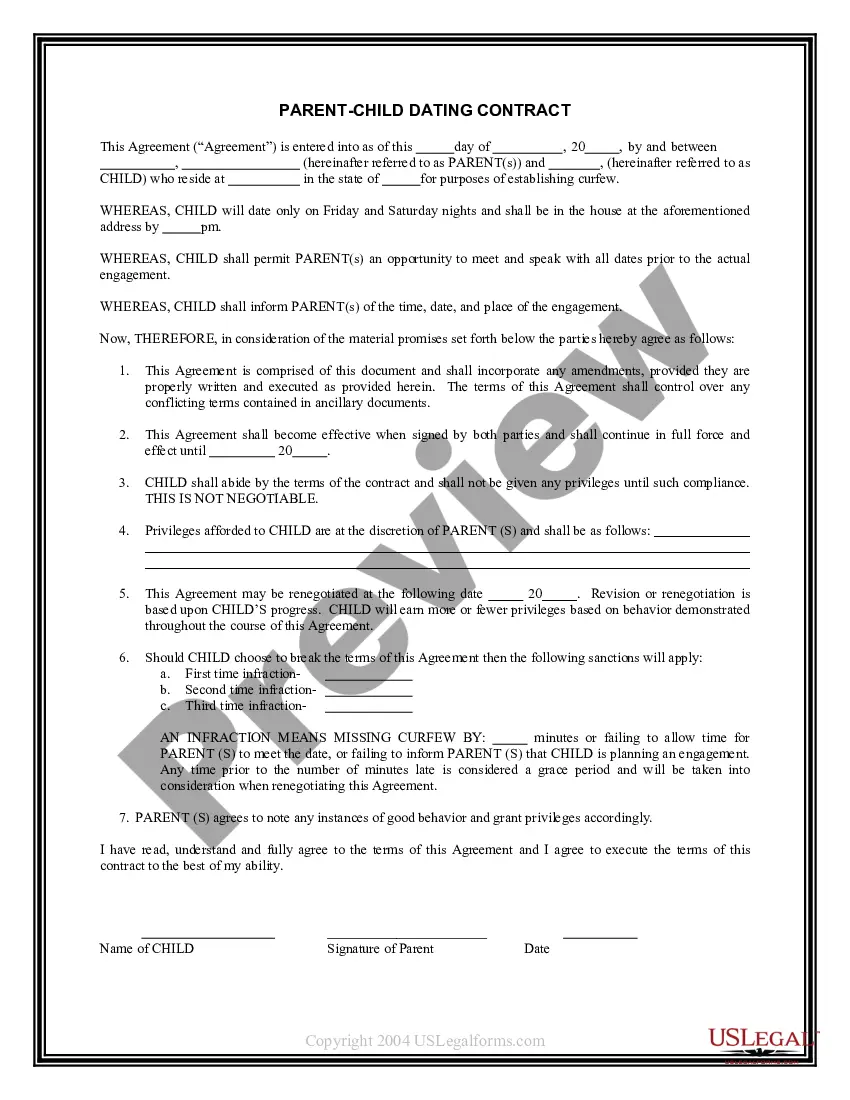
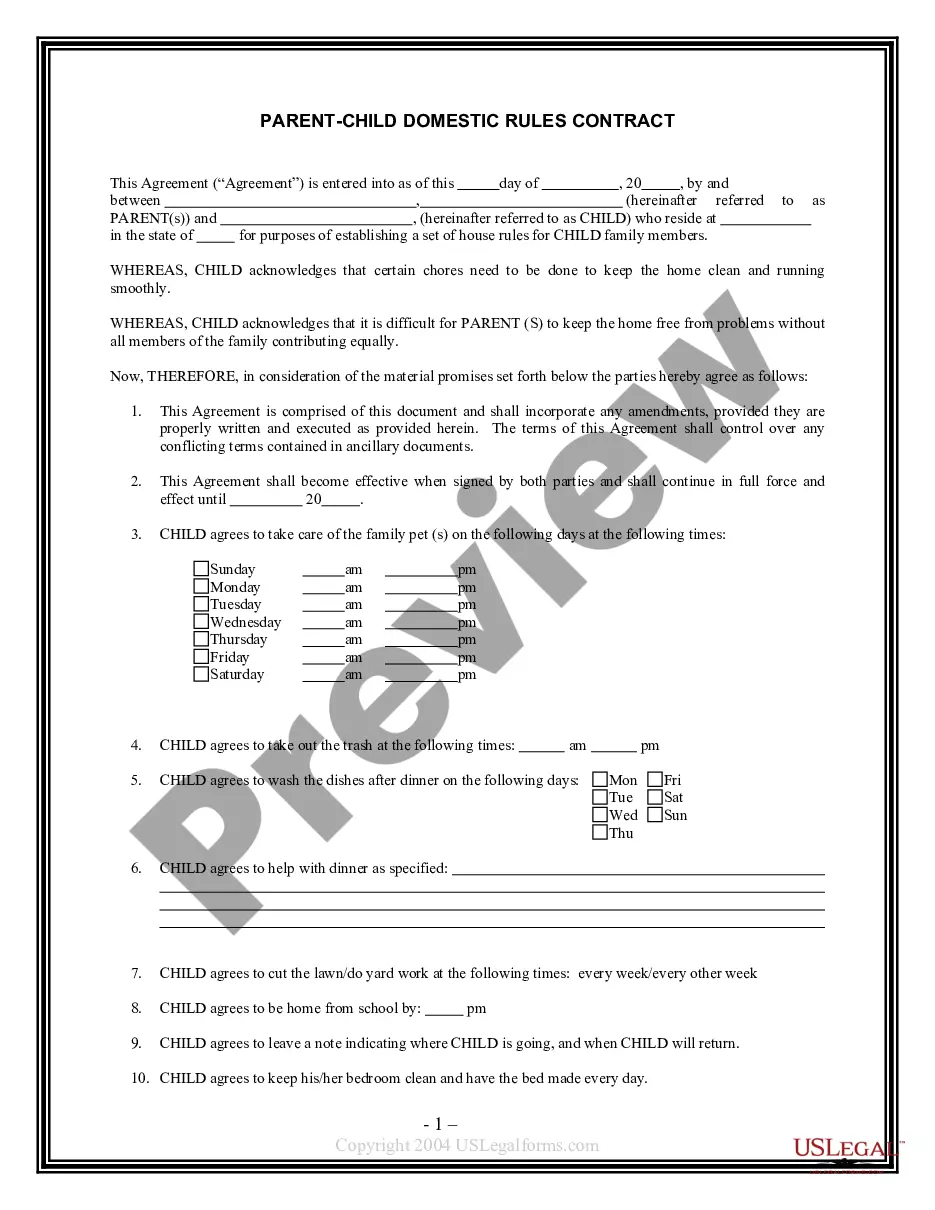
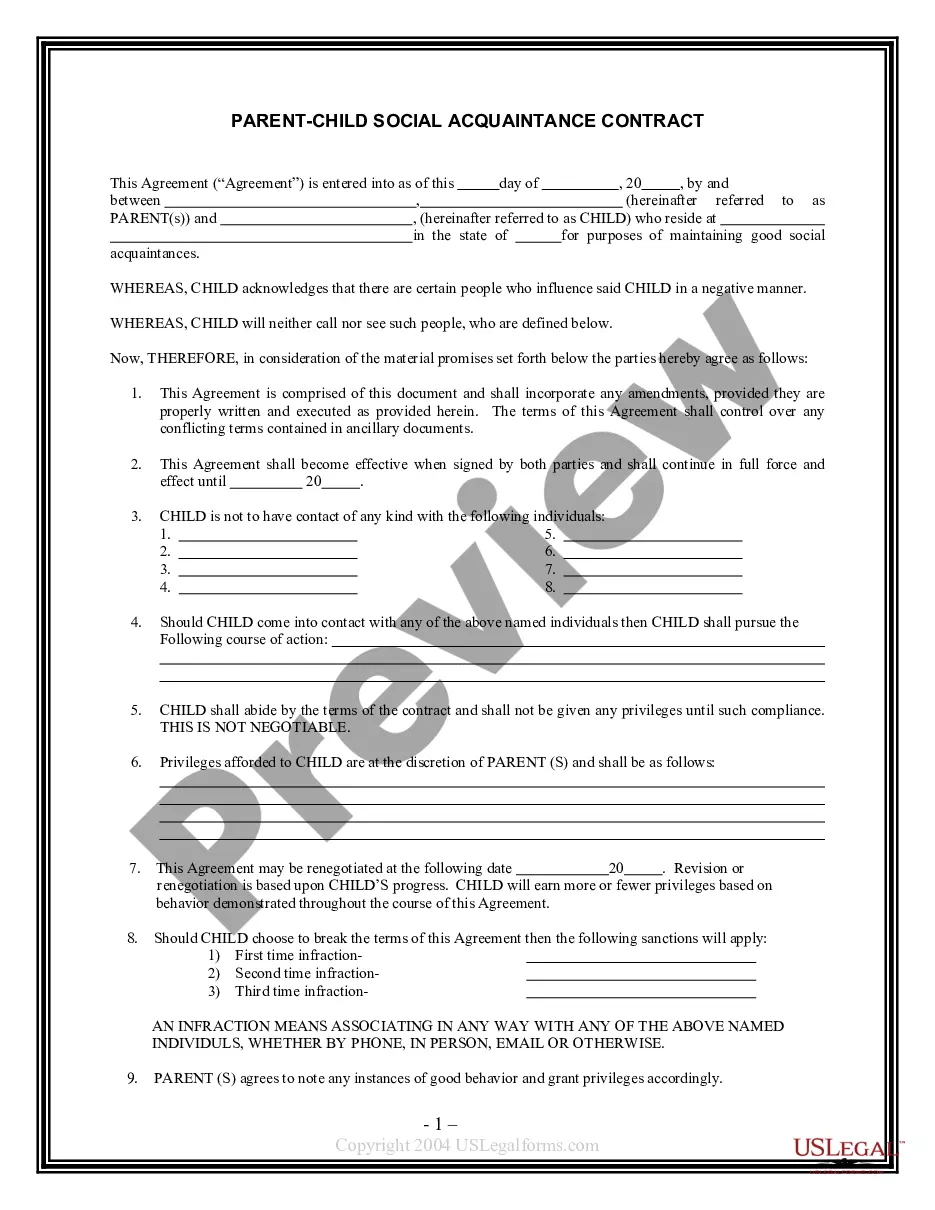
This is a contract between a parent(s)and child requiring the maintaining of a minimum grade point average. This contract details the repercussions for failing to make the agreed upon grades.
Connecticut Parent - Child Contract For Grades
Category:
State:
Multi-State
Control #:
US-PC01
Format:
Word;
Rich Text
Instant download
Description
Free preview
Get your form ready online
Our built-in tools help you complete, sign, share, and store your documents in one place.
Built-in online Word editor
Make edits, fill in missing information, and update formatting in US Legal Forms—just like you would in MS Word.
Export easily
Download a copy, print it, send it by email, or mail it via USPS—whatever works best for your next step.
E-sign your document
Sign and collect signatures with our SignNow integration. Send to multiple recipients, set reminders, and more. Go Premium to unlock E-Sign.
Notarize online 24/7
If this form requires notarization, complete it online through a secure video call—no need to meet a notary in person or wait for an appointment.
Store your document securely
We protect your documents and personal data by following strict security and privacy standards.

Make edits, fill in missing information, and update formatting in US Legal Forms—just like you would in MS Word.

Download a copy, print it, send it by email, or mail it via USPS—whatever works best for your next step.

Sign and collect signatures with our SignNow integration. Send to multiple recipients, set reminders, and more. Go Premium to unlock E-Sign.

If this form requires notarization, complete it online through a secure video call—no need to meet a notary in person or wait for an appointment.

We protect your documents and personal data by following strict security and privacy standards.
Looking for another form?



How to fill out Parent - Child Contract For Grades?
Are you presently in a situation where you require documents for either business or personal purposes nearly every day.
There are numerous legal document templates available online, but finding ones you can trust is not easy.
US Legal Forms offers thousands of template forms, such as the Connecticut Parent - Child Agreement For Grades, which are designed to comply with federal and state regulations.
Utilize US Legal Forms, the most extensive collection of legal forms, to save time and avoid errors.
The service provides professionally crafted legal document templates that can be used for a variety of purposes. Create an account on US Legal Forms and start simplifying your life.
- If you are already familiar with the US Legal Forms website and have an account, simply Log In.
- Then, you can download the Connecticut Parent - Child Agreement For Grades template.
- If you do not have an account and wish to start using US Legal Forms, follow these steps.
- Find the form you need and ensure it is for the correct city/region.
- Utilize the Preview feature to review the form.
- Check the description to confirm that you have chosen the correct form.
- If the form is not what you are looking for, use the Search section to locate the form that fits your needs and criteria.
- Once you find the right form, click Get now.
- Select the pricing plan you desire, complete the required information to create your account, and pay for the order using your PayPal or credit card.
- Choose a convenient document format and download your copy.
- Access all the document templates you have purchased in the My documents section. You can acquire another copy of the Connecticut Parent - Child Agreement For Grades anytime, if needed. Just click on the desired form to download or print the document template.
Form popularity
FAQ
In Connecticut, a child can express their preference regarding which parent to live with at the age of 18. However, children as young as 12 years old may have their views considered by the court during custody proceedings. This is where a Connecticut Parent - Child Contract For Grades can come in handy. It allows parents to outline expectations and responsibilities, fostering an environment where children feel heard and understood.
A parent child contract for grades is a written agreement between parents and their children regarding academic expectations and responsibilities. This contract often includes specific goals, consequences for not meeting those goals, and rewards for achievements. Implementing a Connecticut Parent - Child Contract For Grades can promote accountability and communication within the family. Utilizing resources like USLegalForms can guide you in creating an effective contract tailored to your family's needs.
To make a parenting agreement legally binding in Connecticut, both parents must sign the document, ideally in the presence of a notary. After signing, it is advisable to submit the agreement to the court for approval. This step ensures that your Connecticut Parent - Child Contract For Grades is enforceable and recognized by the legal system. By formalizing the agreement, you create a clear framework for co-parenting that benefits everyone involved.
In Connecticut, a child can express their wishes regarding visitation as early as age 12. However, the court will consider various factors, including the child's maturity and the reasons for their preference. It is crucial for parents to understand that while a child's feelings are important, the court ultimately prioritizes the child's best interests. For parents navigating these situations, a Connecticut Parent - Child Contract For Grades can help establish clear agreements about visitation and responsibilities.
The most common joint custody arrangements include the 2-2-3 plan and the 2-2-5 plan. Both involve spending alternate sets of days with either parent. Also common is the alternate week plan, where the child spends one week with a parent and the next week with the other.
Definition of family contract : a contract between the members of a family settling the distribution or descent of its estates.
A parent contract is a legally binding document that sets out the contractual terms and conditions between a parent and an independent school. It is formed once a school place has been clearly offered and accepted, and should be signed by all relevant parties.
If a minor enters into a contract, the parents are not a party to the contract and may not be held liable if the minor doesn't fulfill the contract terms. But if a parent or both parents co-sign a contract along with the minor, the contract is valid, and they are bound by the terms.
50/50 schedules can benefit a child because the child spends substantial time living with both parents. This allows him or her to build a close relationship with both parents, and to feel cared for by both parents. 50/50 schedules work best when: The parents live fairly close to each other, so exchanges are easier.
Connecticut custody laws only require that the child is "of sufficient age" to have his or her wishes considered. Connecticut case law generally treats 12 as a reasonable age to express a custody preference.