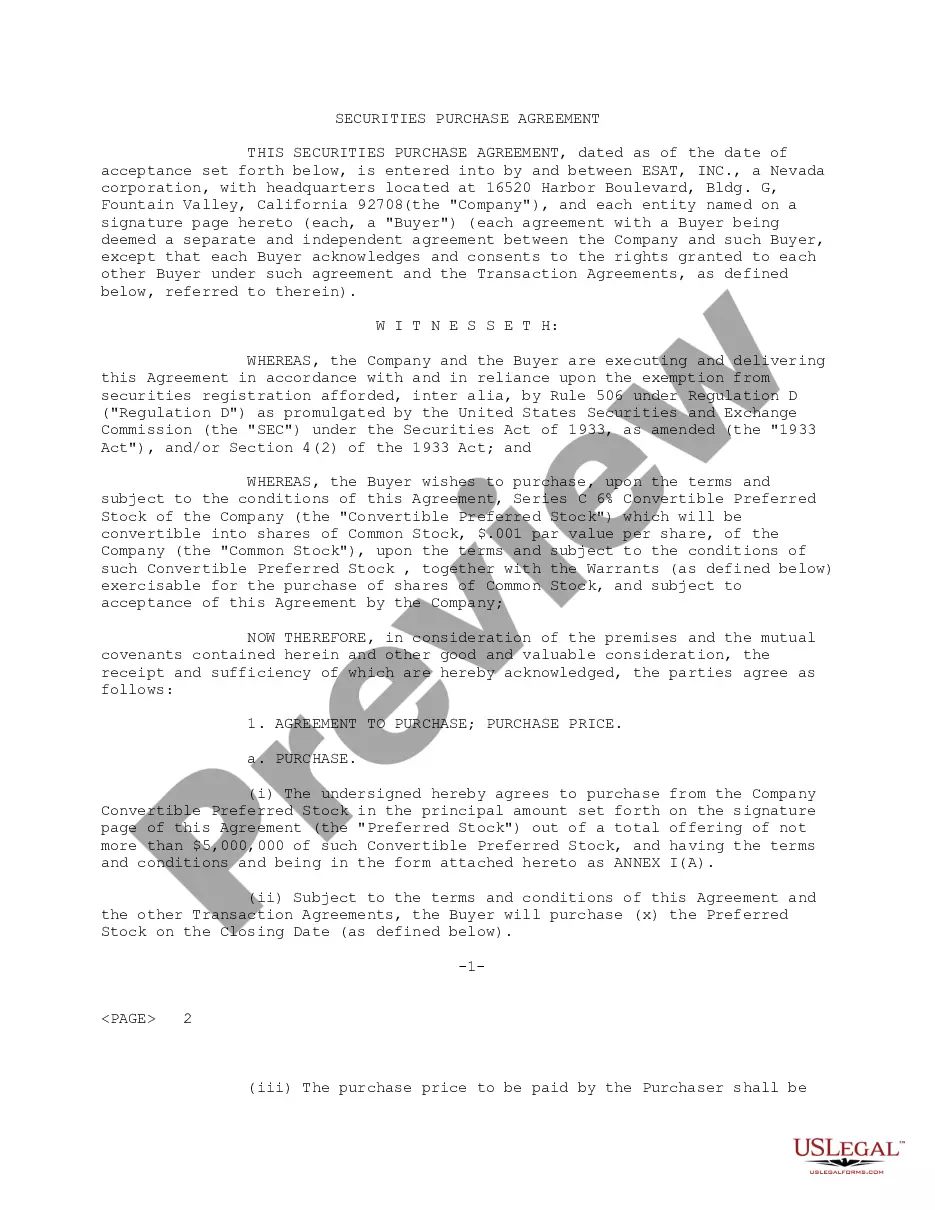
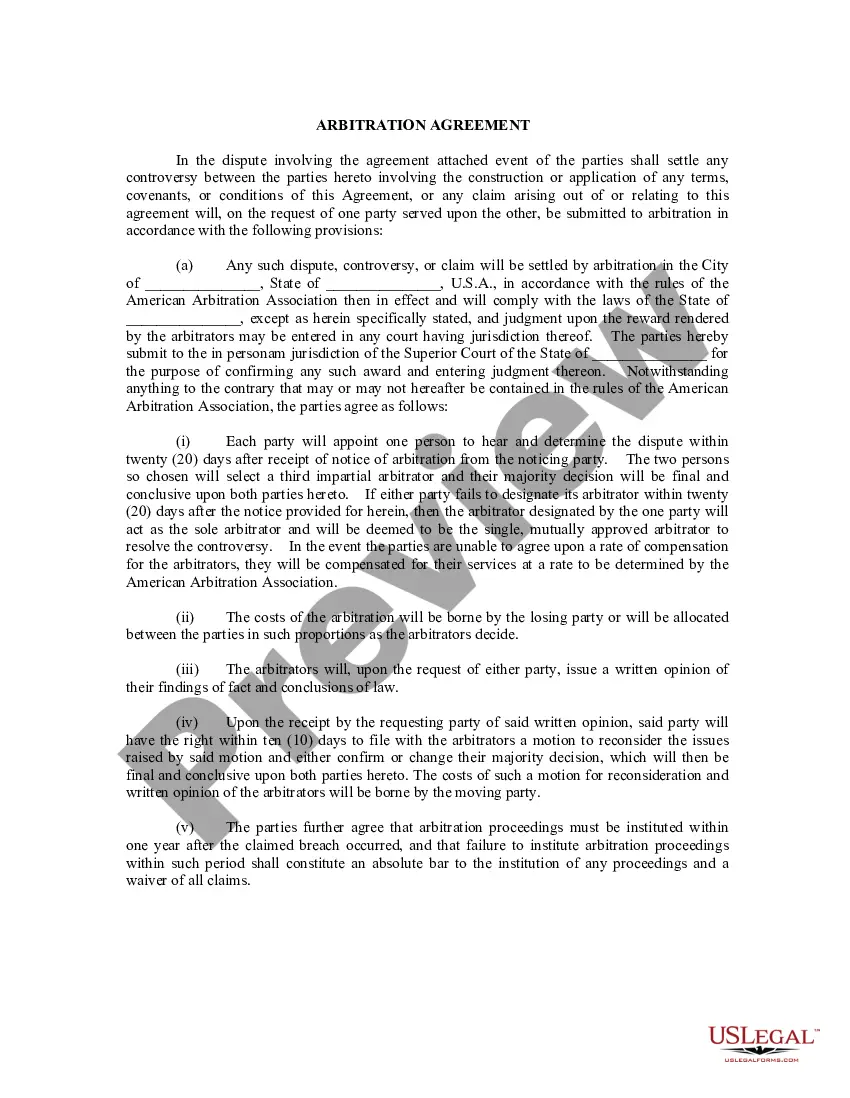
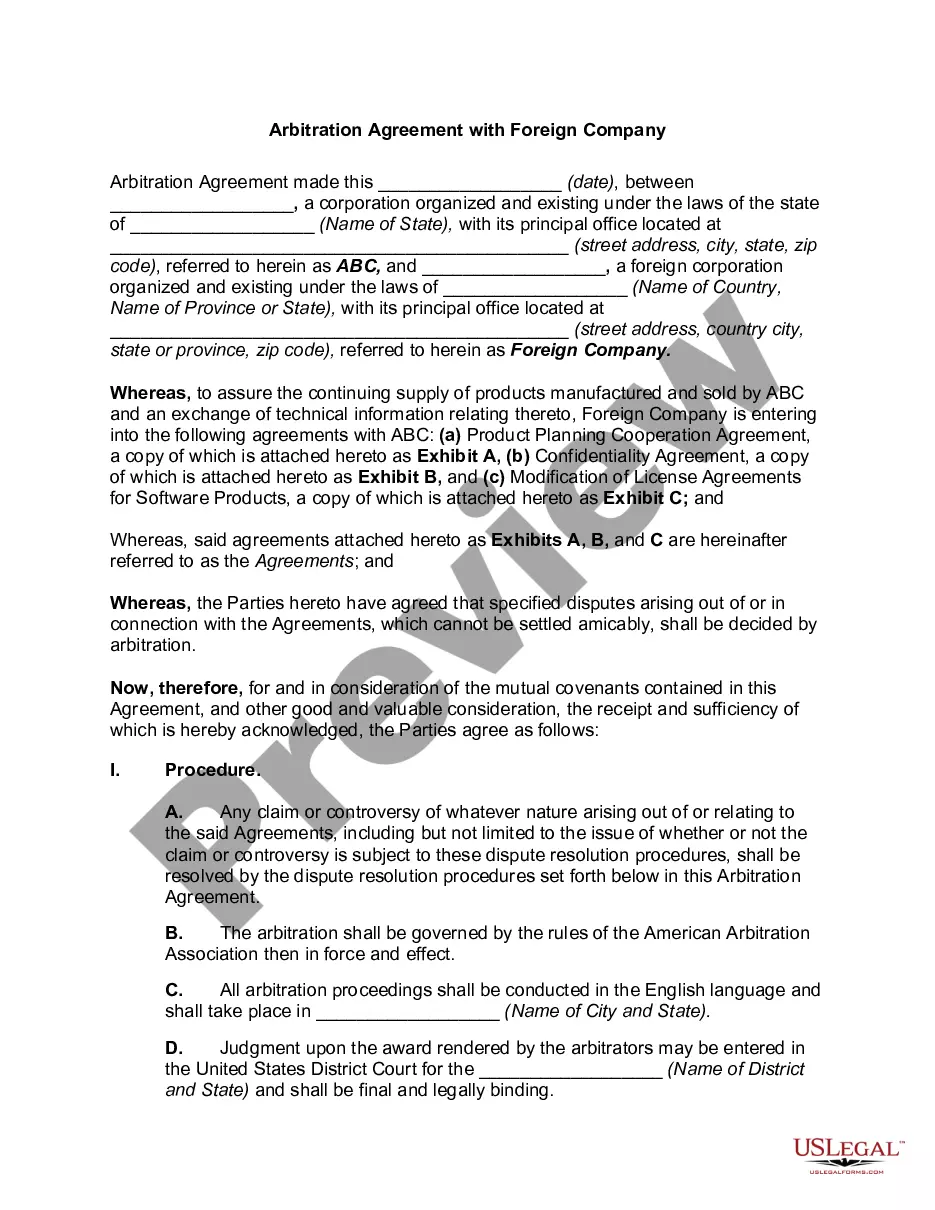
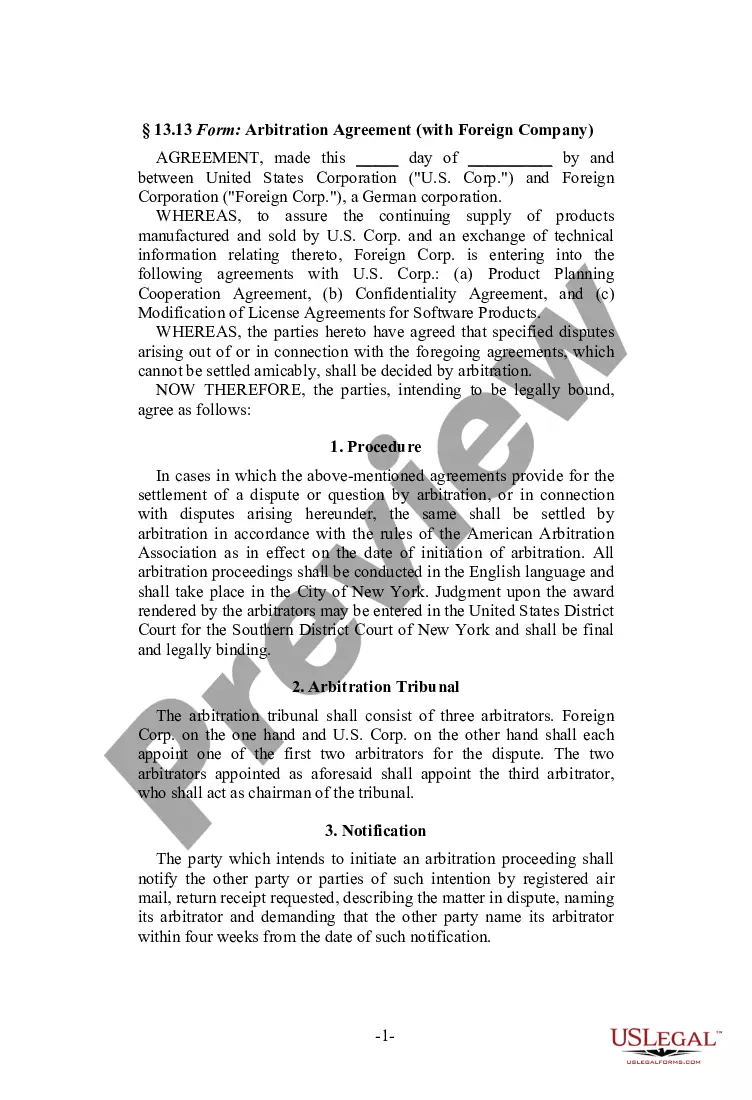
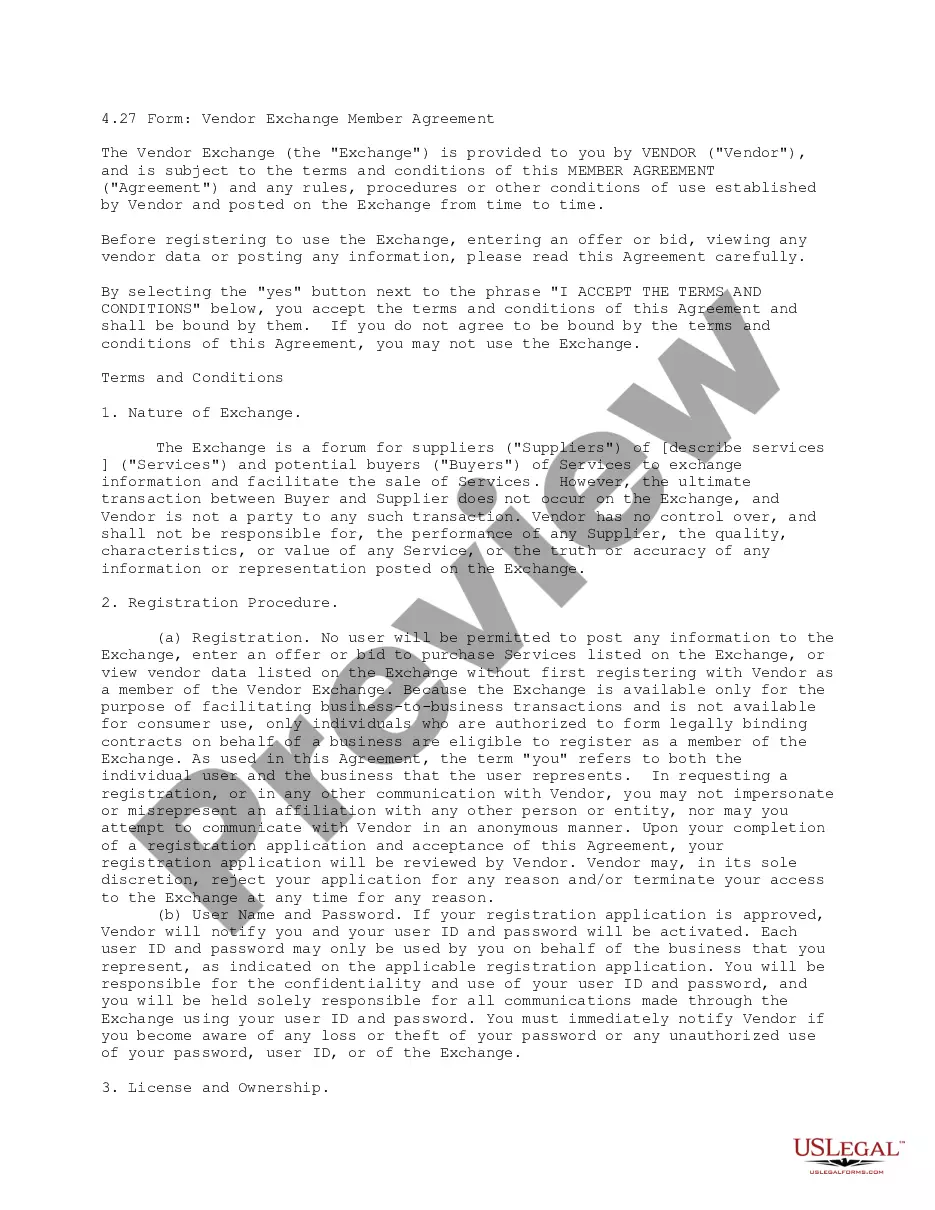
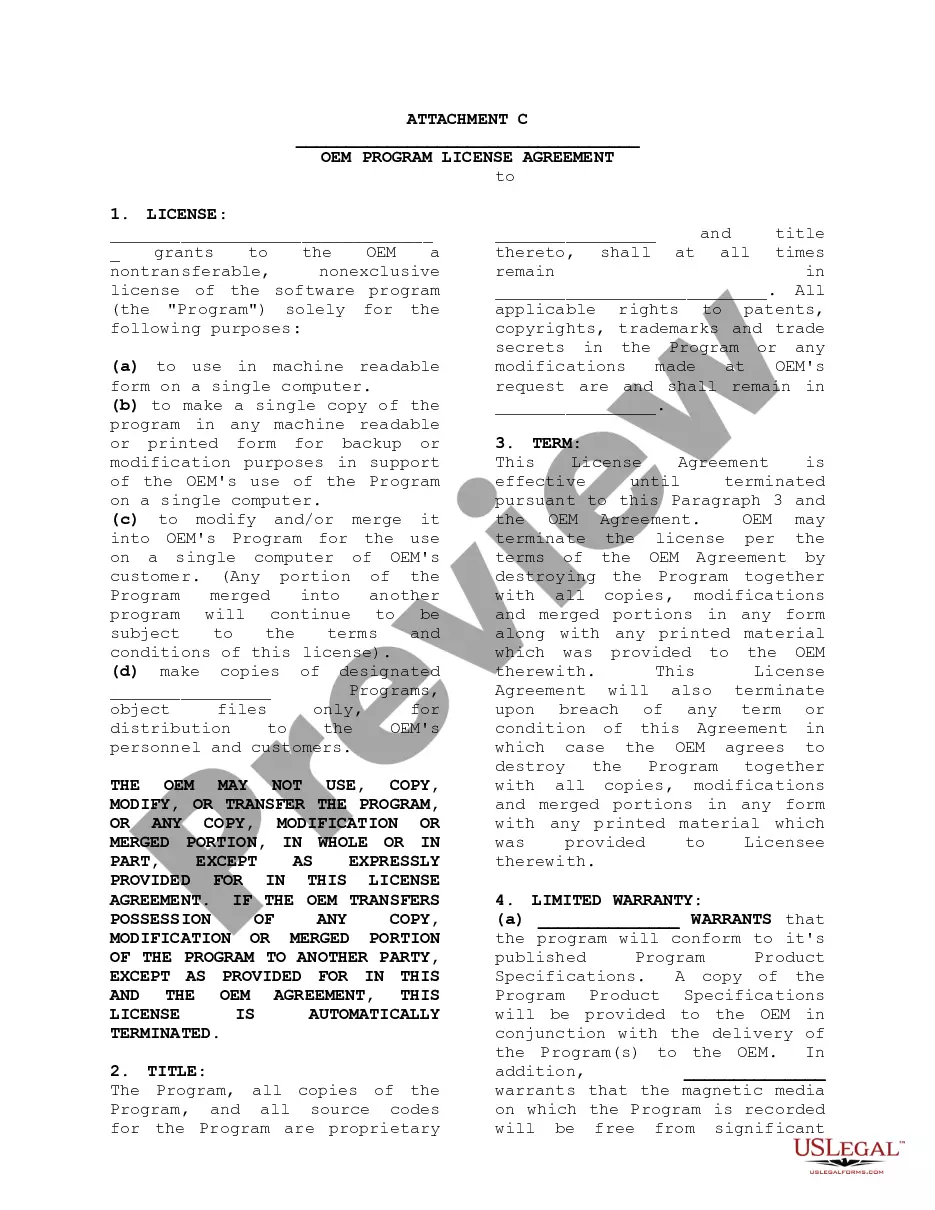
This form is an Arbitration Agreement. The form provides that each party will appoint one person to hear and determine the dispute within twenty days after receipt of notice of arbitration from the noticing party. The costs of the arbitration will be absorbed by the losing party or will be allocated between the parties in such proportions as the arbitrators decide.
Connecticut OEM Arbitration Agreement
Category:
State:
Multi-State
Control #:
US-KWP-0046
Format:
Word;
Rich Text
Instant download
Description

Get your form ready online
Our built-in tools help you complete, sign, share, and store your documents in one place.
Built-in online Word editor
Make edits, fill in missing information, and update formatting in US Legal Forms—just like you would in MS Word.
Export easily
Download a copy, print it, send it by email, or mail it via USPS—whatever works best for your next step.
E-sign your document
Sign and collect signatures with our SignNow integration. Send to multiple recipients, set reminders, and more. Go Premium to unlock E-Sign.
Notarize online 24/7
If this form requires notarization, complete it online through a secure video call—no need to meet a notary in person or wait for an appointment.
Store your document securely
We protect your documents and personal data by following strict security and privacy standards.

Make edits, fill in missing information, and update formatting in US Legal Forms—just like you would in MS Word.

Download a copy, print it, send it by email, or mail it via USPS—whatever works best for your next step.

Sign and collect signatures with our SignNow integration. Send to multiple recipients, set reminders, and more. Go Premium to unlock E-Sign.

If this form requires notarization, complete it online through a secure video call—no need to meet a notary in person or wait for an appointment.

We protect your documents and personal data by following strict security and privacy standards.
Looking for another form?
How to fill out OEM Arbitration Agreement?
If you desire to finalize, obtain, or print legal document templates, utilize US Legal Forms, the most extensive selection of legal forms available online. Employ the site's user-friendly and efficient search feature to locate the files you require.
A range of templates for business and personal applications are organized by categories and jurisdictions, or keywords. Utilize US Legal Forms to retrieve the Connecticut OEM Arbitration Agreement in just a few clicks.
If you are already a US Legal Forms user, Log In to your account and click the Download button to access the Connecticut OEM Arbitration Agreement. You can also access forms you previously saved in the My documents section of your account.
Each legal document template you purchase is yours permanently. You have access to all forms you saved in your account. Click the My documents section and select a form to print or download again.
Be proactive and acquire, and print the Connecticut OEM Arbitration Agreement with US Legal Forms. There are countless professional and state-specific forms you can use for your business or personal requirements.
- Step 1. Ensure you have selected the form for the correct city/state.
- Step 2. Utilize the Preview option to review the form's content. Don’t forget to read the description.
- Step 3. If you are not satisfied with the form, make use of the Search field at the top of the screen to find alternative forms of the legal document template.
- Step 4. Once you have located the form you need, click the Buy now button. Choose your preferred pricing plan and enter your details to register for an account.
- Step 5. Complete the transaction. You may use your credit card or PayPal account to process the payment.
- Step 6. Select the format of the legal document and download it to your device.
- Step 7. Fill out, modify, and print or sign the Connecticut OEM Arbitration Agreement.
Form popularity
FAQ
Yes, an arbitration agreement exists in the context of the Connecticut OEM Arbitration Agreement. This agreement is a legal document that both parties sign to agree to resolve disputes outside of court. By choosing this route, individuals can benefit from a more streamlined process, which often saves time and costs when compared to traditional litigation. If you're looking for clarity on arbitration agreements, US Legal Forms provides valuable resources to guide you.
Yes, a contract is essential for arbitration, especially when utilizing the Connecticut OEM Arbitration Agreement. This agreement outlines the terms and conditions that both parties must uphold during the arbitration process. Having a clearly defined contract helps to set expectations and reduces the chance of disputes. It also protects the legal rights of everyone involved.
The latest arbitration act to gain attention in the United States is the Revised Uniform Arbitration Act, which aims to refine and standardize arbitration processes. This act has been adopted by numerous states, including Connecticut, promoting fair arbitration practices. If you are considering entering a Connecticut OEM Arbitration Agreement, staying updated on this act is beneficial. Utilizing platforms like uslegalforms can help you find the most current legal documentation and resources.
Section 52-46 of the Connecticut General Statutes outlines specific provisions regarding arbitration agreements within the state. This section is essential in understanding how arbitration is treated under Connecticut law. Familiarity with this statute can aid your awareness and compliance with a Connecticut OEM Arbitration Agreement. Access to legal resources makes this process easier and more manageable.
The revised Uniform Arbitration Act is a legally adopted framework that modernizes arbitration procedures across various states, including Connecticut. This legislation enhances judicial involvement and promotes flexibility in arbitration agreements. By understanding the revised act, you can better navigate a Connecticut OEM Arbitration Agreement. Knowledge of this act equips you with tools to resolve disputes efficiently.
Deciding whether to opt out of an arbitration clause often depends on your circumstances and preferences. Arbitration can streamline dispute resolution, but it may limit your options compared to traditional court proceedings. If you feel uncertain about a Connecticut OEM Arbitration Agreement, consider evaluating the pros and cons. Consulting with legal professionals can provide clarity on your best course of action.
Connecticut operates under a fault-based insurance system rather than a no-fault state. This means that the party at fault for an accident is responsible for damages. However, being knowledgeable about how insurance interacts with arbitration can help you navigate situations involving a Connecticut OEM Arbitration Agreement effectively. An informed approach can save you time and resources.
The Revised Uniform Arbitration Act (RUAA) is a set of laws that govern arbitration agreements in Connecticut. This act aims to clarify procedures and ensure fairness in the arbitration process. Understanding this act is crucial, especially when dealing with the Connecticut OEM Arbitration Agreement. It provides a framework for resolving disputes outside of traditional court systems.
The 30-day lemon law in Connecticut pertains to issues that arise in newly purchased vehicles that are substantial and unresolved. If your vehicle has a defect that repairs have not fixed after several attempts, this law protects your rights under the Connecticut OEM Arbitration Agreement. Essentially, it allows you to seek recourse if your car's issues persist over a specified timeframe. For assistance navigating these legal pathways, explore uslegalforms, which offers comprehensive resources tailored for lemon law cases.
The three primary types of arbitration include binding arbitration, non-binding arbitration, and expedited arbitration. Binding arbitration means that the decision made by the arbitrator is final and enforceable in court. Non-binding arbitration allows for a different outcome in court, but it serves as a useful means of resolving disputes. When considering the Connecticut OEM Arbitration Agreement, understanding these types can help you choose the best route for your situation.