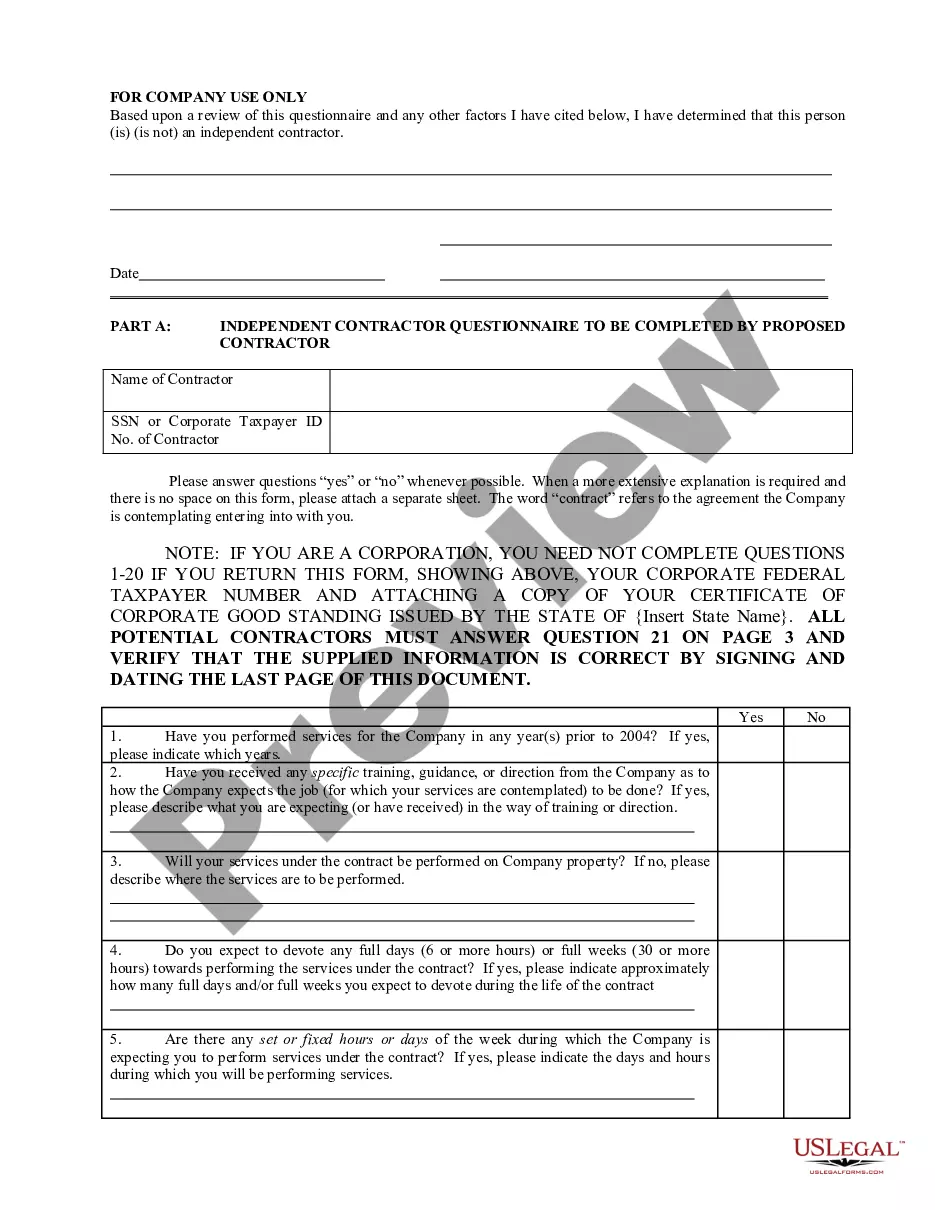
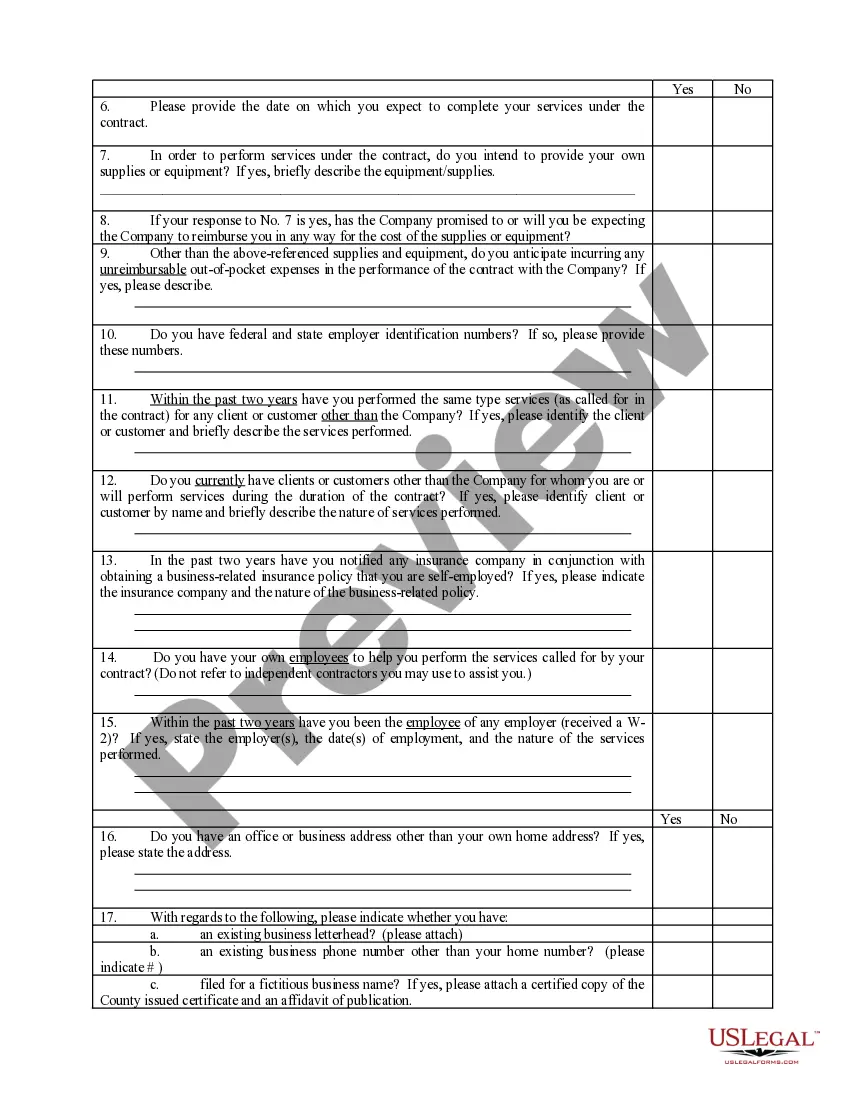
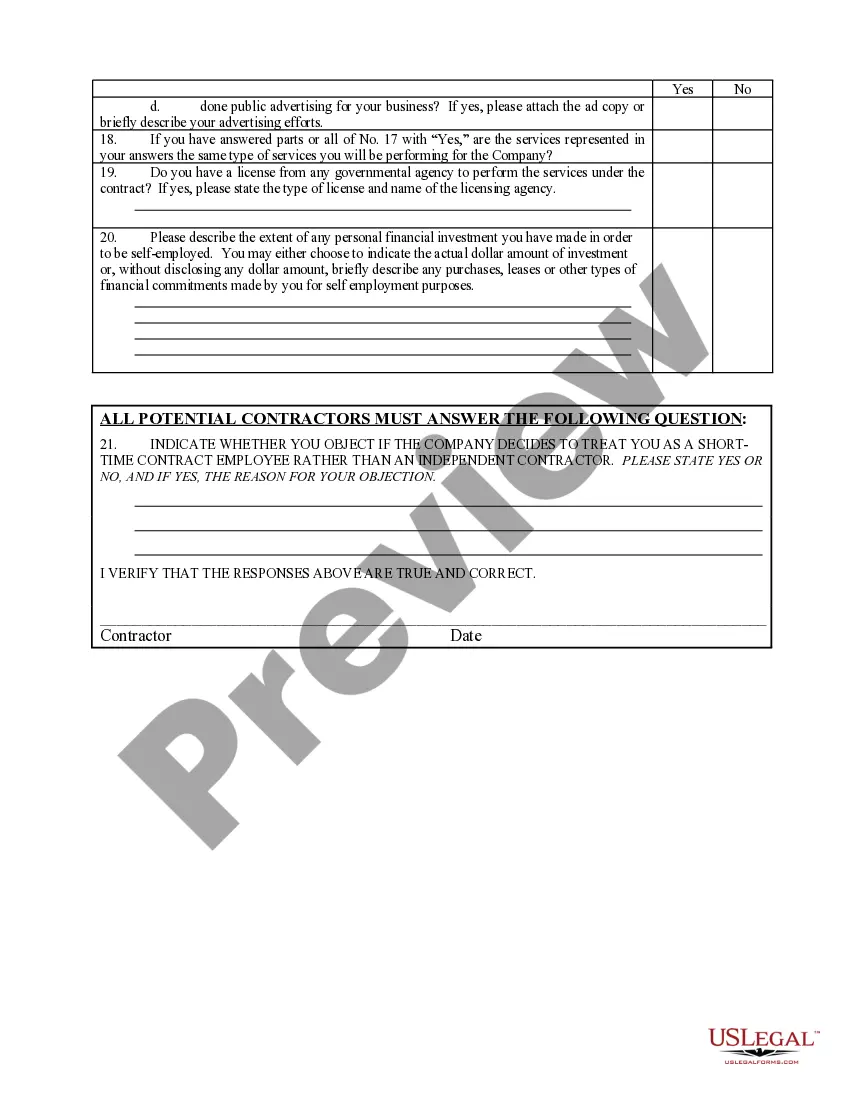
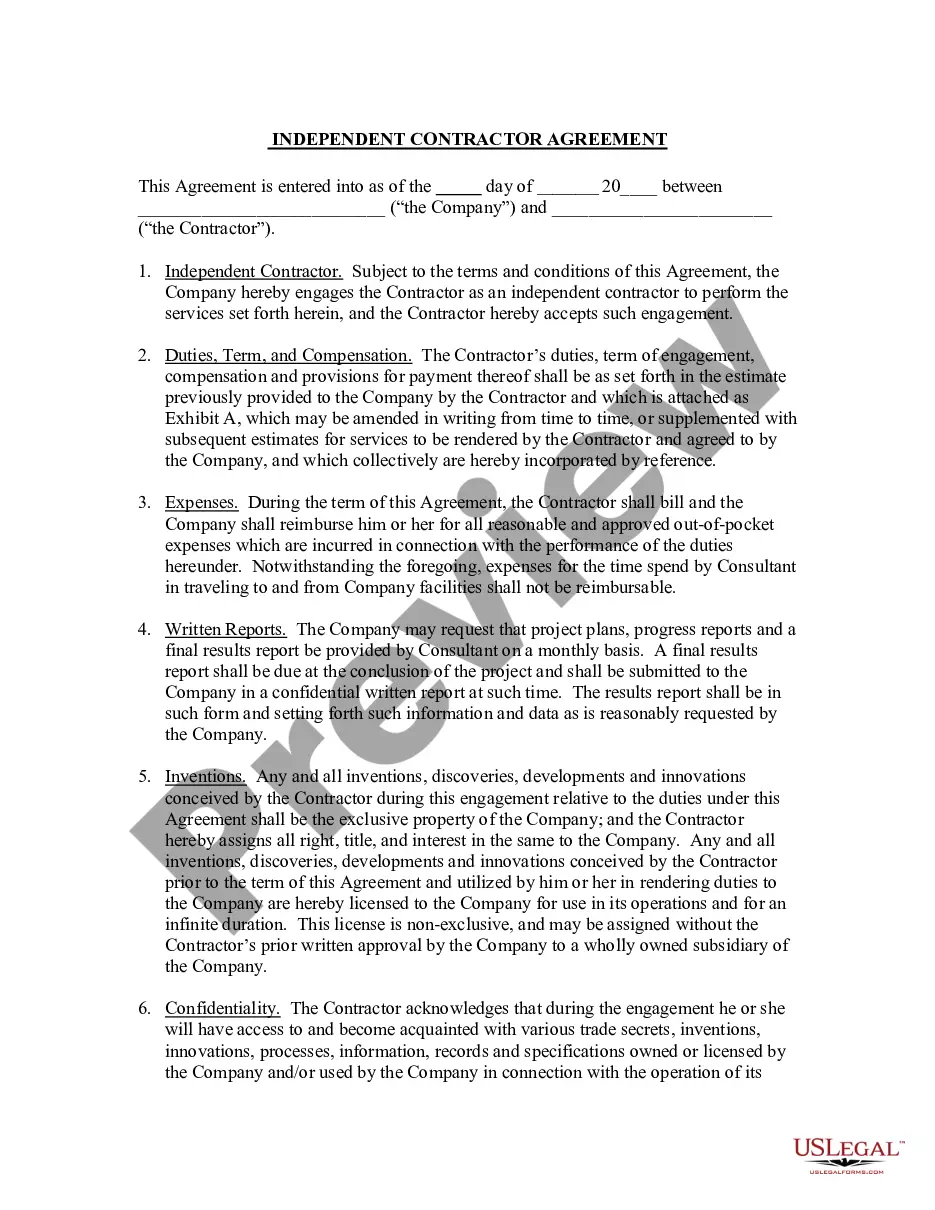
Connecticut Self-Employed Independent Contractor Questionnaire
Description
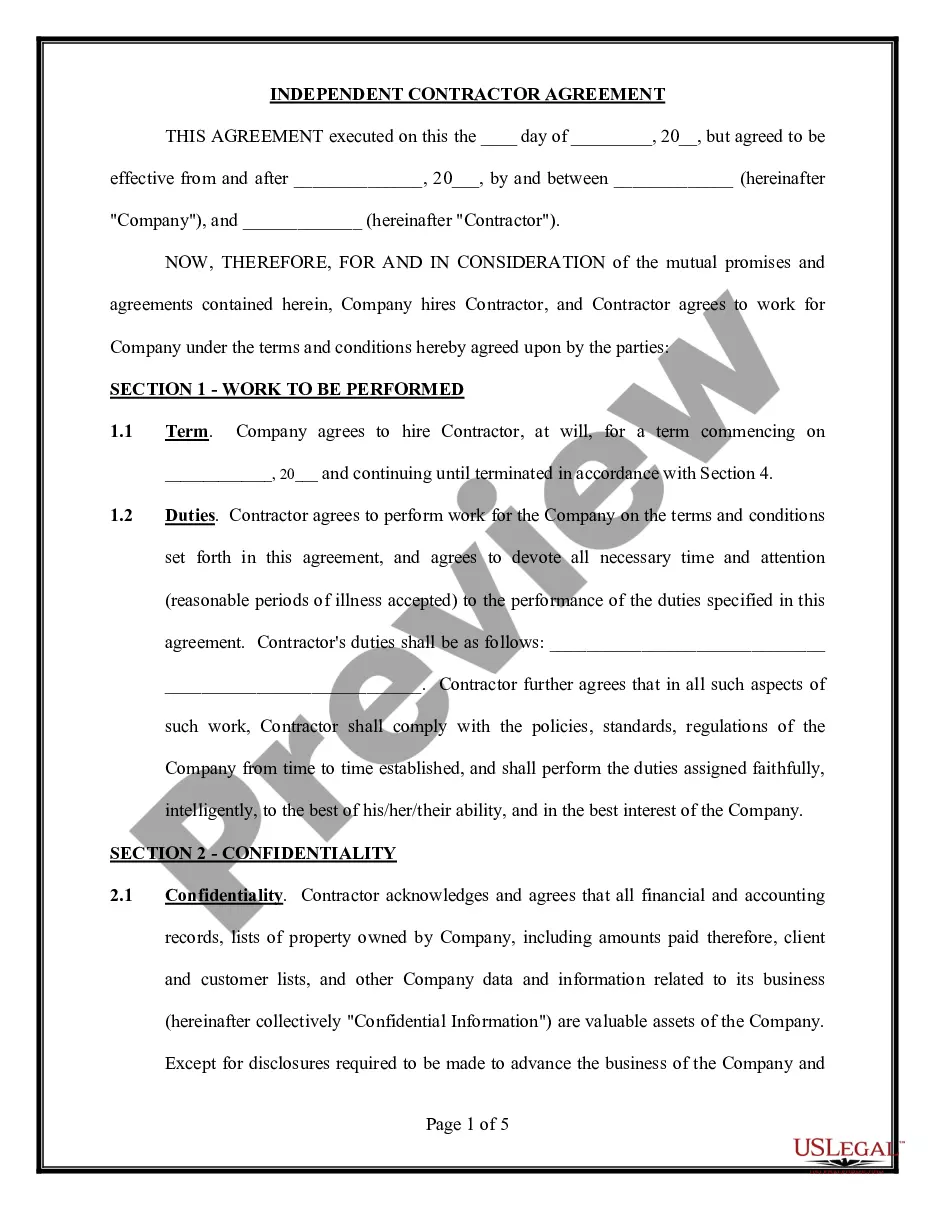
Get your form ready online
Our built-in tools help you complete, sign, share, and store your documents in one place.
Make edits, fill in missing information, and update formatting in US Legal Forms—just like you would in MS Word.
Download a copy, print it, send it by email, or mail it via USPS—whatever works best for your next step.
Sign and collect signatures with our SignNow integration. Send to multiple recipients, set reminders, and more. Go Premium to unlock E-Sign.
If this form requires notarization, complete it online through a secure video call—no need to meet a notary in person or wait for an appointment.
We protect your documents and personal data by following strict security and privacy standards.

Make edits, fill in missing information, and update formatting in US Legal Forms—just like you would in MS Word.

Download a copy, print it, send it by email, or mail it via USPS—whatever works best for your next step.

Sign and collect signatures with our SignNow integration. Send to multiple recipients, set reminders, and more. Go Premium to unlock E-Sign.

If this form requires notarization, complete it online through a secure video call—no need to meet a notary in person or wait for an appointment.

We protect your documents and personal data by following strict security and privacy standards.
Looking for another form?



How to fill out Self-Employed Independent Contractor Questionnaire?
US Legal Forms - one of the largest collections of legal documents in the United States - offers a broad selection of legal document templates that you can download or print.
While using the site, you will access a vast array of forms for business and personal purposes, categorized by types, states, or keywords. You can obtain the latest forms like the Connecticut Self-Employed Independent Contractor Questionnaire in moments.
If you already have an account, Log In and download the Connecticut Self-Employed Independent Contractor Questionnaire from the US Legal Forms library. The Download option will appear on every document you view. You can find all previously downloaded forms in the My documents section of your account.
Complete the transaction. Use your credit card or PayPal account to finalize the process.
Select the format and download the document onto your device. Make edits. Fill out, modify, print, and sign the downloaded Connecticut Self-Employed Independent Contractor Questionnaire. Each template you added to your account has no expiration and is yours indefinitely. Therefore, if you wish to download or print another copy, simply navigate to the My documents section and select the form you require.
Access the Connecticut Self-Employed Independent Contractor Questionnaire with US Legal Forms, the most extensive library of legal document templates. Utilize a plethora of professional and state-specific templates that meet your business or personal needs and requirements.
- Ensure you have selected the correct form for your locality.
- Use the Preview button to review the document's content.
- Check the form description to ensure you have chosen the right one.
- If the form does not suit your needs, utilize the Search area at the top of the screen to find one that fits.
- Once you're satisfied with the form, confirm your choice by clicking the Buy now button.
- Then, choose the payment plan you want and provide your details to create an account.
Form popularity
FAQ
The general rule is that an individual is an independent contractor if the payer has the right to control or direct only the result of the work and not what will be done and how it will be done. If you are an independent contractor, then you are self-employed.
How is an independent contractor paid?Obtain the independent contractor's Form W-9, Request for Taxpayer Identification Number and Certification.Provide compensation for work performed.Remit backup withholding payments to the IRS, if necessary.Complete Form 1099-NEC, Nonemployee Compensation.
As an independent contractor, you'll usually make more money than if you were an employee. Companies are willing to pay more for independent contractors because they don't have the enter into expensive, long-term commitments or pay health benefits, unemployment compensation, Social Security taxes, and Medicare taxes.
To set yourself up as a self-employed taxpayer with the IRS, you simply start paying estimated taxes (on Form 1040-ES, Estimated Tax for Individuals) and file Schedule C, Profit or Loss From Business, and Schedule SE, Self-Employment Tax, with your Form 1040 tax return each April.
To set yourself up as a self-employed taxpayer with the IRS, you simply start paying estimated taxes (on Form 1040-ES, Estimated Tax for Individuals) and file Schedule C, Profit or Loss From Business, and Schedule SE, Self-Employment Tax, with your Form 1040 tax return each April.
Visit us today! The Connecticut Department of Labor today began accepting claim applications for the self-employed, many of whom are eligible to collect unemployment insurance benefits under the federal Pandemic Unemployment Assistance (PUA) Program.
What Is an Independent Contractor? An independent contractor is a self-employed person or entity contracted to perform work foror provide services toanother entity as a nonemployee. As a result, independent contractors must pay their own Social Security and Medicare taxes.
To be considered an "independent contractor," an individual must meet all three of the following factors: A. The individual must be free from direction and control (work independently) in connection with the performance of the service, both under his or her contract of hire and in fact; B.
Becoming an independent contractor is one of the many ways to be classified as self-employed. By definition, an independent contractor provides work or services on a contractual basis, whereas, self-employment is simply the act of earning money without operating within an employee-employer relationship.
Because of the limited scope of the time commitment, an independent contractor is considered to be self-employed. Business owners are responsible for providing Independent contractors with a 1099-MISC form instead of a W-2, showing the total income paid to the independent contractor.