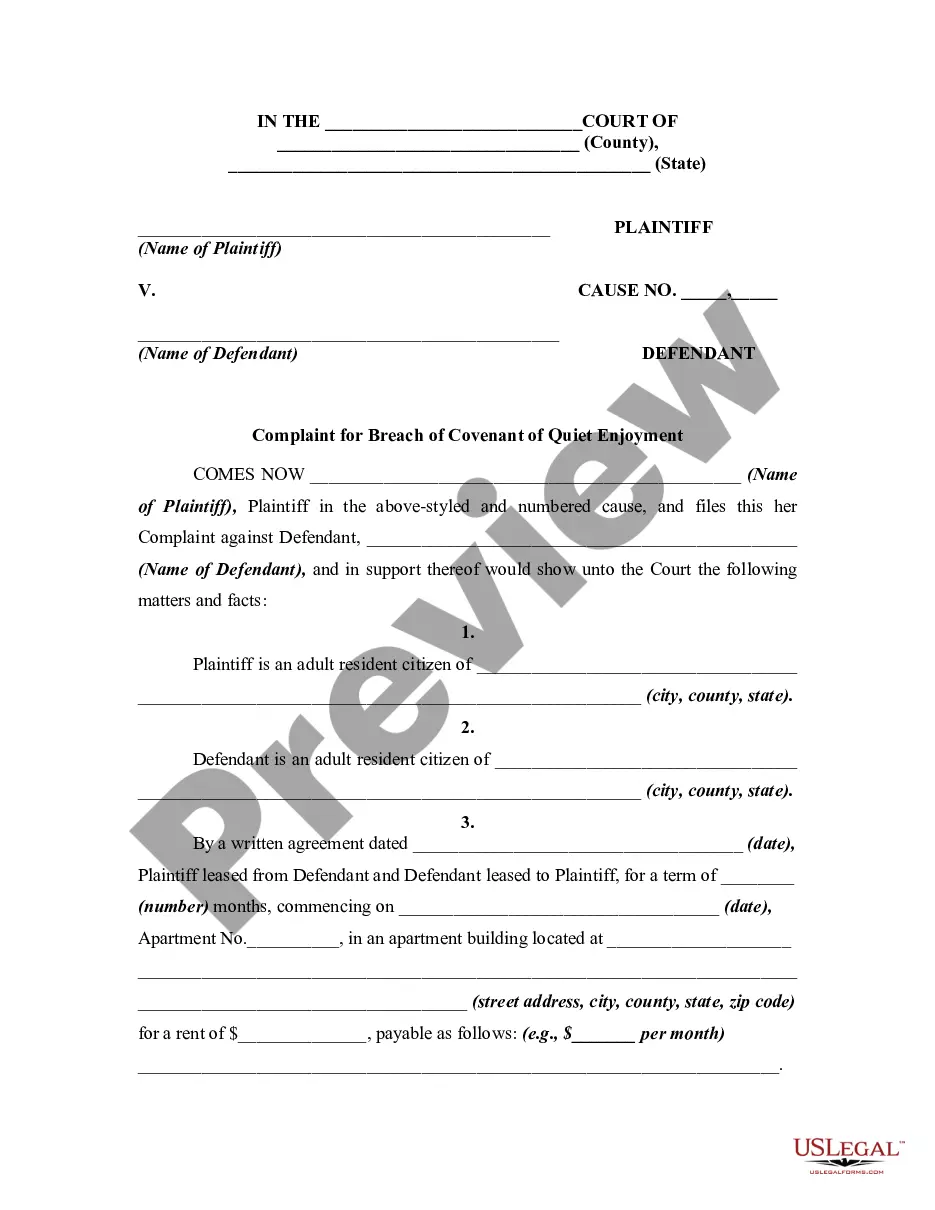
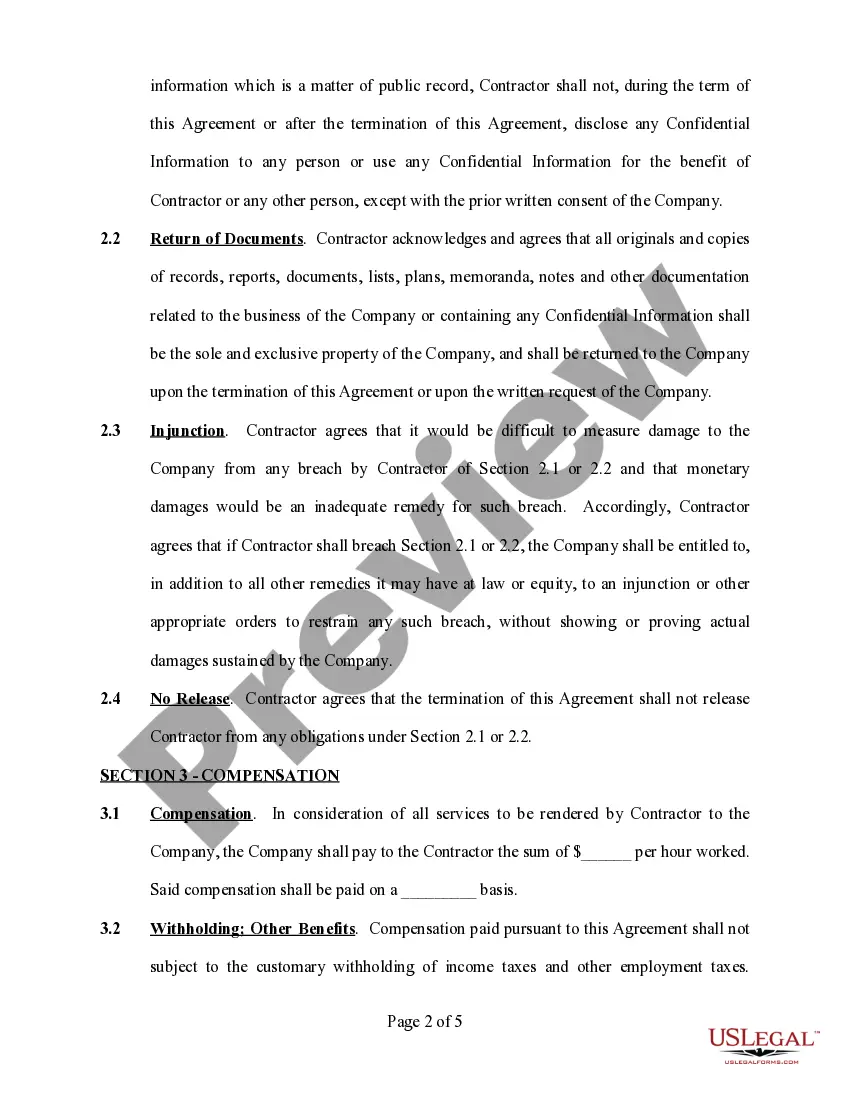
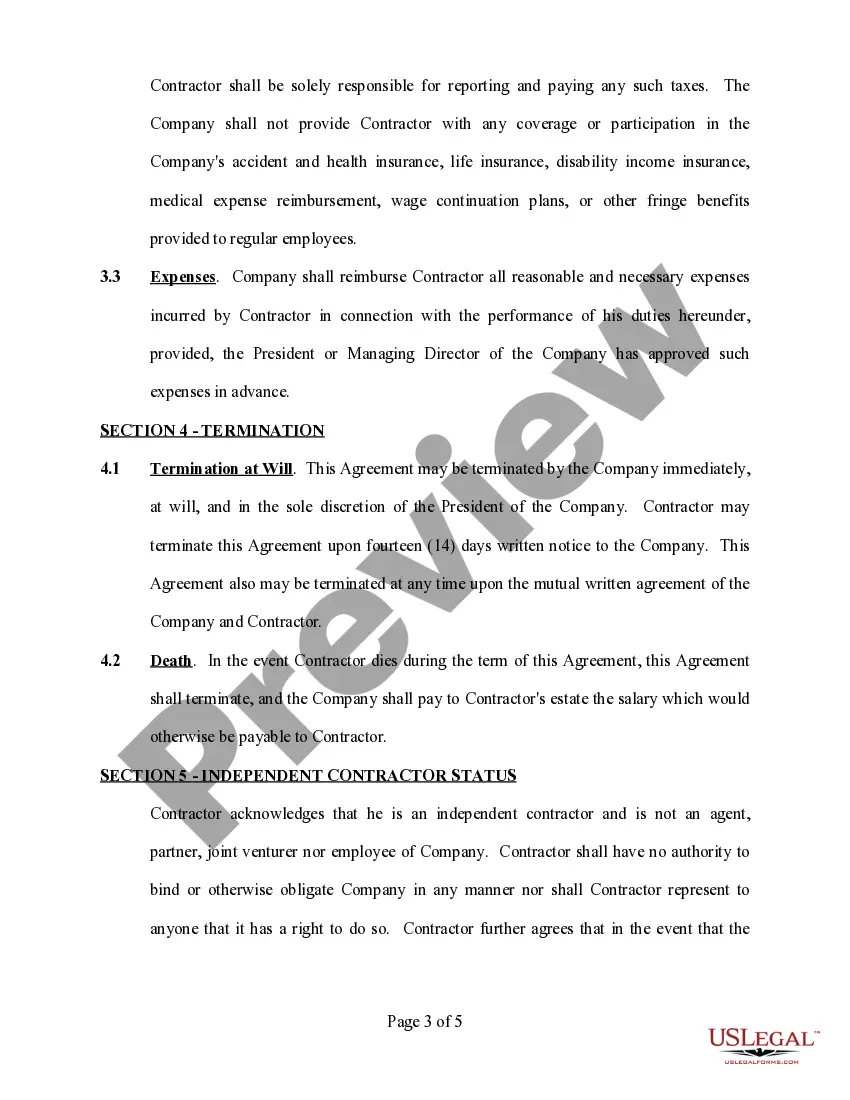
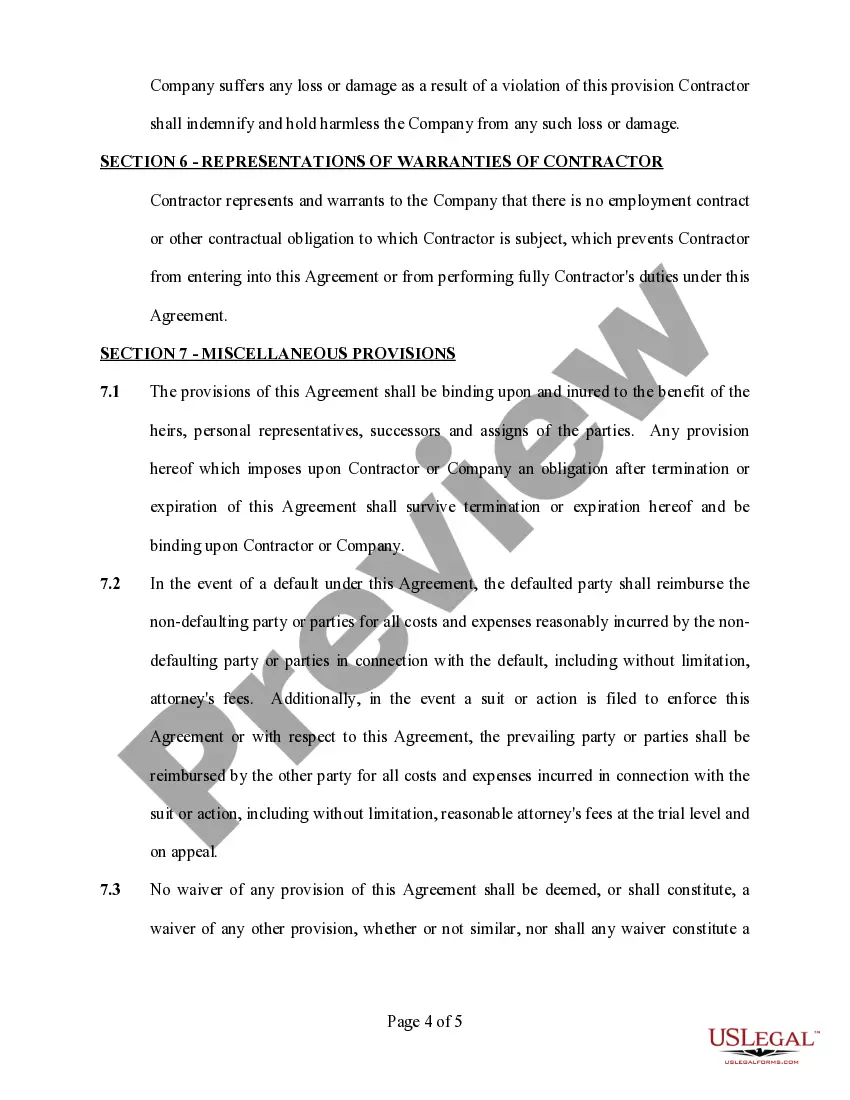
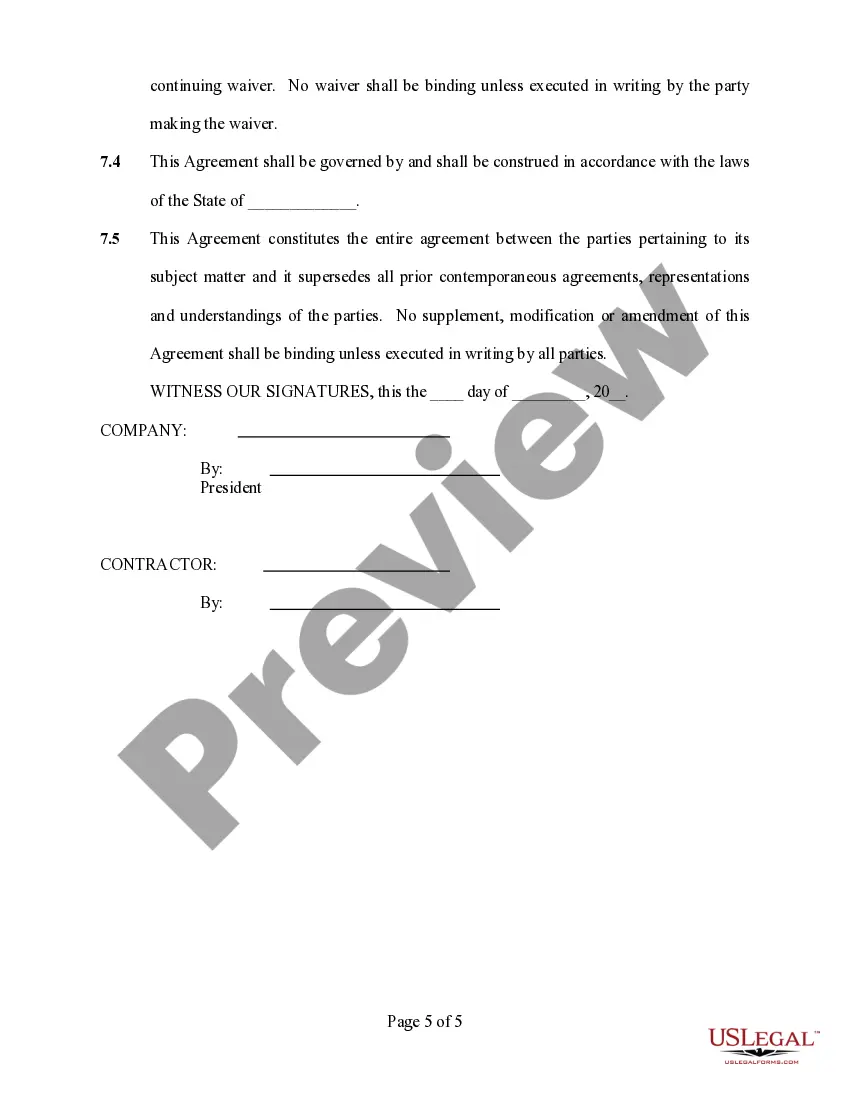
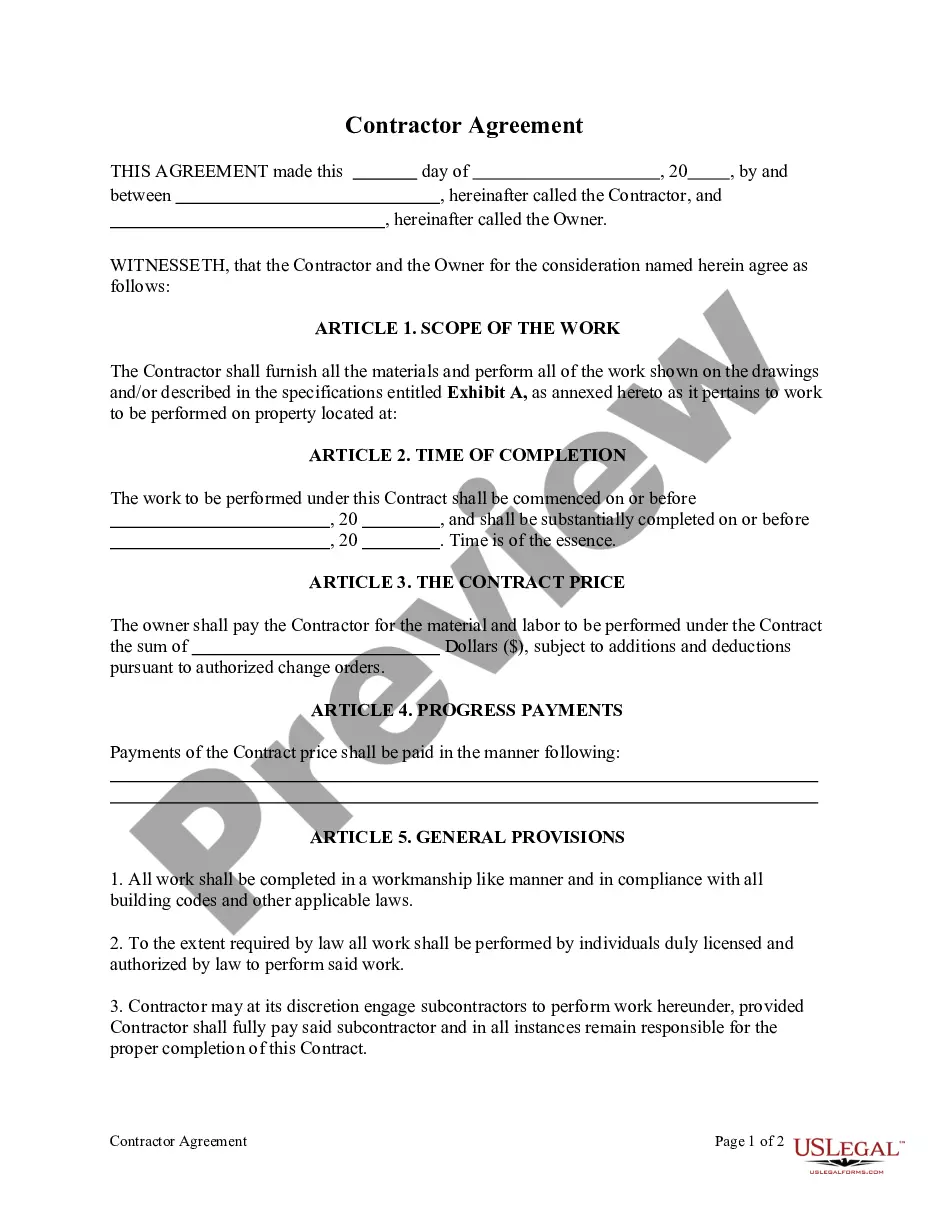
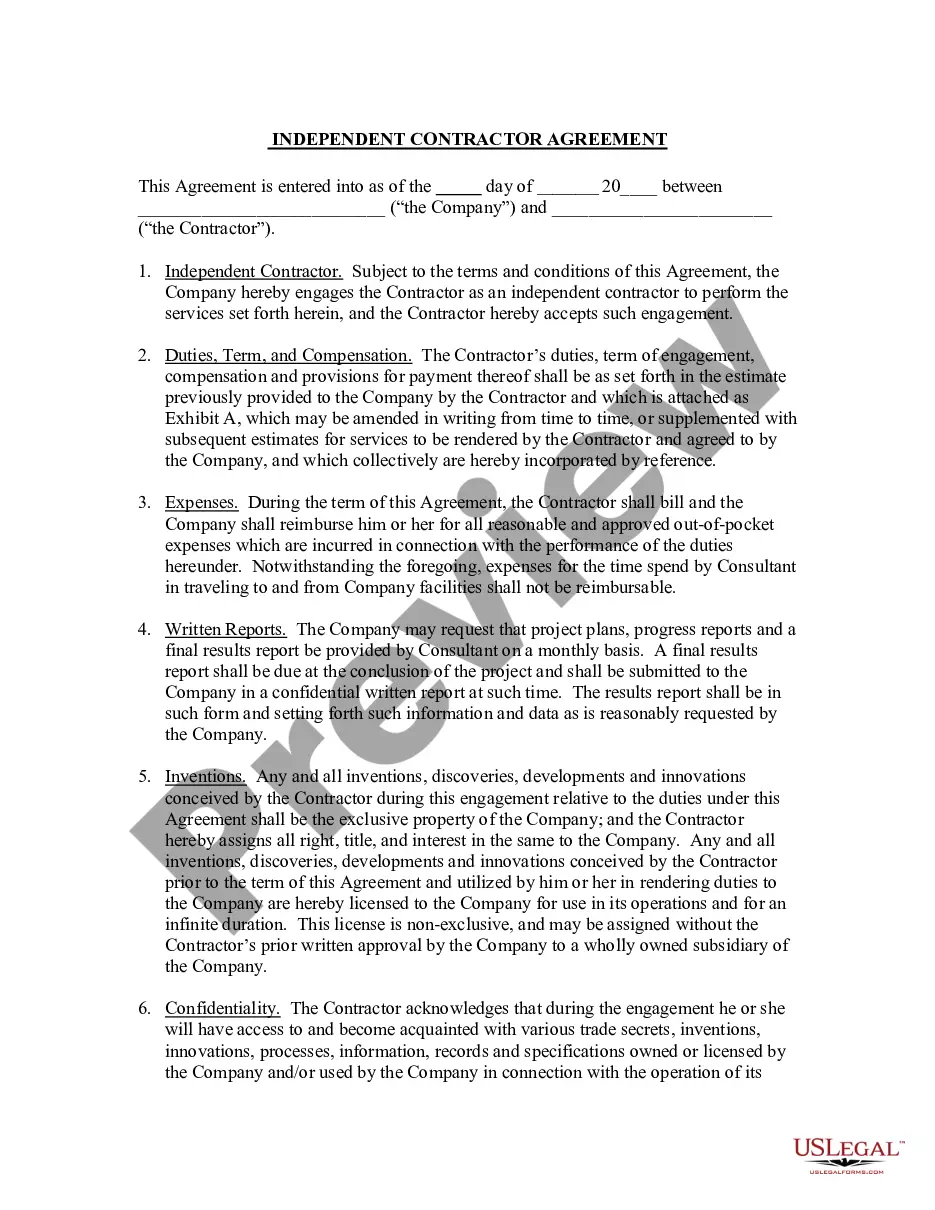
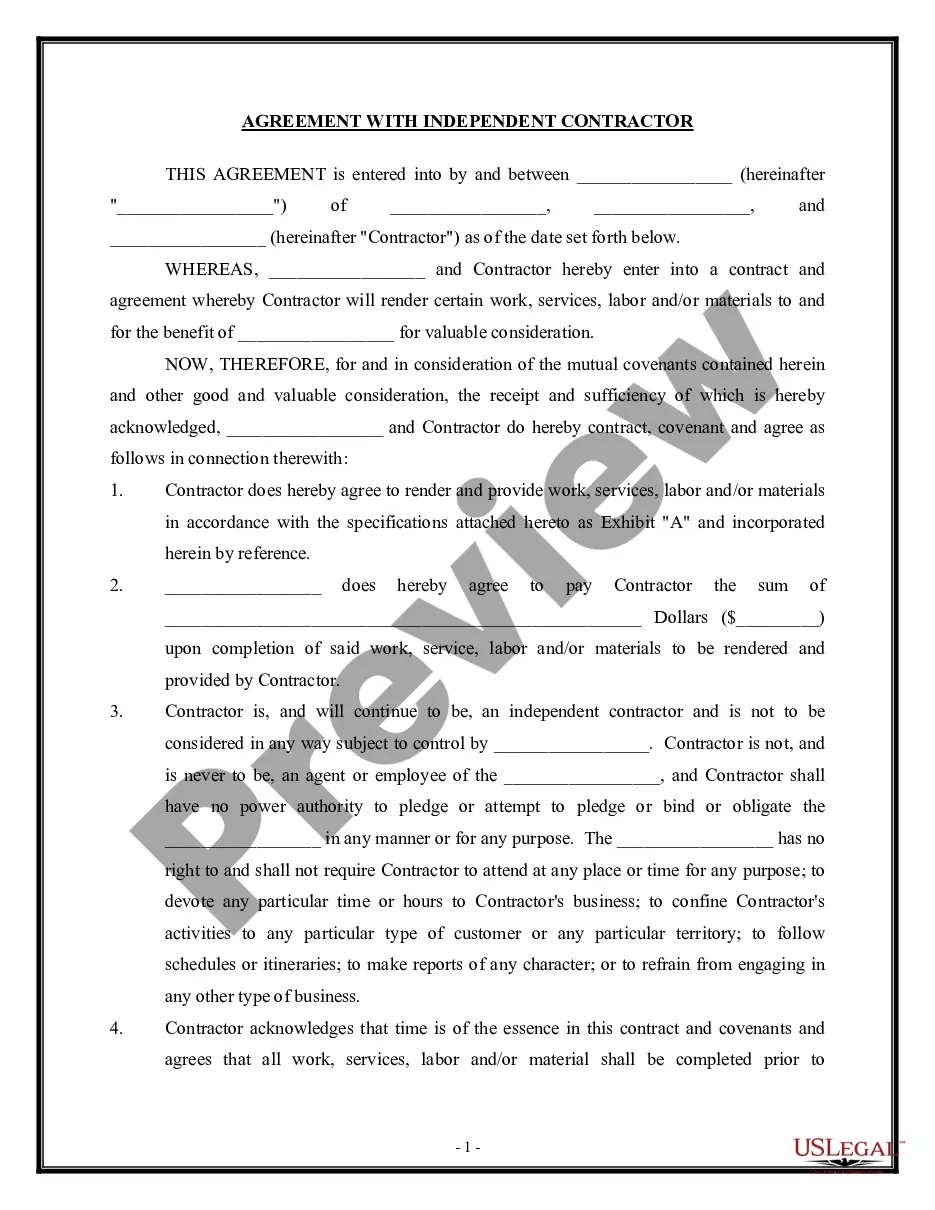
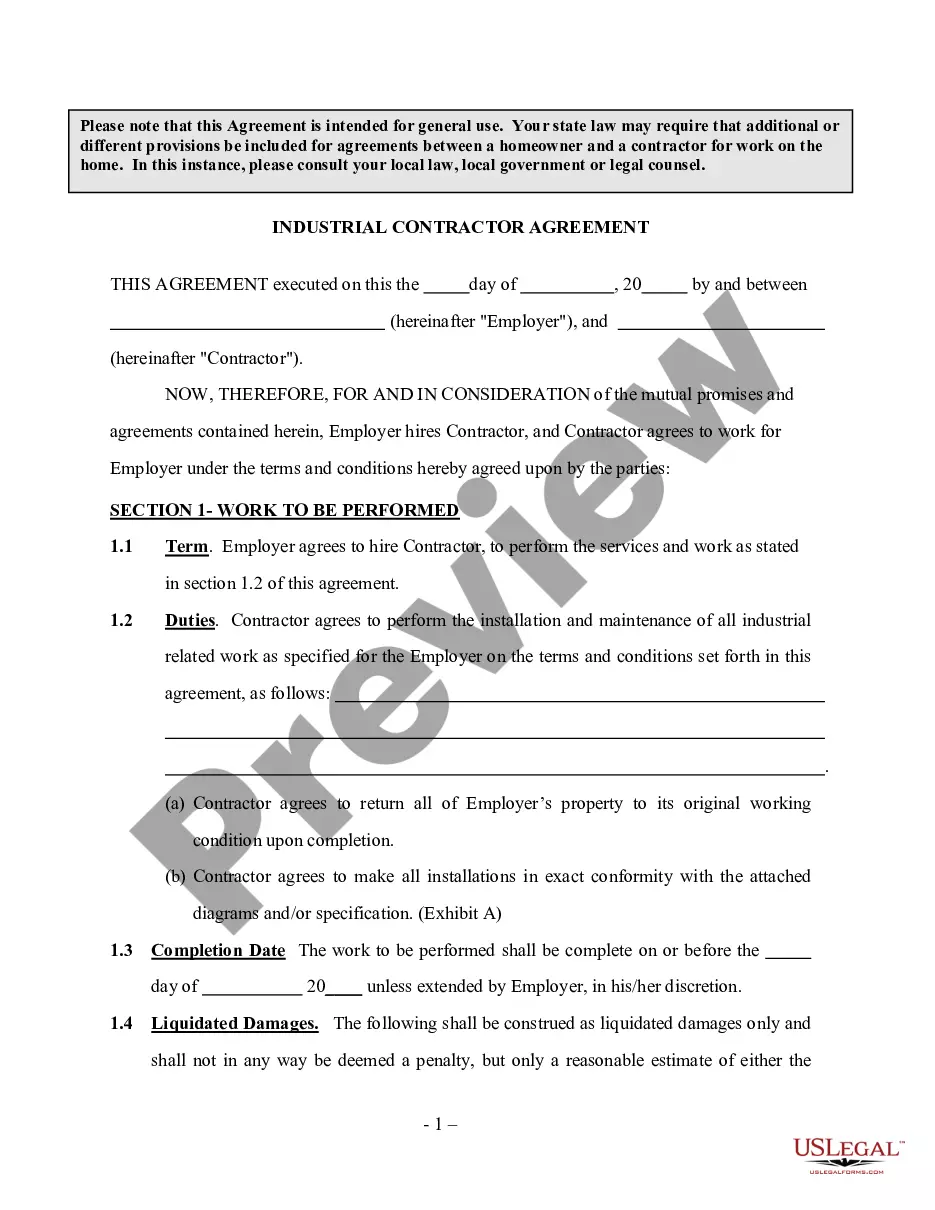
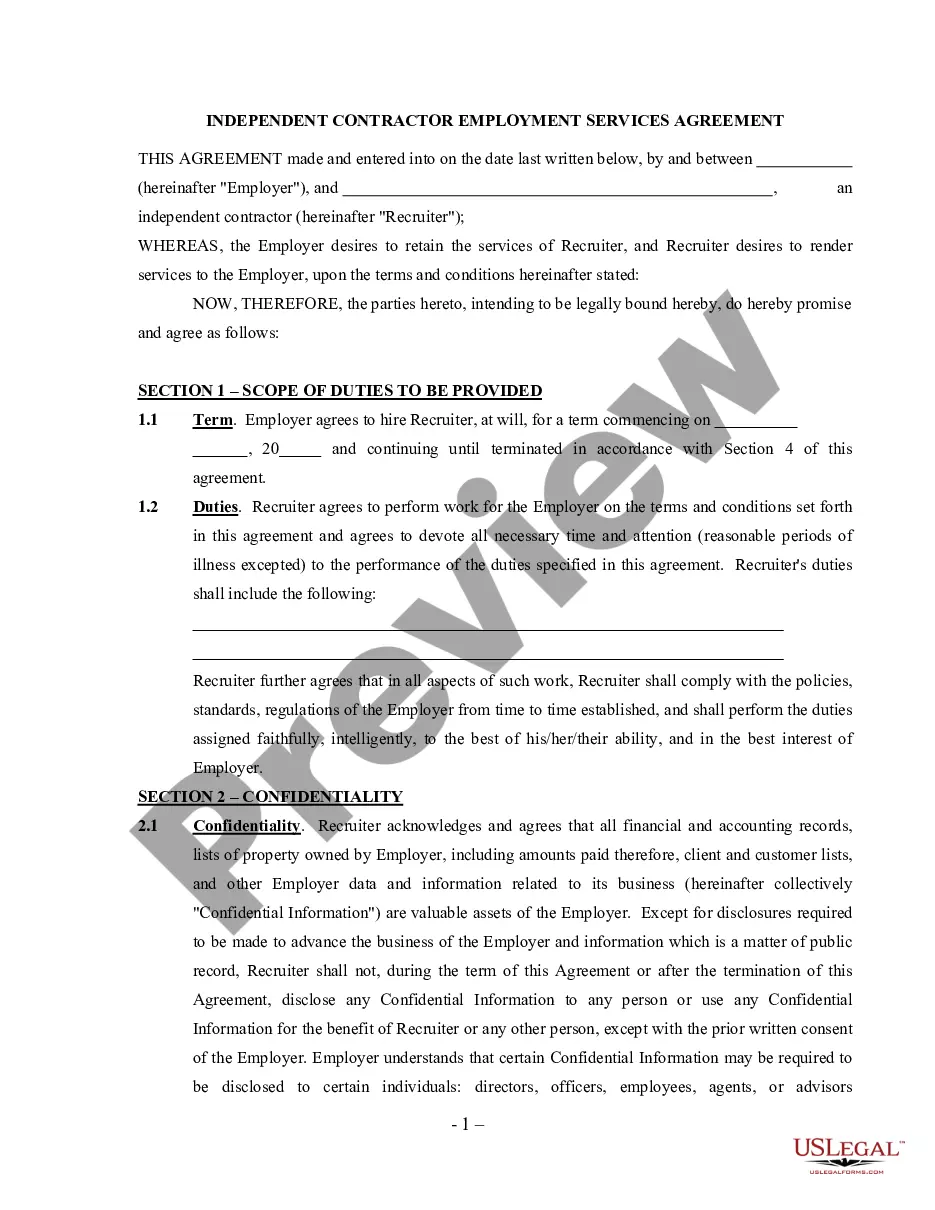
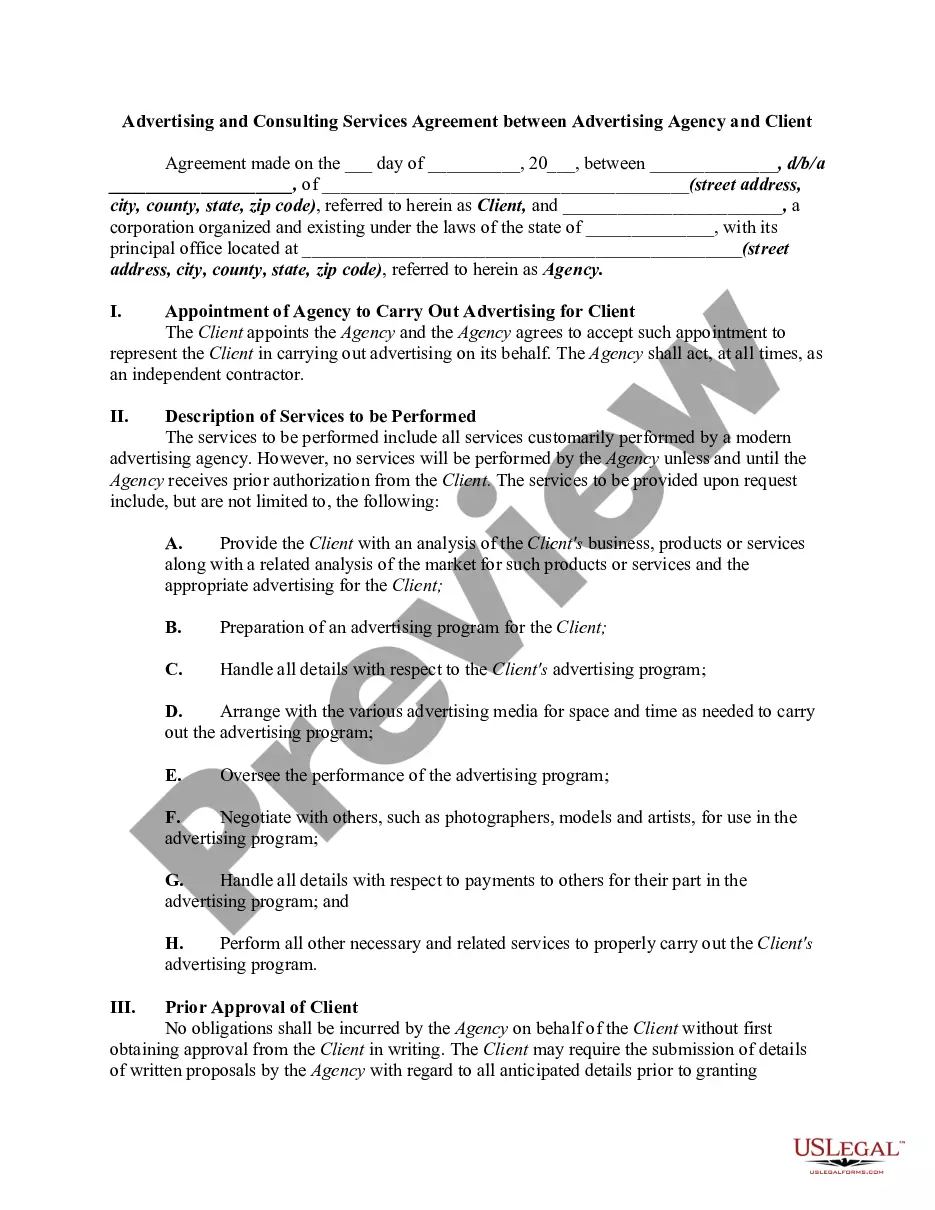
A company agrees to hire a contractor to perform work on the terms and conditions set forth in the agreement. The contractor agrees that all financial and accounting records will remain the confidential property of the company. The form also provides that the company will reimburse the contractor for all reasonable and necessary expenses incurred by the contractor with the performance of his/her duties.
Connecticut Self-Employed Independent Contractor Employment Agreement - General
Category:
State:
Multi-State
Control #:
US-60701
Format:
Word;
Rich Text
Instant download
Description
Free preview

How to fill out Self-Employed Independent Contractor Employment Agreement - General?
US Legal Forms - among the largest collections of valid templates in the United States - provides a broad selection of legal document templates that you can acquire or create.
While using the website, you can access thousands of templates for business and personal purposes, categorized by groups, states, or keywords. You can quickly find the most recent versions of templates such as the Connecticut Self-Employed Independent Contractor Employment Agreement - General.
If you already have a subscription, Log In and retrieve the Connecticut Self-Employed Independent Contractor Employment Agreement - General from the US Legal Forms library. The Download button will be visible on each form you view. You have access to all previously downloaded templates in the My documents section of your account.
Complete the transaction. Use your credit card or PayPal account to finalize the transaction.
Select the format and download the form to your device. Edit. Fill in, modify, print, and sign the downloaded Connecticut Self-Employed Independent Contractor Employment Agreement - General. Each template you saved in your account has no expiration date and is yours forever. Therefore, if you want to download or print another copy, simply go to the My documents section and click on the template you need. Access the Connecticut Self-Employed Independent Contractor Employment Agreement - General with US Legal Forms, one of the largest collections of legal document templates. Utilize thousands of professional and state-specific templates that meet your business or personal requirements.
- Ensure you select the correct form for your city/county.
- Click the Review button to examine the content of the form.
- Check the description of the form to confirm it meets your needs.
- If the form does not meet your needs, use the Search bar at the top of the screen to find one that does.
- If you are satisfied with the form, confirm your selection by clicking the Get now button.
- Then, select a payment plan you prefer and provide your information to register for an account.
Form popularity
FAQ
Independent contractors report their income on Schedule C (Form 1040), Profit or Loss from Business (Sole Proprietorship). Also file Schedule SE (Form 1040), Self-Employment Tax if net earnings from self-employment are $400 or more.
The main pieces of employment legislation, chief among which are the Labour Relations Act 66 of 1995 (LRA) the Basic Conditions of Employment Act 75 of 1997 (BCEA) and the Employment Equity Act 55 of 1998 (EEA), apply to employees and not independent contractors.
In general, an independent contractor is someone who is in business for himself or herself. Independent contractors usually perform work that requires a specialized skill or trade that is not part of a company's regular business.
Independent contractors are self-employed workers who provide services for an organisation under a contract for services. Independent contractors are not employees and are typically highly skilled, providing their clients with specialist skills or additional capacity on an as needed basis.
Remember that an independent contractor is considered to be self-employed, so in effect, you are running your own one-person business. Any income that you earn as an independent contractor must be reported on Schedule C. You'll then pay income taxes on the total profit.
Simply put, being an independent contractor is a way of being self-employed. Is an independent contractor self-employed? Yes. Independent contractors are self-employed who earn an income but do not work as employees.
A 1099 employee is a US self-employed worker that reports their income to the IRS on a 1099 tax form. Freelancers, gig workers, and independent contractors are all considered 1099 employees. In contrast, actual company employees are considered W-2 employees.
Simply put, being an independent contractor is one way to be self-employed. Being self-employed means that you earn money but don't work as an employee for someone else.
A 1099 employee is a US self-employed worker that reports their income to the IRS on a 1099 tax form. Freelancers, gig workers, and independent contractors are all considered 1099 employees.